Dental Technician Visa Pathway to Australia: Complete 2026 Guide
Updated: 16 August 2026
Australia classifies Dental Technicians under ANZSCO 411213. Trades Recognition Australia (TRA) conducts the skills assessment. The role sits on the STSOL and CSOL, unlocking subclasses 190, 491, 482 and 186. Typical 2026 salaries range AUD $75,000-$90,000. No AHPRA registration is required — unlike Dental Prosthetists — which makes this one of the cleaner allied dental migration paths.
Quick Facts: Dental Technician Migration Pathway
| Detail | Information |
|---|---|
| ANZSCO Code | 411213 (Dental Technician) |
| Skill Level | 2 (AQF Diploma or higher, plus at least three years of experience) |
| Skills Assessment | TRA (Trades Recognition Australia) |
| Occupation List | STSOL and CSOL — not on MLTSSL |
| Visa Options | 190, 491, 482, 186 |
| Demand Level | Moderate — small but stable national workforce; lab-based niche |
| Salary Range | AUD $75,000-$90,000 (SEEK, Jora 2026); Sydney AUD $83,750 average |
| Typical 190 Score | 70-80 (low competition because the occupation rarely fills state allocations) |
| Key Challenge | Confirming with TRA that lab-only duties truly match 411213 rather than 411212 |
What Dental Technicians Actually Do in Australia
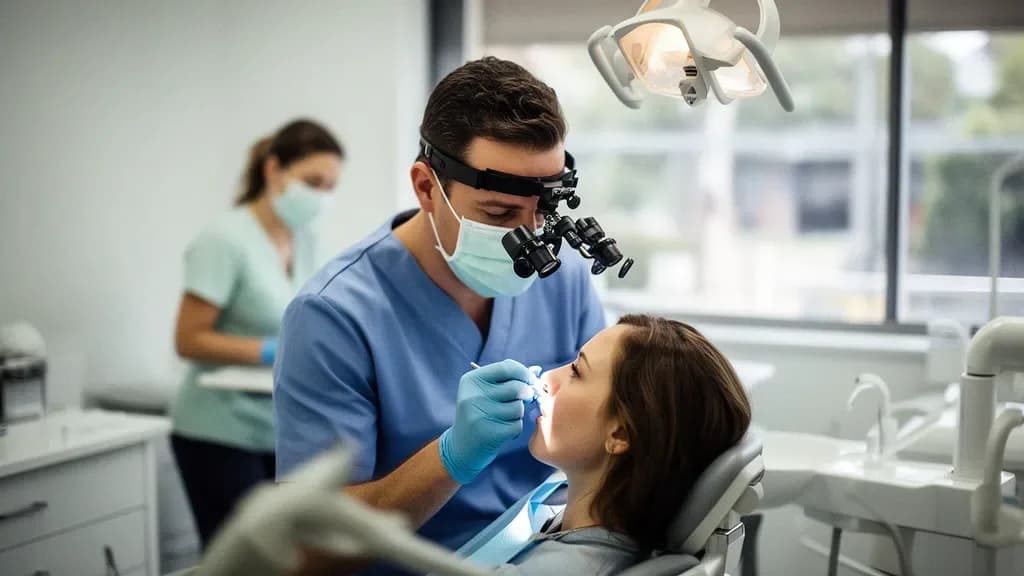
Dental Technicians work in dental laboratories rather than chairside with patients. The job is to build, repair and modify dental appliances — crowns, bridges, dentures, orthodontic plates, mouthguards, splints — from impressions and prescriptions supplied by dentists or prosthetists. The technician never sees the patient. The dentist sees the patient.
Most Australian dental laboratories are small businesses. Major employers include independent dental labs (Modern Dental Pacific, Maven Dental Group's in-house labs), in-house lab operations at hospital and university dental schools, and a growing number of digital dentistry labs running CAD/CAM and 3D printing workflows. The shift toward digital dentistry — intraoral scanners replacing alginate impressions, milled zirconia replacing hand-built ceramics — is the defining trend in the trade.
The Australian workforce is small, sitting in the low thousands nationally. Geographic concentration follows the population — Sydney, Melbourne and Brisbane host most laboratories. Regional roles exist but are sparse, and turnover is low, which means vacancies are infrequent but stable.
ANZSCO 411213 — What the Code Covers
411213 falls under Unit Group 4112 (Dental Hygienists, Technicians and Therapists). Skill Level 2 reflects the diploma-level technical training and three-year practical experience standard.
Core tasks recognised by ANZSCO:
- Constructing and repairing complete and partial dentures, bridges, crowns and orthodontic appliances from impressions
- Selecting and arranging artificial teeth in dentures
- Preparing wax models, plaster casts and metal frameworks
- Operating dental CAD/CAM systems and 3D printers
- Working from dentists' written prescriptions and impressions
- Coordinating with dental prosthetists, dentists and dental specialists
The critical distinction is clinical autonomy. 411213 Dental Technicians do not consult patients, take impressions or fit appliances. The moment any of those tasks enter the job, you are working as a Dental Prosthetist (411212) — and that triggers AHPRA registration plus a different assessment standard. Mixing the codes is the single most common assessment error in this category.
Skills Assessment
Trades Recognition Australia (TRA)
TRA assesses Dental Technicians under its Migration Skills Assessment (MSA) framework.
Qualification requirement: AQF Diploma or higher in dental technology, or comparable overseas qualification. Common overseas qualifications include Indian Diploma in Dental Mechanics, Filipino Bachelor of Science in Dental Technology, UK NVQ Level 3 Diploma in Dental Technology, and corresponding European programmes.
Experience requirement: At least three years of relevant post-qualification employment. Less if the qualification is at Bachelor level.
Assessment cost: Dental technology assessments fall in the complex band — typically AUD $1,500-$3,000 depending on the pathway selected (qualification only versus qualification plus employment verification).
Processing time: 3-6 months. Faster than dental prosthetist assessments because no patient-facing component needs verification.
Common rejection reasons: Three recur. First, applicants who occasionally took impressions or did chairside fitting in their home country supply evidence that pushes the assessment toward 411212 — which then requires AHPRA. Second, qualifications that combine dental assisting with technician training (common in some smaller jurisdictions) fail the "highly relevant" test. Third, employment evidence that does not specify the types of appliances built and the proportion of work on each is rejected as too vague.
No AHPRA Registration Required
Unlike Dental Prosthetists, Dental Technicians do not need to register with the Dental Board of Australia. The Dental Board's national register includes prosthetists, hygienists, therapists, oral health therapists and dentists — but not technicians. This is a meaningful migration advantage. There is no second approval body, no English standard set by AHPRA, no ADC qualification verification.
Visa Pathways
411213 has the broadest visa access of any allied dental role on the CSOL — points-tested via STSOL allows 190 and 491, plus the standard employer-sponsored 482 and 186.
Subclass 190 — Skilled Nominated Visa
State nomination plus permanent residency. Available because 411213 sits on the STSOL.
- Visa fee: AUD $6,140 (primary applicant)
- Points boost: +5 from state nomination
- Processing time: 8-14 months
- Quirk: Because state allocations for dental technicians are small and the applicant pool is thin, nominations often clear at lower point totals than ICT or accounting categories — applicants with 70-80 points sometimes succeed where the same score would fail for software engineers.
Subclass 491 — Skilled Work Regional (Provisional) Visa
Regional nomination plus 5-year provisional residency with a PR pathway via subclass 191.
- Visa fee: AUD $6,140 (primary applicant)
- Points boost: +15 from regional nomination
- Quirk: Regional dental labs — particularly in regional NSW, Tasmania and South Australia — are persistent advertisers because qualified technicians do not always relocate from capital cities. 491 nomination clears more easily in this code than in mainstream professional categories.
Subclass 482 — Skills in Demand Visa
The employer-sponsored route for applicants without enough points or those who already hold a job offer.
- Visa fee: AUD $4,015 (primary applicant)
- Salary threshold: Core Skills Income Threshold AUD $76,515 until 30 June 2026, then AUD $79,423
- Duration: Up to 4 years
- Quirk: Average dental technician salaries (AUD $75,000-$90,000) sit close to the threshold. Sponsors must ensure the nominated salary clears it — junior or part-time roles often miss.
Subclass 186 — Employer Nomination Scheme
Permanent residency via an employer.
- Visa fee: AUD $6,140 (primary applicant)
- Streams: Direct Entry (3+ years experience, age under 45) or Temporary Residence Transition (after 2 years on 482)
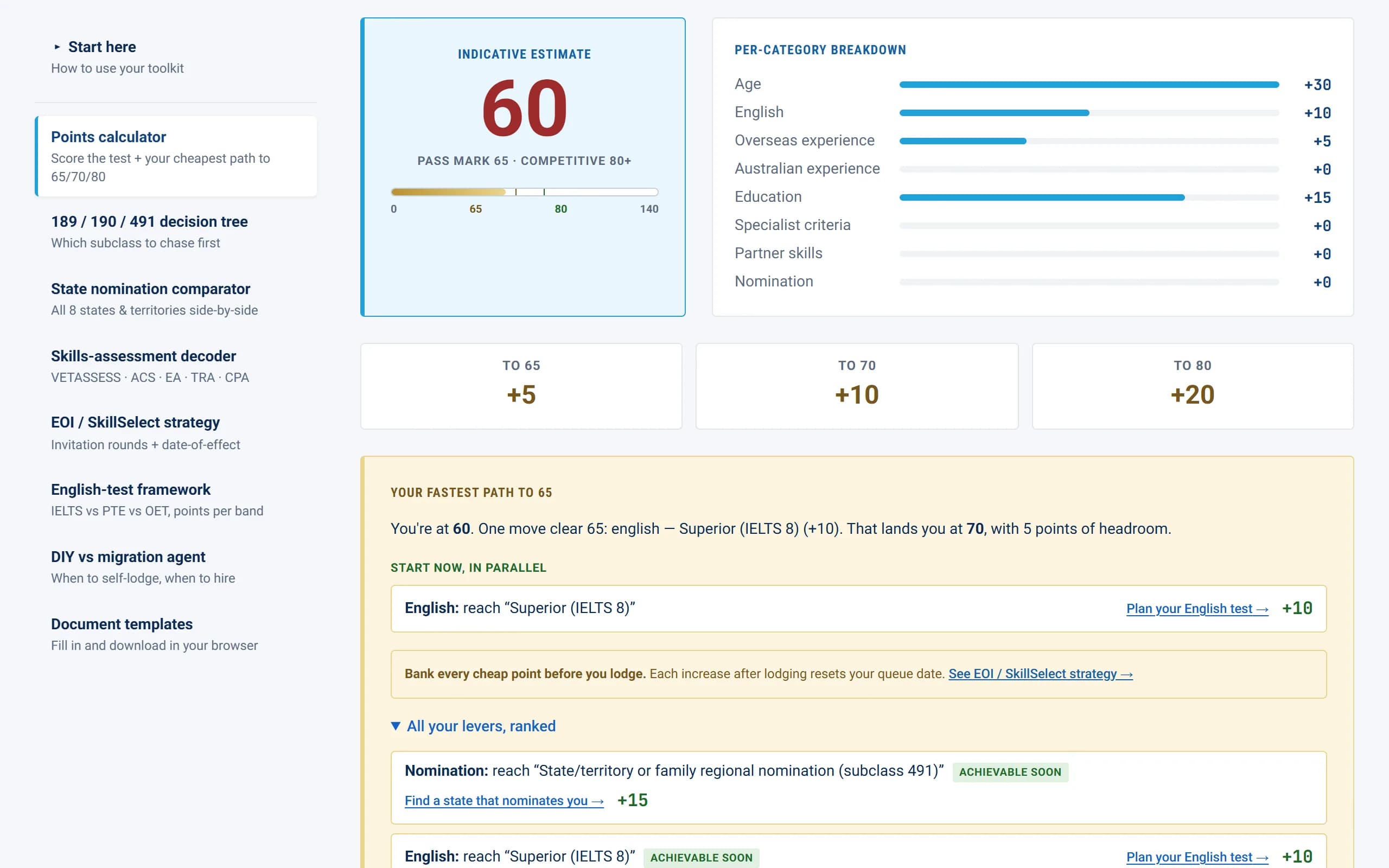
Points Test Strategy
Because Dental Technician is on the STSOL, points-tested pathways (190 and 491) are open. The standard points framework applies.
| Points Factor | Points | Notes |
|---|---|---|
| Age (25-32) | 30 | Maximum bracket |
| Age (33-39) | 25 | Still strong |
| Qualification (Diploma) | 10 | Standard for dental technician AQF level |
| Qualification (Bachelor) | 15 | Where applicable |
| English (Superior — 8.0+) | 20 | Often the swing factor |
| English (Proficient — 7.0) | 10 | More common achievable target |
| Overseas Experience (5-8 years) | 10 | After TRA assessment |
| Overseas Experience (8+ years) | 15 | Maximum bracket |
| State Nomination (190) | 5 | If nominated |
| Regional (491) | 15 | For regional nomination |
| Partner Skills | 5-10 | If partner has skilled occupation |
Realistic Score Scenarios
Scenario 1: Mid-career applicant with state nomination
A 32-year-old technician with a Diploma in Dental Technology, 8 years of experience, and Proficient English. Age 30 + Diploma 10 + English 10 + Experience 15 + 190 nomination 5 = 70 points. Competitive for STSOL state allocations.
Scenario 2: Younger applicant going regional
A 28-year-old with 5 years' experience and Proficient English aiming for regional nomination. Age 30 + Diploma 10 + English 10 + Experience 10 + 491 regional 15 = 75 points. Often sufficient for regional invitation.
State Nomination
State nomination programs that include 411213 in 2026 are limited but specific. Allocation numbers are small, but so is competition.
South Australia
South Australia consistently nominates dental technicians under both 190 and 491. The state's regional dental services and aged care prosthetic supply chains drive demand. Regional South Australian centres (Mount Gambier, Whyalla, Port Augusta) are eligible for the 491 with reduced experience requirements.
Tasmania
Tasmania nominates dental technicians in years where its state allocation includes STSOL health support roles. The state has a structural undersupply of allied dental services outside Hobart and Launceston. Tasmania's English requirements are typically Proficient (7.0 each), and applicants must commit to two years' residence.
Northern Territory
The NT runs persistent dental skills shortages, particularly outside Darwin. The Territory's nomination program includes 411213 in most cycles for both 190 and 491. Lower competition is the consistent feature here.
Regional NSW and Victoria
The 491 visa applies through Regional Development Australia (RDA) committees in regions like the Riverina, Hunter, North Coast NSW, Bendigo, Ballarat and Geelong. Direct sponsorship by a regional dental lab is usually required.
Salary and Employment Outlook
| Role / Experience | Typical Annual Salary (AUD) |
|---|---|
| Entry-level dental technician | $60,000-$70,000 |
| Mid-career dental technician | $75,000-$90,000 |
| Senior / CAD-CAM specialist | $90,000-$110,000 |
| Lab manager / supervisor | $100,000-$130,000 |
| National average (SEEK 2026) | $75,000-$85,000 |
| Sydney average (SEEK 2026) | $83,750 |
| Melbourne (SEEK 2026) | $81,000 |
| Brisbane / Adelaide / Perth | $75,000-$80,000 |
Source: SEEK Career Advice Dental Technician salary May 2026; Jora dental technician salary data 2026.
Total packages typically include 11.5% superannuation. Overtime is common in busy labs producing high-volume crown and bridge work. Specialist skills — CAD/CAM design, ceramics, implant superstructures — command 10-20% premiums above generalist rates.
The highest-paying contexts:
- Digital dentistry labs running intraoral scanner workflows and milled zirconia
- Implant-focused labs serving prosthodontic specialists
- In-house labs at large dental chains and university dental schools
- Senior technicians moving into lab management or quality oversight
Tips for a Successful Application
1. Keep the Code Boundary Clean
If your reference letter mentions taking impressions or fitting appliances in patients' mouths, you have one foot in 411212 territory. TRA will redirect, and you will end up needing AHPRA registration that you may not be qualified for. Have your home country employer rewrite references to focus strictly on lab-based duties.
2. Specify Appliance Types and Proportions
TRA reviewers want detail. A reference that says "constructed dental appliances" is rejected as vague. A reference that says "approximately 40% complete dentures, 30% crowns and bridges, 20% orthodontic plates, 10% custom mouthguards over a 6-year period" passes the verification step on the first read.
3. Build CAD/CAM Evidence If You Have It
Digital dentistry experience is the differentiator in 2026. If you have worked with intraoral scanners (3Shape, iTero, Medit), CAD software (Exocad, 3Shape Dental System) or milling and 3D printing platforms, document the specific systems and your hours of use. Employers running digital workflows pay 15-20% more and sponsor faster.
4. Don't Over-Engineer the English Test
Dental Technician points usually clear at Proficient English (IELTS 7.0). Chasing Superior (IELTS 8.0) for the extra 10 points is worthwhile only if you are close to it already. Most applicants are better served lodging at 70-75 points sooner than chasing an extra 10 points over six months of test prep.
5. Apply to a State With a Real Allocation
Don't lodge an Expression of Interest for a state that doesn't currently nominate 411213. Check South Australia, Tasmania and the Northern Territory first — they are the consistent nominators. NSW and Victoria nominate health support occupations less consistently for this code.
Step-by-Step Migration Roadmap
- Confirm 411213 is the right code — review your duties via the ANZSCO code finder; rule out 411212
- Verify STSOL listing — check the current Skilled Occupation List
- Prepare qualification evidence — transcripts, syllabus, translated where required
- Prepare employment evidence — reference letters specifying appliance types and proportions
- Sit IELTS or PTE — minimum 6.0 each for visa eligibility, 7.0 for points
- Lodge TRA Migration Skills Assessment — full assessment pathway
- Submit Expression of Interest in SkillSelect — for 190 or 491
- Apply for state or regional nomination — South Australia, Tasmania, NT, or RDA committee
- Receive invitation — within 60 days, lodge visa
- Complete health and character checks
- Receive visa grant and relocate
- Live and work in nominating state for the obligation period — 2 years for 190, 5 for 491
Frequently Asked Questions
Do Dental Technicians need AHPRA registration?
No. Unlike Dental Prosthetists, Dental Hygienists, Therapists and Dentists, Dental Technicians are not regulated by the Dental Board of Australia. The role sits outside the AHPRA framework because technicians work from prescriptions issued by registered dentists and do not deal with patients. This is one of the cleanest migration pathways in allied dental.
What's the difference between Dental Technician and Dental Prosthetist?
Dental Prosthetists work with patients directly — taking impressions, fitting dentures, advising on care. They require AHPRA registration through the Dental Board. Dental Technicians work only in laboratories from dentists' prescriptions, never see patients, and require no AHPRA registration. The migration codes (411212 vs 411213) reflect this difference, and choosing the wrong one is the most common cause of failed assessments in the field.
Which states nominate Dental Technicians in 2026?
South Australia, Tasmania and the Northern Territory nominate 411213 most consistently. NSW and Victoria run health-focused nomination programs but rarely include 411213 specifically. Regional 491 nominations are available through Regional Development Australia committees in regional NSW, Victoria and Queensland, but they typically require an employer commitment.
Can my dental technology qualification from India or the Philippines be assessed?
Yes. Indian Diploma in Dental Mechanics and Filipino Bachelor of Science in Dental Technology are both regularly assessed by TRA. The qualification typically maps to AQF Diploma or higher. The challenge is usually employment evidence detail rather than qualification recognition.
How competitive is the points test for Dental Technicians?
Less competitive than ICT, accounting or engineering. The applicant pool is small. Recent invitation rounds for 190 in 411213 have cleared at 70-80 points across the states that nominate. Regional 491 invitations have cleared at 65-75 points. By comparison, software engineer 189 invitations require 85+ points.