Telecommunications Linesworker Visa Pathway to Australia: Complete 2026 Guide
Updated: 16 August 2026
Australia classifies Telecommunications Linesworkers under ANZSCO 342413. Trades Recognition Australia conducts the skills assessment. The occupation is on the CSOL and STSOL, unlocking visa subclasses 190, 491, 482, and 186. Typical 2026 salaries range AUD $75,000-$110,000. Jobs and Skills Australia rates the occupation as in shortage in NSW, QLD, SA, and the ACT.
Quick Facts: Telecommunications Linesworker Migration Pathway
| Detail | Information |
|---|---|
| ANZSCO Code | 342413 (Telecommunications Linesworker / Telecommunications Line Mechanic) |
| Skill Level | 3 (AQF Certificate III with at least two years on-the-job training, or Certificate IV) |
| Skills Assessment | TRA (Trades Recognition Australia) — JRP onshore, OSAP offshore |
| Occupation List | CSOL and STSOL — not on MLTSSL or ROL |
| Visa Options | 190, 491, 482, 186 |
| Demand Level | High — JSA rates national shortage with state-level shortage in NSW, QLD, SA, ACT |
| Salary Range | AUD $75,000-$110,000 (Yourcareer.gov.au and SEEK 2026) |
| Typical 189 Score | Not applicable — occupation is not on MLTSSL |
| Key Challenge | ACMA cabler registration is mandatory for any carrier-network cabling work, in parallel with the TRA assessment |
What Telecommunications Linesworkers Do in Australia
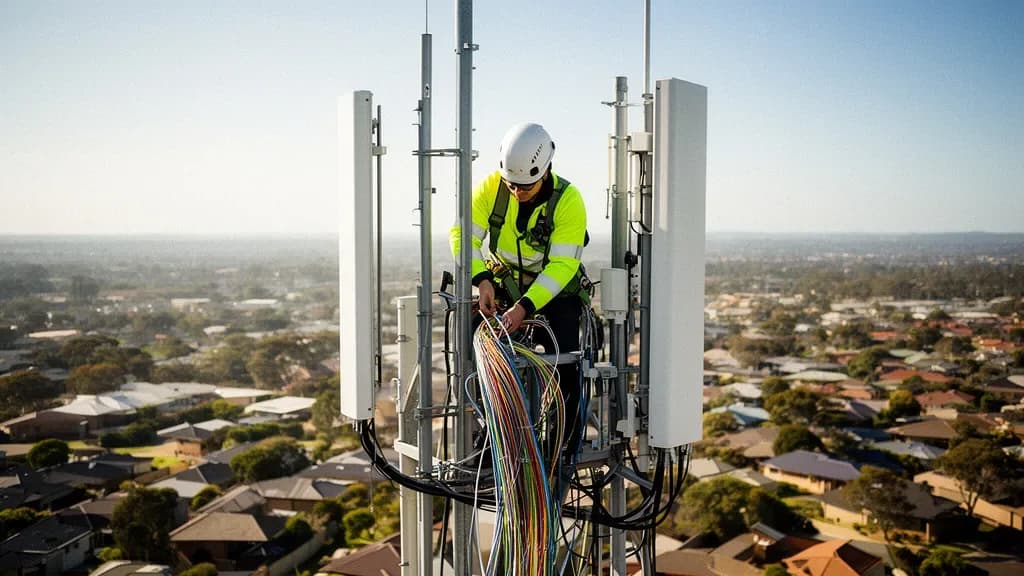
Telecommunications linesworkers install, maintain, and repair external telecommunications equipment — aerial lines, conduits and underground cables, radio and mobile antennae, and limited terminal equipment. The role spans pole-mounted cable runs, underground conduit installation, mobile-tower antenna and feeder work, and microwave dish installation. Much of the work is performed by NBN Co subcontractors, mobile-network contractors, and EPC firms supporting carrier infrastructure programs.
Demand is geographically spread because telecommunications infrastructure follows population. NBN remediation is concentrated in metropolitan and regional centres alike, and mobile-network densification (5G small cells, mid-band macro upgrades, regional black-spot programs) is generating sustained work outside the capitals. The federal Mobile Black Spot Program and the Regional Connectivity Program continue to fund regional infrastructure through 2027. Major employers include Service Stream, Visionstream, Ventia, Lendlease Services, Daly International, and direct carrier contractors to Telstra, Optus, TPG, and NBN Co.
Jobs and Skills Australia rates 342413 as being in national shortage in 2026, with state-level shortage status in NSW, QLD, SA, and the ACT, and no shortage in the NT. This rating supports the occupation's CSOL and STSOL listings.
ANZSCO Code 342413 — What the Code Covers
The 342413 code covers people who install and repair external telecommunications cabling and equipment. Tasks include erecting poles and stringing cables, laying underground cables and conduits, installing and repairing radio antennae and mobile-tower equipment, and locating and repairing faults on external networks.
342413 is distinct from Cabler (Data and Telecommunications) (342411), which covers customer-side and building-internal cabling. It is also distinct from Telecommunications Cable Jointer (342412), which covers specialised jointing in pits and manholes. And it differs from Electrical Linesworker (342211), which covers power-network linework. Match your duties carefully — code mismatches are the most common TRA rejection reason for external-network trades. See the ANZSCO code finder for cross-checking guidance.
Skills Assessment: Trades Recognition Australia
TRA assesses 342413 through OSAP offshore and JRP onshore. The trade is licensed for any work on carrier-network cabling under the ACMA Cabling Provider Rules.
Offshore Skills Assessment Program (OSAP)
OSAP requires a Certificate III equivalent qualification plus at least three years of full-time relevant employment, including the 12 months immediately before lodgement.
- Assessment cost: approximately AUD $1,015 documentary plus technical assessment fees set by the offshore provider
- Processing time: 8-12 weeks documentary; technical assessment scheduling adds 4-8 weeks
- Common rejection reasons: duty statements that conflate external linework with internal cabling; missing tower-rescue or working-at-heights evidence; qualifications from RTOs not aligned with Australian telecommunications competencies
Job Ready Program (JRP)
JRP is the onshore pathway for holders of an Australian Certificate III in Telecommunications.
- Provisional Skills Assessment (PSA) — verifies qualification and prior experience. Valid for three years.
- Job Ready Employment (JRE) — register 1,725 hours of paid work in 12 months. Fee: AUD $490.
- Job Ready Workplace Assessment (JRWA) — workplace assessment by a TRA-authorised assessor. Fee: AUD $2,845.
- Job Ready Final Assessment (JRFA) — final positive outcome. Fee: AUD $75.
Total JRP fees through steps 2-4: approximately AUD $3,410. Realistic JRP timeline: 14-18 months.
ACMA Cabler Registration
Any work on cabling connected to a carrier network requires an ACMA Cabler Registration with appropriate competency endorsements. Open registration is the standard for telecommunications linesworkers. Registration is issued by RIA, BICSI, or ACA. Apply in parallel with the TRA process — sponsoring employers will not let you commence carrier work without it.
Visa Pathways for Telecommunications Linesworkers
342413 is on the CSOL and STSOL, which opens 190 nomination alongside 482 sponsorship and 491 regional pathways. Subclass 189 is not available because the occupation is not on the MLTSSL.
Subclass 482 — Skills in Demand
The 482 is the most common pathway because carrier contractors and EPC firms with NBN, mobile, and regional infrastructure programs sponsor international applicants when local recruitment is short.
- Visa fee: AUD $4,015 (Core Skills stream, primary applicant)
- Salary requirement: Core Skills Income Threshold AUD $79,423 from 1 July 2026 (previously AUD $76,515). Senior linesworker roles clear this; entry-level NBN sub-contracting work often does not.
- Duration: up to 4 years
- Processing time: 50% of Core Skills stream applications in 2-4 months
- Quirk: sponsorship clusters around 5-10 large carrier contractors — Service Stream, Visionstream, Ventia, Lendlease Services dominate
Subclass 190 — Skilled Nominated
The 190 is available because 342413 is on the STSOL. Permanent residency from grant, with a 2-year state commitment.
- Visa fee: AUD $6,140 (primary applicant)
- Points boost: +5 from state nomination
- Obligation: live in the nominating state for 2 years
- Quirk: state nomination of 342413 is uneven; NSW and SA have been the most consistent nominators when shortage data supports the listing
Subclass 491 — Skilled Work Regional (Provisional)
The 491 fits regional postcodes and the Regional Connectivity Program work areas.
- Visa fee: AUD $6,140 (primary applicant)
- Points boost: +15 from regional nomination
- Duration: 5 years provisional with pathway to 191 permanent residency
- Processing time: 50% in 6-20 months; 90% in 15-28 months
Subclass 186 — Employer Nomination Scheme
Permanent residency through employer sponsorship — TRT after 2 years on a 482, or Direct Entry with a TRA assessment plus a 3-year experience minimum.
- Visa fee: AUD $6,140 (primary applicant)
- Processing time: 12-18 months TRT; 12-20+ months Direct Entry
State Nomination for Telecommunications Linesworkers
Always confirm 342413 against each state's current published list. The trade has appeared on multiple 2026 state lists but listings change between program years.
New South Wales
Sydney's NBN remediation footprint and the mobile-network densification programs across the Hunter, Illawarra, and Central Coast drive demand. NSW Skills Lists include trades supporting critical infrastructure; 342413 has appeared on NSW 190 and 491 schedules through 2026.
South Australia
South Australia operates a broad regional 491 list with 900 places for 2025-26. Priority is given to applicants onshore in SA, graduates of SA institutions, and those with confirmed job offers. JSA rates the occupation as in shortage in SA.
Queensland
Queensland responds dynamically to current shortages. The 2,600-place QSOL program (1,850 for 190, 750 for 491) prioritises trades in regional growth corridors and Townsville-Mackay-Cairns infrastructure projects. JSA rates 342413 as in shortage in QLD.
Australian Capital Territory
ACT issues nominations when shortage data supports the listing. The ACT government's defence-sector and federal-agency communications work has sustained demand for linesworkers. JSA rates 342413 as in shortage in the ACT.
Tasmania
Tasmania's 491 program has 650 places. Tasmania emphasises graduates of Tasmanian institutions and employer-driven nominations through the Tasmanian Skilled Employment pathway. Confirm 342413 on the current Tasmanian Skilled Occupation List before lodging.
Salary and Employment Outlook
What Telecommunications Linesworkers Earn in 2026
| Role / Specialisation | Typical Salary Range |
|---|---|
| Entry-level linesworker | AUD $65,000-$80,000 |
| Experienced linesworker (3-7 years) | AUD $80,000-$100,000 |
| Tower / antenna specialist (rigger licensed) | AUD $95,000-$120,000 |
| Senior linesworker / project lead | AUD $100,000-$130,000+ |
| Remote / FIFO project linesworker | AUD $120,000-$160,000+ with allowances |
Sources: Yourcareer.gov.au and SEEK Linesworker salary career advice (2026). Yourcareer reports an average for 342413 of approximately AUD $69,193 per year — pulled down by entry-level NBN sub-contracting work. Tower and antenna specialists with rigger tickets earn substantially more. Total packages add 11.5% superannuation, on-call allowances, and FIFO loadings for remote work.
Highest-Paying Sectors and Employers
- Carrier infrastructure contractors — Service Stream, Visionstream, Ventia, Lendlease Services
- Mobile-tower specialist firms — Daly International, Indara, Axicom (tower portfolio operators)
- Hyperscale data-centre carrier connections — diverse-route fibre installation in metropolitan corridors
- NBN remediation and upgrade programs — copper-to-fibre conversion through 2028
- Regional Connectivity Program and Mobile Black Spot Program — federal-funded infrastructure in regional areas
Tips for a Successful Application
1. Document Working-at-Heights and Tower-Rescue Qualifications
A meaningful share of telecommunications linesworker work happens on poles and mobile towers. Sponsoring employers and TRA assessors look for evidence of working-at-heights training, fall-arrest competency, and tower-rescue qualifications. If you have rigger or basic-scaffolding tickets, include them.
2. Specify External Network Work on Your Duty Statement
Generic "telecommunications technician" duty statements regularly fail TRA assessment. Specify aerial-line work, underground conduit installation, mobile-antenna installation, fault-locator equipment used, and the specific carrier networks you worked on. ANZSCO 342413 is about external work — make your evidence external.
3. Plan ACMA Registration in Parallel With TRA
Apply for the ACMA Cabler Registration via RIA, BICSI, or ACA as soon as your TRA PSA is positive. Sponsoring employers will not let you commence carrier work without the registration. Many migrants underestimate the parallel paperwork load.
4. Target Sponsoring Employers With Active SBS Status
The 482 pathway requires a Standard Business Sponsor. Service Stream, Visionstream, Ventia, and Lendlease Services all hold active SBS approvals and have sponsored international linesworkers consistently. Apply directly through their careers pages rather than relying on third-party recruiters.
5. Use 190 If Your Points and State Choice Align
The 190 is the cleanest permanent residency route because 342413 is on the STSOL. NSW and SA have been the most consistent state nominators through 2026. Build your EOI around a state where the shortage rating supports the listing.
Step-by-Step Migration Roadmap
- Confirm your duties match ANZSCO 342413 — see the ANZSCO code finder
- Confirm 342413 is current on the CSOL and STSOL — see the 2026 Skilled Occupation List hub
- Choose your pathway — OSAP if offshore, JRP if onshore with an Australian qualification
- Lodge the TRA application — documentary stage with employment evidence and qualification certificates
- Begin ACMA Cabler Registration application — via RIA, BICSI, or ACA in parallel
- Complete the technical or workplace assessment — offshore practical or JRWA onshore
- Sit your English test — IELTS 6.0 minimum for points-based pathways; functional English for 482
- For employer sponsorship: secure a 482 offer — carrier contractors or EPC firms
- For points-based: submit EOI in SkillSelect — for 190 or 491 with nomination
- Apply for state nomination — NSW, SA, QLD, ACT, Tasmania
- Receive invitation and lodge the visa — within 60 days
- Complete health and character checks, then receive grant
For the broader process, see the skills assessment bodies guide and the most in-demand occupations hub.
Frequently Asked Questions
What's the difference between 342413 and Cabler (342411)?
342413 covers external telecommunications work — aerial lines, underground cables, mobile-tower antennae, and outdoor terminal equipment. 342411 covers customer-side and building-internal cabling — structured cabling, patch panels, in-building fibre, and data-centre rack work. The two occupations require different qualifications and different competencies. Using the wrong code is the single biggest cause of TRA rejection.
Do I need a riggers ticket to work as a telecommunications linesworker?
Not for all work, but yes for tower work above 2 metres in many states and for any rigging-classified mobile-tower work. Most career linesworkers obtain at least a Basic Rigging or Working at Heights ticket. Sponsoring employers favour candidates who already hold these tickets because state safety regulators apply them to commencement.
Which states have telecommunications linesworker on their 2026 nomination lists?
NSW and South Australia have been the most consistent nominators through 2026. Queensland and the ACT have nominated when shortage data supports the listing. Always confirm against the state's published list before lodging an EOI — listings change between program years.
Is the demand really there? The reported salary average looks low.
The reported average is pulled down by entry-level NBN sub-contracting work, where piece-rate pay sits below carrier-employed wages. Experienced linesworkers, mobile-tower specialists, and FIFO project workers earn substantially more — $95,000 to $160,000+. Demand is genuinely strong in the experienced and specialist tiers, with JSA rating the occupation as in shortage at the national level.
Can I migrate as a telecommunications linesworker without an employer sponsor?
Yes, through subclass 190 or 491 with state nomination. The occupation's STSOL listing makes 190 available, and CSOL plus STSOL together open 491 with regional nomination. The catch is that state nomination quotas are competitive, and employer sponsorship via 482 remains the fastest practical route in most years.
How long does the full pathway take from offshore?
Realistic timeline: 4-6 months for OSAP, 2-3 months for ACMA registration. For employer-sponsored 482, add 2-4 months for visa decision once sponsorship is in place — 9-12 months end-to-end. For 190 with state nomination, the EOI-to-visa-grant cycle is typically 9-15 months. Permanent residency via 186 TRT requires 2 years on the 482 plus 12-18 months processing.