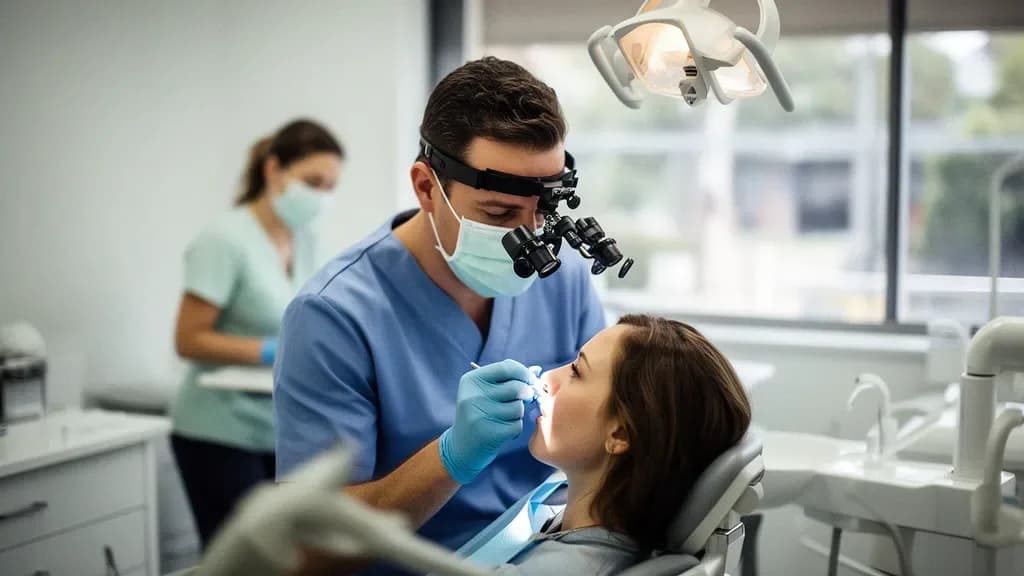
Dentist Visa Pathway to Australia: Complete 2026 Guide
Updated: 16 August 2026
Australia classifies dentists under ANZSCO 252312. The Australian Dental Council (ADC) conducts the skills assessment. The occupation sits on the Core Skills Occupation List (CSOL) and the Regional Occupation List (ROL), unlocking subclasses 491, 494, 482 and 186. Typical 2026 salaries range AUD $130,000-$235,000. Dentist is in shortage in every state and territory.
Quick Facts: Dentist Migration Pathway
| Detail | Information |
|---|---|
| ANZSCO Code | 252312 (Dentist) |
| Skill Level | 1 (Bachelor degree or higher plus registration) |
| Skills Assessment | ADC (Australian Dental Council) |
| Occupation List | CSOL and ROL — not on MLTSSL |
| Visa Options | 491, 494, 482, 186 |
| Demand Level | Critical — Jobs and Skills Australia lists dentist in shortage in every state and territory |
| Salary Range | AUD $130,000-$235,000 (SEEK, 2026) |
| Typical 189 Score | Not applicable (no 189 access; employer or regional routes dominate) |
| Key Challenge | ADC examination pathway runs 18-24 months from initial assessment to AHPRA registration |
What Dentists Actually Do in Australia
Australian dental services are split between private practice (around 80% of the workforce) and the public system through state dental services and the federally funded Child Dental Benefits Schedule. Most dentists work in suburban and regional clinics doing routine restorative work, examinations, cleans, extractions and crown-and-bridge cases. A smaller cohort works in hospital dental units or in academic teaching.
Demand is uneven by geography. Major metropolitan areas hold the highest concentration of practitioners, but rural and regional Australia consistently runs short. Tasmania, regional Queensland, the Northern Territory, regional Western Australia and inland New South Wales have been on the shortage list for years. This regional skew is why the 491 and 494 visas matter for offshore applicants — they unlock locations where private practices and Aboriginal Medical Services are actively recruiting and where state nomination capacity tends to be wider.
The patient base is aging. The 75+ population is the fastest-growing dental cohort, driving demand for prosthodontic work, peri-implant maintenance and complex restorations. Combined with the slow domestic graduate pipeline (roughly 540 new graduates per year from 9 schools), the structural shortage looks durable into 2030.
ANZSCO Code Mapping
The 6-digit code is 252312 — Dentist, sitting inside Unit Group 2523 Dental Practitioners. The ABS describes a dentist as a clinician who diagnoses and treats diseases, injuries, decay and malformations of the teeth, jaws and associated oral structures, including performing fillings, extractions, root canal treatment, prosthodontics and minor oral surgery.
If you are an oral and maxillofacial surgeon, you map instead to 253518 (Surgeon — Oral and Maxillofacial). Dental specialists with formal specialist qualifications (orthodontists, endodontists, periodontists, prosthodontists, paediatric dentists) map to 252311 (Dental Specialist) and follow a separate ADC specialist assessment pathway. General dentists, including those with significant cosmetic or implant practice, sit under 252312.
Skills Assessment
ADC Assessment Pathway
The ADC runs both the dental practitioner assessment process (the registration pathway) and a standalone skills assessment for migration. For most offshore dentists with non-accredited qualifications, the route is:
- Initial Assessment — document verification of your dental degree, transcripts and registration. Fee AUD $647. Processing target approximately 8 weeks from a complete application.
- Written Examination — 150 multiple choice questions covering basic and clinical sciences, delivered through Pearson VUE twice a year (March and September). Application fee AUD $2,122.
- Practical Examination — clinical OSCE delivered in Melbourne, covering operative dentistry, endodontics, prosthodontics and oral surgery on phantom heads and standardised patients. Application fee AUD $4,775. Sittings are allocated by ballot and can be 4-12 months out.
- AHPRA Registration — once you pass both exams, you apply to the Dental Board of Australia through AHPRA. The 2025-26 annual registration fee is AUD $818.
End-to-end, applicants typically take 18-24 months from initial assessment to general AHPRA registration if they pass both exams first time. Failing the practical extends the timeline by 6-12 months per re-sit.
Common rejection reasons: incomplete or unverified university documentation; English test scores below the required IELTS Academic 7.0 across all four bands (or OET equivalent); attempting the practical exam without sufficient hands-on preparation on Australian phantom-head equipment.
For a complete view of all assessing bodies and how they compare, see the complete list of skills assessment bodies.
Skills Assessment for Migration Specifically
For visa applications, ADC issues a separate skills assessment letter once you have completed the practitioner assessment process. There is no additional charge for the migration skills assessment letter where the full practitioner pathway has already been completed.
Recognised Qualification Pathway
Graduates of accredited dental programs in Ireland, the United Kingdom, New Zealand and Canada follow a different route. They apply directly to AHPRA for general registration without sitting the ADC examinations, although they still need an ADC skills assessment for migration purposes.
Visa Pathways for Dentists
Dentist is on the CSOL and ROL but not on the MLTSSL, so the 189 visa is not available. Employer sponsorship and regional routes are the dominant pathways.
Subclass 482 — Skills in Demand Visa
The most common entry route for offshore dentists with a job offer at an Australian practice.
- Visa fee: AUD $4,015 (Core Skills stream, primary applicant)
- Salary threshold: AUD $79,423 Core Skills Income Threshold (from 1 July 2026; previously AUD $76,515)
- Processing: 75% of Core Skills cases decided within 2 months
- Quirk: Dentists must hold AHPRA general or limited registration before the 482 can be granted. Some applicants enter on a limited-registration role at a teaching hospital or rural health service while completing the ADC exam pathway.
Subclass 494 — Skilled Employer Sponsored Regional
Dominant route for offshore dentists targeting regional Australia, including most of Tasmania, regional South Australia, regional Western Australia, regional Queensland and the Northern Territory.
- Visa fee: AUD $4,770 (primary applicant)
- Duration: 5 years provisional with a pathway to subclass 191 permanent residency after 3 years
- Quirk: Nearly all of metropolitan Sydney, Melbourne, Brisbane and Perth is excluded. Adelaide, Hobart and Darwin remain inside the 494 footprint.
Subclass 491 — Skilled Work Regional (Provisional)
The state-nominated regional route. Dentists are explicitly invited by several state programs.
- Visa fee: AUD $6,140 (primary applicant)
- Points boost: +15 from state or family-sponsored regional nomination
- Processing: 75% within 11 months
Subclass 186 — Employer Nomination Scheme
The direct-entry permanent residency route once you hold full general AHPRA registration and have an employer willing to nominate. Most commonly used by dentists already in Australia on a 482 or 494, transitioning via the Temporary Residence Transition stream after 2+ years.
- Visa fee: AUD $6,140 (primary applicant)
- Processing: 75% within 5 months
- Quirk: Direct Entry requires three years of post-qualification skilled experience. The TRT pathway is the easier of the two for most dentists.
Points Test Strategy
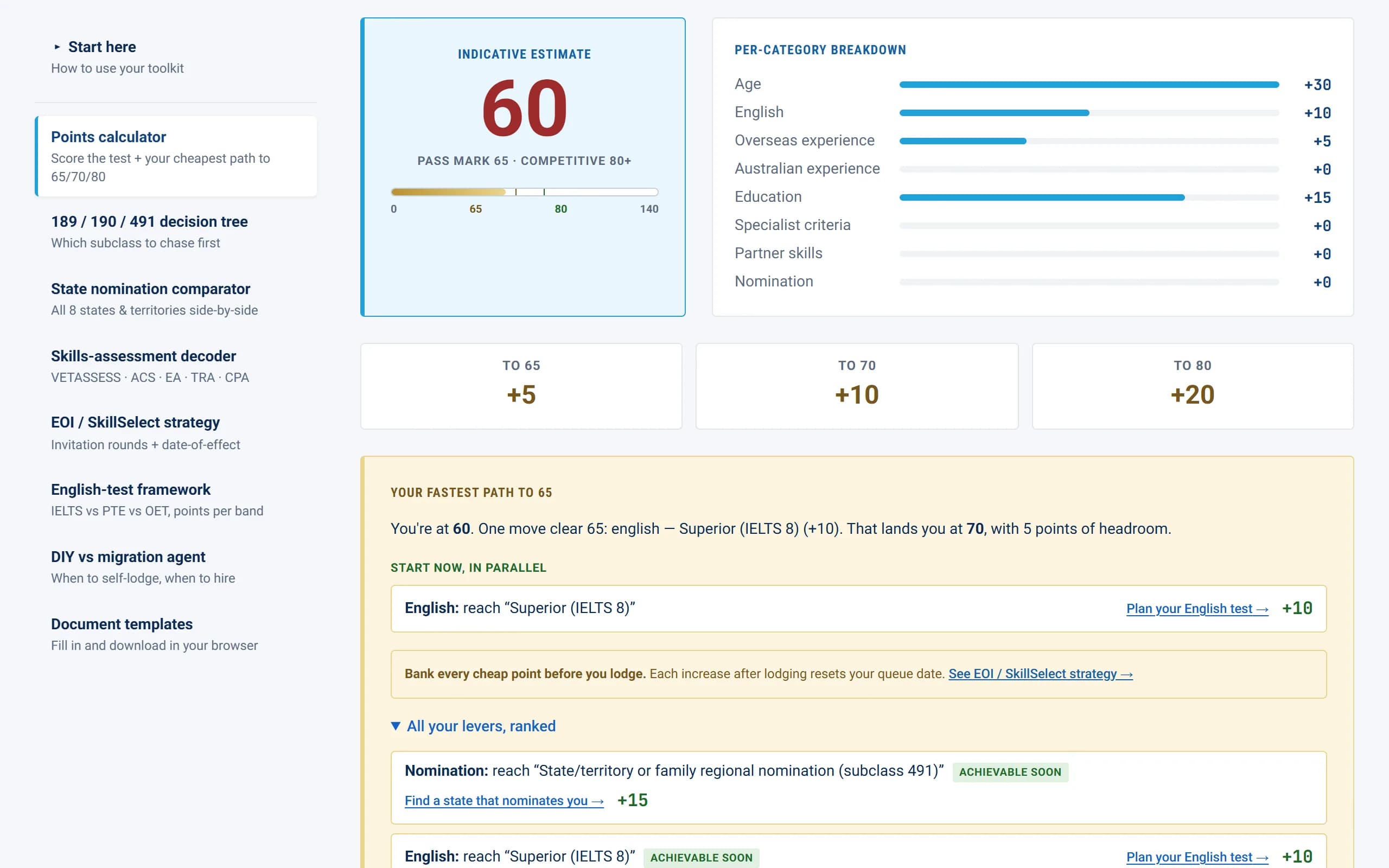
Because dentist is not on the MLTSSL, the 189 visa is closed. The points test still applies to 190 and 491 visa pathways where available.
| Points Factor | Points | Notes |
|---|---|---|
| Age 25-32 | 30 | Maximum bracket |
| Age 33-39 | 25 | Common for migrating dentists |
| Bachelor degree | 15 | Standard BDS or equivalent |
| Master's degree | 15 | No additional uplift over bachelor |
| PhD | 20 | Academic dentists |
| English Proficient (IELTS 7) | 10 | Already required for AHPRA |
| English Superior (IELTS 8) | 20 | Strong leverage for ICT and clinical roles |
| Overseas experience 5-7 years | 10 | Most experienced dentists |
| Overseas experience 8+ years | 15 | Senior practitioners |
| State nomination (190) | 5 | If a state currently invites 252312 |
| Regional nomination (491) | 15 | Available through most regional programs |
| Partner skills | 5-10 | Standard partner uplift |
Realistic Score Scenarios
Scenario 1 — Mid-career offshore dentist (UK trained, 34, 9 years experience, IELTS 7) Age 25 + Degree 15 + English 10 + Experience 15 = 65 points. Add 491 regional nomination (+15) = 80 points. Competitive in most regional programs.
Scenario 2 — Junior offshore dentist (India trained, 29, 4 years experience after ADC, IELTS 7.5) Age 30 + Degree 15 + English 10 + Experience 5 = 60 points. Realistic strategy is 491 nomination (+15) or 482 employer sponsorship. The points route is not the strongest play for dentists with under 5 years of post-qualification experience.
State Nomination
Dentist appears on multiple state lists in 2025-26 because of national shortage. Always check the current state portal — allocations and skill lists are revisited each financial year.
New South Wales
NSW prioritises healthcare under its 2025-26 program. Dentist is in scope for both 190 and 491 nomination where the applicant has a job offer in a NSW location with confirmed shortage. NSW filled its 491 allocation within hours of opening in January 2026; the 2026-27 round opens July 2026. See the NSW state nomination 2026 guide for current invitation thresholds.
Victoria
Victoria includes Dentist in its 2025-26 occupation list under the Care and Support Economy priority. The 2025-26 program is closed to new Registrations of Interest; 2026-27 details release mid-year. Victoria typically requires either a Victorian employer offer or residence and skilled employment in Victoria. See Victoria state nomination 2026.
Queensland
Queensland nominates dentists under both 190 and 491 streams, with strong regional pull through health districts in Cairns, Townsville, Mackay, Rockhampton and Toowoomba. Migration Queensland requires evidence of a regional job offer or current regional residence for 491 pathways. See Queensland state nomination 2026.
South Australia
South Australia treats dentistry as a priority health occupation and offers wider eligibility windows than most states, including English exemptions for offshore healthcare professionals nominated to regional roles. See South Australia state nomination 2026.
Tasmania
Tasmania consistently nominates dentists through both 190 and 491. Demand concentrates around Hobart, Launceston, Devonport and Burnie. The state runs a graduate pathway for offshore dentists who study or complete supervised practice at a Tasmanian institution. See Tasmania state nomination 2026.
Western Australia
WA nominates dentists under its General Stream for both 190 and 491, with the Goldfields, Pilbara, Kimberley and South West regions running active recruitment campaigns through 2026.
Northern Territory
The NT runs one of the more accessible nomination programs for dentists. Aboriginal Medical Services and remote health districts across the Top End sponsor consistently.
Australian Capital Territory
The ACT includes Dentist on its Critical Skills List, scoring well under the Canberra Matrix for applicants with ACT residence or a confirmed ACT job offer.
Salary and Employment Outlook
Typical 2026 Salary Ranges
| Role | Typical Salary Range |
|---|---|
| Associate Dentist (1-3 yrs) | AUD $130,000-$160,000 |
| Established Associate Dentist | AUD $160,000-$210,000 |
| Senior / Principal Dentist | AUD $200,000-$280,000 |
| Practice Owner (after costs) | AUD $250,000-$450,000+ |
| Public Sector Dentist (state services) | AUD $110,000-$160,000 |
| Locum Dentist (daily) | AUD $900-$1,400/day |
| Hospital Dental Officer | AUD $115,000-$155,000 |
Most private associate roles pay on a commission model — typically 40-45% of billings — which means rural and regional placements with higher billings often out-earn metropolitan salaried roles. Total packages include superannuation (currently 11.5%, rising to 12% from July 2026), professional indemnity contributions and continuing education allowances.
SEEK's May 2026 data places the median dentist salary band at AUD $205,000-$225,000 nationally, with the April 2026 reading sitting slightly higher at AUD $215,000-$235,000.
Highest-Paying Sectors and Locations
- Regional and rural private practice — commission models in shortage locations can push experienced associates above AUD $300,000
- Mining and FIFO dental contracts — Western Australia and Queensland resources towns
- Aboriginal Medical Services — competitive packages, often with relocation, housing and CPD funding
- Boutique cosmetic practices — Sydney inner-east, Melbourne inner-south, Gold Coast
- Defence and corrections dental services — stable salaried roles with full benefits
Demand Outlook
Jobs and Skills Australia's Occupation Shortage List flags Dentist (252312) as in shortage in every state and territory in 2026, one of only a small set of occupations to hit this status nationally. The driver is structural — an aging population, slow graduate output and uneven geographic distribution.
Tips for a Successful Application
1. Start the ADC Initial Assessment Before Anything Else
The ADC examination pathway is the gating step. Submitting documents while you complete IELTS or OET avoids a wasted year. Apply for ECFMG primary source verification of your dental degree at the same time as your initial assessment — both processes run in parallel and add 8-12 weeks if started sequentially.
2. Book the Written Exam Early
The written exam runs only twice a year. Missing the September window pushes your next attempt to March. Plan your IELTS and prep timeline so you can sit the written exam at the first available date after passing the initial assessment.
3. Practice on Phantom-Head Equipment Before Sitting the Practical
The ADC practical is the highest-failure stage. Candidates who have only practiced on equipment used in their home country routinely struggle with Australian-standard handpieces and burs. Coaching academies in Melbourne, Sydney and online run condensed phantom-head prep courses; budget 2-4 weeks of intensive practice.
4. Target Regional Locations Directly
Most dentist visas grant through 482, 494 or 491 — all of which depend on a regional employer offer or state nomination. Practices in Bega, Mount Isa, Karratha and Devonport are sponsoring directly through migration agents and locum agencies. Apply with a clear willingness to work outside metro Sydney or Melbourne and your options multiply.
5. Map AHPRA Registration in Parallel With the Visa Application
AHPRA registration is independent of the visa process but is required before you can practice. Start the AHPRA application as soon as ADC confirms your exam pass. Plan to land in Australia with general registration already granted and the dental practice ready to onboard you on day one.
Step-by-Step Migration Roadmap
- Confirm your ANZSCO mapping — general dentist sits at 252312; specialists at 252311. See how to find your ANZSCO code.
- Sit your English test — IELTS Academic 7.0 across all four bands is the AHPRA floor. Aim for 8.0 if you want maximum points.
- Apply for ADC initial assessment — submit primary qualification documents and pay AUD $647.
- Pass the ADC written examination — AUD $2,122 application fee; sittings in March and September.
- Pass the ADC practical examination — AUD $4,775 application fee; in-person OSCE in Melbourne.
- Apply for AHPRA general registration — AUD $818 annual fee once registered.
- Request the ADC migration skills assessment letter — included once the practitioner pathway is complete.
- Choose your visa pathway — 482, 494, 491 or 186 depending on job offer and location.
- Lodge EOI in SkillSelect if pursuing 491 or 190 — see the skills assessment complete guide.
- Secure state nomination or employer sponsorship.
- Lodge visa application — health, character and police clearance.
- Receive grant and relocate — register your private practice or onboard with your sponsoring employer.
Frequently Asked Questions
Why isn't Dentist on the MLTSSL despite the shortage?
The MLTSSL prioritises occupations with national long-term shortage signals and clear points-tested pathway viability. Dentist was moved to the CSOL framework after the 482 reforms in December 2024 because the dominant pathway for offshore dentists is employer-sponsored or regional, not the independent 189. Inclusion on the CSOL and ROL preserves access to 482, 494, 491 and 186 while channelling new entries through routes that match where the work actually is — regional and employer-tied.
How long does the full migration take for an offshore dentist?
Allow 24-36 months end-to-end. The ADC examination pathway alone runs 18-24 months if you pass each exam first time. Adding visa processing — typically 2-12 months depending on subclass — pushes most realistic timelines past two years. Dentists who hold registration from the UK, Ireland, NZ or Canada bypass the ADC examinations and can complete the whole process in 6-12 months.
Which state offers the easiest nomination for dentists?
In 2025-26, South Australia, Northern Territory and Tasmania have run the most accessible programs for offshore dentists, with English exemptions for some regional health roles and faster processing than NSW or Victoria. The trade-off is that nomination locks you to the state for the duration of the provisional visa (5 years for 491, full duration for 190).
Can I work as a dentist on a 482 visa before completing AHPRA general registration?
Limited registration is available through AHPRA for specific supervised roles — typically at teaching hospitals, rural health services or Aboriginal Medical Services. A 482 can be granted against a limited-registration role. You then transition to general registration once you pass the ADC examinations.
What are the most common reasons dentist applications fail?
The three recurring failure points are: incomplete primary source verification of the dental degree (causing the ADC initial assessment to stall), English test results below the AHPRA threshold of IELTS 7 in every band, and underprepared practical exam attempts that exhaust the candidate's allowed re-sits. None are unrecoverable, but each costs 6-12 months and several thousand dollars.
Is my dental qualification from India or the Philippines recognised?
Indian BDS and Filipino DDM qualifications are not accredited by the Australian Dental Council. Holders must complete the full ADC examination pathway — initial assessment, written exam and practical exam — to qualify for AHPRA general registration. The qualification is recognised at the degree level for skills assessment and points purposes once the ADC pathway is passed.