Pastrycook Visa Pathway to Australia: Complete 2026 Guide
Updated: 16 August 2026
Australia classifies Pastrycook under ANZSCO 351112. Trades Recognition Australia (TRA) conducts the skills assessment, usually via the Job Ready Program. The occupation sits on the Core Skills Occupation List (CSOL), opening subclasses 190, 491, 482, and 186. Typical 2026 SEEK salaries range AUD $70,000-$80,000, with regional shortages widening the door for 491 candidates.
Quick Facts: Pastrycook Migration Pathway
| Detail | Information |
|---|---|
| ANZSCO Code | 351112 (Pastrycook) |
| Skill Level | 3 (AQF Certificate III or IV in patisserie or retail baking, with relevant employment) |
| Skills Assessment | TRA (Trades Recognition Australia) — Job Ready Program or Offshore Skills Assessment |
| Occupation List | CSOL (no 189 access — sponsorship or state nomination only) |
| Visa Options | 190, 491, 482, 186 |
| Demand Level | Regional shortage — Jobs and Skills Australia records shortages across most regional areas |
| Salary Range | AUD $70,000-$80,000 average; up to $104,600 at the 75th percentile (SEEK Salary Hub + Glassdoor, 2026) |
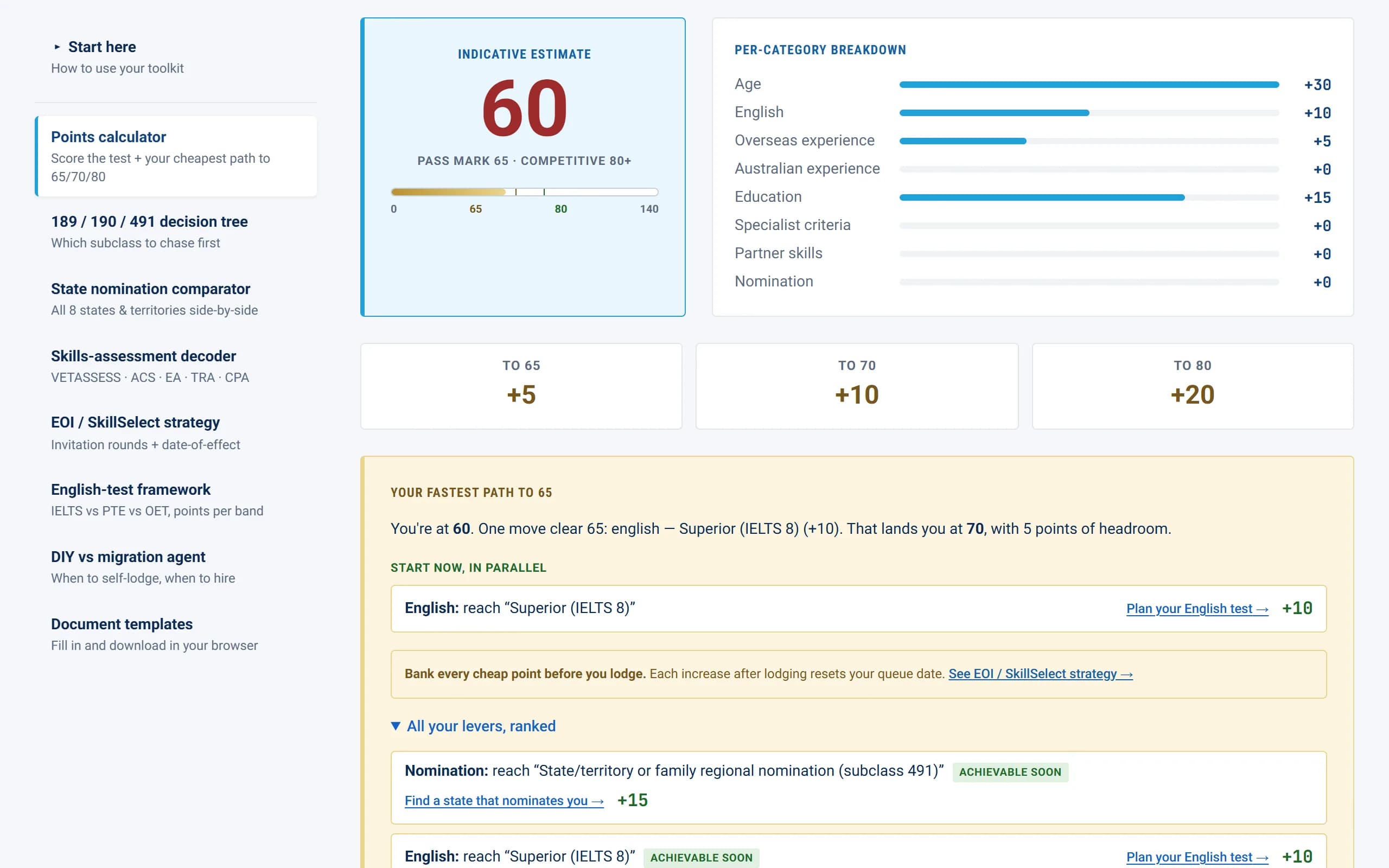
| Typical 491 Score | 65-75 points including regional nomination boost |
| Key Challenge | The TRA Job Ready Program takes a minimum of 12 months and costs ~AUD $3,540 across four stages |
What a Pastrycook Actually Does in Australia
A pastrycook prepares, bakes, and finishes buns, cakes, biscuits, viennoiserie, and pastry goods in a commercial setting. The role is distinct from a chef (ANZSCO 351311), who runs a savoury kitchen, and from a baker (ANZSCO 351111), who specialises in breads. Australian pastrycooks work in patisseries, bakery chains, hotels, hospitals, supermarket in-house bakeries, food manufacturing, and increasingly in dedicated dessert venues.
Demand is geographically uneven. Sydney, Melbourne, and Brisbane house most of the high-profile patisserie roles — Black Star Pastry, LuxBite, Cobb Lane, Lune Croissanterie, and the hotel groups (Crown, Marriott, Hilton, IHG). The deeper structural shortage sits in regional Australia. Jobs and Skills Australia's occupation profile records "Regional Shortage" status across most states and territories, with persistent vacancies in places such as the Tweed, Mackay, Kalgoorlie, Mount Gambier, and the Tasmanian east coast. Roughly 67% of pastrycooks work full-time, and the largest employer industries are Manufacturing, Accommodation and Food Services, and Retail Trade.
For migrants, the regional shortage signal is the practical opening. A Sydney bakery is rarely going to sponsor an unproven offshore pastrycook on a 482. A regional hotel or a country town's only patisserie will.
ANZSCO Code Mapping
The single code is 351112 Pastrycook. The ABS task list includes weighing ingredients; preparing pastes, glazes, and creams; rolling and shaping doughs; controlling oven temperatures; decorating finished products; and managing food safety compliance.
Pastrycook is sometimes confused with three related codes:
- 351111 Baker — bread-focused; assessed by TRA separately
- 351311 Chef — savoury kitchen and menu development; different qualification (Certificate IV in Commercial Cookery)
- 351411 Cook — broader cookery role; assessed at a different level
Your nominated code must match the substantive work you do. A "Pastry Chef" job title in a hotel doesn't automatically mean Pastrycook (351112) — if your duties include leading a section and developing menus, you may sit closer to Chef. TRA assessors look at duties, not titles.
Skills Assessment with TRA
Trades Recognition Australia conducts the assessment via two main routes.
Route A — Job Ready Program (JRP) — Onshore Applicants
The JRP is the dominant pathway for pastrycooks already in Australia (typically on a student or 485 graduate visa after completing an Australian Certificate III in Patisserie). The program has four sequential stages:
| Stage | Fee (AUD) | Description |
|---|---|---|
| 1. Provisional Skills Assessment (PSA) | $130 | Documentary review of qualification + 360 hours work experience |
| 2. Job Ready Employment (JRE) | $490 | Registration of 1,725+ hours of paid Australian employment as a pastrycook |
| 3. Job Ready Workplace Assessment (JRWA) | $2,845 | On-site practical assessment by a TRA-approved assessor |
| 4. Job Ready Final Assessment (JRFA) | $75 | Final documentary check confirming all employment hours and the workplace assessment |
Total TRA cost (2026): approximately AUD $3,540
Minimum duration: 12 months from PSA approval to JRFA outcome, because the JRE stage requires logged Australian employment.
Route B — Offshore Skills Assessment
For pastrycooks applying from outside Australia, TRA offers an offshore route requiring formal qualifications and on-the-job experience evidence equivalent to an Australian Certificate III in Patisserie, plus typically 3 years of post-qualification employment (or 5 years with no formal qualification). Specific country-of-residence rules apply; check the TRA website before lodging.
Common rejection reasons
- Insufficient evidence of patisserie-specific duties — pastrycooks who have spent the bulk of their employment producing bread or savoury items, with patisserie as a side responsibility, frequently fail the 360-hour PSA threshold.
- Documentation gaps in the employment evidence — payslips, contracts, tax records, and supervisor statements must align. Cash-in-hand work and informal hours are common reasons applications stall at JRE.
Visa Pathways for Pastrycooks
The CSOL listing closes the 189 route but opens 190, 491, 482, and 186.
Subclass 491 — Skilled Work Regional (Provisional)
Regional employer or state nomination is the most common pathway for pastrycooks.
- Visa fee: AUD $6,140 (primary applicant)
- Processing time: 12-14 months for most applicants
- Points uplift: 15 from regional nomination
- Quirk: Multiple states currently nominate pastrycooks for 491. Tasmania, South Australia, and regional Victoria have repeatedly issued invitations for the occupation.
Subclass 190 — Skilled Nominated
- Visa fee: AUD $6,140
- Processing time: 6-12 months from invitation, sometimes 9-19 months end to end
- Points uplift: 5 from state nomination
- Quirk: 190 nomination is rare for pastrycooks in metropolitan areas because the shortage signal is regional. Where states do nominate, an existing job offer is usually expected.
Subclass 482 — Skills in Demand (Core Skills stream)
Employer-sponsored temporary visa. Common for hotel and regional patisserie sponsorships.
- Visa fee: AUD $4,015
- Salary requirement: Core Skills Threshold (Core stream) — most full-time pastrycook roles meet the threshold
- Processing time: Median 21-47 days for the Core Skills stream
- Quirk: Hotels with established sponsorship pipelines (Accor, IHG, Marriott) handle 482s for skilled patisserie staff; smaller regional employers often need an agent's help with the nomination process.
Subclass 186 — Employer Nomination Scheme (permanent)
- Visa fee: AUD $6,140
- Eligibility: Direct Entry (3 years skilled employment + TRA assessment) or Temporary Residence Transition (2+ years on 482 with same employer)
- Processing time: Direct Entry currently 12-20+ months; TRT often faster
- Quirk: TRT from a 482 is the realistic permanent pathway. Direct Entry 186 for trades is increasingly backlogged.
See the subclass 482 guide for the full nomination, sponsorship, and labour market testing detail.
State Nomination for Pastrycooks
Verify against each state's published list at the point of application — programs revise lists annually and mid-year.
Tasmania
Tasmania nominates pastrycooks under the 491 stream when the role appears on the Tasmanian Onshore Skilled Occupation List (TOSOL). The state operates an onshore preference: candidates working in Tasmania for three months in their nominated occupation, with a confirmed employment offer of at least 12 months remaining, are eligible to apply. Pastrycook is a long-standing inclusion. Hobart, Launceston, and the east coast tourism corridor regularly advertise the role.
South Australia
SA has nominated pastrycooks across recent program years under the 491 stream for regional applicants, with a preference for candidates with existing SA employment. The state's hospitality sector — wineries with cellar-door bakeries, Adelaide Hills patisseries, and regional bakery chains — sustains the listing.
Victoria (regional)
Victoria's regional stream nominates trades occupations including pastrycook in 491 form when candidates are working in designated regional Victoria. Geelong, Ballarat, Bendigo, the Goulburn Valley, and Gippsland account for the bulk of regional placements.
Queensland (regional)
Queensland's 491 stream includes hospitality trades in regional zones, particularly Far North Queensland, Wide Bay, and Townsville. The state's tourism economy keeps the role active on regional lists.
Western Australia
WA periodically nominates the role under its 491 stream for regional applicants, with the strongest demand in the South West and Goldfields-Esperance regions.
NSW does not consistently nominate pastrycook in 2026 — metropolitan demand is absorbed by the existing workforce, and regional NSW programs have been narrower than VIC/SA/TAS for hospitality trades.
Salary and Employment Outlook
2026 Salary Bands
| Role | Typical Salary Range |
|---|---|
| Junior Pastrycook (apprentice / Cert III holder) | AUD $55,000-$65,000 |
| Pastrycook (qualified, 1-3 years) | AUD $65,000-$80,000 |
| Senior Pastrycook / Pastry Section Leader | AUD $80,000-$95,000 |
| Pastry Chef / Head of Patisserie (hotel) | AUD $90,000-$110,000 |
| Executive Pastry Chef (premium hotel / 5-star) | AUD $110,000-$140,000+ |
| 75th percentile (all roles, Glassdoor 2026) | AUD $104,600 |
Sources: SEEK Salary Hub (May 2026 average AUD $75,000-$80,000 for "Pastry Chef"), Glassdoor Australia (25th-75th percentile $59,350-$104,600), Indeed Career Insights (average AUD $72,088 for "Pastry Cook").
Note: SEEK's "Pastry Chef" salary band is reported above because the dataset includes Pastrycook roles. SEEK's pastrycook-specific bands sit slightly lower in the metro averages.
Total package usually includes the 11.5% superannuation guarantee. Premium hotels add a service charge component or annual bonus; smaller bakeries typically don't.
Highest-paying employers and sectors
- Five-star hotels — Crown, Park Hyatt, Four Seasons, The Langham, Capella pay the highest base for executive pastry roles
- Premium patisserie chains — Lune Croissanterie, Black Star Pastry, Brunetti, Bourke Street Bakery
- Hospital and aged care food services — stable hours, slightly lower base, strong job security
- Food manufacturing — large bakery groups (Goodman Fielder, George Weston Foods) hire pastrycooks for production lines at solid rates
- Cruise lines and resorts — Hamilton Island, Hayman, the Great Barrier Reef resorts pay accommodation-included packages
Jobs and Skills Australia signal
The 2026 Jobs and Skills Australia profile for 351112 Pastrycook records Regional Shortage (R) status across most states and territories, with No Shortage in selected metro areas. Future demand is rated "Strong". The shortage signal is a key reason the occupation remains on state nomination lists.
Tips for a Successful Application
1. Build your evidence file from day one
TRA's Job Ready Program is a documentation exercise as much as a skills test. Keep payslips, contracts, supervisor letters, and a daily duties log from the moment you start any pastrycook role. Reconstructing 1,725 hours of employment retrospectively is a common reason JRE applications stall.
2. Target regional employers directly
Most successful pastrycook migration outcomes in 2025-26 came through regional 491 nominations, not metropolitan 190s. Email regional hotels, patisseries, and aged-care food services directly with a CV and a portfolio of finished items. Council-run job boards in regional LGAs are underused by overseas applicants.
3. Don't conflate pastry chef and pastrycook on your application
If your overseas job title is "Pastry Chef" but your duties were 80% production pastrywork under another chef's direction, file under 351112 Pastrycook. If you led a brigade and developed menus, you may belong under 351311 Chef. The wrong code at lodgement is the most expensive mistake — the assessment will fail and the fee is non-refundable.
4. Sit IELTS (or PTE Academic) early
For 491 nomination most states want at least Competent English (IELTS 6 in each band). For 190 some states require Proficient (IELTS 7 in each). English is also the most common gatekeeper at 482 visa stage. Sit the test before lodging skills assessment.
5. Consider an Australian Certificate III in Patisserie
Many migrant pastrycooks reduce overall cost and time by enrolling in an AQF Certificate III in Patisserie at a TAFE or registered RTO. This grants a 485 graduate visa (up to 2 years) that lets you complete the JRE stage of the Job Ready Program with Australian employment, and may qualify the candidate for state graduate streams.
Step-by-Step Migration Roadmap
- Confirm the ANZSCO match — verify your duties match 351112 against the ANZSCO code finder
- Check CSOL status — confirm pastrycook remains on the current Core Skills Occupation List
- Choose your route — offshore TRA assessment or onshore Job Ready Program (decide based on whether you already hold an Australian qualification + work rights)
- Lodge PSA with TRA — AUD $130; documentary review of qualifications
- For onshore candidates — complete JRE stage with at least 1,725 paid hours in pastrycook role
- Complete JRWA workplace assessment — AUD $2,845; arranged with a TRA-approved assessor
- Receive JRFA outcome — AUD $75 final step
- Sit English test — IELTS or PTE Academic; target Proficient if pursuing 190
- Submit EOI in SkillSelect — claim 190, 491, and 482 as appropriate
- Apply for state nomination — direct to the state's skilled migration portal
- Receive nomination and ITA — 60 days to lodge the visa
- Lodge visa, complete health and character checks, receive grant
Frequently Asked Questions
What's the difference between Pastrycook (351112) and Pastry Chef for migration purposes?
There is no separate ANZSCO code for "Pastry Chef" — it's a job title, not a recognised migration occupation. If you lead a pastry section, develop menus, and supervise a brigade, your duties may map to Chef (351311). If you primarily produce pastry goods under another chef's direction, you map to Pastrycook (351112). The wrong choice fails the assessment; review your last three years' duties honestly before nominating.
Is the Job Ready Program really the only TRA route?
No. TRA offers an Offshore Skills Assessment for applicants outside Australia who hold qualifications and experience equivalent to Australian standards. The offshore route is shorter and cheaper but requires strong documentary evidence from your home country. The Job Ready Program is the dominant route for onshore candidates because it converts an Australian Certificate III plus paid work into a positive TRA outcome, which then unlocks state nomination.
Why does the Job Ready Program take 12 months minimum?
The Job Ready Employment (JRE) stage requires 1,725+ paid hours of Australian employment as a pastrycook, working under TRA monitoring. At a standard 38-hour week, that's roughly 45 weeks of full-time work — about 12 months. There is no shortcut. Candidates who try to compress the timeline by combining roles or claiming hours from informal work routinely fail the stage.
Which states give pastrycooks the strongest 491 chance in 2026?
Tasmania, South Australia, and regional Victoria have consistently nominated pastrycook for 491 across 2025-26. Tasmania's TOSOL onshore stream is particularly accessible for candidates already working in the state for three months with a confirmed employment offer. Regional QLD and WA also nominate, with stronger preference for candidates already in the region. Metropolitan 190 nominations for pastrycook are uncommon.
How realistic is permanent residency for an offshore pastrycook?
Realistic but slow. The most common pattern in 2026 is: regional 482 sponsorship → 2 years of skilled employment with the same employer → 186 Temporary Residence Transition stream. Alternatively, 491 provisional → 3 years regional residence → 191 permanent visa. Both routes are well-trodden for hospitality trades; the choke point is typically securing the first sponsoring employer.