Hotel or Motel Manager Visa Pathway to Australia: Complete 2026 Guide
Updated: 16 August 2026
Australia classifies Hotel or Motel Manager under ANZSCO 141311, a Skill Level 2 occupation needing an AQF Diploma or higher. VETASSESS conducts the skills assessment. The occupation sits on the Core Skills Occupation List (CSOL) but not the MLTSSL, so it opens subclasses 190, 491, 482 and 186 rather than the independent 189. Typical 2026 salaries run AUD $77,000-$120,000, with larger and resort properties at the top.
Quick Facts: Hotel or Motel Manager Migration Pathway
| Detail | Information |
|---|---|
| ANZSCO Code | 141311 (Hotel or Motel Manager) |
| Skill Level | 2 (AQF Diploma or higher, or equivalent experience) |
| Skills Assessment | VETASSESS (Group C) |
| Occupation List | CSOL and STSOL — not on MLTSSL |
| Visa Options | 190, 491, 482, 186 |
| Demand Level | High — sustained tourism and accommodation staffing shortages, strongest in regional and resort areas |
| Salary Range | AUD $77,000-$120,000 (SEEK, Talent.com 2026) |
| Typical 190/491 Score | 65-80 points with nomination |
| Key Challenge | Distinguishing genuine management duties from front-desk or supervisory work in references |
What a Hotel or Motel Manager Does in Australia
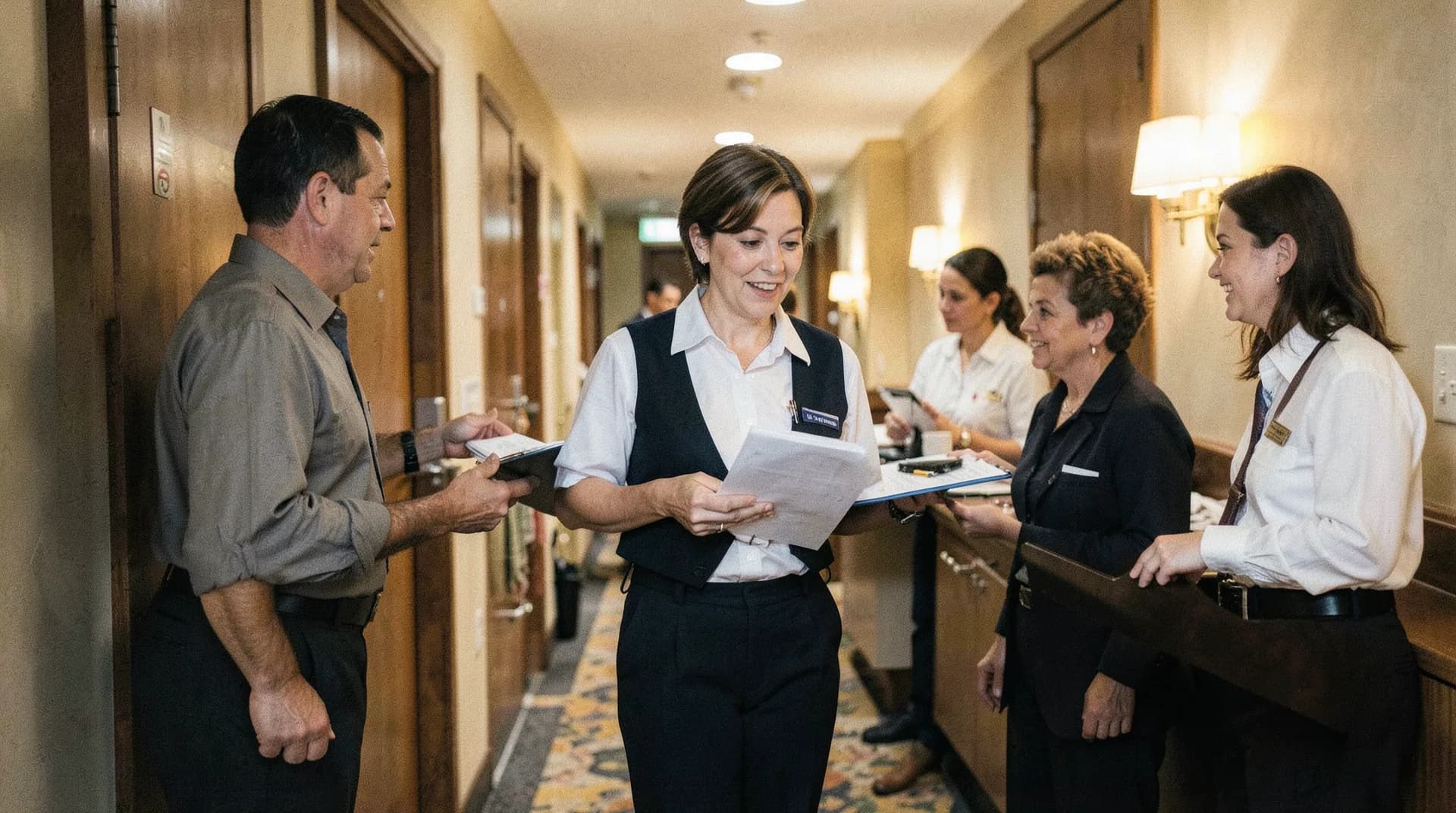
A Hotel or Motel Manager organises and controls the operations of a property that provides guest accommodation, meals and related services. The role is full operational management. You direct reservations, reception, room service and housekeeping, supervise security and property maintenance, plan and oversee bar, restaurant, function and conference activity, manage budgets and statistical and financial records, and handle staffing and guest complaints. Compliance with liquor, gaming and food-safety law is part of the job, and on smaller properties the manager often carries commercial responsibility for the whole site.
Australia's accommodation sector rebuilt strongly after the pandemic travel slump and now runs with persistent staffing gaps, especially in management. Demand is strongest in tourism-heavy regional and resort destinations, including Queensland's coast, the Northern Territory, Tasmania and the wine and alpine regions, where finding experienced managers willing to relocate is a constant challenge. City hotels recruit competitively too, but the acute shortages, and therefore the better migration odds, sit outside the capitals.
ANZSCO Code 141311 in Detail
The code 141311 belongs to ANZSCO unit group 1413, Hotel and Motel Managers. The official description covers organising and controlling the operations of a hotel or motel to provide guest accommodation, meals and other services. Core tasks include directing reservation, reception, room service and housekeeping; supervising security, garden and property maintenance; planning and supervising bar, restaurant, function and conference activities; observing liquor, gaming and other regulations; and assessing and reviewing guest satisfaction.
The related code Accommodation and Hospitality Managers nec (141999) covers managers of accommodation and hospitality establishments that do not fit the named codes, such as serviced apartments, hostels or holiday parks. Choose 141311 only where the property is genuinely a hotel or motel and your duties are full operational management rather than departmental supervision. VETASSESS assesses against the duties your references describe.
Skills Assessment
VETASSESS (Group C)
VETASSESS assesses Hotel or Motel Manager as a Group C occupation. Group C occupations require both a relevant qualification and relevant employment, with the qualification benchmarked to the ANZSCO skill level. VETASSESS updated the criteria for this occupation in early 2024.
Requirements:
- A qualification assessed at AQF Diploma level or higher in a highly relevant field, plus at least one year of post-qualification highly relevant employment at the appropriate skill level in the last five years, OR
- A higher-level qualification (Bachelor or above) in a related field with relevant employment, OR
- Pathways for applicants whose qualification is in a less directly related field, provided employment is highly relevant and of sufficient length.
Assessment cost: AUD $1,096 for applicants outside Australia (AUD $1,205.60 including GST for online applications within Australia), current after the 22 October 2025 fee increase.
Processing time: Around 7 weeks standard. Priority processing returns an outcome in about 10 business days for an extra AUD $825 (AUD $907.50 including GST).
Common rejection reasons: References that describe front-office or single-department supervision rather than whole-of-property management; and qualifications that are not assessed as highly relevant to hospitality or business management without enough relevant employment to compensate. From 1 January 2026, Pathway 1 applicants must also lodge a Language, Literacy, Numeracy and Digital Skills assessment with their documents.
Visa Pathways for Hotel or Motel Managers
Hotel or Motel Manager is on the CSOL and STSOL but not the MLTSSL, so the independent subclass 189 is closed. The available routes are state-nominated, regional and employer-sponsored.
Subclass 491 — Skilled Work Regional (Provisional)
Often the strongest fit, given that the sharpest accommodation shortages are in regional and resort areas.
- Visa fee: AUD $6,140 (primary applicant)
- Points boost: +15 from regional nomination
- Duration: 5 years, with a pathway to the permanent 191
- Quirk: Regional resort and tourism towns are exactly where managers are hardest to recruit, so the occupation aligns naturally with regional nomination intent.
Subclass 190 — Skilled Nominated (Permanent)
Permanent residency where a state or territory nominates the occupation.
- Visa fee: AUD $6,140 (primary applicant)
- Points boost: +5 from state nomination
- Obligation: Live and work in the nominating state for two years
- Quirk: Some states reserve hospitality management nomination for regional employment even on the 190.
Subclass 482 — Skills in Demand (Temporary)
Employer-sponsored. Common where a hotel group or a regional property recruits a manager directly.
- Visa fee: AUD $1,895 (Core stream) or AUD $3,035 (Specialist stream)
- Eligibility: A sponsoring employer, a positive skills assessment, and a salary meeting the relevant income threshold
- Quirk: Manager salaries at smaller regional properties can sit near the Core stream floor, so confirm the package clears the current threshold.
Subclass 186 — Employer Nomination Scheme (Permanent)
Permanent residency through an employer, usually after time on a 482.
- Visa fee: AUD $6,140 (primary applicant)
- Streams: Direct Entry or the Temporary Residence Transition stream after qualifying 482 service
Points Test Strategy
The points test applies to the 190 and 491. The base pass mark is 65, and nomination points usually do the heavy lifting for a hospitality management applicant.
| Points Factor | Points | Notes |
|---|---|---|
| Age (25-32) | 30 | Maximum bracket |
| Age (33-39) | 25 | Common for experienced managers |
| English (Proficient — 7.0) | 10 | Realistic target |
| English (Superior — 8.0+) | 20 | Strong advantage |
| Qualification (Diploma) | 10 | AQF Diploma level |
| Qualification (Bachelor) | 15 | Where held |
| Skilled Experience (overseas) | 5-15 | Depends on assessed years |
| State Nomination (190) | 5 | If nominated |
| Regional Nomination (491) | 15 | The largest single lift |
| Partner Skills | 5-10 | If partner has a skilled occupation |
Realistic Score Scenarios
Scenario 1: Property manager, 31, Proficient English, six years managing a mid-size hotel, Bachelor in hospitality
Age 30 + English 10 + Bachelor 15 + experience 10 = 65, then +15 for a 491 nomination = 80 points. Competitive in a regional program.
Scenario 2: Motel manager, 36, Proficient English, four years, AQF Diploma
Age 25 + English 10 + Diploma 10 + experience 5 = 50, then +15 for a 491 nomination = 65 points. Reaching the pass mark with regional nomination; Superior English would add a useful buffer.
State Nomination
Several states nominate hospitality management, but eligibility is usually tied to regional employment and changes each program year. Verify the current list on each state's site.
Queensland and Tasmania
Both lean heavily on tourism, and regional Queensland and regional Tasmania frequently include accommodation and hospitality management in their skilled programs to staff coastal and resort properties. Regional residence on the 491 lines up well with where these jobs sit.
Northern Territory and South Australia
The Northern Territory has long used skilled migration to fill management roles across its hospitality and tourism sector, including remote properties. South Australia nominates hospitality management for regional employment and has at times applied more flexible criteria for offshore applicants in shortage areas.
Treat these as indicative. Nomination depends on the specific state program open when you apply, and a confirmed regional job offer strengthens almost every application.
Salary and Employment Outlook
| Role | Typical Salary Range |
|---|---|
| Assistant / Duty Manager | AUD $65,000-$80,000 |
| Hotel or Motel Manager (mid-size property) | AUD $77,000-$95,000 |
| Hotel Manager (larger property) | AUD $95,000-$115,000 |
| General Manager / Resort Manager | AUD $110,000-$150,000+ |
SEEK places hotel manager pay around AUD $80,000-$100,000, while Talent.com reports an average near AUD $77,500 with experienced managers up to about AUD $105,000. General managers of large or resort properties sit well above this range. Packages commonly add superannuation at 11.5%, and live-in roles at regional and remote properties often include accommodation, which materially raises the real value of the offer.
The highest-paying roles tend to be general management of large city hotels, branded resorts and multi-property groups. Regional and remote properties pay competitively for experienced managers because the talent pool willing to relocate is thin, and that scarcity is exactly what makes the migration pathway viable.
Tips for a Successful Application
- Prove whole-of-property management in your references. VETASSESS draws a clear line between managing an entire hotel and supervising one department. References that read like a front-office role are the most common reason this assessment fails.
- Target regional employment. The 491's +15 points and the strongest staffing shortages both sit in regional and resort areas, so a regional job offer improves both eligibility and your competitiveness.
- Push for Superior English if you can. Moving from Proficient to Superior adds 10 points, which often decides whether a Skill Level 2 applicant clears the pass mark comfortably.
- Confirm the 482 salary threshold before relying on sponsorship. Manager pay at smaller properties can land near the Core stream floor. Check the current figure against the written offer.
- Note the 2024 criteria update. VETASSESS revised the assessment criteria for this occupation in early 2024, so use the current information sheet rather than older guidance when preparing documents.
Step-by-Step Migration Roadmap
- Confirm your ANZSCO code with the ANZSCO code finder and check 141311 fits, not the nec code 141999.
- Confirm CSOL status on the Core Skills Occupation List and review the Skilled Occupation List for 2026.
- Gather references describing full operational management of a hotel or motel.
- Sit an English test, aiming for Proficient or higher.
- Lodge your VETASSESS skills assessment with the LLND assessment included.
- Calculate your points against the 190 and 491 thresholds.
- Submit an Expression of Interest through SkillSelect.
- Apply for state or regional nomination, or secure an employer for a 482.
- Receive an invitation and lodge the visa within the deadline.
- Complete health and character checks.
- Receive the grant and relocate to the nominating region.
Frequently Asked Questions
Can a Hotel or Motel Manager apply for the subclass 189 visa?
No. Subclass 189 is limited to MLTSSL occupations, and Hotel or Motel Manager (141311) sits on the CSOL and STSOL only. The permanent options are the 190 and 186, with the 491 regional visa providing a provisional pathway that leads to permanent residency through the subclass 191.
What is the difference between 141311 and the nec code 141999?
Code 141311 is specifically for managers of hotels and motels. Code 141999, Accommodation and Hospitality Managers nec, covers managers of establishments that do not fit a named code, such as serviced apartments, hostels and holiday parks. Use 141311 only where the property is genuinely a hotel or motel and you run the whole operation.
Is regional or city work better for migration?
Regional. The 491 visa adds 15 points for regional nomination, and Australia's sharpest accommodation management shortages are in regional and resort areas. A regional job offer improves both your eligibility for nomination and your competitiveness in the points test, which is why most successful applicants in this occupation go the regional route.
What qualifications does VETASSESS require?
Hotel or Motel Manager is a Skill Level 2 occupation, so the benchmark is an AQF Diploma or higher in a highly relevant field, paired with relevant employment. A higher qualification such as a Bachelor in hospitality or business management strengthens the case. VETASSESS updated its criteria for this occupation in 2024, so check the current information sheet.
What can a hotel or motel manager earn in Australia?
SEEK reports roughly AUD $80,000-$100,000 for hotel managers, and Talent.com an average near AUD $77,500, with experienced managers higher. General managers of large or resort properties reach AUD $110,000-$150,000 and beyond. Live-in regional roles often include accommodation on top of salary and superannuation.