Accommodation and Hospitality Managers nec Visa Pathway to Australia: Complete 2026 Guide
Updated: 16 August 2026
Australia classifies Accommodation and Hospitality Managers nec under ANZSCO 141999, a Skill Level 2 occupation needing an AQF Diploma or higher. VETASSESS conducts the skills assessment. The occupation sits on the Core Skills Occupation List (CSOL) but not the MLTSSL, opening subclasses 190, 491, 482 and 186 rather than the independent 189. Typical 2026 salaries run AUD $75,000-$115,000 across the varied roles this code covers.
Quick Facts: Accommodation and Hospitality Managers nec Migration Pathway
| Detail | Information |
|---|---|
| ANZSCO Code | 141999 (Accommodation and Hospitality Managers nec) |
| Skill Level | 2 (AQF Diploma or higher, or equivalent experience) |
| Skills Assessment | VETASSESS (Group C) |
| Occupation List | CSOL and STSOL — not on MLTSSL |
| Visa Options | 190, 491, 482, 186 |
| Demand Level | High — broad catch-all role covering tourism, accommodation and hospitality staffing gaps |
| Salary Range | AUD $75,000-$115,000 (SEEK 2026) |
| Typical 190/491 Score | 65-80 points with nomination |
| Key Challenge | Proving the role does not fit a named code, and that duties are genuine management |
What an Accommodation and Hospitality Manager nec Does in Australia
The "nec" tag means not elsewhere classified. This code captures managers who organise and control accommodation or hospitality establishments that do not fit one of the named codes such as Hotel or Motel Manager, Cafe or Restaurant Manager, or Licensed Club Manager. In practice that includes managers of serviced apartments, hostels and backpacker lodges, holiday parks and caravan parks, retreats, and other accommodation or hospitality venues that sit outside the standard categories. The duties mirror other hospitality management: directing reservations, reception, room service and housekeeping, supervising security and property maintenance, managing budgets and staff, and handling guest relations.
Australia's tourism and accommodation sector runs with sustained management shortages, and the breadth of this code means it absorbs a wide range of genuine management roles. Demand is strong across regional and resort destinations, where holiday parks, retreats and self-contained accommodation are common, as well as in cities with large serviced-apartment markets. Because the code is a catch-all, the practical test is always whether the specific venue truly falls outside the named codes and whether the applicant is managing the whole operation.
ANZSCO Code 141999 in Detail
The code 141999 sits in ANZSCO unit group 1419, Accommodation and Hospitality Managers nec. The official description covers managers who organise and control the operations of accommodation and hospitality establishments not classified elsewhere. Core tasks align with the broader hospitality management group: directing reservation, reception, room service and housekeeping activities; supervising security and property maintenance; planning and overseeing food, beverage and function services where relevant; observing regulations; and reviewing guest or customer satisfaction.
Choosing 141999 correctly is the central judgement. If your venue is a hotel or motel, use 141311. If it is a cafe or restaurant, use the relevant manager code. If it is a member-based licensed club, use 141411. Use 141999 only where the establishment genuinely does not fit a named code, such as a holiday park, serviced-apartment complex or hostel. VETASSESS assesses against the duties your references describe, and it will look closely at whether a named code applies first.
Skills Assessment
VETASSESS (Group C)
VETASSESS assesses this occupation as a Group C role, examining both a relevant qualification and relevant employment. VETASSESS updated its criteria for this occupation in early 2024.
Requirements:
- A qualification assessed at AQF Diploma level or higher in a highly relevant field, plus at least one year of post-qualification highly relevant employment at the appropriate skill level in the last five years, OR
- A higher-level qualification (Bachelor or above) in a related field with relevant employment, OR
- Pathways for applicants whose qualification is in a less directly related field, provided employment is highly relevant and of sufficient length.
Assessment cost: AUD $1,096 for applicants outside Australia (AUD $1,205.60 including GST for online applications within Australia), current after the 22 October 2025 fee increase.
Processing time: Around 7 weeks standard. Priority processing returns an outcome in about 10 business days for an extra AUD $825 (AUD $907.50 including GST).
Common rejection reasons: Roles that should have been assessed under a named code, where VETASSESS finds the venue is in fact a hotel, restaurant or club; and references describing supervisory or single-department work rather than whole-of-establishment management. From 1 January 2026, Pathway 1 applicants must also lodge a Language, Literacy, Numeracy and Digital Skills assessment with their documents.
Visa Pathways for Accommodation and Hospitality Managers nec
This occupation is on the CSOL and STSOL but not the MLTSSL, so the independent subclass 189 is closed. The routes are state-nominated, regional and employer-sponsored.
Subclass 491 — Skilled Work Regional (Provisional)
Often the strongest fit, since many of the venues this code covers, including holiday parks and retreats, sit in regional and resort areas.
- Visa fee: AUD $6,140 (primary applicant)
- Points boost: +15 from regional nomination
- Duration: 5 years, with a pathway to the permanent 191
- Quirk: Regional tourism operators struggle to recruit experienced managers, which aligns the occupation with regional nomination intent.
Subclass 190 — Skilled Nominated (Permanent)
Permanent residency where a state or territory nominates the occupation.
- Visa fee: AUD $6,140 (primary applicant)
- Points boost: +5 from state nomination
- Obligation: Live and work in the nominating state for two years
- Quirk: Some states limit hospitality management nomination to regional employment even on the 190.
Subclass 482 — Skills in Demand (Temporary)
Employer-sponsored. Common where a holiday park group or serviced-apartment operator recruits a manager directly.
- Visa fee: AUD $1,895 (Core stream) or AUD $3,035 (Specialist stream)
- Eligibility: A sponsoring employer, a positive skills assessment, and a salary meeting the relevant income threshold
- Quirk: Pay at smaller venues can sit near the Core stream floor, so confirm the package clears the current threshold.
Subclass 186 — Employer Nomination Scheme (Permanent)
Permanent residency through an employer, usually after time on a 482.
- Visa fee: AUD $6,140 (primary applicant)
- Streams: Direct Entry or the Temporary Residence Transition stream after qualifying 482 service
Points Test Strategy
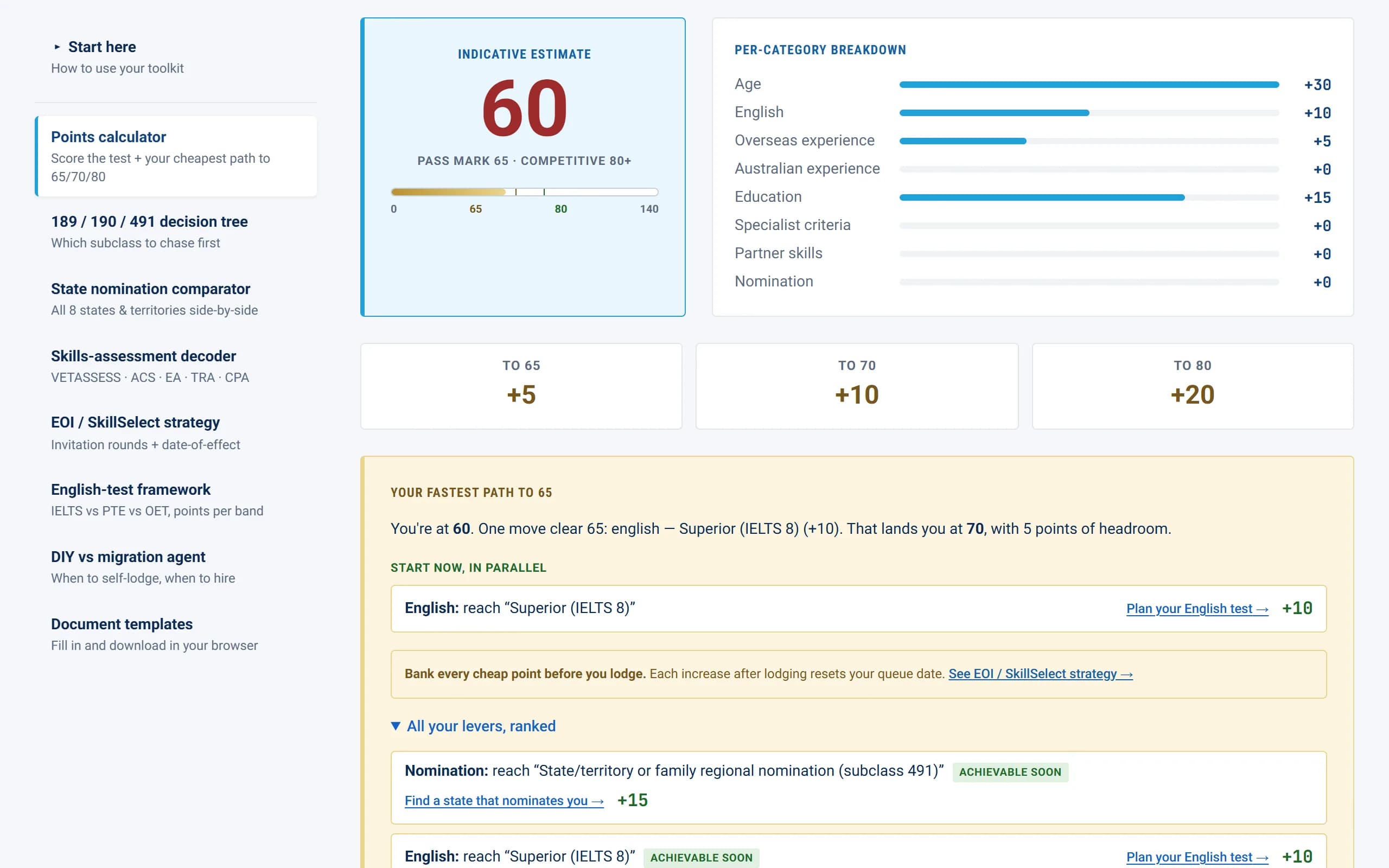
The points test applies to the 190 and 491. The base pass mark is 65, and nomination points usually decide whether an applicant in this occupation is competitive.
| Points Factor | Points | Notes |
|---|---|---|
| Age (25-32) | 30 | Maximum bracket |
| Age (33-39) | 25 | Common for experienced managers |
| English (Proficient — 7.0) | 10 | Realistic target |
| English (Superior — 8.0+) | 20 | Strong advantage |
| Qualification (Diploma) | 10 | AQF Diploma level |
| Qualification (Bachelor) | 15 | Where held |
| Skilled Experience (overseas) | 5-15 | Depends on assessed years |
| State Nomination (190) | 5 | If nominated |
| Regional Nomination (491) | 15 | The largest single lift |
| Partner Skills | 5-10 | If partner has a skilled occupation |
Realistic Score Scenarios
Scenario 1: Holiday park manager, 30, Proficient English, six years, Bachelor in tourism management
Age 30 + English 10 + Bachelor 15 + experience 10 = 65, then +15 for a 491 nomination = 80 points. Competitive in a regional program.
Scenario 2: Serviced-apartment manager, 37, Proficient English, four years, AQF Diploma
Age 25 + English 10 + Diploma 10 + experience 5 = 50, then +15 for a 491 nomination = 65 points. Reaching the pass mark; Superior English would add a useful buffer.
State Nomination
Several states nominate this broad hospitality management code, generally tied to regional employment, with lists revised each program year. Verify the current list on each state's site.
Queensland and Tasmania
Both depend heavily on tourism, and regional Queensland and regional Tasmania periodically include accommodation and hospitality management in their skilled programs to staff parks, retreats and resort properties. Regional residence on the 491 lines up with where these jobs sit.
Northern Territory and Western Australia
The Northern Territory has used skilled migration to fill management roles across remote tourism and accommodation operations. Regional Western Australia, including its resort and mining-town accommodation, has at times nominated hospitality management roles where local recruitment falls short.
Treat these as indicative. A confirmed regional job offer strengthens nearly every application for this occupation, and program availability shifts year to year.
Salary and Employment Outlook
| Role | Typical Salary Range |
|---|---|
| Assistant / Duty Manager | AUD $65,000-$80,000 |
| Accommodation / Hospitality Manager | AUD $75,000-$95,000 |
| Holiday Park / Serviced-Apartment Manager | AUD $85,000-$110,000 |
| Multi-site / Group Manager | AUD $110,000-$140,000+ |
SEEK hospitality and accommodation management data centres on roughly AUD $80,000-$100,000, with larger operations and multi-site roles above that. The wide range reflects how varied this catch-all code is, from a single small park to a group of serviced-apartment buildings. Packages add superannuation at 11.5%, and live-in roles at regional parks and retreats frequently include on-site accommodation, which lifts the real value of the offer.
The highest-paying roles tend to involve managing large holiday-park groups, sizeable serviced-apartment portfolios, or integrated tourism operations with multiple revenue streams. Managers who can run accommodation, food and beverage, and events together are the most sought after.
Tips for a Successful Application
- Confirm a named code does not apply first. VETASSESS will check whether your venue is really a hotel, restaurant or club. Establish clearly that the establishment sits outside those categories before relying on 141999.
- Prove whole-of-establishment management. References should show you ran the operation, not just one department. Supervisory-only descriptions are a frequent cause of refusal.
- Target regional employment. The 491's +15 points and the genuine staffing shortages both sit in regional tourism, so a regional job offer improves eligibility and competitiveness.
- Aim for Superior English where possible. Moving from Proficient to Superior adds 10 points, which often decides whether a Skill Level 2 applicant clears the pass mark.
- Note the 2024 criteria update. VETASSESS revised the assessment criteria for this occupation in early 2024, so work from the current information sheet rather than older guidance.
Step-by-Step Migration Roadmap
- Confirm your ANZSCO code with the ANZSCO code finder, checking no named code applies before using 141999.
- Confirm CSOL status on the Core Skills Occupation List and review the Skilled Occupation List for 2026.
- Gather references showing whole-of-establishment management of a venue outside the named codes.
- Sit an English test, aiming for Proficient or higher.
- Lodge your VETASSESS skills assessment with the LLND assessment included.
- Calculate your points against the 190 and 491 thresholds.
- Submit an Expression of Interest through SkillSelect.
- Apply for state or regional nomination, or secure an employer for a 482.
- Receive an invitation and lodge the visa within the deadline.
- Complete health and character checks.
- Receive the grant and relocate to the nominating region.
Frequently Asked Questions
What does "nec" mean in this occupation?
The letters stand for "not elsewhere classified". The code 141999 is a catch-all for accommodation and hospitality managers whose venue does not fit a named ANZSCO code such as Hotel or Motel Manager (141311) or Licensed Club Manager (141411). Examples include managers of holiday parks, serviced apartments, hostels and retreats.
How do I know whether to use 141999 or a named code?
Check the named codes first. If your venue is genuinely a hotel or motel, use 141311. If it is a cafe or restaurant, use the relevant manager code. If it is a member-based licensed club, use 141411. Use 141999 only where none of those fit, and be ready to show why. VETASSESS examines this point closely, and choosing the wrong code is a common reason assessments fail.
Can I get permanent residency directly with this occupation?
Yes, through the subclass 190 if a state nominates you, or the subclass 186 if an employer sponsors you. The subclass 189 independent visa is closed because the occupation is on the CSOL and STSOL rather than the MLTSSL. The 491 regional visa is provisional but leads to permanent residency through the subclass 191.
Which states are most likely to nominate this occupation?
Tourism-dependent states, chiefly Queensland, Tasmania, the Northern Territory and regional Western Australia, are the most likely to include accommodation and hospitality management in their regional programs. Lists change each program year, so confirm the current state nomination list before lodging an Expression of Interest.
What can an accommodation and hospitality manager earn in Australia?
SEEK data centres on roughly AUD $80,000-$100,000, with holiday-park and serviced-apartment management often in the AUD $85,000-$110,000 range and multi-site roles higher. Superannuation at 11.5% is added, and live-in regional roles frequently include on-site accommodation on top of salary.