Aeroplane Pilot Visa Pathway to Australia: Complete 2026 Guide
Updated: 16 August 2026
Australia classifies Aeroplane Pilot under ANZSCO 231111. The Civil Aviation Safety Authority (CASA) conducts the skills assessment for AUD $100. The occupation sits on the Core Skills Occupation List and the Regional Occupation List, unlocking subclasses 491, 494, 482, and 186. Typical 2026 salaries range AUD $95,000 for first-year regional turboprop pilots to AUD $520,000+ for senior Qantas widebody captains.
Quick Facts: Aeroplane Pilot Migration Pathway
| Detail | Information |
|---|---|
| ANZSCO Code | 231111 (Aeroplane Pilot) |
| Skill Level | 1 (Bachelor degree-equivalent + minimum flying hours + licensing) |
| Skills Assessment | CASA (Civil Aviation Safety Authority) |
| Occupation List | CSOL + ROL (Regional Occupation List) |
| Visa Options | 491, 494, 482, 186 |
| Demand Level | High — post-pandemic pilot pipeline still tight at regional and turboprop level |
| Salary Range | AUD $95,000-$520,000+ (SEEK May 2026, Qantas/Virgin EBA data) |
| Typical 482 Threshold | Most pilot roles exceed Core Skills minimum AUD $79,423 |
| Key Challenge | CASA Pathway B requires conversion of overseas qualifications including IREX |
Role Context: Commercial Aviation in Australia 2026
Commercial aviation in Australia is a small market by global standards but a strategically important one — three carrier groups (Qantas/Jetstar, Virgin Australia, and Rex/Bonza-successor operators) plus a long tail of regional airlines, charter operators, freight carriers, and corporate jet fleets. The pilot shortage that emerged after the 2020-2021 industry contraction is still working its way through the system: first-officer recruitment at the majors remains active, regional carriers compete aggressively for turboprop pilots, and general aviation operators outside Sydney, Melbourne, and Brisbane struggle to fill seats.
Demand is concentrated by aircraft type. Multi-engine instrument-rated pilots with 1,500+ hours are the easiest to place; pilots with type ratings on common Australian fleets (Dash 8, ATR 72, Saab 340, Boeing 737, Airbus A320/A330) move fastest. Mining and resources sector charter operations — running King Airs, Citations, and similar twins out of Perth, Karratha, and regional Queensland — represent a significant slice of the commercial pilot market and pay well.
ANZSCO Code 231111: What the Code Covers
ANZSCO 231111 covers pilots who fly aeroplanes (fixed-wing aircraft) to transport passengers, mail, or freight, or to perform specialised operations such as agricultural application, surveillance, search and rescue, or instructional work that does not fall under Flying Instructor (231113). The unit group 2311 sits within sub-major group 23 (Design, Engineering, Science and Transport Professionals). The official skill level is 1 — bachelor degree-equivalent or five years of relevant experience plus a prescribed minimum of flying hours.
Related codes within unit group 2311:
- 231112 Air Transport Professionals (nec) — fallback code for niche aviation roles
- 231113 Flying Instructor — see the flying instructor pathway page
- 231114 Helicopter Pilot — see the helicopter pilot pathway page
If your primary role is instructing student pilots, 231113 is the correct code even if you also fly revenue operations. If you fly both fixed-wing and rotary, the nomination must match the licence type that supports the majority of your hours.
Skills Assessment: Civil Aviation Safety Authority (CASA)
CASA assesses pilots for migration under Form 079. Two pathways apply depending on the licence you hold at the time of application.
Pathway A — Holders of an Australian CASA Licence
If you already hold an Australian Commercial Pilot Licence (CPL) or Air Transport Pilot Licence (ATPL) issued by CASA, the skills assessment confirms your qualification status against the ANZSCO requirements. This is the simpler pathway, typically used by overseas-trained pilots who have converted their licences before applying.
Pathway B — Holders of Overseas Licences Only
If you hold a foreign CPL or ATPL but no current Australian licence, CASA assesses your qualifications against the Australian standard and confirms what conversion steps you must complete. Most Pathway B applicants must:
- Pass the Australian Instrument Rating Examination (IREX) before flying commercial operations
- Demonstrate Aviation English Language Proficiency (AELP) at Level 4 or higher
- Provide medical certification meeting CASA Class 1 standards
Assessment fee: AUD $100 (cost-recovery fee charged by CASA) Processing time: Variable; typically 4-8 weeks once all documentation is provided
Common rejection reasons:
- Failure to evidence the prescribed minimum flying hours specified for the ANZSCO description
- Foreign licence types that do not map cleanly to CASA CPL/ATPL standards (some jurisdictions issue restricted commercial licences)
- AELP below Level 4
The licence conversion process itself runs in parallel and is more involved than the skills assessment. Plan for 6-12 months between CASA assessment outcome and full operational licence depending on theory exam and flight test scheduling.
Visa Pathways for Aeroplane Pilots
Subclass 491 — Skilled Work Regional (Provisional)
Aeroplane Pilot is on the Regional Occupation List, which makes the 491 visa one of the strongest pathways for pilots prepared to base themselves outside Sydney, Melbourne, and Brisbane CBDs.
- Visa fee: Approximately AUD $6,140 (primary applicant) — confirm current fee on the Home Affairs pricing estimator
- Points boost: +15 from regional state nomination
- Processing: Current Home Affairs data shows 90% of 491 cases finalised in 15-28 months in 2026
- Quirk: Many regional charter operators in WA, QLD, and NT actively support 491 candidates because their bases are already in regional areas
Subclass 494 — Skilled Employer Sponsored Regional
The 494 is the regional equivalent of the 482 and applies where a sponsoring employer is based in regional Australia. Common for pilots employed by mining-services charter operators or regional airlines.
- Visa fee: AUD $4,770 (primary applicant)
- Duration: Up to 5 years
- PR pathway: Transition to subclass 191 after 3 years of compliant regional work
Subclass 482 — Skills in Demand Visa
The 482 is the main employer-sponsored pathway where the role is based in major cities. Larger carriers and corporate operators in Sydney, Melbourne, and Brisbane sponsor through this route.
- Visa fee: AUD $4,015 (primary applicant)
- Salary floor: Core Skills minimum AUD $79,423 — entry-level pilot salaries can sit close to this floor; senior roles are well above
- Duration: Up to 4 years
- Quirk: First-officer roles at Qantas, Virgin, Jetstar typically come with sponsorship support built into the offer; charter and corporate operators may require the candidate to drive the visa process
Subclass 186 — Employer Nomination Scheme
Permanent residency through employer sponsorship — usually entered via the Temporary Residence Transition stream after two years on a 482, or by Direct Entry if the candidate already has three years of skilled experience and a positive CASA assessment.
- Visa fee: AUD $6,140 (primary applicant)
- Streams: Direct Entry or Temporary Residence Transition
Why No 189 or 190?
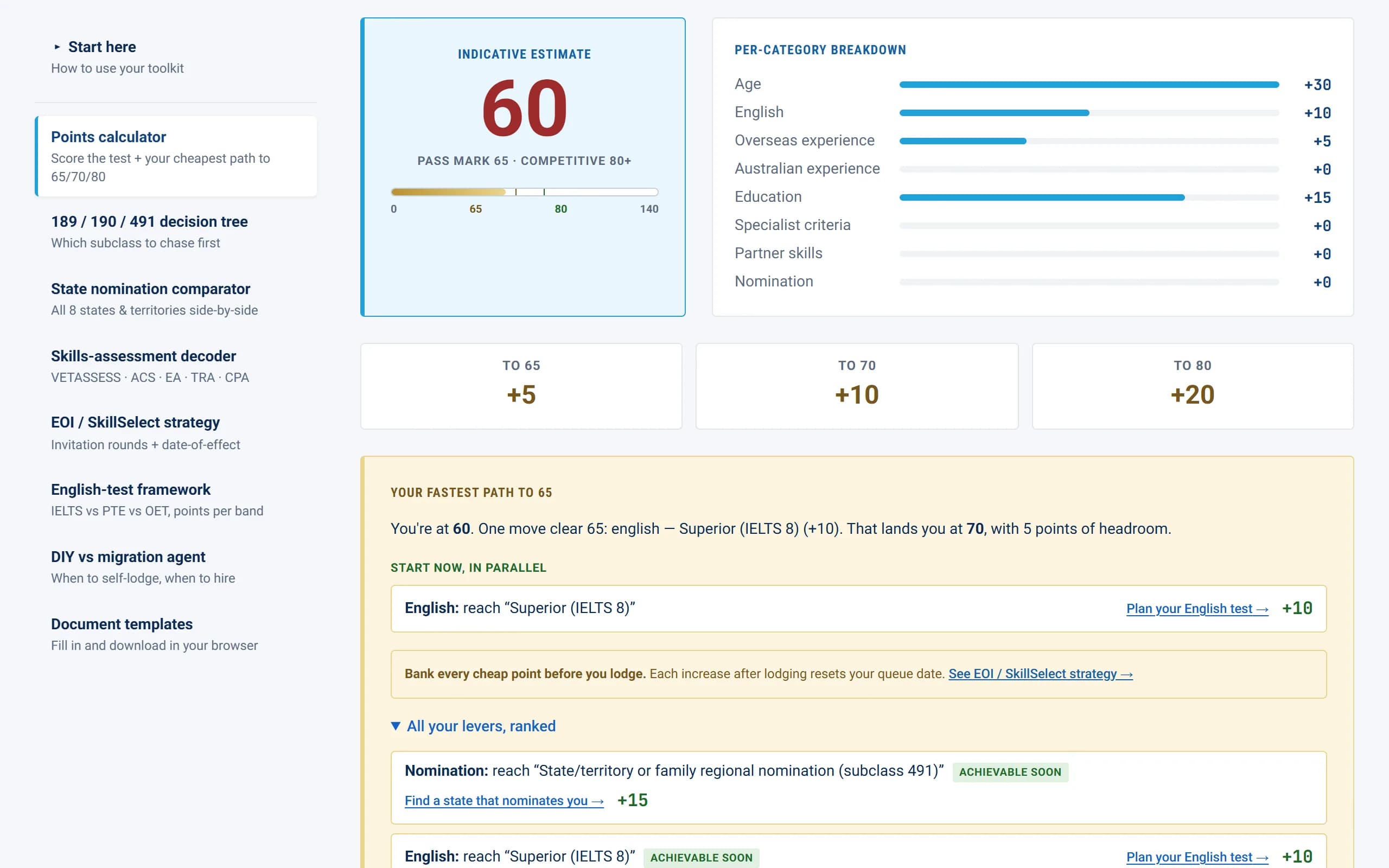
Aeroplane Pilot is on the CSOL and ROL but not on the MLTSSL in 2026. This closes both the points-tested subclass 189 (independent) and the subclass 190 (state nominated, non-regional). The regional and employer-sponsored pathways listed above are the available routes.
State Nomination — Where Pilots Get Invited
Northern Territory
Charter and tourism operators across the NT — Darwin, Alice Springs, Kakadu, the Tiwi Islands — run continuous demand for fixed-wing pilots on Cessna Caravans, King Airs, and similar aircraft. NT typically maintains an open approach to occupations supporting regional industry and is one of the more practical 491 nomination targets for pilots.
Western Australia
The mining services sector based out of Perth, Karratha, Broome, and Port Hedland creates strong demand for King Air, Citation, and turboprop pilots. WA's state nomination programme prioritises occupations supporting regional industry, and pilots based out of regional WA airports fit that profile.
Queensland
Cairns, Townsville, Mount Isa, and the Bowen Basin support significant general aviation, charter, and mining-services flying. Queensland's 491 programme considers pilots where regional employment is secured.
Tasmania
Tasmania offered the lowest 491 invitation threshold in Australia for the 2025-26 programme year at 40 base points, making it accessible for pilots who can secure eligible regional employment in the state. The aviation market in Tasmania is small but includes charter operators and general aviation businesses.
State priorities change each programme year. Always check the target state's currently-published list before lodging an EOI.
Salary and Employment Outlook
Typical Aeroplane Pilot Earnings 2026
| Role | Typical Salary Range |
|---|---|
| General Aviation / Charter (1st year) | AUD $65,000-$95,000 |
| Regional Turboprop First Officer | AUD $95,000-$135,000 |
| Mining Charter / Corporate (King Air, Citation) | AUD $130,000-$180,000 |
| Virgin Australia First Officer (base from mid-2025) | AUD $180,206 |
| Qantas First Officer | AUD $168,000-$300,000 |
| Virgin Australia Captain (base from mid-2025) | AUD $277,256 |
| Qantas Narrow-body Captain | AUD $320,000-$380,000 |
| Qantas Widebody Senior Captain (A380) | AUD $400,000-$520,000+ |
| Per diems and overnight allowances | +AUD $12,000-$24,000 |
SEEK's April 2026 data places the broad pilot average at AUD $95,000-$115,000, reflecting the mix of regional and entry-level roles in the dataset. Qantas and Virgin Australia EBA-published rates anchor the upper end of the market.
Highest-Paying Sectors
- Mainline carriers — Qantas, Virgin Australia widebody captain seats
- Corporate jet operations — high-net-worth operators flying Citations, Gulfstreams, Globals
- Mining and resources charter — Pilbara, Goldfields, Bowen Basin; King Air and Dash 8 fleets
- International freight — Qantas Freight, DHL contracted operators
- Government and emergency services — RFDS (Royal Flying Doctor Service), state aerial firefighting fleets
Total packages include superannuation (typically 11.5% but higher under some pilot EBAs), per diems, overnight allowances, and bonus structures that add 10-25% to base in some carriers.
Tips for a Successful Application
1. Confirm Pathway A or Pathway B Early
Pathway A (existing Australian licence) is faster and cheaper. Pathway B (overseas licence only) adds the conversion process — Australian theory exams, flight tests, and the IREX. If you can convert your licence to a CASA CPL or ATPL before applying for migration, the skills assessment is straightforward and predictable. Many overseas pilots underestimate the time and cost of Pathway B conversion.
2. Log Your Hours With ANZSCO Categories in Mind
ANZSCO 231111 expects evidence of fixed-wing flying. If your logbook is mixed (rotary, single-engine, glider, ultralight), the assessor wants to see clear separation. Maintain logbook records that distinguish multi-engine instrument-rated commercial operations from other categories.
3. Aim for AELP Level 5 or Higher
Aviation English Language Proficiency Level 4 is the minimum, but Level 5 or 6 reduces revalidation frequency and improves your candidacy with major carriers. The test is administered by CASA-approved assessors.
4. Type Ratings Are Career Currency
Australian operators run specific fleets — Boeing 737, Airbus A320 family, A330, Dash 8, ATR 72, Saab 340. A type rating on any of these aircraft significantly accelerates job placement. Candidates without Australian type ratings are not disqualified, but they compete on hours and experience alone.
5. Position for Regional Pathways Strategically
The 491 and 494 visas are the strongest open routes for pilots in 2026. Regional carriers and charter operators sit in eligible postcodes. Build relationships with these employers — Rex (where operating), Skytrans, Sharp Airlines, Chartair, Network Aviation, Maroomba — before lodging an EOI.
Step-by-Step Migration Roadmap
- Confirm 231111 is the right code — fixed-wing commercial flying must dominate your hours
- Compile logbook and licence evidence — every hour, every type, every endorsement
- Take the AELP assessment — Level 4 minimum, Level 5+ preferred
- Lodge CASA Form 079 skills assessment — AUD $100 cost-recovery fee
- Begin licence conversion if Pathway B — Australian theory exams plus IREX
- Sit IELTS or PTE for visa English — competent or proficient depending on visa subclass
- Identify sponsoring employer or regional state target — major carrier, charter, mining-services
- Lodge EOI in SkillSelect (for 491) — or work with the employer on 482/494 nomination
- Apply for state nomination if pursuing 491
- Lodge visa application — 491, 494, 482, or 186 depending on pathway
- Complete CASA flight test and final licence issue — if you came in on Pathway B
- Transition to 186 TRT after 2 years — for permanent residency on the employer route
For broader detail, see the most in-demand occupations 2026 list, the CSOL hub page, and the skills assessment bodies list.
Frequently Asked Questions
Can I migrate to Australia as a pilot under the 189 points-tested visa?
No. ANZSCO 231111 is on the CSOL and ROL in 2026 but not on the MLTSSL. The subclass 189 (independent points-tested) and 190 (state nominated, non-regional) visas are therefore not open. The available pathways are the regional 491 and 494 visas, plus the employer-sponsored 482 and 186 visas.
What's the difference between CASA Pathway A and Pathway B?
Pathway A applies if you already hold an Australian CPL or ATPL issued by CASA — the skills assessment confirms your qualification status against the ANZSCO requirements. Pathway B applies if you hold only an overseas licence — CASA assesses your qualifications and confirms the conversion steps required, which typically include the Instrument Rating Examination (IREX) and Australian theory exams before commercial flying.
Will my foreign type rating count toward CASA recognition?
Type ratings on common Australian fleet aircraft (Boeing 737, Airbus A320/A330, Dash 8, ATR 72) are generally recognised by CASA for licence conversion purposes, though specific recurrency and check requirements apply. Type ratings on aircraft not operated in Australia (older Soviet airframes, narrow-market commuter types) are documented but may not deliver job-market value.
Is regional Australia a viable option for a commercial pilot?
For migration purposes it is one of the strongest options. The 491 and 494 visas require regional employment or nomination, and regional Australia is where pilot demand is most acute — mining-services charter in WA, tourism and freight in the NT, general aviation across regional QLD and SA. Cost of living in regional areas is also typically lower than capital cities, which improves take-home value at the entry-pilot pay band.
How long does the full migration take from CASA application to permanent residency?
Plan for 18-30 months from CASA Form 079 lodgement to 491 or 482 grant, depending on Pathway A or B and current visa processing times. Permanent residency follows: 491 holders apply for 191 after three years of compliant regional work; 482 holders typically transition to 186 TRT after two years. Total time to PR is typically 4-6 years on the regional pathway, 3-4 years on the employer-sponsored route.