Cinema or Theatre Manager Visa Pathway to Australia: Complete 2026 Guide
Updated: 16 August 2026
Australia classifies Cinema or Theatre Manager under ANZSCO 149912. VETASSESS conducts the skills assessment as a Group C occupation. The role sits on both the Core Skills Occupation List (CSOL) and the Regional Occupation List (ROL), unlocking employer-sponsored subclasses 482 and 186 plus the regional 491 and 494. Typical 2026 salaries run AUD $70,000 to $110,000. The ROL listing makes regional venues a real pathway.
Quick Facts: Cinema or Theatre Manager Migration Pathway
| Detail | Information |
|---|---|
| ANZSCO Code | 149912 (Cinema or Theatre Manager) |
| Skill Level | 2 (AQF Diploma or higher, or equivalent experience) |
| Skills Assessment | VETASSESS (Vocational Education and Training Assessment Services) |
| Occupation List | CSOL (Core Skills Occupation List) and ROL (Regional Occupation List) |
| Visa Options | 482 (Skills in Demand), 186 (Employer Nomination Scheme), 491, 494 (regional) |
| Demand Level | Moderate — niche, with the strongest openings in regional venues |
| Salary Range | AUD $70,000-$110,000 (SEEK venue manager data 2026) |
| Typical 189 Score | Not applicable — CSOL/ROL occupation, not on the 189 list |
| Key Challenge | Establishing managerial duties for a small entertainment-venue team |
What a Cinema or Theatre Manager Does in Australia
A Cinema or Theatre Manager runs an entertainment venue. The work covers programming and scheduling, ticketing and pricing, front-of-house and event operations, staff rostering and training, supplier and distributor relationships, budgets, and compliance with safety and licensing rules. A multiplex manager balances film scheduling against concession revenue and casual staffing. A performing-arts theatre manager juggles touring productions, hire arrangements and a mix of paid and volunteer staff.
Australia's cinema and live-performance sector spans national multiplex chains, independent art-house cinemas, council-owned performing arts centres and commercial theatres. The role is niche, but it exists across the country, including regional towns whose council theatre or local cinema is a genuine cultural anchor. That regional spread matters for migration, because Cinema or Theatre Manager is one of the few management codes on the Regional Occupation List, which opens regional visa pathways that most CSOL management roles cannot use. Demand is steadiest where a venue cannot fill a management post locally, which happens more often in regional centres than in the capital cities.
ANZSCO Code 149912 in Detail
ANZSCO 149912 covers a manager who organises and controls the operations of a cinema or theatre. The code sits at Skill Level 2, mapping to an AQF Diploma or above, an Associate Degree, or three years of relevant experience in place of the qualification.
Indicative tasks include developing business plans and budgets, setting policies and procedures, arranging promotions, setting ticket prices, maintaining financial records, supervising staff and meeting health and safety obligations. VETASSESS focuses on whether you run the venue as a business. A duty manager who supervises a single shift, or a projectionist, sits below this code. Read the descriptor through the ANZSCO code finder before lodging.
Skills Assessment with VETASSESS
VETASSESS assesses Cinema or Theatre Manager as a Group C occupation. Your qualification must be assessed as comparable to an AQF Diploma or higher in a highly relevant field. For this code the relevant fields are Arts Management and Business Management.
Assessing body: VETASSESS — vetassess.com.au
Qualification and employment pathways. VETASSESS sets four routes:
- A highly relevant Diploma or higher plus at least one year of post-qualification employment in the last five years.
- A non-relevant Diploma plus a Certificate IV or higher in a relevant field plus one year of employment.
- A non-relevant Diploma plus two years of post-qualification employment.
- Four years of relevant employment in total, including at least one year of highly relevant work in the last five years.
Each route counts only work of 20 hours or more per week at the appropriate skill level.
Assessment cost: AUD $1,096 for the full skills assessment (offshore applicant, ex-GST). Priority processing adds AUD $825.
Processing time: Standard processing was shortened in 2025; priority processing aims for around 10 business days after eligibility is confirmed.
Common rejection reasons: The most common failure is evidence that reads as front-of-house supervision rather than venue management. A second is a qualification outside the arts and business fields without enough compensating experience. VETASSESS expects an organisational chart showing your position, supervisor and reporting structure, or a statutory declaration if one is unavailable. The full list of authorities sits on the skills assessment bodies guide.
Visa Pathways for Cinema or Theatre Managers
Cinema or Theatre Manager is unusual among management codes because it sits on both the CSOL and the ROL. That gives it regional pathways alongside the standard employer-sponsored routes. There is still no subclass 189 for this code.
Subclass 482 — Skills in Demand Visa
An approved employer nominates you for a real role paying at least the Core Skills Income Threshold and the market rate, whichever is higher.
- Visa fee: from AUD $3,210 (Core Skills stream, primary applicant)
- Income threshold: Core Skills Income Threshold of AUD $76,515, rising to AUD $79,499 for nominations lodged on or after 1 July 2026
- Work experience: generally at least one year of relevant full-time experience in the role
- Quirk that matters: multiplex chains have sponsorship infrastructure, but venue salaries can sit close to the threshold, so confirm guaranteed pay before assessing
Subclass 494 — Skilled Employer Sponsored Regional Visa
Because the code is on the ROL, a regional employer can nominate you under the 494. This is a five-year provisional visa with a pathway to permanent residency through the subclass 191.
- Visa fee: from AUD $4,910 (primary applicant)
- Requirement: the role must be in designated regional Australia, and you need a positive skills assessment and at least three years of relevant experience
- Quirk that matters: regional council theatres and independent cinemas are exactly the venues that struggle to recruit managers locally, which makes the 494 a genuine option here
Subclass 491 — Skilled Work Regional Visa
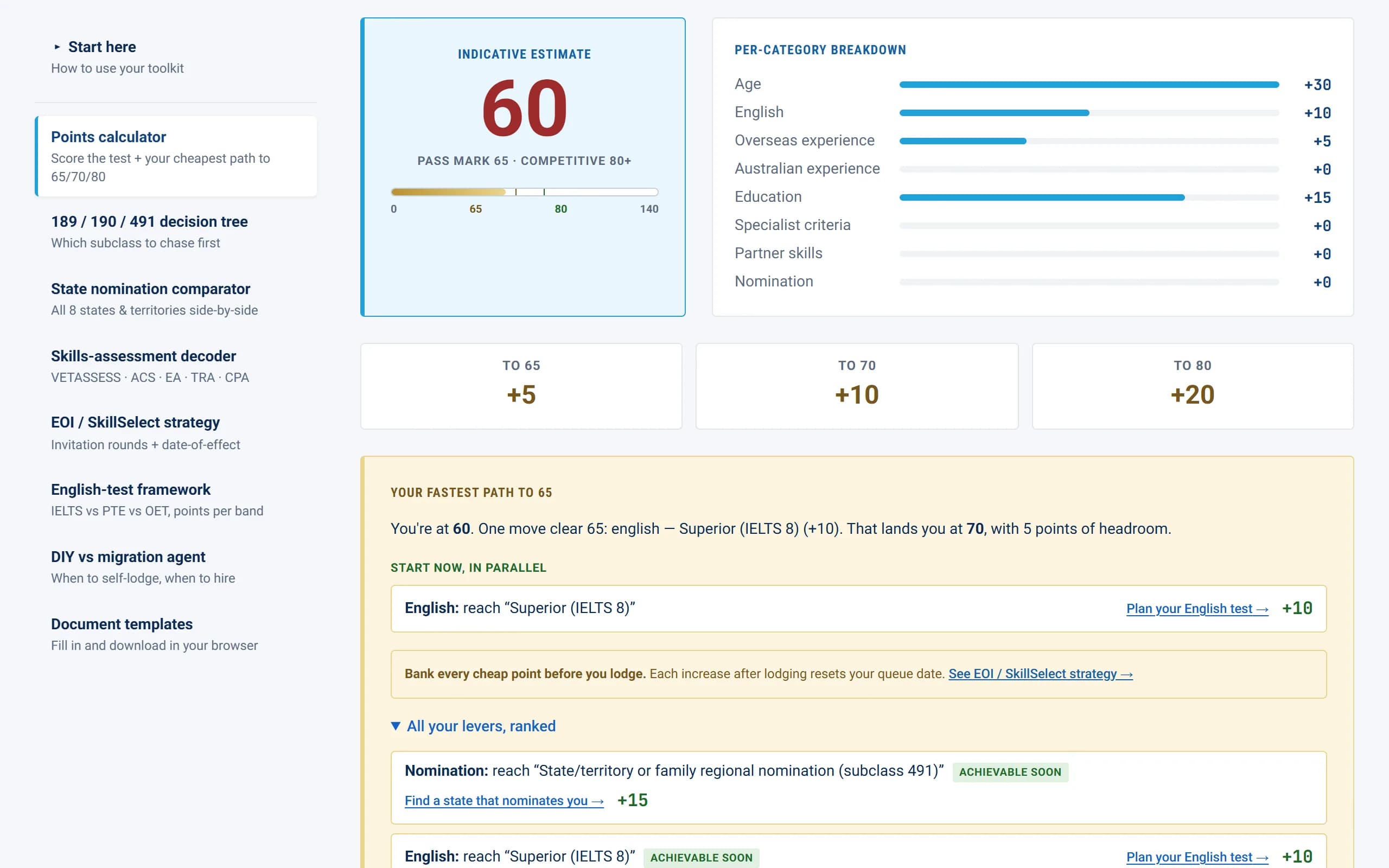
The ROL listing also opens the points-tested regional 491. State or family nomination adds 15 points, and the visa is provisional for five years with a pathway to permanent residency.
- Visa fee: from AUD $6,140 (primary applicant)
- Points boost: +15 from regional nomination
- Quirk that matters: this is the one route for this occupation that uses the points test; you lodge an Expression of Interest through SkillSelect and seek a regional state nomination. See how SkillSelect and the EOI work
Subclass 186 — Employer Nomination Scheme
The 186 grants permanent residency through an employer, usually via the Temporary Residence Transition stream after a 482.
- Visa fee: AUD $6,140 (primary applicant)
- Streams: Direct Entry, or Temporary Residence Transition after time on a 482
- Quirk that matters: Direct Entry generally expects at least three years of relevant experience
State Nomination
State and territory programs draw on the CSOL and, for regional visas, the ROL. Because Cinema or Theatre Manager is on the ROL, regional nomination for a 491 or 494 is a live possibility where a regional venue cannot recruit locally. The code is not on the routes that drive metropolitan 190 nominations. Allocations and occupation eligibility change each program year, so confirm the current position on the relevant state migration website before you build a plan around it. The regional angle is the distinctive feature of this occupation compared with other management codes.
Salary and Employment Outlook
| Role | Typical Salary Range (AUD) |
|---|---|
| Cinema or Venue Manager (single site) | $70,000-$90,000 |
| Performing Arts Centre Manager | $80,000-$105,000 |
| Multi-site or Area Manager | $95,000-$120,000 |
| General Manager (large venue) | $110,000-$140,000+ |
SEEK reported the average venue manager salary in the $85,000-$100,000 band in 2026, with single-site cinema and entertainment roles spanning roughly $70,000 to $110,000 depending on venue size and location. Total packages add superannuation at 11.5 per cent. The largest commercial venues and multiplex groups pay the most, while regional council-run centres pay less but are the venues most likely to sponsor. For broader context see the salary expectations by occupation guide.
Tips for a Successful Application
- Use the ROL advantage. This code is one of few management roles on the Regional Occupation List. If you are open to regional Australia, the 491 and 494 routes are available where most CSOL managers have only the 482.
- Show venue management, not shift supervision. References should cover programming, budgets, pricing and staffing across the venue, not running a single front-of-house shift. Align the language with ANZSCO 149912.
- Prepare the organisational chart. VETASSESS asks for it specifically. A chart showing your team and reporting lines settles the managerial question early.
- Confirm the salary clears the threshold for employer routes. Venue salaries can sit close to the Core Skills Income Threshold, so check guaranteed pay before lodging a 482 or 186 nomination.
- Target regional venues for sponsorship. Regional council theatres and independent cinemas have the recruitment difficulty that justifies a 494 or a regional 491 nomination.
Step-by-Step Migration Roadmap
- Confirm your duties match ANZSCO 149912 using the ANZSCO code finder.
- Check the list status — the code is on the CSOL and the ROL within the 2026 skilled occupation list.
- Decide between the employer-sponsored and regional routes.
- Gather qualifications and management-focused references.
- Prepare your organisational chart.
- Lodge the VETASSESS skills assessment under the right pathway.
- For a 491, lodge an Expression of Interest through SkillSelect and seek regional nomination.
- For employer routes, find a nominating venue and confirm the salary clears the threshold.
- Lodge your visa application with the positive assessment.
- Work in the role and, for provisional visas, meet the regional living and income requirements.
- Apply for permanent residency through the 186 or 191 once eligible.
- Complete health and character checks and receive the grant.
Frequently Asked Questions
Can a cinema or theatre manager move to regional Australia on a skilled visa?
Yes, and this is the standout feature of the code. Because Cinema or Theatre Manager is on the Regional Occupation List, the regional 491 and 494 visas are available. A regional employer can nominate you for a 494, or you can lodge a points-tested 491 with regional state or family nomination.
Why isn't this occupation eligible for a 189 visa?
The subclass 189 draws from a separate list that does not include 149912. This code sits on the Core Skills Occupation List and the Regional Occupation List, which feed the employer-sponsored 482 and 186 and the regional 491 and 494. There is no independent, non-sponsored permanent route.
What qualification does VETASSESS want for a cinema or theatre manager?
VETASSESS treats Arts Management and Business Management at AQF Diploma level or above as highly relevant. If your qualification falls outside these fields, the experience-based pathways let you qualify with additional years of relevant management work.
How does VETASSESS decide I am a manager and not a duty supervisor?
The assessor looks for venue-level management: business planning, budgets, pricing, programming, promotion and staff oversight. A duty manager who runs a single shift, or a technical role like projection, falls below the code. An organisational chart and management-focused references keep the case on ANZSCO 149912.
Is there much demand for cinema and theatre managers in Australia?
Demand is moderate and niche, but it exists across the country, including regional centres where a council theatre or local cinema struggles to recruit a manager locally. Those regional venues, combined with the code's place on the Regional Occupation List, create the clearest openings for migrants.