Helicopter Pilot Visa Pathway to Australia: Complete 2026 Guide
Updated: 16 August 2026
Australia classifies Helicopter Pilots under ANZSCO 231114. The Civil Aviation Safety Authority (CASA) conducts the migration skills assessment. The occupation sits on the CSOL as a Regional Occupation List (ROL) entry, unlocking subclasses 491, 494, 482 and 186. Typical 2026 salaries range AUD $85,000-$150,000, with mining, offshore and emergency-services pilots earning the upper band.
Quick Facts: Helicopter Pilot Migration Pathway
| Detail | Information |
|---|---|
| ANZSCO Code | 231114 (Helicopter Pilot) |
| Skill Level | 1 (Bachelor degree or equivalent CASA-recognised licence plus flight experience) |
| Skills Assessment | CASA (Civil Aviation Safety Authority) — Form 79 |
| Occupation List | CSOL / ROL only — regional and employer-sponsored pathways |
| Visa Options | 491, 494, 482, 186 |
| Demand Level | High — mining charter, EMS, offshore oil & gas, tourism |
| Salary Range | AUD $85,000-$150,000+ (SEEK, 2026; PayScale Australia, 2026) |
| Typical 491 Score | 70-85 points (including +15 regional nomination) |
| Key Challenge | CASA licence conversion requires travel to Australia for exams and flight test |
What a Helicopter Pilot Does in Australia
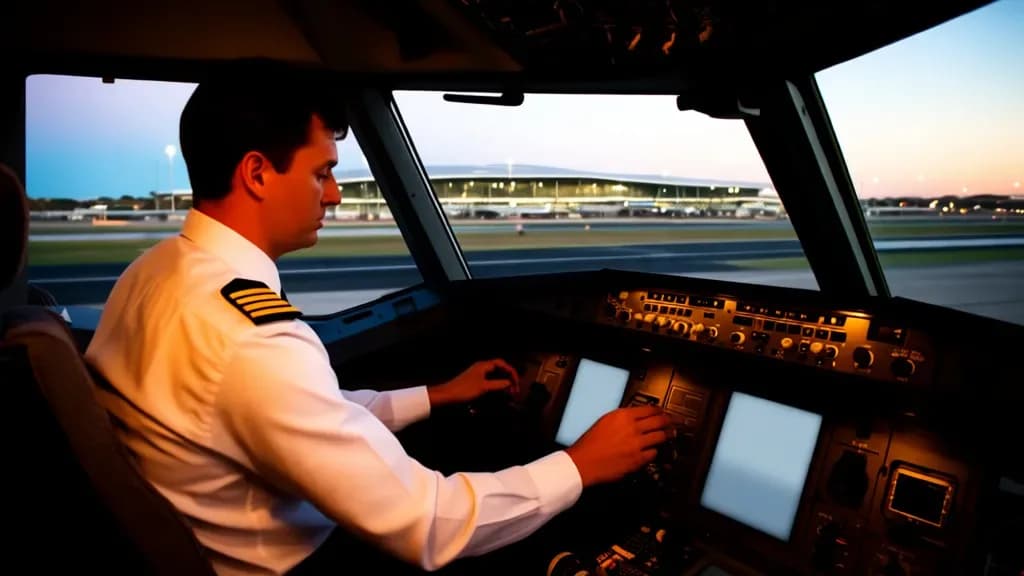
Australian helicopter operations cover a far wider range of work than most jurisdictions. Offshore oil and gas (Bass Strait, Carnarvon Basin, Browse Basin), mining charter (Pilbara, Goldfields, Bowen Basin), aerial firefighting, agricultural mustering, search and rescue, emergency medical services (RFDS, CareFlight, Westpac, LifeFlight), tourism (Great Barrier Reef, Tasmania, Kimberley), law enforcement, and military contract aviation all run on commercial helicopter capacity.
Operators include Babcock Mission Critical Services, CHC Helicopters Australia, PHI International, Bristow, Heliwest, Pay's Helicopters, Helicorp, Toll Helicopters, Sydney HeliMustering, Air Frontier and dozens of smaller regional charter and tourism operators. The Royal Flying Doctor Service and state-based aero-medical services together run the largest EMS rotor fleet in the country.
Geographically, the work is concentrated where the demand is — Perth and Karratha for offshore and mining, Brisbane and Cairns for tourism and EMS, Darwin and Broome for remote operations, Melbourne for EMS, Sydney for ENG and HEMS. The most lucrative roles cluster in offshore (Sikorsky S-92, AW189, EC225) and EMS (AW139, EC135, BK117, AW169) with type-rated captains earning the upper end of the salary band.
ANZSCO 231114 — How the Code Is Defined
ANZSCO 231114 covers pilots who fly helicopters to transport passengers, mail and freight, and to undertake aerial activities such as agricultural cultivation, photography, surveying, search and rescue and emergency medical retrieval. The closely related ANZSCO 231111 (Aeroplane Pilot) covers fixed-wing operations and is assessed separately. ANZSCO 231112 covers Flying Instructor; 231113 covers Air Transport Professionals (Air Traffic Controllers and similar). For migration purposes a working commercial helicopter pilot maps to 231114.
ANZSCO designates skill level 1, requiring a Bachelor degree or equivalent. In practice, CASA equivalency operates on the licence and flying-hour basis — a CASA Commercial Pilot Licence (Helicopter) or Air Transport Pilot Licence (Helicopter), or a recognised overseas equivalent, plus the prescribed flight hours.
Skills Assessment — CASA Form 79
The Civil Aviation Safety Authority is the sole assessing authority for both 231111 Aeroplane Pilot and 231114 Helicopter Pilot. The full list of Australian assessing bodies shows CASA's narrow remit against the wider professional and trades assessor landscape. The migration assessment is a single document (Form 79) that maps overseas qualifications and experience against Australian licence standards.
Core requirements (Pathway A — CASA licence holders):
- Already holding a CASA Commercial Pilot Licence (Helicopter) or Air Transport Pilot Licence (Helicopter). Pathway A applicants effectively just request a written confirmation from CASA for migration purposes.
Core requirements (Pathway B — overseas licence holders):
- Hold an overseas Commercial or ATPL helicopter licence in good standing.
- Demonstrate flight time meeting CASA's minimum experience thresholds.
- Convert the overseas licence to a CASA licence — this requires sitting CASA's regulatory examinations (CASR, human factors, meteorology, navigation, performance and loading, principles of flight), the Instrument Rating Exam (IREX) if required for instrument operations, an English proficiency test (Aviation English Level 6 ideal), and an in-aircraft flight test with a CASA-approved testing officer.
Cost: The CASA Form 79 skills assessment fee is AUD $100. This is just the migration assessment — the licence conversion process (examinations, flight tests, medical, English assessment) is a separate set of fees totalling several thousand AUD.
Processing time: Variable. Pathway A skills assessment letters are usually issued within a few weeks. Full Pathway B licence conversion, including travel to Australia for exams and flight test, typically takes three to nine months depending on examination scheduling and aircraft availability.
Common rejection reasons: Insufficient documented flight time on the licence category claimed; expired or suspended overseas licences; flight logs that don't reconcile against employer letters. CASA expects clean records and verifiable hours.
CASA Class 1 Medical
A CASA Class 1 Aviation Medical Certificate is mandatory before commercial flying. Many overseas pilots arrange this through a Designated Aviation Medical Examiner (DAME) at the same time as the flight test trip. Medical issues — vision, ECG findings, cardiovascular history — that pass scrutiny in some jurisdictions may need additional clearance under CASA's standards. Get the medical sorted before booking flight-test travel.
Visa Pathways for Helicopter Pilots
Because 231114 sits on the ROL (regional and employer-sponsored), no 189 or 190 pathway exists in 2026. Plan for 491, 494, 482 or 186.
Subclass 482 — Skills in Demand Visa
For most overseas helicopter pilots with a confirmed Australian operator job offer, the 482 is the fastest route. Offshore oil and gas operators, EMS providers and major mining-charter contractors all sponsor regularly.
- Visa fee: AUD $4,015 (primary applicant)
- Stream: Most line pilot roles sit in the Core Skills stream (salary threshold AUD $76,515 for 2025-26, rising to AUD $79,423 from 1 July 2026). Senior captains on offshore S-92/AW189 contracts often exceed the Specialist Skills threshold (AUD $146,576) and qualify for fast-tracked processing
- Processing time: Core Skills 90% finalised within roughly eight months in 2026; Specialist Skills 7-67 days
- Quirk: Babcock, CHC, Bristow and the major operators are approved sponsors with experienced migration teams. Smaller regional operators may not be sponsors — verify before negotiating
Subclass 494 — Skilled Employer Sponsored Regional Visa
Direct sponsorship into a regional location. Most Australian helicopter work qualifies geographically. Five-year provisional visa with a 191 pathway to permanent residency.
- Visa fee: AUD $4,910 (primary applicant)
- Eligibility: A nominating regional employer plus CASA assessment and Regional Certifying Body approval
- Quirk: Mining charter bases (Karratha, Port Hedland, Newman, Kalgoorlie), tourism operators (Cairns, Broome, Hobart) and remote EMS bases all sit comfortably in 494 geography
Subclass 491 — Skilled Work Regional Visa
Points-based regional nomination route. Five-year provisional visa with permanent residency via 191 after three qualifying regional years.
- Visa fee: AUD $6,140 (primary applicant)
- Points boost: +15 regional nomination
- Eligibility: State or territory regional nomination plus minimum 65 points
Subclass 186 — Employer Nomination Scheme
Permanent residency via employer sponsorship. Direct Entry or Temporary Residence Transition (after two years on a 482 with the same employer).
- Visa fee: AUD $6,140 (primary applicant)
- Quirk: Most offshore and EMS sponsors will commit to the 186 TRT pathway after the two-year qualifying period — the dominant permanent-residency route for line pilots
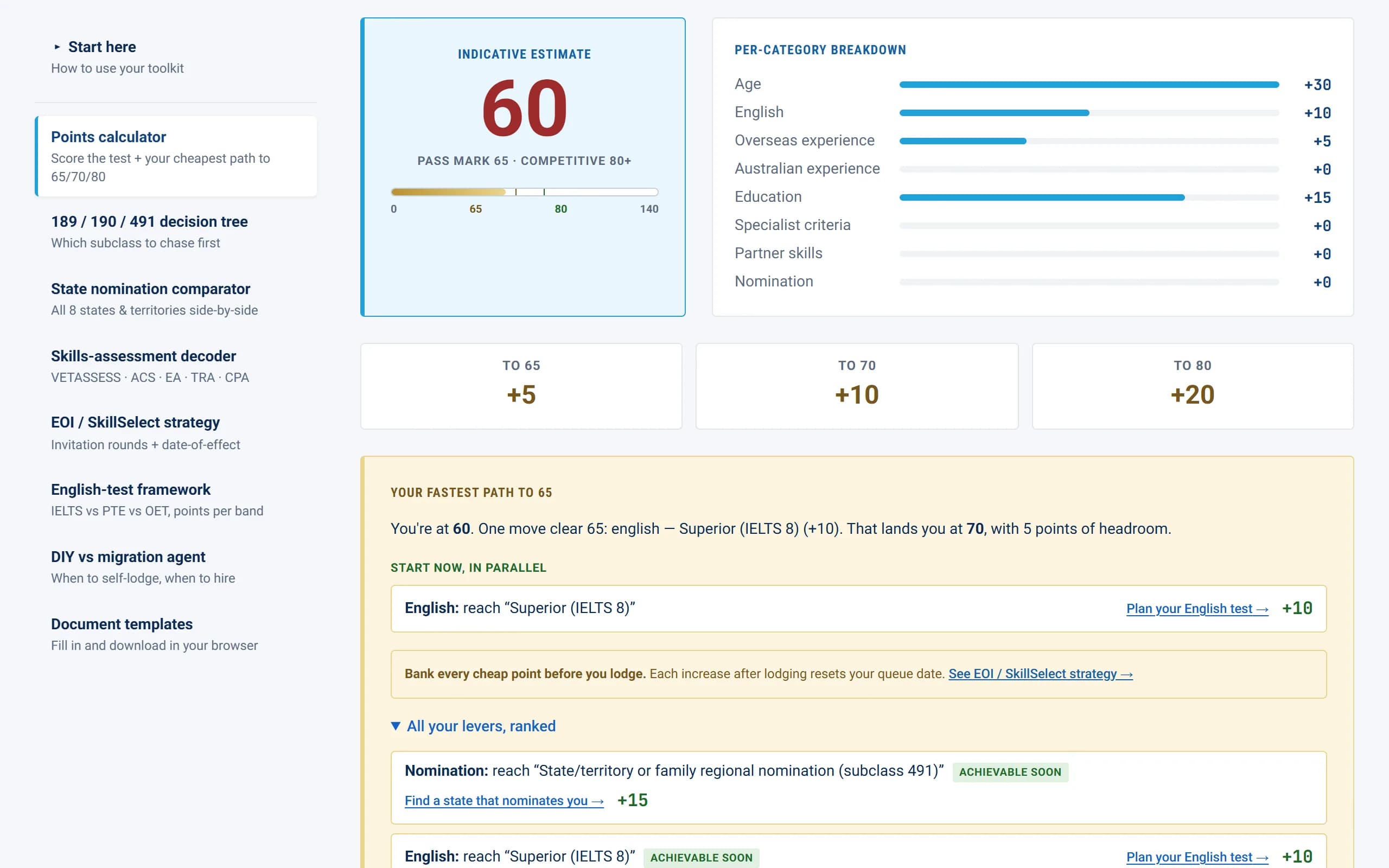
Points Test Strategy for 491
| Points Factor | Points | Notes |
|---|---|---|
| Age 25-32 | 30 | Maximum bracket |
| Age 33-39 | 25 | |
| Bachelor degree (where held) | 15 | Often held by ex-military pilots |
| Diploma / CASA CPL(H) | 10 | Standard credential path |
| English Proficient (IELTS 7.0) | 10 | |
| English Superior (IELTS 8.0+) | 20 | |
| Overseas experience 5-8 years | 10 | |
| Overseas experience 8+ years | 15 | |
| Regional nomination (491) | 15 | |
| Partner skills | 5-10 |
Realistic Scenarios
Scenario 1 — Ex-military Kiwi helicopter pilot, age 32, Bachelor of Aviation, CPL(H) and ATPL(H), 4,500 hours, IELTS 7.0, applying for 491 (Western Australia):
30 (age) + 15 (bachelor) + 10 (English proficient) + 15 (8+ years experience) + 15 (491) = 85 points. Highly competitive for offshore and mining charter.
Scenario 2 — UK-trained civilian helicopter pilot, age 36, CPL(H) plus EASA ATPL(H) frozen, 3,200 hours including 800 IFR, IELTS 7.5, applying for 491 (Northern Territory):
25 (age) + 10 (qualification) + 10 (English) + 15 (8+ years) + 15 (491) = 75 points. Competitive for NT and Queensland regional charter and EMS.
State Nomination for Helicopter Pilots
Western Australia
The single strongest state for helicopter pilot migration. Perth's offshore oil and gas operation (Carnarvon and Browse Basins), the Pilbara mining-charter network, the Kimberley tourism sector, and the WA Police Air Wing all generate continuous demand. WA's 2025-26 program reserved 1,000 places for the 491 stream. WASMOL includes pilot roles where regional employment is confirmed.
Queensland
Cairns, Townsville and the Whitsundays support tourism and EMS rotor operations. Queensland's coal industry (Bowen Basin) and the RACQ LifeFlight network add to the demand profile. The state's 491 program treats aviation roles as priority, with the strongest invitation rates for applicants with confirmed regional positions.
Northern Territory
Darwin and the remote NT (Katherine, Alice Springs, Gove) carry persistent helicopter pilot shortages tied to mining, tourism, agricultural mustering and RFDS operations. The NT runs lower competition and faster processing than the major states — often the most accessible 491 route.
Tasmania
Hobart and the west coast tourism operations (and the Hydro Tasmania support fleet) underpin Tasmanian helicopter demand. The state's 491 program favours candidates with documented in-state connections.
Victoria
Less rotor demand than the mining-state counterparts, but Victoria's air ambulance (LifeFlight, Victoria Police Air Wing) and Bass Strait offshore operations support continuing recruitment. Regional Victoria — Bendigo, Ballarat, Sale — covers nomination geography.
South Australia
SA's offshore (Gippsland Basin overlap), Olympic Dam mining support and Adelaide-based tourism create modest but ongoing helicopter pilot demand. SA's 491 program is reasonably accessible to offshore candidates with confirmed offers.
Salary and Employment Outlook
| Role | Typical Salary Range |
|---|---|
| Entry-Level CPL(H) — Tourism / GA | AUD $70,000-$95,000 |
| Charter Pilot (mid-experience) | AUD $95,000-$120,000 |
| Mining Charter Captain (Pilbara) | AUD $130,000-$165,000 |
| Offshore Captain (S-92, AW189) | AUD $180,000-$240,000+ |
| EMS / HEMS Pilot (AW139, BK117) | AUD $140,000-$185,000 |
| Senior Captain / Chief Pilot | AUD $170,000-$220,000+ |
Source: PayScale Australia (2026) average AUD $84,580 with base range AUD $49k-$148k; SEEK Career Advice (April 2026); industry reporting on offshore and EMS contract rates.
Total package commonly includes 11.5% superannuation, FIFO loadings, type endorsement bonuses, sign-on bonuses (especially offshore), per-diems, and in some EMS roles a defined-benefit pension equivalent. Offshore and EMS contracts often run a 2-on-2-off or 4-on-4-off roster with full pay across both periods.
Highest-Paying Operations
- Offshore oil and gas (Sikorsky S-92, Airbus H175/H225, AW189)
- HEMS captain — multi-engine type-rated (AW139, BK117)
- Senior firefighting captain (Erickson Air Crane / Coulson type)
- Search and rescue captain (CHC, Babcock)
- Mining FIFO captain (AS350, BK117, BO105)
Tips for a Successful Application
1. Plan a Two-Trip Conversion Strategy
CASA licence conversion typically requires travel to Australia for written examinations, the IREX (where needed), and a flight test with a CASA testing officer. Many pilots make two trips — first for exams and medical, second for the flight test once an instructor has been booked and aircraft scheduled. Build this into the timeline; it adds three to nine months to the visa-readiness date.
2. Document Hours Meticulously
Every type, every hour, every PIC/SIC split should be recorded against a verifiable source. Photocopies of logbook pages, employer letters confirming aircraft type and total hours, and licence-authority verifications all matter for the CASA assessment. Discrepancies between logbook and employer records cause delays.
3. Target Specialty Endorsements
Offshore type ratings (S-92, AW189, H175), EMS rated experience, NVG endorsements, longline external load, mountain flying, and over-water IFR all carry weight in Australian employer recruitment. A pilot offering specialty endorsement plus 1,500+ hours generally has stronger sponsorship leverage than a 5,000-hour generalist.
4. Sit IELTS for both English Bands
The points test favours IELTS 8.0 (Superior, +20 points). Aviation English Level 6 is the operational threshold. Most pilots can clear ICAO Level 6 with preparation; IELTS 8.0 is harder but worth pursuing because Superior English is the single biggest points lever for 491 candidates.
5. Build a 491-then-191 Plan from Day One
There is no 189 or 190 pathway for 231114. The cleanest permanent-residency route is 491 + three qualifying regional years + 191. Choose a state and regional area at the EOI stage and align everything (job search, family relocation, schooling) around that decision.
Step-by-Step Migration Roadmap
- Confirm 231114 is the correct code via the ANZSCO code finder — distinct from 231111 (Aeroplane Pilot).
- Verify ROL status on the 2026 Skilled Occupation List hub.
- Take ICAO Aviation English Level 6 (or equivalent) plus IELTS for visa points.
- Compile detailed logbooks, type endorsements and employer references.
- Lodge CASA Form 79 skills assessment ($100).
- Begin CASA licence conversion — sit regulatory examinations, IREX where needed, Class 1 medical, English assessment.
- Travel to Australia for flight test with a CASA-approved testing officer (often coordinated through an Australian flight school).
- Submit an EOI in SkillSelect for 491, or progress 482/494 employer sponsorship with an Australian operator.
- Apply for state or territory regional nomination, or finalise sponsor nomination.
- On invitation, lodge the visa within 60 days — $4,015 (482), $6,140 (491/186), or the current 494 charge.
- Arrive in Australia, finalise CASA licence issue, complete operator line training.
- After three qualifying regional years (491) or two years on 482, transition to 191 or 186 TRT for permanent residency.
Frequently Asked Questions
Does my FAA, EASA or CAA helicopter licence convert directly to a CASA licence?
No — there is no automatic conversion. CASA recognises overseas licences as evidence of experience and theoretical knowledge, but the migrating pilot must sit CASA's regulatory examinations, complete an Australian Class 1 medical, demonstrate Aviation English Level 4 minimum (Level 6 preferred), and pass a flight test with a CASA-approved testing officer. The Form 79 skills assessment is a separate document from the licence-conversion process.
Can I work as a helicopter pilot while my licence conversion is in progress?
Generally no — commercial flying requires a current CASA licence in the appropriate category. Some operators run a structured onboarding where a pilot arrives on a 482 visa under company sponsorship and completes the final flight test and licence issue within the first weeks of arrival, but this requires careful coordination between the employer, CASA and the migrating pilot. Don't plan to fly commercially in Australia until the CASA licence is in hand.
Which operators are the best sponsorship targets for offshore helicopter work?
Babcock Mission Critical Services, CHC Helicopters Australia, PHI International, and Bristow operate the major offshore contracts off WA's North-West Shelf and Bass Strait. All four are approved 482 sponsors with experienced migration teams. Sponsorship for type-rated S-92, AW189 and H175 captains is consistent year-round.
How much commercial flight time do I need to be competitive?
Entry-level CPL(H) tourism and charter work typically asks for 500-1,000 hours minimum. Mining charter and IFR roles start at 1,500-2,500 hours. Offshore captain positions usually require 3,000+ hours with type endorsement. EMS captain requires both hours and specific HEMS experience or NVG endorsement. The Australian market is competitive at the lower end — 500-hour pilots without local experience face limited options.
Will the lack of a 189/190 pathway hurt my long-term migration plan?
Not significantly. The 491 regional + 191 permanent residency path is the standard route and lands at the same outcome as 189/190 after three years. Regional Australia is where the work actually sits anyway — offshore bases, mining charter, EMS, tourism and remote operations all qualify as regional under the 491 framework. Many 491 holders complete the 191 transition without ever needing to relocate. See the most in-demand occupations hub for the broader 2026 picture, or compare with the Aircraft Maintenance Engineer (Structures) pathway if your aviation career sits engineering-side. Cross-check placement against the Core Skills Occupation List hub.