Construction Estimator Visa Pathway to Australia: Complete 2026 Guide
Updated: 16 August 2026
Australia classifies Construction Estimator under ANZSCO 312114. VETASSESS conducts the skills assessment as a Group C occupation. The code is on the Core Skills Occupation List (CSOL) and the Regional Occupation List (ROL), making subclasses 491, 494, 482 and 186 available. The 189 and 190 are closed for this code. Typical 2026 salaries range AUD $85,000-$135,000, with senior commercial estimators clearing $150,000+.
Quick Facts: Construction Estimator Migration Pathway
| Detail | Information |
|---|---|
| ANZSCO Code | 312114 (Construction Estimator) |
| Skill Level | 2 (AQF Diploma or higher) |
| Skills Assessment | VETASSESS (Group C) |
| Occupation List | CSOL + ROL (no MLTSSL, no STSOL — 189 and 190 unavailable) |
| Visa Options | 491, 494, 482, 186 |
| Demand Level | High — 78,900 people employed nationally; sustained tender activity across infrastructure and residential |
| Salary Range | AUD $85,000-$135,000 (SEEK, Talent.com, SalaryExpert 2026) |
| Typical 482 Salary | Mid-level estimators clear Core Skills threshold; senior estimators clear Specialist threshold |
| Key Challenge | No 190 pathway — regional 491 or employer sponsorship is the route |
What Construction Estimators Do in Australia
Construction Estimators prepare cost plans and tender estimates for construction projects from concept through tender settlement. The day-to-day work is detailed quantity take-offs, subcontractor and supplier price calls, schedule of rates analysis, risk pricing, and putting the final tender number behind a bid. Estimators sit at the commercial heart of every construction company — when the firm wins or loses a tender by 0.5%, the estimator's work is what made the difference.
Most Australian construction estimators specialise by sector. Commercial estimators tender for office, retail and institutional buildings. Civil estimators price roads, rail, water and energy infrastructure. Residential estimators work for volume builders or boutique custom-home companies. Subcontract estimators specialise within a trade — formwork, mechanical services, electrical, fit-out. The skill is portable across sectors but each has its own benchmarks, software and pricing logic.
Demand is high. Jobs and Skills Australia reports 78,900 people employed as Construction Estimators nationally, with sustained activity across the infrastructure pipeline (Inland Rail, Suburban Rail Loop, Western Sydney Airport, AUKUS-linked defence works), the National Housing Accord pipeline, and major commercial projects. Employers include the tier-one builders (Multiplex, Lendlease, John Holland, CPB, Built), tier-two and specialist contractors, large subcontractors, quantity-surveying consultancies, and major residential builders. Pricing software fluency — particularly CostX, Buildsoft, Cubit and Bluebeam — is now a baseline expectation.
ANZSCO 312114 — The Code in Detail
The ABS description: Construction Estimators prepare and deliver estimates and cost plans for construction projects up to the tender settlement stage.
Typical tasks:
- Reviewing drawings, specifications and tender documents
- Performing quantity take-offs by trade and work package
- Obtaining quotations from subcontractors and suppliers
- Preparing rate analysis, cost plans and tender summaries
- Risk-pricing variations, contingencies and inclusions
- Liaising with design teams to clarify scope
- Producing the final tender submission and supporting cost narrative
- Handover of awarded contracts to project teams
The adjacent codes worth understanding: 233213 Quantity Surveyor (university-trained, broader cost-management scope through the project lifecycle — on the MLTSSL with assessment by AIQS) and 312113 Building Inspector (compliance-focused). Construction Estimator is the most accessible code for migrants with vocational or applied-degree backgrounds in construction cost management.
Skills Assessment — VETASSESS
VETASSESS classifies Construction Estimator as a Group C occupation.
Assessment fees (current schedule from October 2025):
- Full skills assessment (offshore): AUD $1,096
- Full skills assessment (onshore, GST inclusive): AUD $1,205.60
- Priority Processing (additional): AUD $825 (offshore) / $907.50 (onshore)
Processing time: VETASSESS publishes 12-14 weeks standard processing. Priority Processing reduces this to approximately 10 business days. Add 4-6 weeks where overseas qualifications require verification.
Group C qualification + employment pathways:
- AQF Diploma equivalent in a highly relevant field + 1 year post-qualification highly relevant employment in the last 5 years
- AQF Diploma in a less relevant field + AQF Certificate IV in a highly relevant field + 1 year employment
- AQF Diploma in a less relevant field + 2 years post-qualification highly relevant employment in the last 5 years
- No relevant qualification + 4 years employment including 1 year in the last 5 years
Highly relevant qualification fields include Construction Estimating, Construction Management, Quantity Surveying, and Building. Civil Engineering with substantial cost-management content can qualify.
Common rejection reasons. First: applicants whose employment is genuinely as a quantity surveyor performing post-contract cost management — the role is closer to 233213 and VETASSESS will note the mismatch. Construction Estimator is specifically pre-contract, up to tender settlement. Second: applicants from project-management backgrounds whose actual estimating content is limited or supervisory rather than hands-on.
Visa Pathways for Construction Estimator
With 312114 on CSOL and ROL but not MLTSSL or STSOL, the available routes are 491, 494, 482 and 186.
Subclass 491 — Skilled Work Regional (Provisional)
The dominant skilled-migration pathway for this code. 5-year provisional visa with PR pathway through subclass 191 after meeting income and residence requirements. Adds 15 points to your EOI.
- Visa application fee: AUD $6,140 (primary applicant)
- Regional definition: Everywhere outside Sydney, Melbourne and Brisbane
- Best states for 312114: South Australia, Tasmania, Northern Territory, ACT (treated as regional for skilled migration), regional Queensland and regional WA
- Reality: Regional pipelines for housing, water, energy and roads underpin estimator demand across the country.
Subclass 482 — Skills in Demand Visa
Employer-sponsored temporary visa, up to 4 years.
- Visa application fee (primary): AUD $4,015
- Salary thresholds: Core Skills $79,423; Specialist Skills $146,576 from 1 July 2026 (previously $76,515 and $141,210).
- Reality for estimators: Mid-level estimators sit in the Core band ($85k-$120k). Senior commercial and infrastructure estimators clear Specialist threshold and benefit from fast processing.
- Labour Market Testing applies to Core Skills nominations.
Subclass 494 — Skilled Employer Sponsored Regional (Provisional)
Regional employer-sponsored provisional visa. The regional counterpart of the 482 with a PR pathway via subclass 191.
- Visa application fee: AUD $4,915
- Regional employer requirement: Sponsor must be based in regional Australia
- PR pathway: Through subclass 191 after meeting requirements
- Common use: Mid-tier construction firms in regional centres looking to bring in experienced estimators
Subclass 186 — Employer Nomination Scheme
Permanent residency through employer sponsorship.
- Visa application fee: AUD $6,140
- Streams: Direct Entry (3+ years experience + skills assessment) or Temporary Residence Transition (after time on a 482)
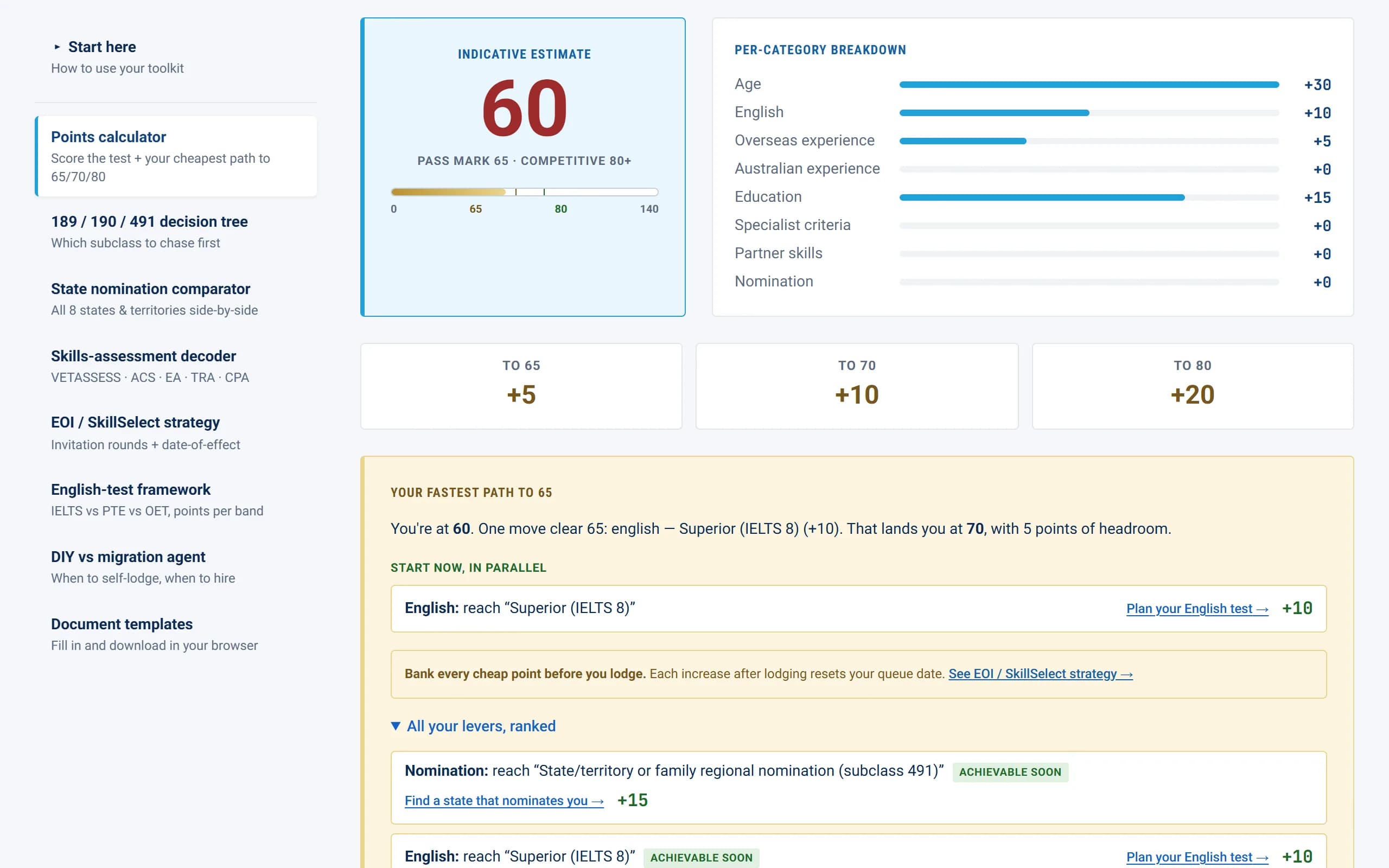
Points Test Strategy (for 491)
| Points Factor | Points | Notes |
|---|---|---|
| Age 25-32 | 30 | Maximum |
| Age 33-39 | 25 | |
| AQF Diploma | 10 | Minimum for the code |
| Bachelor degree | 15 | Common for estimators |
| Master's | 15 | |
| English Proficient (IELTS 7) | 10 | |
| English Superior (IELTS 8) | 20 | Major lever |
| Overseas experience 3-5 years | 5 | |
| 5-8 years | 10 | |
| 8+ years | 15 | |
| Australian study | 5 | |
| Regional nomination 491 | 15 | |
| Partner skills | 5-10 |
Realistic Scenarios
Scenario A — Indian estimator, 30, bachelor in civil engineering, 7 years experience, IELTS 7: 30 + 15 + 10 + 10 = 65. With 491 (+15) reaches 80, competitive for South Australia and Tasmania.
Scenario B — UK senior estimator, 35, BSc Construction Management, 10 years experience, IELTS 8: 25 + 15 + 20 + 15 = 75. With 491 (+15) reaches 90, comfortable across most regional state programs.
State Nomination (491 only)
312114 is not eligible for 190 in 2026. The 491 is the points-based route.
South Australia
SA's Skilled Migration Program includes construction estimating, particularly tied to defence-linked construction (AUKUS shipbuilding expansion at Osborne), the SA Hospital Network expansion, and residential pipelines. Adelaide is treated as regional for skilled migration purposes, which means the entire state qualifies for 491.
Tasmania
Tasmania's program lists construction estimating intermittently, with strongest activity when major housing pipelines are active. Hobart's construction sector is small but consistent; the program favours applicants with completed Tasmanian study or a Tasmanian job offer.
Northern Territory
The NT Government's skilled migration program covers construction estimating in some streams, often linked to the DAMA arrangements. Darwin's construction pipeline tied to defence and resources sustains demand.
Australian Capital Territory
The ACT runs a Critical Skills List. Construction estimating appears intermittently linked to commercial fit-out for federal tenants and the ACT's residential development program. Onshore candidates already working in Canberra have the strongest position.
Regional Queensland and Regional WA
Both states open 491 streams for construction-related occupations when regional pipelines justify it. Regional QLD (Townsville, Cairns, Toowoomba) tied to mining-services and tourism construction; regional WA (Bunbury, Geraldton, Kalgoorlie) tied to mining and energy.
Salary and Employment Outlook
| Role | Typical Range (AUD) |
|---|---|
| Junior Estimator (0-3 yrs) | $70,000-$90,000 |
| Estimator (3-7 yrs) | $90,000-$115,000 |
| Senior Estimator | $115,000-$140,000 |
| Senior Commercial / Infrastructure Estimator | $130,000-$160,000 |
| Tender Manager / Bid Lead | $140,000-$180,000 |
| Contract estimator (day rate) | $700-$1,200/day |
Sources: SEEK Career Advice (Feb-May 2026) — Estimator average $99,177 across construction; Building Estimator average $85k-$105k. PayScale 2026 data — average AUD $118,954 for senior estimators. Talent.com Australia — average $102,500. Cross-checked against current SEEK job-ad disclosures for 312114-aligned roles.
Sydney pays the highest median (Building Estimators averaging $106,250 per SEEK). Melbourne ($97,500) and Adelaide ($95,000) follow. Brisbane has converged with Sydney through 2025-26 on Olympic-linked tender volume. Regional centres pay 10-15% below capital-city medians but with materially lower living costs.
Superannuation is 11.5% on top of base. Tier-one builders typically pay 10-20% completion bonuses on major bids. Senior estimators with infrastructure or commercial specialisation routinely clear $150k base, and contract estimating into tier-one tender rooms can clear $200k+ in strong years.
Highest-paying domains: major infrastructure delivery (transport, water, energy), defence-linked construction (AUKUS, base upgrades), and tier-one commercial. Residential estimating is the steadiest but lower-paid segment.
Tips for a Successful Application
1. Hold the line on pre-contract scope
VETASSESS rejects applications where the employment reads as quantity surveying — post-contract cost management, variations administration, final-account work. Construction Estimator (312114) is strictly pre-contract: tender preparation, take-offs, bid pricing, handover at contract award. References must keep within that scope.
2. Software fluency is a sponsorship multiplier
CostX dominates the tier-one commercial market. Buildsoft and Cubit cover the tier-two segment. Bluebeam is standard for drawing markup. Excel-only estimators interview poorly. Investing in CostX certification before lodgement consistently lifts sponsorship outcomes.
3. Plan for 491 regional, not 190
312114 is not on the 190 list in 2026. The realistic skilled-migration route is 491 regional, with PR via 191 after meeting income and residence thresholds. Plan the state choice around real intent — Adelaide and Tasmania have the most consistent activity for this code.
4. Senior estimators should target Specialist Skills threshold
A senior commercial estimator on a tier-one project routinely commands $135k-$160k base. Pushing the offered salary past the Specialist Skills threshold ($146,576 from 1 July 2026, previously $141,210) opens the 482 Specialist stream — under 1 month processing and no Labour Market Testing.
5. Document your sectors and project sizes
VETASSESS and sponsoring employers both care about the sectors you've estimated in and the project value bands. Reference letters that name specific projects, contract values, and the bid outcomes you contributed to read materially better than generic role descriptions. Bid outcomes also help in interviews.
Step-by-Step Migration Roadmap
- Confirm your role is pre-contract estimating, not post-contract QS — see ANZSCO code finder
- Gather qualification documents (degree/diploma, transcripts, syllabus where available)
- Prepare employment references with named projects, contract values and your specific role
- Sit IELTS, PTE or OET — Superior English is the single biggest points lever
- Lodge VETASSESS Group C assessment (AUD $1,096 offshore; 12-14 weeks)
- Calculate points
- Choose route: 491 regional (points-based) or 482/494 (employer-sponsored)
- For 491, target SA, Tasmania, NT, ACT or regional QLD/WA based on intent
- For sponsorship, target tier-two builders, subcontractor specialists and regional firms
- Lodge EOI (491) or have employer lodge nomination (482/494)
- Receive invitation; lodge visa application within 60 days
- Complete medicals and police checks; receive grant
Internal references: skills assessment bodies complete list, CSOL hub, quantity surveyor pathway, construction project manager pathway, SOL 2026.
Frequently Asked Questions
What is the difference between Construction Estimator (312114) and Quantity Surveyor (233213)?
The boundary is pre- versus post-contract. Construction Estimators work up to tender settlement — preparing the bid that wins (or loses) the contract. Quantity Surveyors typically work through the project life: cost planning, contract administration, variations, claims and final accounts. Quantity Surveyor is on the MLTSSL and assessed by AIQS, with university-level qualification expectations. Construction Estimator is on the CSOL and ROL with vocational-level pathways. For migrants whose actual work is bid pricing, 312114 is the cleaner fit; for those doing lifecycle cost management with formal QS training, 233213 unlocks more visa options.
Can I move from 312114 to 233213 Quantity Surveyor after arriving?
Yes, but it requires AIQS-assessed qualification (typically a recognised bachelor's in Quantity Surveying or equivalent post-graduate qualification) and the experience to match. Many estimators in Australia transition into QS roles by completing AIQS-accredited courses while working — University of Newcastle, Deakin, Bond and Curtin all run distance-learning options.
Is regional Australia genuinely viable for an estimator on a 491?
Yes — and increasingly so. The infrastructure pipeline in regional Australia is substantial: Inland Rail, regional water and energy projects, defence base upgrades, regional housing pipelines, and mining-services construction. Adelaide (treated as regional for skilled migration), Hobart, Newcastle, Wollongong, Geelong and Townsville all have meaningful estimator demand. The 491-to-191 PR pathway is well-established.
Will my overseas project values translate to Australia?
VETASSESS does not weight by project value, but sponsoring employers do. Estimators with experience on $50m+ commercial or $100m+ infrastructure projects interview materially better for tier-one roles. If your overseas projects were smaller, target tier-two builders and residential specialists where the scale matches more directly.
Do I need to pass a CostX or Buildsoft test as part of the visa process?
No — software competence is not part of the VETASSESS assessment or the visa. But sponsoring employers commonly run a software test as part of interviews. Adding CostX or Buildsoft training before applying significantly improves your sponsorship conversion rate.
Is there genuine demand for offshore estimators, or do employers prefer onshore candidates?
Demand is genuine. The 78,900 people employed nationally underpin steady tender room headcount across the industry. Tier-two builders and regional firms sponsor offshore candidates regularly, particularly for senior estimators with proven sector experience. Tier-one majors lean toward onshore candidates with current Australian project experience, but make exceptions for senior infrastructure and commercial specialists.