Developer Programmer Visa Pathway to Australia: Complete 2026 Guide
Updated: 16 August 2026
Australia classifies the Developer Programmer occupation under ANZSCO 261312. The Australian Computer Society (ACS) conducts the skills assessment. The occupation sits on the Core Skills Occupation List (CSOL) and Medium and Long-term Strategic Skills List (MLTSSL), giving access to subclasses 189, 190, 491, 482 and 186. Typical 2026 salaries range AUD $90,000-$135,000 (SEEK).
Quick Facts: Developer Programmer Migration Pathway
| Detail | Information |
|---|---|
| ANZSCO Code | 261312 (Developer Programmer) |
| Skill Level | 1 (Bachelor degree or higher with ICT major) |
| Skills Assessment | ACS (Australian Computer Society) |
| Occupation List | CSOL + MLTSSL — full skilled stream access |
| Visa Options | 189, 190, 491, 482, 186 |
| Demand Level | High — government targets 1.2 million tech workers by 2030 |
| Salary Range | AUD $90,000-$135,000 (SEEK, May 2026) |
| Typical 189 Score | 90+ points competitive in current rounds |
| Key Challenge | High applicant volume — invitation thresholds remain elevated |
What a Developer Programmer Does in Australia
A Developer Programmer writes, tests, debugs and maintains code from existing specifications. The role is hands-on technical — most of the week is spent building features, reviewing pull requests, fixing defects, refactoring, and handling production incidents. Analysis and stakeholder work exist but are secondary; if you produce specifications more often than you implement them, you map better to Analyst Programmer or Systems Analyst.
Australian demand is concentrated across financial services (Commonwealth Bank, NAB, Westpac, ANZ, Macquarie), product technology companies (Atlassian, Canva, SafetyCulture, REA Group, Domain, Carsales, Seek), federal government (Services Australia, ATO, Defence, Home Affairs), consulting (Accenture, Deloitte, Capgemini, Infosys, TCS), and the in-house engineering teams of the major retailers and telcos. Sydney leads on volume, Melbourne is a close second, and Brisbane, Canberra, Adelaide and Perth round out the market.
The role is on the priority list because Australia's tech worker pipeline lags employer demand. The federal government's stated target is 1.2 million tech workers by 2030. Jobs and Skills Australia continues to flag Software and Applications Programmers (ANZSCO 2613) as a shortage occupation.
ANZSCO 261312 Mapping
The official ANZSCO description for 261312 covers professionals who write, test, debug and maintain the detailed instructions (programs) that computers must follow to perform their functions. Typical tasks include:
- Writing and maintaining program code to meet system requirements and design
- Testing, debugging, diagnosing and correcting errors
- Maintaining a record of the development and revisions of programs
- Writing and maintaining technical documentation
- Conducting code reviews and peer programming
If your duties include significant requirements analysis or specification writing, 261311 Analyst Programmer fits better. If you architect systems and lead engineering decisions across multiple teams, 261313 Software Engineer is the stronger code. If you specialise in front-end web work or full-stack web applications, 261212 Web Developer may apply. ACS reads the actual duty split, not the title — see the ANZSCO code finder.
Skills Assessment — ACS
ACS is the sole assessing authority. The assessment evaluates the qualification against AQF Bachelor with an ICT major, then the post-qualification work history against 261312 tasks.
Requirements:
- A degree (Bachelor or higher) with a major in computing — or non-ICT degree paired with ACS-recognised ICT experience
- Employment references on company letterhead describing duties matching 261312
- English evidence (not required by ACS but needed for the visa stage)
ACS experience deduction:
- 2 years if your ICT major is closely related to 261312
- 4 years if your ICT major is not closely related
- 6 years if your degree is non-ICT
- 8 years for the RPL pathway (no formal ICT qualification)
Assessment cost: AUD $1,498 (General Skills pathway). Post-Australian Study pathway $1,136. RPL pathway adds $625 to the general fee. Processing time: 12 weeks standard. Priority processing (10 business days target) only available to onshore applicants with a visa expiring within 12 weeks.
Common rejection reasons: References that describe analyst work without coding evidence (ACS may push the case to 261311); duties that look like junior internship work despite years on the CV; and the absence of a clear ICT major in the underlying degree, which forces a 6-year deduction or the RPL route.
For cross-body context see the skills assessment bodies complete list.
Visa Pathways for Developer Programmers
Subclass 482 — Skills in Demand
The dominant pathway for offshore Developer Programmers in 2026. Australian product companies, banks and consulting firms sponsor 261312 routinely.
- Visa fee: AUD $3,210 (Core Skills stream)
- Salary thresholds: CSIT AUD $76,515; SSIT AUD $141,210 (1 July 2025 — 30 June 2026)
- Processing time: Core Skills stream around 2 months for 75% of applications
- Reality: Most Sydney and Melbourne 261312 base salaries clear the CSIT comfortably. Senior roles clear the SSIT, which unlocks faster processing.
Subclass 190 — Skilled Nominated
Permanent residency with state nomination. Adds 5 points plus a two-year live-and-work commitment to the nominating state.
- Visa fee: AUD $6,140
- Processing time: ~6 months
- State play: NSW and Victoria both invite the 2613 unit group, which includes 261312.
Subclass 491 — Skilled Work Regional
Five-year provisional visa, adds 15 points. Pathway to 191 PR after three years.
- Visa fee: AUD $6,140
- Processing time: ~11 months
- State play: South Australia, Tasmania, regional NSW and regional Victoria all invite 2613.
Subclass 189 — Skilled Independent
Points-tested, no state link. Full permanent residency.
- Visa fee: AUD $6,135
- Processing time: 75% within 7 months once invited
- Reality: 189 invitations for ICT have been very limited in 2026. Plan for 95+ points to be in the conversation.
Subclass 186 — Employer Nomination Scheme
Permanent residency via Direct Entry or Temporary Residence Transition after 482.
- Visa fee: AUD $6,140
- Processing time: ~5 months
- Note: TRT is now the most common ICT PR conversion route given the slow 189 rounds.
For more detail on the temporary stream, see the subclass 482 hub.
Points Test Strategy
| Points Factor | Maximum | Notes |
|---|---|---|
| Age (25-32) | 30 | Peak band |
| Age (33-39) | 25 | Strong |
| English (Superior 8.0) | 20 | Most valuable single factor |
| English (Proficient 7.0) | 10 | Floor for competitive scores |
| Qualification (PhD) | 20 | Rare for 261312 |
| Qualification (Bachelor/Master) | 15 | Standard |
| Skilled experience overseas (post-deduction) | 5-15 | |
| Skilled experience Australia | 5-20 | |
| State nomination (190) | 5 | |
| Regional nomination (491) | 15 | |
| Partner skills | 5-10 | |
| Professional Year (PY) | 5 | ACS-recognised onshore program |
| NAATI CCL | 5 | Credentialled community language |
Scenario 1 — Offshore mid-level developer, 5 years experience
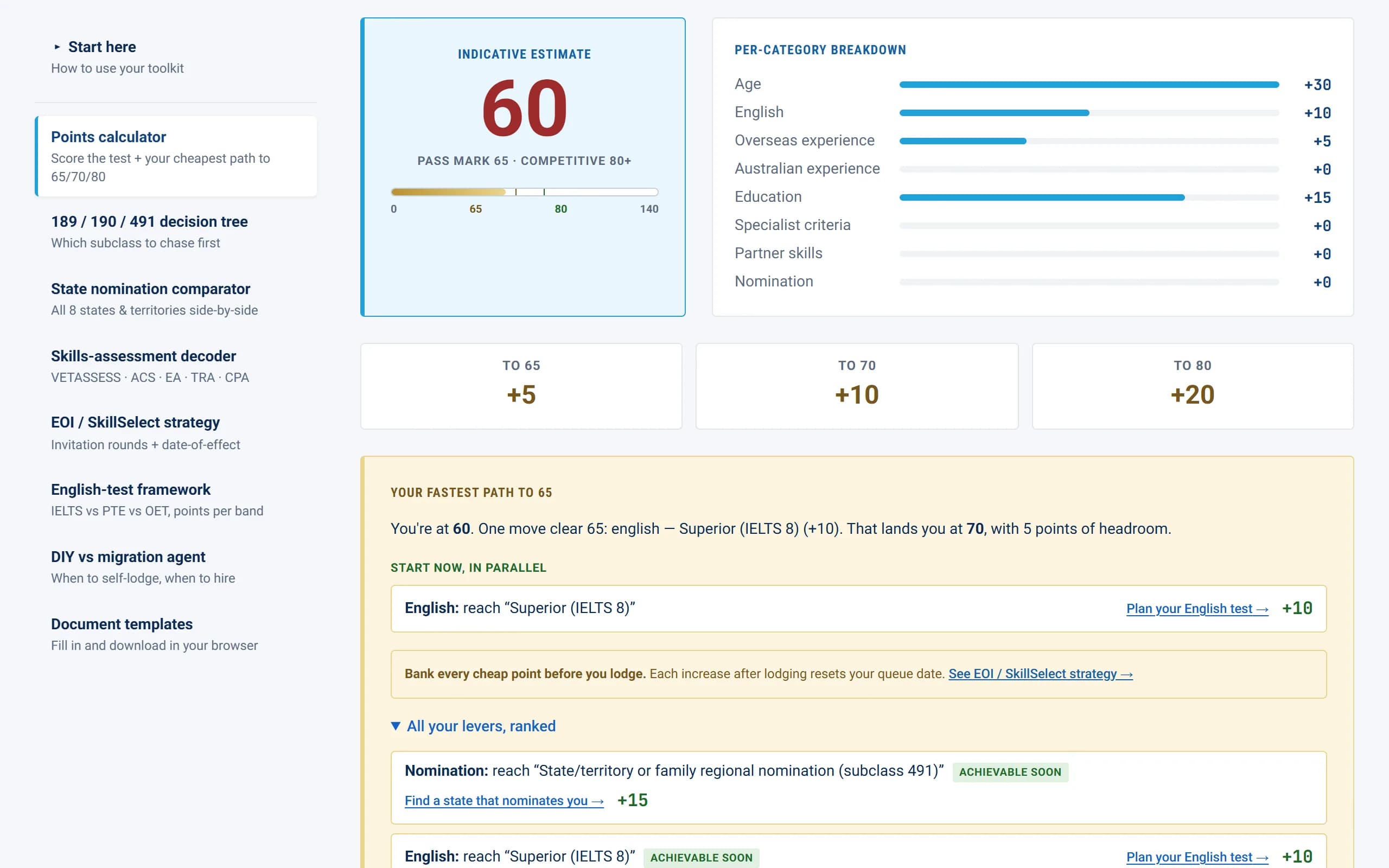
Age 29 (30) + Bachelor ICT (15) + Proficient English (10) + 3 years skilled after 2-year ACS deduction (5) = 60. Add 491 (15) = 75. Lift English to Superior = 85. Strong for regional invitation.
Scenario 2 — Onshore graduate, Australian Master's plus PY plus partner skills
Age 27 (30) + Master's (15) + Australian study (5) + Professional Year (5) + Superior English (20) + partner with positive skills assessment (10) + 2 years onshore work (5) = 90. With 190 = 95. Very competitive for NSW or Victoria invitation in 2026.
State Nomination for Developer Programmer
New South Wales
NSW allocates 3,600 nomination places across 190 and 491 in 2025-26. The 2613 Software and Applications Programmers unit group is eligible for both subclasses, which includes 261312. NSW selection criteria emphasise onshore applicants currently employed in Sydney in the nominated occupation, Superior English, and a strong settlement plan.
Victoria
Victoria runs 3,400 places (2,700 × 190 and 700 × 491). The 2613 unit group is invited. Victoria uses a Registration of Interest model — submit an ROI via Live in Melbourne, and the state selects based on profile fit rather than raw points. Current Victorian employment, Superior English, and demonstrated commitment to staying in Victoria all matter.
South Australia
South Australia accepts 261312 under 491. Adelaide's defence, cybersecurity and resources tech sectors drive demand. Offshore applicants need to demonstrate genuine settlement intent.
Tasmania
Tasmania nominates 261312 for applicants with Tasmanian work history or a job offer. Smaller pool, lower competition, but the cost of living advantage attracts many ICT migrants.
Australian Capital Territory
The ACT runs a separate nomination matrix. 261312 is generally eligible, with extra weight for applicants in Canberra federal government contractor roles requiring security clearance.
Salary and Employment Outlook
| Role | Typical Salary Range (AUD) |
|---|---|
| Junior Developer Programmer | $75,000-$95,000 |
| Mid-level Developer Programmer | $95,000-$120,000 |
| Senior Developer Programmer | $120,000-$150,000 |
| Lead/Staff Developer | $145,000-$190,000 |
| Principal Engineer (large companies) | $200,000-$300,000 |
| Contract day rate | $700-$1,300/day |
Source: SEEK May 2026 data, cross-referenced with Talent.com and PayScale Australia. SEEK reports Developer roles averaging AUD $105,000-$125,000 nationally.
Superannuation adds 11.5%. Sydney and Canberra command 10-15% premiums over Brisbane, Adelaide and Perth. Tech product companies (Atlassian, Canva) and tier-one investment banks pay at the top of the range, often with stock or bonus components.
Highest-paying sectors:
- Product tech companies — Atlassian, Canva, SafetyCulture, REA Group, Domain, Carsales, Seek
- Investment banking and trading — Macquarie, JP Morgan, UBS, Optiver, IMC
- Big-four banks — Commonwealth Bank, NAB, Westpac, ANZ
- Consulting — Accenture, Deloitte, Capgemini, ThoughtWorks
- Federal government (with clearance) — Defence, ASD, Home Affairs
Tips for a Successful Application
-
Make the coding emphasis unmistakable in references. ACS reads 261312 as primarily a coding role. References should describe percentage of time coding, languages and frameworks used, modules owned, and quality metrics. References that describe project management, requirements gathering or stakeholder work weaken the 261312 application.
-
Pick the right ICT code before paying for ACS. 261311, 261312, 261313 and 261212 all share visa access. The only reason to pick one over another is honest duty match. ACS rejects mismatched applications and the AUD $1,498 fee is not refundable.
-
Use Superior English as the cheapest 10 points you will buy. Many strong Developer Programmer applicants stall at Proficient because they have not retaken the test. A PTE Academic score of 79+ across all bands earns 20 points. PTE Academic results return in 1-3 business days and can be retaken inexpensively.
-
If you are onshore, complete the ACS Professional Year. It adds 5 points, satisfies Australian study requirements, and the 12-week internship often converts to permanent employment with sponsorship. Plan the program timing carefully against your current visa expiry.
-
Lodge parallel EOIs for 189, 190 and 491. Each invitation round runs independently. There is no penalty for appearing in multiple lists, and the chance of an early invitation rises materially.
Step-by-Step Migration Roadmap
- Compare 261312 to 261311, 261313 and 261212 using the ANZSCO code finder
- Verify list status on the 2026 SOL and CSOL
- Gather employment references covering at least 2 years post-qualification, with strong coding evidence
- Sit IELTS, PTE, OET or TOEFL — target Superior bands
- Lodge ACS assessment (AUD $1,498) and wait 12 weeks
- Calculate points with ACS deduction applied
- Submit EOI in SkillSelect for 189, 190 and 491 in parallel
- Apply for state nomination with NSW, Victoria, South Australia and Tasmania as eligible
- If pursuing 482, secure an SBS-approved sponsor and qualifying job offer
- Receive invitation and lodge the visa within 60 days
- Complete health checks and police certificates
- Receive grant and relocate
Frequently Asked Questions
What's the difference between Developer Programmer (261312) and Software Engineer (261313)?
Both sit on the MLTSSL and CSOL with identical visa access. 261313 Software Engineer involves more system design, architecture, and engineering decision-making — typically senior roles. 261312 Developer Programmer focuses on hands-on coding from specifications. ACS reads the actual duties: if your work is mostly building features from designs others created, choose 261312; if you create the designs and own engineering decisions across systems, 261313 fits better. Pick the code that genuinely matches your CV.
Is Developer Programmer on the MLTSSL in 2026?
Yes. ANZSCO 261312 features on both the CSOL (which controls 482 and 186 access) and the MLTSSL (which retains 189 and 190 access). It is also on the 491 regional list. Verify the current status via the skilled occupation list page.
Can I claim Developer Programmer experience from internships?
No. ACS only counts post-qualification employment at the relevant skill level. Pre-graduation internships, tutoring, or part-time roles during study do not count toward the post-qualification experience required for 261312. Map your CV dates carefully before lodging.
Will my coding bootcamp qualify me for ACS assessment?
Bootcamps alone do not satisfy the ACS qualification requirement. ACS evaluates qualifications against the Australian Qualifications Framework, which requires Bachelor-level depth. Bootcamp graduates with extensive industry experience can pursue the Recognition of Prior Learning (RPL) pathway, which costs an additional AUD $625 and requires written project reports plus 8 years of experience (RPL deducts more years).
How does Australia compare to Canada or the UK for Developer Programmer migration?
Australia's points-test conditions for ICT in 2026 are tighter than Canada's Express Entry CRS rounds for tech occupations, and Canadian provincial programs invite more aggressively for technology. The UK's Skilled Worker route has lower salary thresholds than Australia's SSIT but higher overall living costs in London. Australia's strength is total package compensation (salary plus 11.5% superannuation plus equity in tech firms) and a more compact tech-employer cluster in Sydney and Melbourne.
How long is the full pathway from ACS to PR for 261312?
For 190: ACS 3 months + EOI queue 1-3 months + state assessment 1-2 months + visa processing 6 months = 11-14 months. For 482 → 186 TRT: ACS 3 months + 482 grant 2 months + 2 years employment + 186 grant 5 months = around 3 years. 189 timelines depend on invitation rounds, which have been slow for ICT in 2026.