Multimedia Specialist Visa Pathway to Australia: Complete 2026 Guide
Updated: 16 August 2026
Australia classifies the Multimedia Specialist occupation under ANZSCO 261211. The Australian Computer Society (ACS) conducts the skills assessment. The occupation sits on the Core Skills Occupation List (CSOL) and Medium and Long-term Strategic Skills List (MLTSSL), giving access to subclasses 189, 190, 491, 482 and 186. Typical 2026 salaries range AUD $72,000-$110,000 according to SEEK and PayScale data.
Quick Facts: Multimedia Specialist Migration Pathway
| Detail | Information |
|---|---|
| ANZSCO Code | 261211 (Multimedia Specialist) |
| Skill Level | 1 (Bachelor degree or higher with relevant ICT/digital media major) |
| Skills Assessment | ACS (Australian Computer Society) |
| Occupation List | CSOL + MLTSSL |
| Visa Options | 189, 190, 491, 482, 186 |
| Demand Level | Moderate — strong in agency, gaming and broadcast clusters but smaller than core dev roles |
| Salary Range | AUD $72,000-$110,000 (SEEK + PayScale, 2026) |
| Typical 189 Score | 90+ points required; most 261211 migrants use 190 or 482 |
| Key Challenge | ACS reads 261211 narrowly — pure designers without ICT depth often fail |
What a Multimedia Specialist Does in Australia
A Multimedia Specialist produces and integrates digital content for interactive products — websites, mobile apps, games, broadcast graphics, training simulations, and AR/VR experiences. The work blends design, scripting, and technical content production. It is not a pure graphic design role, and ACS draws a firm line between aesthetic creatives and technically capable multimedia developers.
Demand clusters around Melbourne and Sydney's agency scenes, the gaming studios in Melbourne (Wargaming, Bohemia Interactive, plus the studios attached to the Victorian Government's Digital Games Tax Offset incentive), broadcast media (ABC, SBS, Nine, Seven), e-learning vendors, and the in-house digital teams at the major banks and retailers. Brisbane has a growing presence around Queensland's Digital Games Investment Attraction Fund. Western Australia and South Australia have smaller pools.
The role is on the priority list because Australian studios continue to recruit internationally, particularly for senior interactive developers, motion graphics technical artists, and Unity/Unreal generalists with both creative and code skills.
ANZSCO 261211 Mapping
The official ANZSCO description for 261211 covers professionals who design, develop and integrate multimedia content using a range of computer applications, programming languages, multimedia technologies and authoring tools. Typical tasks include:
- Designing and integrating animation, audio, video and graphic image files
- Writing and editing scripts that bind interactive elements
- Communicating with clients on production schedules and budgets
- Designing the structure, navigation and interactive features of multimedia products
- Producing prototypes and testing them with end users
If your work is purely art-direction or print design, you map better to 232411 Graphic Designer (assessed by VETASSESS, not ACS). If you primarily write web application code, 261313 Software Engineer or 261212 Web Developer fits. If you build games and write significant gameplay code, ACS will usually accept either 261211 or 261313 depending on how your duties are framed in references — see the ANZSCO code finder for side-by-side comparison.
Skills Assessment — ACS
ACS is the sole assessing authority. The assessment evaluates both the qualification (against AQF Bachelor level with an ICT or relevant multimedia major) and the post-qualification work history.
Requirements:
- A degree (Bachelor or higher) with an ICT or relevant multimedia/digital media major — or a non-ICT qualification supported by demonstrable ICT experience
- Employment references on company letterhead, describing duties that match 261211 tasks
- Vendor certifications or portfolio evidence helps support the technical depth claim
ACS experience deduction:
- 2 years if your qualification is closely related to 261211
- 4 years if you have an ICT major but it's not closely related
- 6 years if you have a non-ICT qualification
- 8 years for the RPL pathway (no formal ICT qualification)
Assessment cost: AUD $1,498 (General Skills pathway). RPL pathway $625 application plus the general fee. Processing time: 12 weeks standard. Priority processing (10 business days target) available only for onshore applicants with a visa expiring within 12 weeks.
Common rejection reasons: Portfolios that emphasise visual design over technical implementation; references that describe the applicant as a "graphic designer" or "video editor" rather than a multimedia developer; absence of scripting, authoring or integration evidence.
For a full assessing-body comparison, see skills assessment bodies complete list.
Visa Pathways for Multimedia Specialists
Subclass 482 — Skills in Demand
The dominant pathway for 261211 in 2026. Australian agencies, gaming studios and broadcasters routinely sponsor international hires.
- Visa fee: AUD $4,015 (Core Skills stream)
- Salary thresholds: CSIT AUD $79,423; SSIT AUD $146,576 (from 1 July 2026)
- Processing time: Core Skills stream around 2 months for 75% of applications
- Reality: Most 261211 roles fall in the Core stream because base salaries cluster below the Specialist threshold
Subclass 190 — Skilled Nominated
Permanent residency with state nomination. Adds 5 points.
- Visa fee: AUD $6,140
- Processing time: ~6 months
- State play: Victoria's Digital Games Tax Offset and broadcast cluster make it the most viable nominator for 261211, though invitations are smaller than for 2611/2613 codes.
Subclass 491 — Skilled Work Regional
Five-year provisional visa, adds 15 points. Pathway to 191 PR.
- Visa fee: AUD $6,140
- Processing time: ~11 months
- State play: Tasmania and South Australia run more flexible regional ICT programs that have historically included 261211.
Subclass 189 — Skilled Independent
Points-tested, no state link.
- Visa fee: AUD $6,135
- Processing time: 75% within 7 months once invited
- Reality: ICT 189 invitations have been scarce in 2026. Multimedia Specialist applicants almost always need 95+ points to feature.
Subclass 186 — Employer Nomination Scheme
Permanent residency via Direct Entry or Temporary Residence Transition (TRT) after 482 service.
- Visa fee: AUD $6,140
- Processing time: ~5 months
For more on the temporary stream, see the subclass 482 hub.
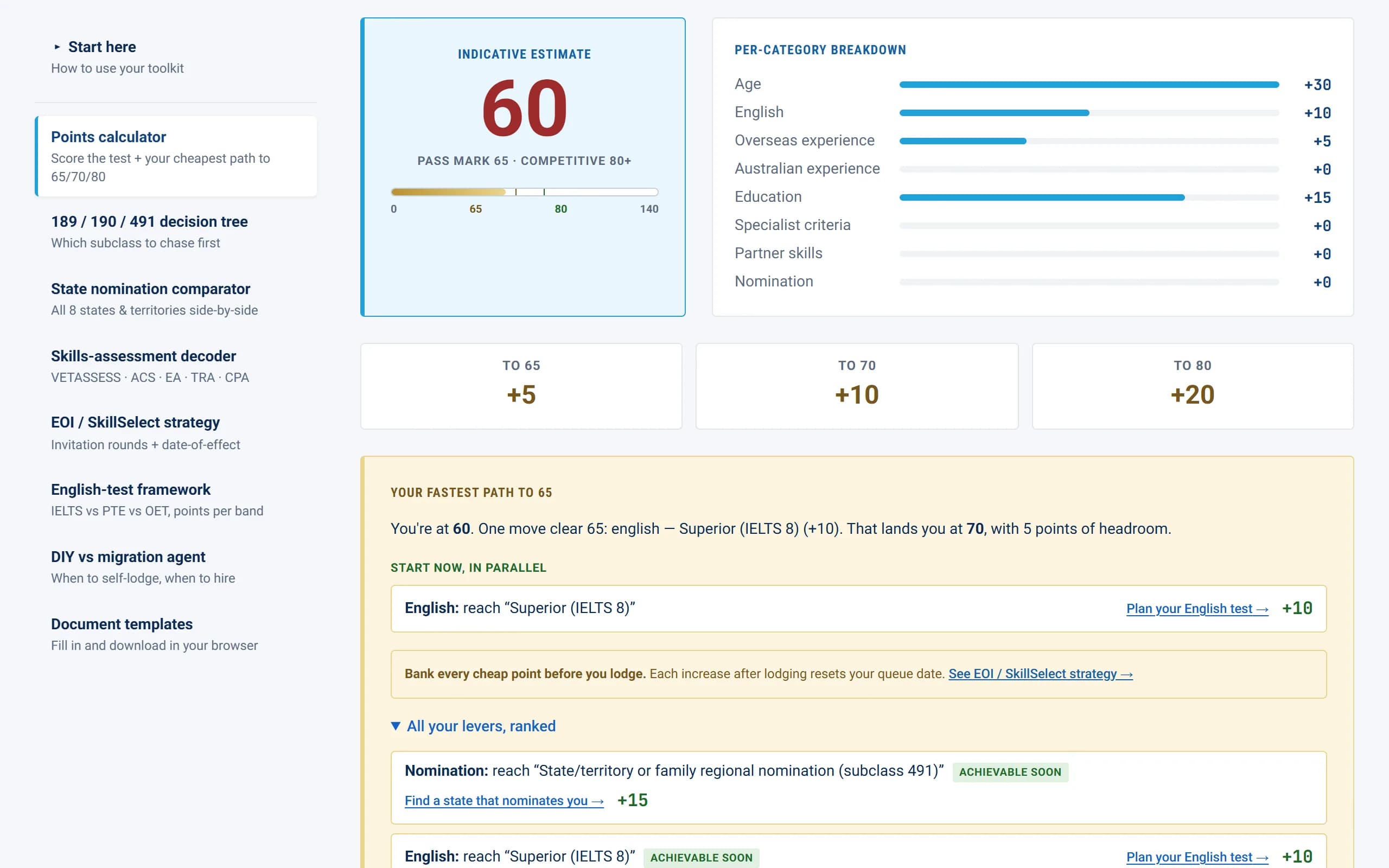
Points Test Strategy
| Points Factor | Maximum | Notes |
|---|---|---|
| Age (25-32) | 30 | Peak band |
| Age (33-39) | 25 | Strong |
| English (Superior 8.0) | 20 | Highest-value single factor |
| English (Proficient 7.0) | 10 | Floor for competitive scores |
| Qualification (PhD) | 20 | Uncommon |
| Qualification (Bachelor/Master) | 15 | Typical |
| Skilled experience overseas (post-deduction) | 5-15 | |
| Skilled experience Australia | 5-20 | |
| State nomination (190) | 5 | |
| Regional nomination (491) | 15 | |
| Partner skills | 5-10 | |
| Professional Year (PY) | 5 | ACS-recognised onshore program |
| NAATI CCL | 5 | Community language test |
Scenario 1 — Offshore agency producer, 6 years experience
Age 30 (30) + Bachelor ICT/digital media (15) + Proficient English (10) + 4 years skilled experience after 2-year ACS deduction (5) = 60. Add 491 (15) = 75. Realistic for South Australia or Tasmania regional invitation.
Scenario 2 — Onshore gaming developer with Australian Master's
Age 28 (30) + Master's (15) + Australian study (5) + Professional Year (5) + Superior English (20) + 2 years onshore work (5) = 80. With 190 = 85. Strong for Victoria invitation given the gaming cluster.
State Nomination for Multimedia Specialist
State nomination for 261211 is narrower than the broader 2611/2613 ICT pool. Verify your eligibility directly with the state's published list before lodging.
Victoria
Melbourne hosts Australia's largest gaming cluster and the Digital Games Tax Offset incentive draws international studios. Victoria's 2025-26 nomination program (3,400 places) prioritises onshore applicants with current Victorian employment. Live in Melbourne requires a Registration of Interest before formal nomination.
Tasmania
Tasmania's smaller program admits 261211 for applicants with either Tasmanian work history or a current job offer in the state. Hobart's screen industry, supported by Screen Tasmania, sponsors animation and post-production roles each year.
South Australia
Adelaide's broadcast and film cluster (anchored by the Adelaide Studios precinct and the South Australian Film Corporation) supports some 261211 nominations under 491. Offshore applicants need to demonstrate genuine settlement intent and a clear connection to the local market.
Salary and Employment Outlook
| Role | Typical Salary Range (AUD) |
|---|---|
| Junior Multimedia Specialist | $65,000-$80,000 |
| Multimedia Specialist (mid-level) | $80,000-$100,000 |
| Senior Multimedia Specialist | $95,000-$120,000 |
| Technical Artist (gaming) | $100,000-$140,000 |
| Motion Graphics Lead | $110,000-$145,000 |
| Contract day rate | $550-$900/day |
Source: SEEK May 2026 data, cross-referenced with PayScale Australia and Glassdoor Australia. Sydney salaries run 10-15% above the national average; regional locations sit 10-15% below.
Highest-paying sectors:
- Gaming and interactive entertainment — Melbourne, Brisbane, smaller Sydney studios
- Broadcast media — ABC, SBS, Nine, Seven, Foxtel
- Big-four-bank in-house digital teams — Commonwealth Bank, NAB, Westpac, ANZ
- Agency and consulting — Accenture Song, R/GA, Deloitte Digital, AKQA
- E-learning — Open Universities, university media teams, corporate L&D vendors
Superannuation adds 11.5% to base. Agency bonuses are smaller than financial-services bonuses, but equity is common in startups.
Tips for a Successful Application
-
Frame your work as multimedia development, not design. ACS rejects applications that read like graphic-design portfolios. References must describe scripting, integration, animation programming, authoring-tool use, and interactive feature design — not just "designed graphics" or "produced videos".
-
Include vendor and platform evidence. Adobe Certified Professional (Premiere Pro, After Effects), Unity Certified User, Unreal Engine Authorised Instructor and similar credentials carry weight with ACS. A portfolio link in the cover letter is useful but does not replace certificates.
-
Avoid the graphic designer overlap trap. If your duties shift more than 50% toward layout, illustration and brand work, you map to 232411 Graphic Designer (VETASSESS, longer assessment, narrower visa access). Be honest with yourself before lodging.
-
Plan around 482, not 189. The 261211 invitation pool for 189 in 2026 has been minimal. The fastest realistic path to Australia is securing a sponsoring studio or agency on 482 and transitioning to 186 after two years. Apply directly to Australian employers from offshore.
-
Consider Melbourne first. The Victorian Government's Digital Games Tax Offset has measurably grown studio hiring in Melbourne over the past three years. Job density for 261211 is materially higher than any other capital.
Step-by-Step Migration Roadmap
- Compare 261211 to 232411 and 261313 using the ANZSCO code finder
- Confirm list status on the 2026 SOL and CSOL
- Assemble employment references and a technical portfolio
- Complete English testing — Superior bands are the single most valuable points investment
- Lodge ACS assessment (AUD $1,498) and wait 12 weeks
- Calculate points with ACS deduction applied
- Submit EOI in SkillSelect for 189, 190 and 491 in parallel
- Apply for state nomination with Victoria, Tasmania and South Australia where eligible
- In parallel, apply directly to Australian studios and agencies for 482 sponsorship
- Receive invitation and lodge the visa within 60 days
- Complete health checks and police certificates
- Receive grant and relocate
Frequently Asked Questions
What's the difference between 261211 Multimedia Specialist and 261212 Web Developer?
261212 Web Developer focuses on building websites and web applications — front-end and back-end code, server configuration, deployment. 261211 Multimedia Specialist focuses on interactive multimedia products that combine animation, audio, video and scripting. If you work primarily in HTML/CSS/JavaScript and frameworks like React or Vue, 261212 fits. If you work in Unity, Unreal, After Effects, or build interactive installations and games, 261211 fits.
Can a self-taught multimedia developer pass the ACS assessment?
Yes, through the Recognition of Prior Learning (RPL) pathway. The RPL fee is AUD $625 on top of the general assessment. Applicants need 6 years of relevant experience for the RPL pathway plus a 2-year deduction (so 8 years total), or 4 years experience plus the standard deduction if they hold vendor certifications. RPL applications must include written project reports demonstrating ICT competency.
Is Multimedia Specialist still on the MLTSSL in 2026?
Yes. ANZSCO 261211 features on both the CSOL (controlling 482 and 186 access) and the MLTSSL (supporting 189 and 190 access). Always confirm current status on the official skilled occupation list page, since the lists are reviewed periodically.
Are gaming studios actively sponsoring on 482?
Yes. The major Melbourne studios and several Sydney and Brisbane studios sponsor international hires every year, particularly for technical artists, gameplay programmers, and senior multimedia developers. The Victorian Digital Games Tax Offset has accelerated this. Smaller studios sponsor less often because the SBS (sponsorship) compliance overhead is significant.
How does my points score compare to a Software Engineer applicant?
Multimedia Specialist invitations historically clear at slightly lower points than Software Engineer because the applicant pool is smaller, but the gap has narrowed since the 2026 CSOL reforms. Plan for 85+ for 190 and 95+ for 189 in mid-2026 conditions. If your points are below 80, the 482 route is faster.
Does Australia recognise a multimedia degree from India or the Philippines?
ACS assesses qualifications against the Australian Qualifications Framework. Bachelor degrees in Multimedia, Animation, Game Design, or Digital Media from accredited Indian and Filipino universities are usually mapped to AQF 7 (Bachelor level). The harder question is whether ACS will accept the major as "closely related" to 261211 — that determines whether your experience deduction is 2 years or 4 years.