Architect Visa Pathway to Australia: Complete 2026 Guide
Architecture is one of the more established pathways for skilled migration to Australia, and the profession is seeing renewed demand in 2026. If you're a qualified architect considering the move, the occupation sits on the MLTSSL with full visa access, Australia's design and construction sector is growing, and salaries are strong — particularly for experienced professionals. But the skills assessment process through AACA is unique and involves a portfolio review, so understanding the process upfront is essential. Here's everything you need to know.
Quick Facts: Architect Migration Pathway
| Detail | Information |
|---|---|
| ANZSCO Code | 232111 (Architect) |
| Skill Level | 1 (degree-level qualification) |
| Skills Assessment | AACA (Architects Accreditation Council of Australia) |
| Registration Required | Yes — state/territory architects board |
| Occupation List | MLTSSL — full visa access |
| Visa Options | 189, 190, 491, 482, 186, 494 |
| Typical Salary | AUD $80,000–$140,000+ |
| Demand Level | High — growing with infrastructure and housing pipeline |
Why Australia Needs Architects
Infrastructure and Housing Boom
Australia is in the middle of a significant construction cycle, driven by multiple factors:
- The federal government's $120+ billion infrastructure pipeline includes major road, rail, and public building projects
- Housing supply targets of 1.2 million new homes by 2029 require substantial architectural input
- Population growth — Australia is targeting 1.5% annual population growth — demands new residential, commercial, and community infrastructure
- Urban densification policies in Sydney, Melbourne, and Brisbane are creating demand for medium and high-density residential design
- Sustainability requirements are adding complexity to projects, requiring more skilled architects
Design Complexity Is Increasing
Modern Australian building codes, environmental regulations, and sustainability standards mean that architectural projects are more complex than ever. Practices need more architects — not fewer — to manage compliance, design innovation, and project delivery.
Skills Mix Is Changing
Australia's architecture sector is increasingly looking for architects with experience in:
- Sustainable and green building design (Green Star, Passivhaus)
- BIM (Building Information Modelling) proficiency
- Urban design and master planning
- Healthcare and education facility design
- Adaptive reuse and heritage conservation
If you've got experience in any of these areas, you're more competitive in the Australian market.
AACA Skills Assessment: The Portfolio Process
The Architects Accreditation Council of Australia conducts skills assessments for architects seeking migration. The AACA process is distinctive — it centres on a portfolio review rather than just document verification.
AACA Assessment Pathways
Pathway A: Qualification Assessment For architects with qualifications from programmes recognised by the Canberra Accord, AACA may grant recognition based on your degree alone. Recognised programmes include those accredited by RIBA (UK), NAAB (USA), and other Canberra Accord signatories.
Pathway B: Assessment of Qualifications and Experience (Most Common) For architects whose qualifications aren't automatically recognised, AACA conducts a detailed assessment of both your academic qualifications and professional experience through a portfolio submission.
Pathway C: National Examination If your qualifications don't meet the standard, AACA offers the Architectural Practice Examination (APE) as an alternative pathway.
The Portfolio Review
This is the core of the AACA assessment for most overseas architects, and it's more involved than a typical skills assessment.
What Your Portfolio Must Demonstrate:
- Design competency across different project types and scales
- Technical knowledge (construction, structure, environmental systems)
- Understanding of professional practice
- Evidence of your personal contribution to projects (not just team output)
- Progression of skill and responsibility throughout your career
Portfolio Requirements:
- A3 or A4 format, typically 20–40 pages
- Mix of design work, technical documentation, and project narratives
- Clear identification of your role and contribution on each project
- Before-and-after, concept-to-completion sequences where possible
- Construction photographs showing built work
Common Mistakes to Avoid:
- Submitting team projects without clearly identifying your contribution
- Including too many renders and not enough technical documentation
- Failing to show a range of project types and scales
- Poor organisation or presentation quality — AACA expects professional-standard presentation
Documentation Required
- Certified copies of your architecture degree(s)
- Full academic transcripts
- Professional registration or licence from your home country
- Portfolio of architectural work (detailed above)
- Employment references confirming your role and responsibilities
- CV/resume with chronological career history
- English language test results
- Passport and identity documents
Processing Time and Cost
- Processing Time: 8 to 16 weeks for a standard assessment
- Cost: Approximately AUD $1,500–$3,000 depending on pathway
- Additional: APE examination fees if required (AUD $2,000+)
- Check the AACA website for current fees and requirements
Appeal Process
If your assessment is unsuccessful, AACA provides feedback on areas that need strengthening. You can resubmit with additional evidence or pursue the examination pathway. Many applicants succeed on a second submission after addressing AACA's specific feedback.
State Registration: Required to Use the Title
In Australia, "architect" is a protected title. You cannot call yourself an architect or offer architectural services without registration with the relevant state or territory board. This applies even if you have a positive AACA assessment and a valid visa.
Registration by State
| State/Territory | Registration Body |
|---|---|
| NSW | NSW Architects Registration Board |
| Victoria | Architects Registration Board of Victoria |
| Queensland | Board of Architects of Queensland |
| South Australia | SA Architects Board |
| Western Australia | Architects Board of WA |
| Tasmania | Architects Board of Tasmania |
| Northern Territory | Architects Board of the NT |
| ACT | ACT Architects Board |
Registration Process:
- Obtain a positive AACA assessment
- Apply to the board in the state where you'll practise
- Provide documentation (AACA assessment, qualifications, insurance details)
- Some states require an interview or local knowledge examination
- Pay the annual registration fee (AUD $300–$800 depending on state)
- Processing: typically 2 to 8 weeks
Mutual Recognition: Once registered in one state, you can generally practise in other states under mutual recognition arrangements — though you should notify the relevant board.
Visa Options for Architects
The MLTSSL listing gives architects access to all major skilled visa categories. For a comprehensive comparison of occupation lists, see our MLTSSL vs STSOL vs ROL vs CSOL guide.
Subclass 189 — Skilled Independent
- Points-tested, no sponsor required
- Minimum 65 points, competitive invitations typically at 75–85
- Permanent residency on grant
- Application fee: AUD $6,135
- Architects typically need strong English and/or Australian study to reach competitive scores
Subclass 190 — State Nominated
- Adds 5 points through state nomination
- Permanent residency
- Application fee: AUD $6,140
- Available from states experiencing construction growth
- Two-year residency commitment in the nominating state
Subclass 491 — Skilled Work Regional (Provisional)
- 15 bonus points via nomination
- 5-year provisional visa, pathway to 191 permanent visa
- Application fee: AUD $6,140
- Regional cities with growing populations (Geelong, Gold Coast, Newcastle, Wollongong) have architectural firms actively hiring
Subclass 482 — Temporary Skill Shortage
- Employer-sponsored with a job offer
- Salary must meet TSMIT: AUD $76,515 for Core Skills stream
- Application fee: AUD $3,210
- Medium to large architecture practices regularly sponsor overseas architects
- Pathway to permanent residency via 186
Subclass 186 — Employer Nomination Scheme
- Permanent residency through employer nomination
- Application fee: AUD $6,140
- Direct entry or transition from 482
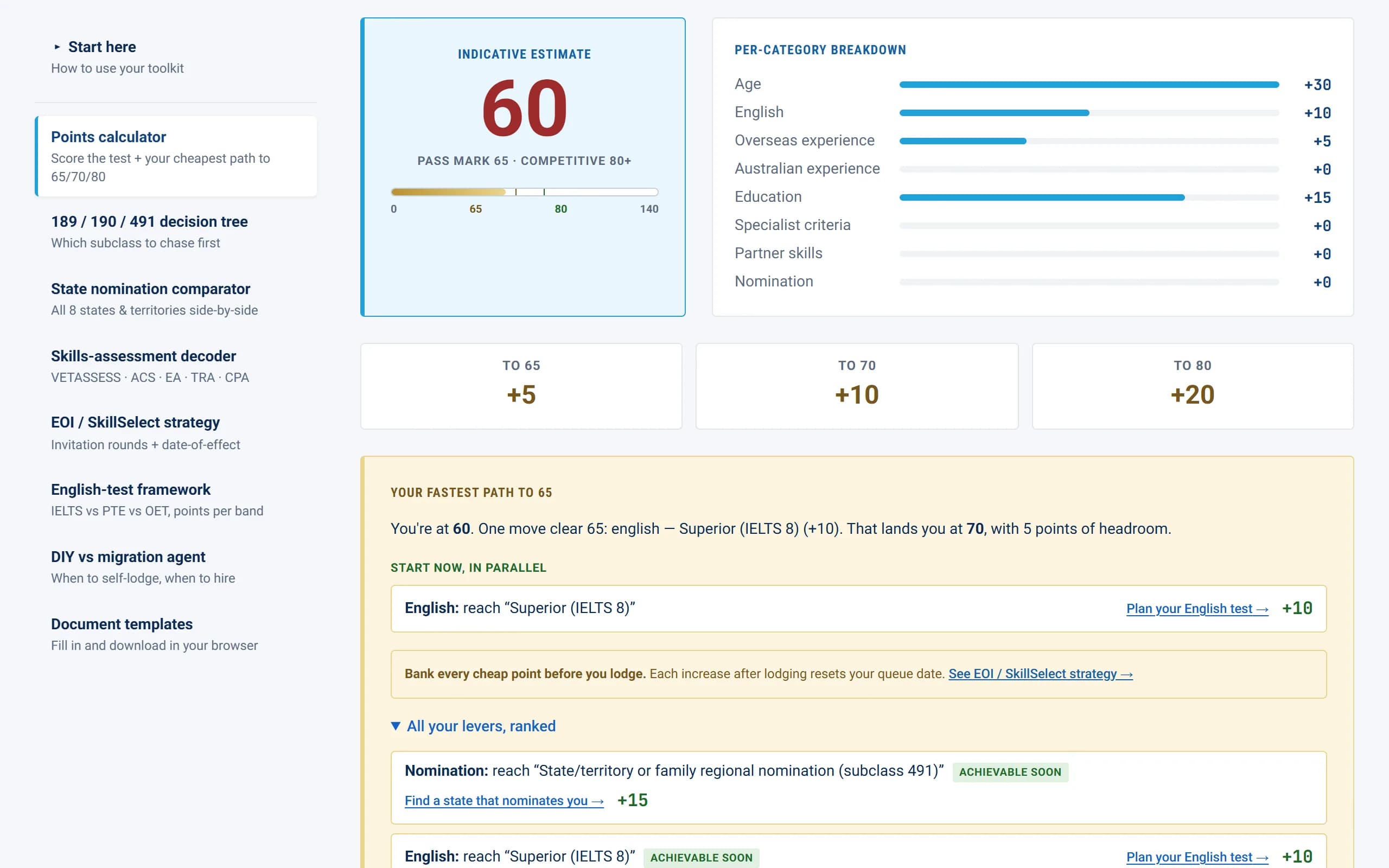
Points Calculation for Architects
How does a typical architect applicant score?
| Factor | Points | Notes |
|---|---|---|
| Age (25–32) | 30 | Maximum age points |
| English (IELTS 7.0 each) | 10 | Proficient English |
| Qualification (bachelor's degree) | 15 | Degree-level |
| Experience (5+ years overseas) | 10 | Overseas experience capped |
| State nomination (190) | 5 | If applicable |
| Total (with 190) | 70 | Competitive for 190 |
Architects benefit from Skill Level 1 classification, which means your degree earns 15 points (compared to 10 for trade qualifications). If you have a master's degree, you may claim the same 15 points. Australian study or a PhD can push this higher.
Salary and Working Conditions
What Architects Earn in Australia
| Experience Level | Annual Salary (AUD) |
|---|---|
| Graduate architect | $60,000–$72,000 |
| 3–5 years experience | $75,000–$95,000 |
| Senior architect / project architect | $95,000–$120,000 |
| Associate / studio director | $120,000–$140,000 |
| Principal / director | $140,000–$200,000+ |
Salaries vary significantly by city. Sydney and Melbourne generally pay 10–15% more than other capitals, reflecting higher project values and cost of living. Regional firms may pay slightly less in base salary but offer lower cost of living.
Employer Superannuation
On top of these figures, your employer pays 11.5% superannuation. For an architect earning $100,000, that's an additional $11,500 annually into your retirement fund. For a detailed breakdown of salary, tax, and super across occupations, see our salary expectations guide.
Industry Working Conditions
- Standard hours: 38–40 hours per week, though project deadlines can extend this
- Annual leave: 4 weeks paid (minimum)
- Most practices use BIM software (Revit, ArchiCAD) — proficiency is expected
- Hybrid/remote work has become more common since the pandemic, though site visits and studio collaboration remain important
- Professional indemnity insurance is required for registered architects
Metro vs Regional
| Factor | Metro (Sydney/Melbourne) | Regional |
|---|---|---|
| Salary | $80,000–$140,000+ | $70,000–$120,000 |
| Rent (2-bed apartment) | $600–$900/week | $300–$500/week |
| Commute | 30–60 minutes | 10–20 minutes |
| Project types | High-rise, commercial, institutional | Residential, community, mixed-use |
| Competition | Higher | Lower |
Specialisations in Demand
Certain architectural specialisations are particularly sought-after in the Australian market:
Sustainable Design
With Australia's commitment to net-zero targets and increasingly stringent building sustainability requirements (NCC 2025 energy provisions), architects with genuine sustainability expertise are highly valued. Green Star, WELL, and Passivhaus accreditations strengthen your profile.
Healthcare Architecture
Hospital and healthcare facility design is a growing sector as state governments invest in new and upgraded health infrastructure. Experience in healthcare architecture — understanding infection control, patient flow, and medical technology integration — is a significant differentiator.
Education Facilities
School and university building programs across multiple states are generating demand for architects with education facility experience. Understanding learning environment design principles is a plus.
Residential Medium-Density
As Australian cities densify, there's growing demand for architects who can design quality medium-density housing — the "missing middle" between detached houses and high-rise towers. If you've got experience in townhouse, terrace, or low-rise apartment design, that's directly relevant.
Step-by-Step Migration Timeline
| Step | Timeframe |
|---|---|
| English test preparation and sitting | 1–3 months |
| Portfolio preparation for AACA | 2–6 weeks |
| AACA assessment processing | 8–16 weeks |
| EOI submission and invitation wait | 1–6 months |
| Visa application and processing | 6–12 months |
| State board registration | 2–8 weeks |
| Total estimated | 10–22 months |
Tips for a Stronger Application
-
Invest time in your AACA portfolio. This isn't a formality — it's the most important element of your assessment. Spend weeks, not days, preparing it. Show range, technical depth, and clearly identify your personal contribution on team projects.
-
Get your ANZSCO code right. Architect (232111) is the standard code, but related roles like Landscape Architect (232112) or Interior Designer (232511) have different codes and different assessing authorities. Confirm yours using our ANZSCO code guide.
-
Push your English score higher. The jump from IELTS 7.0 to 8.0 gives you 10 extra points. For architects, where competition can be tighter, those points can make the difference between waiting and receiving an invitation.
-
Consider employer sponsorship. Many mid-to-large architecture practices in Australia sponsor overseas architects, especially for senior roles. Job boards like ArchitectureAU, Seek, and LinkedIn are good starting points.
-
Look beyond Sydney and Melbourne. Brisbane, Perth, Adelaide, and regional cities like the Gold Coast and Newcastle have active architecture markets with less competition for jobs. The 491 regional visa is an underused pathway for architects.
-
Review the most in-demand occupations list to understand where architects sit relative to other professions in the current migration landscape.
Frequently Asked Questions
Can I work as an architect in Australia before getting state registration?
No — you can't use the title "architect" or offer architectural services without state registration. However, you can work as a "design professional," "architectural graduate," or "building designer" without the protected title, though this limits your scope of practice and typically means a lower salary. Most migrant architects aim to complete registration as quickly as possible after arrival.
How long does the AACA portfolio review take?
Typically 8 to 16 weeks from submission to outcome. The timeline can extend if AACA requests additional information or clarification. Submit a complete, well-organised portfolio to avoid delays. If you're also sitting the APE examination, the overall process takes longer — factor in exam scheduling.
Is there mutual recognition with other countries?
Australia is a signatory to the Canberra Accord, which provides recognition pathways for architecture qualifications from other signatory countries (including the UK, USA, Canada, and others). If your degree is from a Canberra Accord-recognised programme, the AACA assessment is significantly simpler. Check the AACA website for the current list of recognised programmes.
What software skills do Australian practices expect?
Revit is the industry standard for BIM-based work in Australia, followed by ArchiCAD. Most practices also expect proficiency in Adobe Creative Suite (Photoshop, InDesign, Illustrator), SketchUp, Rhino/Grasshopper (for parametric design), and Enscape or Lumion for visualisation. AutoCAD is still used but is declining as the primary tool. If you're proficient in Revit, you'll be employable at most Australian firms.
What's the difference between an architect and a building designer in Australia?
An architect holds a five-year (or equivalent) degree, has completed professional experience requirements, passed a practice examination, and is registered with a state board. A building designer holds a diploma or advanced diploma and isn't subject to the same registration requirements. Architects can work on projects of any scale and complexity, while building designers typically focus on residential and small commercial work. As a migrant architect, your qualification and experience set you apart — but you need registration to prove it.