IT Professional Visa Pathway to Australia: Complete 2026 Guide
Information and Communications Technology professionals are among the most successful applicants in Australia's skilled migration program. With multiple ICT occupations on the MLTSSL, strong employer demand, and competitive salaries, the pathway for software engineers, developers, analysts, and other IT professionals is well-established. This guide covers everything from ACS skills assessment to visa selection and points optimisation.
Quick Facts: IT Migration Pathway
| Detail | Information |
|---|---|
| Key ANZSCO Codes | 261313 (Software Engineer), 261312 (Developer Programmer), 261111 (ICT Business Analyst), 263111 (Computer Network and Systems Engineer) |
| Skills Assessment | Australian Computer Society (ACS) |
| Main Visa Options | 189, 190, 491, 482, 186 |
| Occupation List | Most ICT roles on MLTSSL |
| ACS Processing | 6-8 weeks |
| Points Competition | 80-95+ for 189, lower for state-nominated |
ICT Occupations on Skilled Lists
Multiple IT occupations appear on the MLTSSL, giving full visa access:
| Occupation | ANZSCO | List |
|---|---|---|
| Software Engineer | 261313 | MLTSSL |
| Developer Programmer | 261312 | MLTSSL |
| Analyst Programmer | 261311 | MLTSSL |
| ICT Business Analyst | 261111 | MLTSSL |
| Systems Analyst | 261112 | MLTSSL |
| Computer Network and Systems Engineer | 263111 | MLTSSL |
| ICT Security Specialist | 262112 | MLTSSL |
| Database Administrator | 262111 | MLTSSL |
| ICT Project Manager | 135112 | MLTSSL |
| Multimedia Specialist | 261211 | MLTSSL |
| Web Developer | 261212 | STSOL |
Note that Web Developer is on the STSOL, not the MLTSSL, which limits it to state-nominated pathways and short-term employer sponsorship.
ACS Skills Assessment
The Australian Computer Society (ACS) is the designated assessing authority for all ICT occupations. Understanding the ACS process is critical.
Assessment Pathways
ACS offers several assessment pathways:
Skills Assessment (most common): For experienced professionals with ICT qualifications or substantial work experience.
Recognition of Prior Learning (RPL): For applicants without formal ICT qualifications but with extensive industry experience.
Post-Australian Study Skills Assessment: For applicants who completed Australian ICT qualifications.
ACS Requirements
With an ICT Major Qualification (Bachelor's or higher):
- ICT qualification closely related to your nominated occupation
- Minimum 2 years of relevant work experience in the last 10 years (after deducting "skill level met date")
With a Non-ICT Qualification:
- Bachelor's degree or higher in any field
- Minimum 4 years of ICT work experience in the last 10 years
Without a Degree (RPL):
- Minimum 6 years of relevant ICT work experience
- Additional documentation including project reports and references
The Skill Level Met Date
ACS calculates a "skill level met date" based on your qualifications and experience. Experience before this date doesn't count toward the points test. This is one of the most important and most misunderstood aspects of the ACS assessment.
For example: If you have an ICT bachelor's degree and ACS determines your skill level was met after 2 years of experience, only experience after that 2-year mark counts for points.
Documentation Required
- Academic transcripts and degree certificates
- Detailed employment references on company letterhead (must describe duties, dates, hours)
- CV/resume
- Statutory declaration if employer references aren't available
- NAATI-certified translations of non-English documents
ACS Fees and Processing
The assessment fee is approximately AUD $530 for a standard skills assessment. Processing takes 6 to 8 weeks for standard applications.
Visa Pathway Options
Subclass 189 (Skilled Independent)
The most competitive option. No nomination needed, but points requirements are high:
- Minimum 65 points, but realistically 80-95+ for ICT occupations
- Software Engineer and Developer Programmer are among the most competitive codes
- Round sizes and invitation frequency vary
Subclass 190 (State Nominated)
State nomination adds 5 points and may have lower effective thresholds:
- Victoria, NSW, and ACT prioritise ICT professionals
- State-specific requirements apply
- Typically competitive at 75-85 points
Subclass 491 (Skilled Work Regional)
15 bonus points for regional nomination:
- Available in most states' regional programs
- Perth, Adelaide, and Hobart offer city living with regional benefits
- Competitive at 70-80 points for many ICT roles
Subclass 482 (Employer Sponsored)
For IT professionals with Australian job offers:
- Medium-term stream (4 years) for MLTSSL occupations
- Pathway to permanent residency via subclass 186
- No points test — employer sponsorship based
- Must meet TSMIT salary threshold
Subclass 186 (Employer Nomination Scheme)
Direct permanent residency through employer sponsorship or transition from 482.
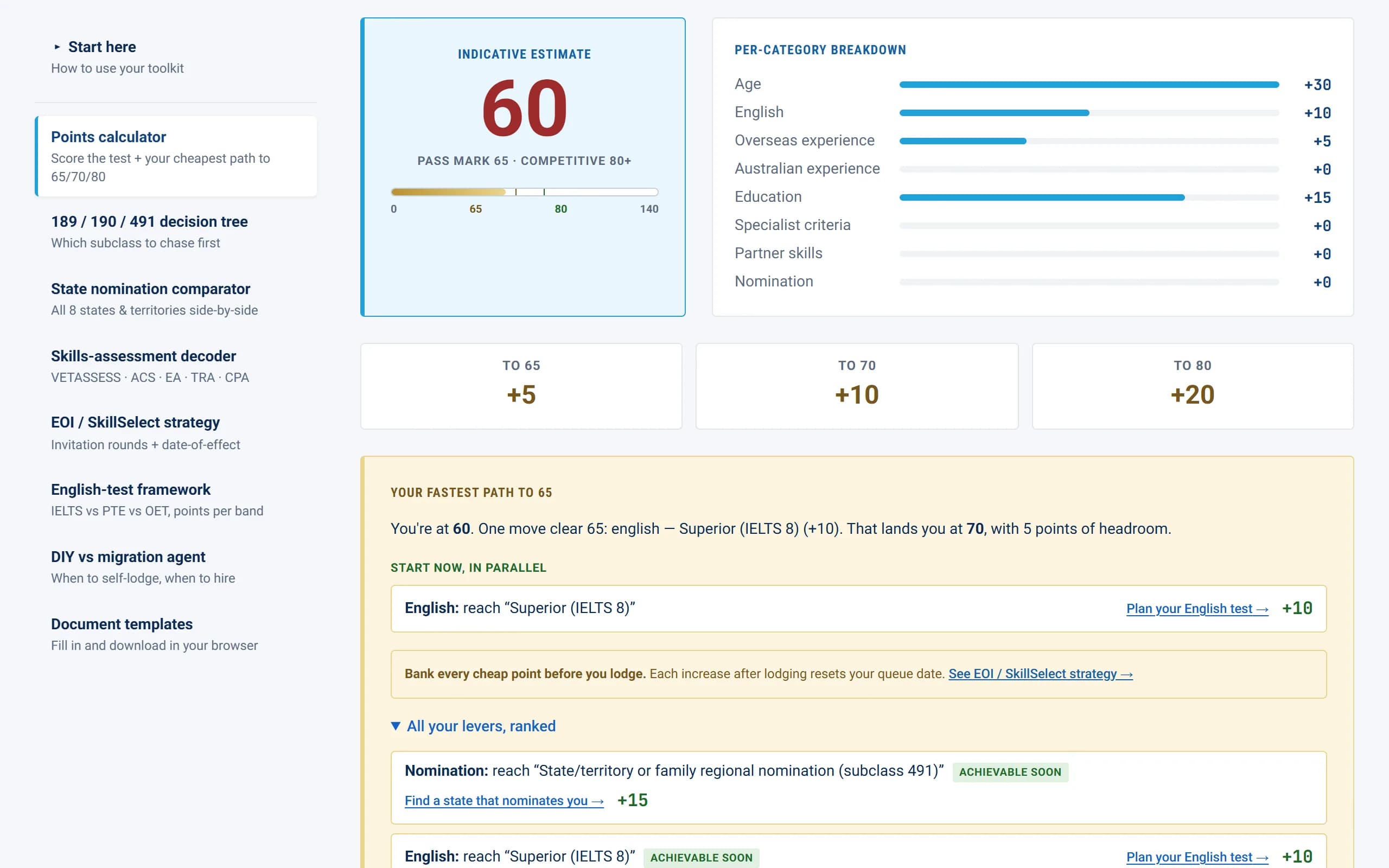
Points Optimisation for IT Professionals
Where IT Applicants Typically Score
| Factor | Typical IT Score | Maximum |
|---|---|---|
| Age (25-32) | 30 | 30 |
| English (PTE 79+) | 20 | 20 |
| Overseas experience (8+ years) | 15 | 15 |
| Australian experience (1+ years) | 5-10 | 20 |
| Qualifications (Bachelor's) | 15 | 20 |
| State nomination (190) | 5 | 5 |
| Regional (491) | 15 | 15 |
Key Strategies
Maximise English: Many IT professionals already have strong English. Push for Superior (PTE 79+ or IELTS 8.0 each) to claim 20 points.
Professional Year Program: An ACS Professional Year in Australia adds 5 points and provides Australian experience.
Australian Study: An Australian Master's degree adds qualification points plus potential regional study bonus.
State Nomination: If your 189 score isn't competitive, the 190 or 491 with state nomination provides a significant boost.
Common Challenges for IT Professionals
ACS Experience Deduction
The ACS "skill level met date" deduction reduces your claimable experience. A software engineer with 6 years of experience might only be able to claim 4 years after the deduction. Plan for this in your points calculation.
High Competition
ICT occupations attract large numbers of applicants globally, particularly from India, China, and Southeast Asia. Competition pushes the effective points threshold higher than many other occupations.
Web Developer Limitation
Web Developer (261212) is on the STSOL, not the MLTSSL, limiting it to state-nominated and short-term employer-sponsored pathways. If you're a web developer, consider whether your duties actually align more closely with Developer Programmer (261312) or Software Engineer (261313) on the MLTSSL.
Frequently Asked Questions
Which ANZSCO code should I choose — Software Engineer or Developer Programmer?
Choose based on your actual duties. Software Engineer (261313) implies more design, architecture, and systems-level work. Developer Programmer (261312) is more focused on coding and development. Read the full ANZSCO descriptions and match to your duties.
How long does ACS assessment take?
Standard processing is 6-8 weeks. Priority processing may be available for an additional fee.
Can I count freelance/contract work for ACS assessment?
Yes, but you need to provide contracts, invoices, and statutory declarations as evidence. Each engagement should be documented separately.
What's the Professional Year and is it worth it?
The ACS Professional Year is a 44-week program combining formal learning and internship in Australia. It adds 5 points and provides Australian work experience. It's worth considering if you're already in Australia on a student or graduate visa.
Do I need an Australian degree?
No. ACS assesses both Australian and overseas qualifications. However, an Australian degree adds points and may strengthen your profile.
What salary can IT professionals expect in Australia?
Salaries vary by role and location. Software engineers in Sydney/Melbourne typically earn AUD $90,000-$150,000+. Regional areas may be lower but cost of living is also less.