Furniture Maker Visa Pathway to Australia: Complete 2026 Guide
Updated: 16 August 2026
Australia classifies Furniture Maker under ANZSCO 394113. Trades Recognition Australia conducts the skills assessment, typically through the Migration Skills Assessment or Job Ready Program. The occupation sits on the Core Skills Occupation List, unlocking subclasses 482 and 186. Typical 2026 salaries range AUD $67,000-$90,000 depending on specialisation. Employer sponsorship is the only practical migration pathway because state nomination is closed.
Quick Facts: Furniture Maker Migration Pathway
| Detail | Information |
|---|---|
| ANZSCO Code | 394113 (Furniture Maker) |
| Skill Level | 3 (AQF Certificate III + 2 years on-the-job training, or Certificate IV) |
| Skills Assessment | TRA (Trades Recognition Australia) |
| Occupation List | CSOL (Core Skills Occupation List) |
| Visa Options | 482, 186 |
| Demand Level | High — bespoke and premium residential segment is short-staffed |
| Salary Range | AUD $67,500-$90,000 (SEEK, May 2026; specialist roles higher) |
| Typical 482 Salary Threshold | Core Skills stream AUD $76,515 minimum |
| Key Challenge | Generalist roles often advertise below the CSIT; specialisation lifts pay above the threshold |
What a Furniture Maker Does in Australia
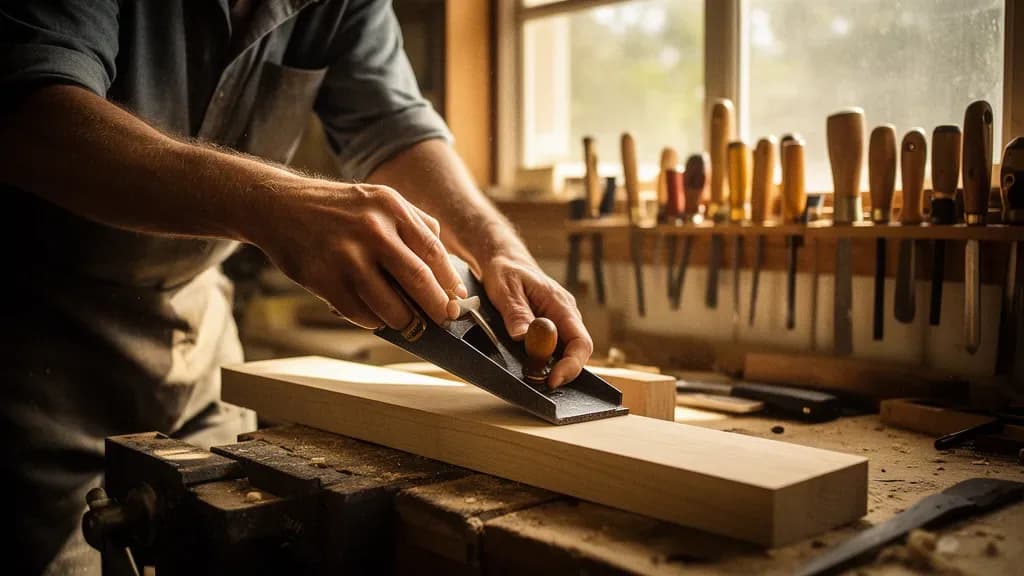
The role covers fabrication, assembly, and repair of wooden and cane furniture — chairs, tables, beds, dressers, occasional pieces, and bespoke commissions. Day-to-day work involves reading drawings and specifications, selecting timber and engineered wood products, machining components on table saws, planers, and routers, joinery (mortise-and-tenon, dovetail, dowel and biscuit), assembly, sanding, and finishing.
The Australian furniture market splits into three layers. High-volume manufacturing has largely moved offshore. Mid-tier production continues in regional centres and the outer suburbs of Sydney and Melbourne. The growth segment is bespoke and premium residential — small studios producing limited runs and one-off commissions for residential clients, interior designers, and the hospitality fit-out sector. This is where employer-sponsored migration opportunities concentrate, and where Jobs and Skills Australia continues to record shortage.
ANZSCO Code Mapping
The exact code is 394113 Furniture Maker, sitting within Unit Group 3941 Cabinet and Furniture Makers (ANZSCO 2022). The ABS task list covers examining drawings, work orders, and sample parts to determine specifications; selecting and working with timber, veneers, particle board, and engineered wood products; fabricating, assembling, and repairing wooden and cane furniture; fitting and assembling prepared wooden parts; and operating CNC machines where applicable.
Furniture Finishers (394211) are explicitly excluded from this code — that work falls under Unit Group 3942 Wood Machinists and Other Wood Trades Workers. Where applicants split time between furniture fabrication and cabinetry, the adjacent code 394112 Cabinet Maker may fit better if cabinetry dominates the duty mix. See the cabinet maker visa pathway for that route.
Skills Assessment
TRA Migration Skills Assessment (MSA)
Applicants with formal training and documented employment apply through the MSA pathway. The MSA is a documentary assessment covering qualification equivalence and post-qualification work experience.
Requirements:
- A qualification at least comparable to AQF Certificate III in Furniture Making (or AQF III in Cabinet Making with furniture-making units)
- At least three years of post-qualification employment performing the ANZSCO 394113 task set
- Documentary evidence of training transcripts, employer references on letterhead, payslips, tax records
Assessment cost: Documentary stage from AUD $1,000.
Processing time: 10-14 weeks for the documentary stage when records are complete.
TRA Job Ready Program (JRP)
Applicants whose overseas training is not directly recognised by the documentary route are directed into the JRP — a four-stage program that adds an Australian workplace placement and practical assessment.
Stage fees (2026):
- Stage 1 — Provisional Skills Assessment: AUD $200
- Stage 2 — Job Ready Employment registration: AUD $450
- Stage 3 — Job Ready Workplace Assessment: AUD $2,540
- Stage 4 — Job Ready Final Assessment: AUD $65
- Total program cost: approximately AUD $3,255
Processing time: 12-18 months from Stage 1 to Final Assessment.
Common rejection reasons: thin documentary evidence (no payslips, references from informal workshops); training delivered without supervised practical hours; duty descriptions that align more closely with furniture finisher (394211), wood machinist (394211 unit group), or cabinet maker (394112) than furniture maker. For broader assessment context, see the skills assessment bodies complete list.
Visa Pathways
Subclass 482 — Skills in Demand Visa
The dominant pathway. Furniture Maker is on the CSOL, eligible for the Core Skills stream of the 482.
- Visa fee: AUD $3,210 (primary applicant, July 2025 indexation)
- Salary threshold: AUD $76,515 (Core Skills Income Threshold)
- Reality check: SEEK's median advertised salary for Furniture Maker jobs sits around AUD $67,500 — below the CSIT. The route works when applicants are senior bench joiners, bespoke specialists, or workshop managers whose pay clears $80,000+. Generalist or entry-level applicants typically need the employer to top up to meet the threshold.
- Duration: Up to 4 years
- Processing time: Core Skills stream 3-6 months from lodgement; accredited sponsors lodge nominations under a 10-day service standard introduced in March 2026
For more on the visa, see the subclass 482 visa guide.
Subclass 186 — Employer Nomination Scheme
Permanent residency through employer sponsorship. Two streams apply:
- Direct Entry: for applicants with a positive TRA assessment and 3+ years of post-qualification experience. Visa fee AUD $6,140. Processing 12-19 months at the 90th percentile.
- Temporary Residence Transition: for applicants who have held a 482 with the nominating employer for at least 2 years. Faster decisions in practice.
The Direct Entry stream is the only viable offshore PR option for Furniture Makers because the occupation is not on the lists eligible for the 189, 190, or 491.
State Nomination
Furniture Maker is not currently nominated for the 190 or 491 by any state or territory in the 2025-26 program year on standard skilled migration lists. The CSOL-only listing restricts the occupation to employer-sponsored pathways at federal level.
Limited entry points exist through state-administered Designated Area Migration Agreements (DAMAs). The Goldfields, South West, and Pilbara DAMAs in Western Australia, and several Northern Territory and regional Victoria DAMAs, have at various times included furniture-trade occupations under concessional terms. Verify the current DAMA occupation lists directly with the relevant regional authority — DAMA scopes change frequently.
Salary and Employment Outlook
| Role | Typical Salary Range |
|---|---|
| Entry Maker (1-3 yrs) | AUD $52,000-$62,000 |
| Furniture Maker (3-7 yrs) | AUD $67,500-$80,000 |
| Senior Bench Joiner / Bespoke | AUD $80,000-$100,000 |
| Workshop Lead | AUD $90,000-$115,000 |
| Designer-Maker / Studio Principal | AUD $95,000-$140,000 |
| Sole Trader (gross billings) | AUD $80,000-$180,000 |
Source: SEEK Career Advice, May 2026 (Furniture Maker average AUD $67,500; Wood Machinist comparator AUD $77,287; Cabinet Maker comparator AUD $80,000-$90,000); cross-referenced against Jora and PayScale.
Total packages on permanent roles add superannuation at 11.5%. The highest-paying segments are bespoke residential studios (Sydney's eastern suburbs, Melbourne's inner south, Hobart, Byron Bay), high-end designer-maker workshops supplying interior designers and architects, and hospitality fit-out contractors producing custom hospitality furniture for venues and hotels.
Regional centres carry surprising premiums. Northeastern Tasmania and the Sunshine Coast report some of the highest advertised pay rates because of the concentration of premium residential and heritage restoration work, combined with a smaller local workforce.
Tips for a Successful Application
1. Specialise Above the CSIT
The Core Skills Income Threshold is AUD $76,515 — above the SEEK median for generalist Furniture Makers. The migration route works when you are a bench joiner, bespoke specialist, designer-maker, or workshop manager whose advertised pay sits above the threshold. Identify which sub-specialty fits your portfolio and aim there.
2. Build a Portfolio That Reads as a Maker, Not an Assembler
TRA distinguishes Furniture Maker from production-line assembly work. Photo and video evidence of complete pieces — from drawings through machining, joinery, assembly, and finishing — supports the case that your duties match the ABS task list. Include CAD/CAM drawings, jig setups, and joinery details where you have them.
3. Target Premium and Bespoke Studios
Bespoke studios employ small teams and often hire internationally for specific specialisations (Scandinavian-style joinery, Japanese hand-tool work, French polishing, marquetry). These employers are not always accredited sponsors, but several premium studios in Sydney, Melbourne, and Hobart hold standard business sponsorship. Direct outreach with a portfolio outperforms generic job-board applications in this segment.
4. Order Sealed Trade Documents Early
TRA requires original training transcripts in sealed envelopes from the issuing institution. Many family-business apprenticeships in other countries lack formal documentation — in those cases, supplementary evidence (statutory training records, master craftsman certifications, recognised guild membership) helps but does not always substitute for formal AQF III equivalence. Plan for the Job Ready Program if your training was informal.
5. Consider Cabinet Maker (394112) if Your Work Includes Built-Ins
If your duty mix includes kitchen, bathroom, or wardrobe cabinetry, Cabinet Maker (394112) may be the stronger nomination. Cabinet Maker benefits from TRA's construction-trade prioritisation through June 2026 and is well established in employer-sponsored channels. See the cabinet maker visa pathway.
Step-by-Step Migration Roadmap
- Confirm ANZSCO 394113 fits your duties — review the how to find ANZSCO code guide
- Check the CSOL listing on the Core Skills Occupation List hub
- Order sealed training transcripts from your issuing institution
- Build a portfolio of complete pieces with drawings, joinery details, and finished images
- Sit your English test — IELTS 5.0 average minimum for the 482
- Lodge the TRA application — MSA if your training and records are strong, JRP otherwise
- Search for a sponsoring employer — premium and bespoke studios, designer-maker workshops, hospitality fit-out specialists
- Receive nomination from the sponsor — under the 10-day accredited service standard where applicable
- Lodge the 482 visa — within the validity window of your nomination
- Work in Australia for 2 years on the 482 — clearing the Core Skills Income Threshold
- Transition to 186 via TRT stream — for permanent residency
- Complete health and character checks, receive visa grant, continue working
For broader context, see the most in-demand occupations in Australia 2026.
Frequently Asked Questions
Can I get permanent residency directly as a Furniture Maker?
Yes, through the 186 Direct Entry stream if you hold a positive TRA assessment, a sponsoring employer willing to nominate, and a salary clearing AUD $76,515 plus the Annual Market Salary Rate test. Direct Entry processing currently runs 12-19 months at the 90th percentile. Most applicants enter on a 482 first and transition through the TRT stream after 2 years.
Why isn't Furniture Maker on the state nomination lists for the 190 or 491?
The CSOL-only listing is a federal designation. State nomination programs administer their own lists drawn from federal eligibility, and most states currently prioritise occupations with broader 189/190 access. Some DAMAs include furniture-trade occupations under concessional terms — verify current scopes directly with the relevant regional authority.
What is the difference between Furniture Maker and Furniture Finisher?
Furniture Maker (394113) fabricates and assembles furniture pieces — machining, joinery, assembly. Furniture Finisher (394211, a separate code in Unit Group 3942 Wood Machinists and Other Wood Trades Workers) applies stains, lacquers, polishes, and decorative finishes to completed pieces. The two codes have different list eligibility and different assessing authorities for some pathways. Match the code to your dominant duty.
Will TRA accept a Bachelor's degree in Industrial or Furniture Design?
Industrial Design and Furniture Design degrees are theory-heavy and often light on supervised practical workshop hours. TRA assesses against AQF Certificate III equivalence, which requires substantial hands-on training. Applicants with design degrees but no formal trade training are typically directed into the Job Ready Program. The JRP's Stage 3 Workplace Assessment then confirms practical competency.
Which Australian employers actively sponsor Furniture Makers?
Bespoke residential studios, designer-maker workshops in Sydney, Melbourne, Hobart, and Byron Bay, hospitality fit-out contractors producing custom hotel and restaurant pieces, and several premium kitchen-and-furniture studios serving high-end interior designers. The market is fragmented — direct outreach to studio owners with a strong portfolio outperforms generic job-board applications.