ICT Sales Representative Visa Pathway to Australia: Complete 2026 Guide
Updated: 16 August 2026
Australia classifies ICT Sales Representative under ANZSCO 225213. VETASSESS conducts the skills assessment. The occupation sits on the Core Skills Occupation List and the older STSOL, which opens subclasses 190, 491, 482 and 186 but not the independent 189. Typical 2026 base salaries run AUD $70,000 to $110,000, plus commission. State nomination or employer sponsorship is the route, since no points-only pathway exists.
Quick Facts: ICT Sales Representative Migration Pathway
| Detail | Information |
|---|---|
| ANZSCO Code | 225213 (ICT Sales Representative) |
| Skill Level | 1 (bachelor degree or higher, or five years relevant experience) |
| Skills Assessment | VETASSESS (Vocational Education and Training Assessment Services) |
| Occupation List | CSOL (Core Skills Occupation List); also STSOL — not on the MLTSSL |
| Visa Options | 190, 491, 482, 186 |
| Demand Level | Moderate — solid demand, strong local candidate supply |
| Salary Range | AUD $70,000-$110,000 base (SEEK, 2026), plus commission |
| Typical 190/491 Score | 65-80 points before nomination, plus state nomination points |
| Key Challenge | No subclass 189 access — secure state nomination or employer sponsorship |
What an ICT Sales Representative Does in Australia
An ICT Sales Representative develops sales opportunities and converts them into sales of computer hardware, software and ICT services. The role runs the transactional end of technology selling: prospecting leads, demonstrating products, quoting, negotiating terms, and following through to delivery and installation. It differs from account management, which stewards existing relationships, and from business development, which targets new markets at a strategic level. The sales representative is closest to the individual deal.
Australian demand follows the technology channel: hardware vendors, software resellers, cloud and telecommunications providers, and managed service firms all employ sales representatives. Sydney and Melbourne hold the largest markets, with Brisbane and Perth carrying smaller but real demand. Because the role is well supplied by local candidates and leans on local product and market knowledge, overseas sponsorship is more selective here than for senior or technical ICT occupations. A clear record of quota attainment in a technology setting is the credential that carries weight.
ANZSCO Code 225213 Explained
The code 225213 belongs to ANZSCO unit group 2252, ICT Sales Professionals, under the 2022 revision 1. ABS rates it at Skill Level 1, meaning a bachelor degree or higher, or at least five years of relevant experience as a substitute in some cases.
Recognised tasks include developing and converting sales opportunities for ICT goods and services, assessing customer needs, demonstrating products, quoting and negotiating, and arranging delivery and installation. The two neighbouring codes shape your choice: 225211 ICT Account Manager grows existing accounts, and 225212 ICT Business Development Manager wins new business at a strategic level. If your work is mainly transactional selling, 225213 fits. Compare the definitions on the ANZSCO code finder.
Skills Assessment: VETASSESS
VETASSESS assesses ICT Sales Representative as a Group B professional occupation. Both your qualification and your employment must pass.
Requirements
- A qualification assessed as comparable to an Australian bachelor degree or higher in a highly relevant field, such as business, ICT, commerce or marketing.
- Highly relevant post-qualification employment. With a relevant degree, VETASSESS asks for at least one year of work in the last five years. A degree plus a relevant diploma needs at least two years, and a degree without a relevant field needs at least three years.
- An organisational chart and references that show ICT sales duties at the right skill level.
Assessment cost: AUD $1,096 for offshore applicants; AUD $1,205.60 for Australian residents (includes GST). Priority processing adds AUD $825 offshore. VETASSESS set these fees on 22 October 2025.
Processing time: about 8 to 12 weeks for standard assessment; priority processing targets roughly 10 business days.
Common rejection reasons: references describing retail or non-technology sales, and a Skill Level 1 expectation that clashes with junior or counter-sales duties. VETASSESS needs the ICT context and a level of responsibility consistent with a professional occupation, so a general retail sales background is the most frequent mismatch.
For a fuller view of assessing authorities, see the skills assessment bodies complete list.
Visa Pathways for ICT Sales Representatives
Because 225213 is not on the MLTSSL, the subclass 189 independent visa is closed. Plan around nomination and sponsorship.
Subclass 190 — Skilled Nominated Visa
State or territory nomination adds 5 points and grants permanent residency.
- Visa fee: AUD $6,140 (primary applicant)
- Eligibility: a state must currently nominate 225213, and you must meet its points and experience thresholds
- Obligation: live and work in the nominating state for two years
- Quirk: sales-focused ICT roles are not always prioritised over technical occupations, so a stronger score helps
Subclass 491 — Skilled Work Regional (Provisional)
Regional nomination adds 15 points. A five-year provisional visa with a route to permanent residency through subclass 191.
- Visa fee: AUD $6,140 (primary applicant)
- Points boost: +15
- Quirk: regional technology resellers exist, but enterprise sales concentrates in capital cities, so verify a genuine regional employer base
Subclass 482 — Skills in Demand Visa
Employer-sponsored temporary work, in the Core Skills stream.
- Visa fee: AUD $3,210 (primary applicant, Core Skills stream)
- Eligibility: an approved sponsor, a genuine position, and a salary at or above the Core Skills income threshold
- Quirk: base salaries at the lower end of this role can sit close to the income threshold, so confirm the guaranteed base meets the requirement before relying on commission
Subclass 186 — Employer Nomination Scheme
Permanent residency through employer nomination, via the Direct Entry stream or the Temporary Residence Transition stream after time on a 482.
- Visa fee: AUD $6,140 (primary applicant)
- Quirk: the Temporary Residence Transition stream is the usual route once you have built a quota record with an Australian sponsor
To understand how the expression of interest feeds the 190 and 491, read how SkillSelect and the EOI work.
Points Test Strategy
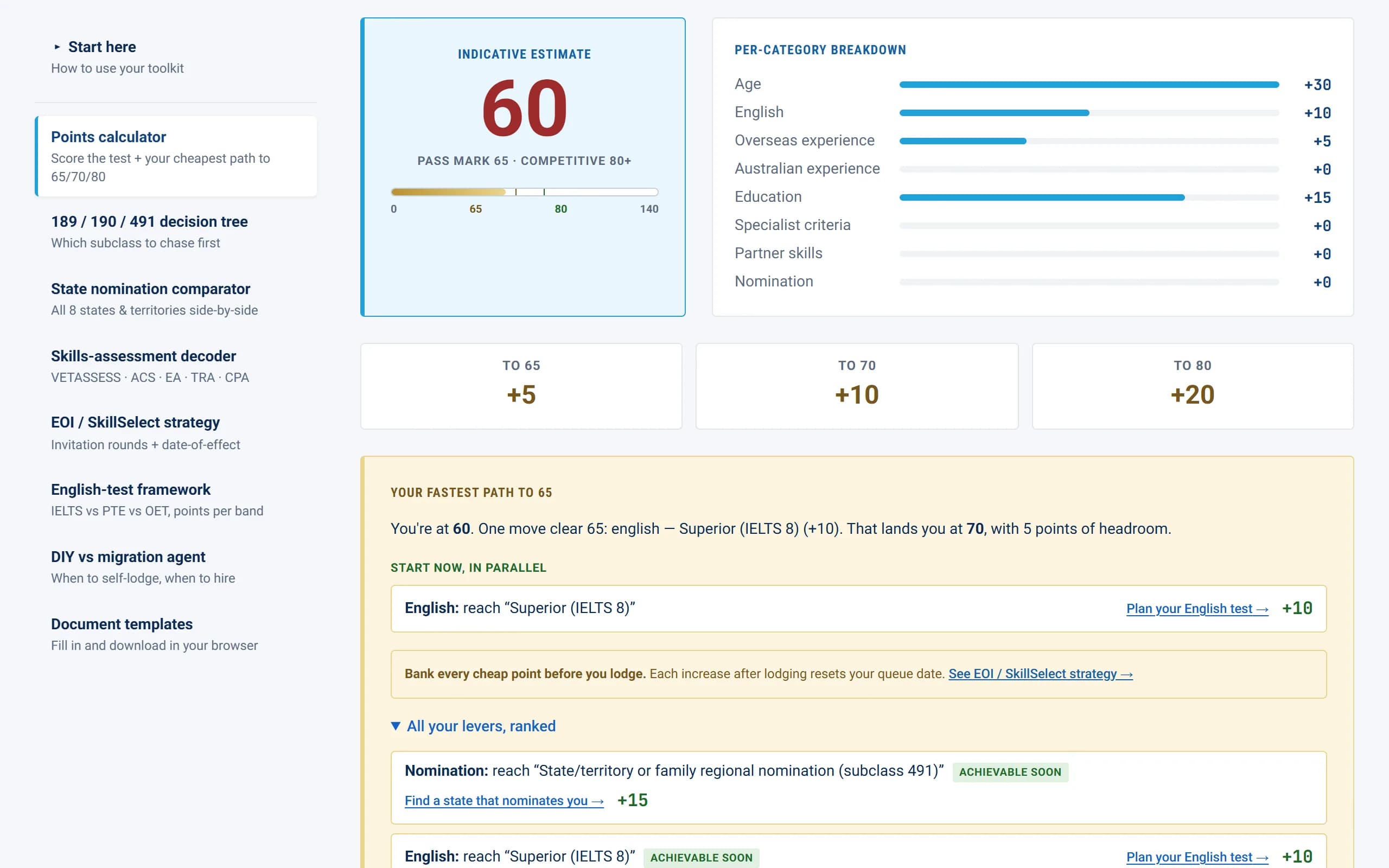
The 190 and 491 still run through the points test. You need at least 65 points to lodge, with the realistic bar higher in a contested ICT category.
| Points Factor | Points | Notes |
|---|---|---|
| Age (25-32) | 30 | Maximum bracket |
| Age (33-39) | 25 | Still strong |
| English (Superior, 8.0+) | 20 | The fastest single lift |
| English (Proficient, 7.0) | 10 | The common starting point |
| Bachelor degree | 15 | Minimum for Skill Level 1 |
| Master or PhD | 15-20 | Useful for senior applicants |
| Skilled experience (8+ years) | 15 | Counts years assessed as skilled |
| State nomination (190) | 5 | Permanent |
| Regional nomination (491) | 15 | Provisional |
| Partner skills | 5-10 | If your partner has a skilled occupation |
| NAATI CCL | 5 | Community language credential |
Realistic Score Scenarios
Scenario 1: experienced sales rep, 30, superior English, eight years ICT sales. Age 30 + degree 15 + English 20 + experience 15 = 80 points. A 190 nomination lifts this to 85, competitive in most years.
Scenario 2: mid-career sales rep, 34, proficient English, five years experience. Age 25 + degree 15 + English 10 + experience 10 = 60 points. This applicant needs the 491 (+15) to reach 75, a better English result, or an employer prepared to sponsor a 482.
State Nomination for ICT Sales Representatives
State lists change each program year, so confirm the current position on the relevant government site before lodging. As a CSOL and STSOL occupation, 225213 appears on some state programs, often with conditions such as a job offer or minimum recent experience in ICT sales.
Sales representatives compete with technical ICT occupations for limited nomination places, and several states favour the technical roles. New South Wales and Victoria hold the deepest technology markets, which supports their demand, while regional 491 nomination depends on a genuine regional employer base. Check each state's published occupation list and conditions, and see the on-site summaries of the Core Skills Occupation List and the Skilled Occupation List 2026.
Salary and Employment Outlook
| Role | Typical Salary Range (AUD, base) |
|---|---|
| ICT Sales Representative (early career) | $65,000-$80,000 |
| ICT Sales Representative | $80,000-$100,000 |
| Senior Sales Representative | $100,000-$120,000 |
| Sales Team Lead | $120,000-$150,000 |
SEEK 2026 data places ICT sales base salaries broadly in the $70,000 to $110,000 range, with commission and on-target earnings often lifting total pay well beyond base. Packages add superannuation at 11.5 percent, and most roles carry a variable component tied to quota.
The strongest pay sits with software vendors, cloud providers and large resellers, where deal sizes and commission plans are most generous. Sydney leads on base salary, with Melbourne close behind. Because the variable component is significant, weigh on-target earnings, not just base, when comparing offers. For wider benchmarks, see salary expectations by occupation.
Tips for a Successful Application
- Keep the technology context explicit. VETASSESS needs to see that you sold ICT hardware, software or services, not general goods. Name the products in your references.
- Demonstrate professional-level responsibility. Skill Level 1 expects more than counter sales. Show solution selling, quoting, negotiation and quota ownership to clear the assessment.
- Lift English to Superior. The move from Proficient to Superior adds 10 points, which often decides a contested ICT EOI.
- Choose the right code in the group. If you grow existing accounts, 225211 Account Manager may fit; if you win new markets, 225212 Business Development Manager may fit. Match the code to your duties.
- Check your base against the salary threshold. Lower-end ICT sales base pay can sit near the Core Skills income threshold, so confirm the guaranteed figure before counting on commission for a 482.
Step-by-Step Migration Roadmap
- Confirm your duties match 225213 using the ANZSCO code finder.
- Check current list status on the Core Skills Occupation List.
- Order VETASSESS Points Test Advice if you want your qualification mapped first.
- Sit an English test and aim for Superior where possible.
- Lodge the full VETASSESS skills assessment (AUD $1,096 offshore).
- Calculate your points with the assessed experience figure.
- Submit an expression of interest in SkillSelect for the 190 or 491.
- Apply for state nomination where 225213 is listed.
- Alternatively, secure an employer to sponsor a 482 or nominate a 186.
- Receive your invitation and lodge the visa within 60 days.
- Complete health and character checks.
- Receive the grant and relocate to your nominating state or region.
Frequently Asked Questions
Can an ICT Sales Representative apply for the subclass 189 visa?
No. The 189 independent visa requires an occupation on the Medium and Long-term Strategic Skills List. ICT Sales Representative sits on the CSOL and STSOL, not the MLTSSL, so the 189 is closed. Your permanent options are the state-nominated 190, the regional 491 with its 191 pathway, or employer nomination through the 186.
Which assessing body handles ICT Sales Representative applications?
VETASSESS assesses ANZSCO 225213 as a Group B professional occupation. It reviews both your qualification and your employment, and it asks for an organisational chart. The standard offshore fee is AUD $1,096, with processing usually taking 8 to 12 weeks.
Does retail technology sales experience count for this code?
Only if it reaches the professional skill level the code expects. VETASSESS looks for solution selling, quoting, negotiation and account responsibility in an ICT context. Counter or retail sales of consumer electronics generally falls short, because it does not match the Skill Level 1 expectation for the occupation.
Which of the three ICT sales codes should I choose?
Pick the one that matches most of your work. ICT Sales Representative (225213) converts individual deals. ICT Account Manager (225211) grows existing accounts. ICT Business Development Manager (225212) opens new markets. All three are CSOL and STSOL occupations with the same visa options, so the decision rests on your duties and references.
Will commission help me meet the visa salary requirement?
The 482 income test focuses on guaranteed base earnings rather than variable commission. Confirm that your base salary meets the Core Skills income threshold, and treat commission as additional income. For lower-end sales roles this matters, since the base can sit close to the threshold.