Mine Deputy Visa Pathway to Australia: Complete 2026 Guide
Updated: 16 August 2026
Australia classifies Mine Deputies under ANZSCO 312913. VETASSESS conducts the skills assessment at AQF Diploma level or higher. The occupation is on the Core Skills Occupation List (CSOL) and the Short-Term Skilled Occupation List (STSOL), unlocking subclasses 190, 491, 482 and 186. Typical 2026 packages range AUD $160,000-$220,000 in NSW and Queensland coal operations. A statutory certificate of competency from the host state is required to work in the role.
Quick Facts: Mine Deputy Migration Pathway
| Detail | Information |
|---|---|
| ANZSCO Code | 312913 (Mine Deputy) |
| Skill Level | 2 (AQF Diploma + statutory certificate of competency) |
| Skills Assessment | VETASSESS (Vocational Education and Training Assessment Services) |
| Occupation List | CSOL and STSOL |
| Visa Options | 190, 491, 482, 186 |
| Demand Level | High — structural shortage of certified statutory ticket-holders in NSW and QLD coal |
| Salary Range | AUD $160,000-$220,000 (SEEK, Hunter Valley and Bowen Basin job market 2026) |
| Typical 482 Threshold | Specialist Skills stream often achievable (AUD $141,210+) |
| Key Challenge | NSW or QLD statutory ticket must be obtained — overseas tickets are not directly transferable |
Role Context in Australia
Mine Deputies are the legally accountable on-shift supervisors in Australian underground coal operations. They inspect their assigned panel before each shift, sign off on gas readings and ventilation, supervise miners on production, ensure compliance with the mine's principal hazard management plans, and stop work if conditions deteriorate. The role exists in legislation, not just in job descriptions — Deputies hold statutory functions under the NSW Work Health and Safety (Mines and Petroleum Sites) Regulation 2022 and the Queensland Coal Mining Safety and Health Regulation.
Australia concentrates demand in two geographic clusters. The Hunter Valley, Illawarra and Western Coalfields in NSW supply metallurgical and thermal coal — major operators include Glencore, Whitehaven, Yancoal, Centennial Coal and South32. The Bowen Basin in Queensland is dominated by BMA (BHP-Mitsubishi Alliance), Anglo American, Peabody, Glencore and Stanmore Resources. Most roles are on 7-on-7-off or equivalent rosters and pay drive-in-drive-out, fly-in-fly-out, or residential rates.
The structural shortage is real. Certified Deputies in NSW and QLD are scarce, and operators frequently sponsor experienced overseas underground supervisors — typically from South Africa, the UK (Yorkshire/Welsh coalfields), Poland, Ukraine, India and Indonesia — to fill the statutory roles after they convert their tickets locally.
ANZSCO 312913 Code Mapping
ANZSCO 312913 sits in Unit Group 3129 (Other Building and Engineering Technicians).
The ABS description covers overseeing the safety of mining operations, supervising miners, and managing day-to-day mining activities including production, ventilation, gas monitoring, strata control and emergency response. Typical tasks include pre-shift inspections, gas testing, hazard identification, statutory record-keeping, supervising and training underground crews, and reporting to the mine manager or undermanager.
If your work is in open-cut metalliferous mining (iron ore, gold, copper, nickel) rather than underground coal, the ANZSCO Deputy code is not the right fit. Open-cut supervisors typically nominate under a different ANZSCO — open-cut Examiner roles in Queensland sit closer to Mining Engineer (233611) or Production Supervisor codes. The 312913 Deputy code is specific to underground coal statutory positions.
Skills Assessment — VETASSESS
VETASSESS is the sole assessing authority for ANZSCO 312913.
Body: VETASSESS — Vocational Education and Training Assessment Services
Requirements (Group C occupation):
- A qualification assessed at AQF Diploma level or higher in a highly relevant field (mining engineering, mining technology, mine deputy training, occupational health and safety in mining), AND
- At least one year of post-qualification highly relevant employment at an appropriate skill level in the last five years.
Applicants without a highly relevant Diploma but with longer underground experience may meet the alternate pathway: a Diploma in any field plus at least two years of highly relevant post-qualification employment.
Assessment cost: AUD $1,096 (offshore) or AUD $1,205.60 (within Australia, including GST). Priority processing adds AUD $825-$907.50. (VETASSESS fee schedule, effective 22 October 2025.)
Processing time: Approximately 7 weeks standard; 10 business days under priority processing. Complex coal-sector assessments can take 12-20 weeks.
Common rejection reasons:
- References describe work as a Miner or Shotfirer rather than a supervising Deputy. The role must show statutory supervisory authority — pre-shift inspections signed in your name, panel responsibility, gas readings logged under your authority.
- Qualifications below Diploma. UK NVQ Level 3, Polish technician certificates and Indian mining diplomas frequently need supplementation with a recognised underground supervisor qualification before VETASSESS will accept them at AQF Diploma equivalent.
Statutory Certification — Separate from VETASSESS
A positive VETASSESS skills assessment does not authorise you to work as a Deputy in Australia. The state mining regulator issues the statutory ticket separately.
NSW Deputy Certificate (Underground Coal)
Issued by the NSW Resources Regulator. Applicants must provide evidence of identity, age, qualifications and experience, and pass examination by the NSW Mining Competence Board. Overseas Deputies typically need to bridge their qualification with a recognised Australian course and sit the NSW examination locally.
Queensland Coal Mine Deputy Certificate of Competency
Issued through the Queensland Board of Examiners under Resources Safety & Health Queensland. Since 10 June 2025, competency holders working in statutory positions must be registered in the Board's Practising Certificate Scheme and hold a current practising certificate. Queensland's examination structure differs from NSW's and a Deputy moving between states must hold each ticket separately or have them mutually recognised.
Plan for 6-12 months in Australia to complete bridging training and pass the statutory examination after arrival.
Visa Pathways for Mine Deputies
Subclass 482 — Skills in Demand
The dominant route. Most overseas Deputies enter on a 482 sponsored by the operator while completing their statutory certification.
- Visa fee: AUD $3,210 (primary applicant)
- Stream: Core Skills (CSIT $76,515) is the common stream — but Deputy packages typically exceed the Specialist Skills threshold of AUD $141,210, which gives access to vastly faster processing.
- Processing time: Core Skills stream up to 8 months for 90% of applications (April 2026); Specialist Skills stream as fast as 7-51 days.
- Pathway to PR: Yes — via 186 Temporary Residence Transition after 2 years.
Subclass 190 — Skilled Nominated (State Nominated)
State nomination is available because 312913 is on the STSOL. NSW and Queensland are the relevant nominators, and both prioritise applicants with confirmed coal-sector job offers and progress toward the state statutory ticket.
- Visa fee: AUD $6,140
- Points boost: +5 from state nomination
- Permanent residency on grant.
Subclass 491 — Skilled Work Regional
Most Australian underground coal mines are in regional postcodes (Hunter Valley regional NSW, Illawarra, Bowen Basin, Western Downs). 491 nomination is a realistic option for Deputies committing to a regional location.
- Visa fee: AUD $6,140
- Points boost: +15 from regional nomination
- Pathway to PR: Subclass 191 after 3 years living and working in regional Australia and meeting the taxable income threshold.
Subclass 186 — Employer Nomination Scheme
Most Deputies arrive on 482 and transition to 186 TRT after two years. Direct Entry 186 is possible but requires the skills assessment and 3+ years experience.
- Visa fee: AUD $6,140
- Processing time: 10-15 months for permanent ENS applications (April 2026).
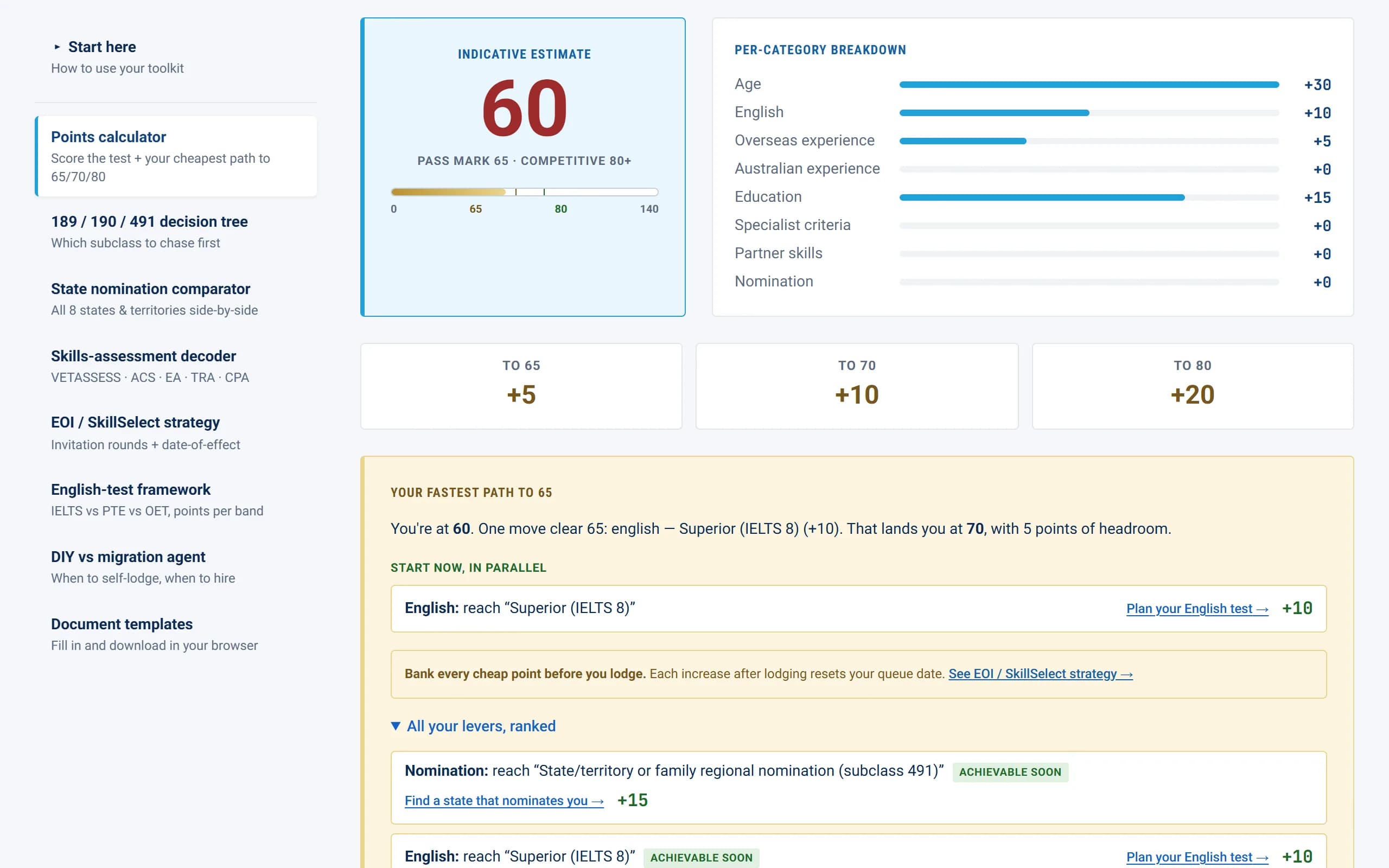
Points Test — When 190 or 491 Is Realistic
Deputies typically score competitively because the role attracts mature applicants with substantial experience, often partner-skilled too.
| Points Factor | Typical Points |
|---|---|
| Age (33-39 most common for experienced Deputies) | 25 |
| Qualification (AQF Diploma) | 10 |
| English (Proficient, IELTS 7.0) | 10 |
| Overseas experience (8+ years) | 15 |
| State nomination (190) | 5 |
| Regional nomination (491) | 15 |
| Partner skills points | 5-10 |
A typical scenario: 39-year-old underground supervisor from South Africa, Diploma in Mining, IELTS 7.0, 12 years underground coal experience, partner with skilled occupation. Base 65 points, +15 with 491 nomination = 80 points. Competitive.
State Nomination
New South Wales
NSW Treasury's skilled visa team confirms 312913 in selected program rounds where the Hunter Valley and Illawarra demand is acute. Applicants need an active NSW job offer, a credible plan to obtain the NSW Deputy Certificate, and at least three years of underground coal supervisory experience.
Queensland
Migration Queensland has been receptive to 312913 nominations in 2025-26 given the Bowen Basin labour pressure. The 190 onshore stream requires nine months of recent Queensland work experience, which a 482 visa holder can accrue. The 491 offshore stream is possible for applicants with a Queensland coal operator's offer in hand.
State nomination beyond NSW and Queensland is not relevant for this code — Western Australia, Victoria and South Australia do not have underground coal industries that hire Deputies.
Salary and Employment Outlook
| Role | Typical Package (AUD, 2026) |
|---|---|
| Deputy (residential, NSW Hunter) | $160,000-$190,000 |
| Deputy (FIFO/DIDO, Bowen Basin) | $180,000-$220,000 |
| Senior Deputy / Acting Undermanager | $200,000-$240,000 |
| Undermanager (next step up) | $240,000-$320,000 |
| Contractor Deputy (day rate) | $1,000-$1,400/day |
Packages are based on Hunter Valley and Bowen Basin job market data (SEEK, Indeed, Jora, May 2026). Most include superannuation, site allowances, FIFO/DIDO transport, accommodation and production bonuses. Underground roles typically command a 15-25% premium over open-cut.
The highest-paying operators are the metallurgical coal producers — BMA, Anglo American, Whitehaven and Glencore's coking-coal operations. Thermal coal producers pay slightly less but offer steadier rosters.
Tips for a Successful Application
-
Apply for the state statutory ticket before, not after, arrival. Engage with the NSW Resources Regulator or Queensland Board of Examiners while still offshore. Some bridging coursework can be completed remotely. This compresses the timeline from arrival to first shift.
-
Target operators that historically sponsor — not contractors. Tier-1 owner-operators (BMA, Whitehaven, Glencore, Anglo American, South32) have visa-sponsoring HR functions. Smaller contractors often do not. The Skilled Migration Internship Programs and direct LinkedIn outreach to operations managers work better than job boards.
-
Document statutory supervisory work in references precisely. VETASSESS and Home Affairs both look for evidence that you held a supervisory ticket overseas. Reference letters should quote your home jurisdiction's certificate number, the size of crew supervised, and the panels or sections under your responsibility.
-
Plan around the medical and character checks early. Underground mining requires a Coal Board Medical (or equivalent) in addition to the Home Affairs immigration medical. NSW also requires Order 41/43 medical clearance for underground coal work. Run these in parallel with the visa application, not after.
-
Get the family relocation right. Deputy work is often residential in regional towns (Singleton, Muswellbrook, Mackay, Moranbah). Schooling, partner employment and housing are major decisions. Use the 482 onshore period to test the location before committing to PR.
Step-by-Step Migration Roadmap
- Confirm your underground supervisory duties match ANZSCO 312913 against the how to find ANZSCO code guide.
- Confirm 312913 status on the CSOL.
- Gather underground coal experience evidence — payslips, statutory logs, certificate of competency from home country.
- Sit your English test — IELTS 5.0 (482 Core), 6.0 (186 Direct Entry).
- Lodge VETASSESS skills assessment — AUD $1,096-$1,205.60, 7 weeks.
- Apply to NSW and Queensland coal operators that sponsor.
- Sponsor lodges 482 nomination (AUD $330 + SAF levy).
- Lodge 482 visa application — AUD $3,210.
- Apply for NSW Deputy Certificate or QLD Deputy Certificate of Competency.
- Complete Coal Board medical and bridging coursework.
- Sit the statutory examination in your host state.
- After 2 years on 482 with same sponsor, transition to 186 TRT for PR.
Frequently Asked Questions
Is my overseas Deputy ticket recognised in Australia?
Not directly. NSW and Queensland both require examination by their state regulators before issuing a statutory certificate of competency. Overseas experience accelerates the process — applicants with substantial underground supervisory time typically complete the bridging requirements and examination within 6-12 months of arrival.
Can I work as a Deputy in Australia on a 482 visa before I have the state ticket?
No. The Deputy role is a statutory position under state mines safety legislation. You cannot hold the role without the state certificate. Most sponsors recruit experienced overseas supervisors into a Coal Mine Worker or Production Crew role on day one, with a documented plan and timeline to obtain the Deputy ticket. The 482 nomination is then for the Deputy position the worker will move into.
Is Mine Deputy on the MLTSSL?
No. ANZSCO 312913 is on the CSOL and STSOL in 2026, not the MLTSSL. The subclass 189 Skilled Independent visa is not available. The relevant pathways are 482 (employer-sponsored), 190 (state-nominated, permanent), 491 (state-nominated regional, provisional) and 186 (employer-sponsored permanent).
What is the demand outlook for Mine Deputies in 2026?
Strong. NSW and Queensland metallurgical coal operations face a structural shortage of certified Deputies. The mining workforce is ageing, replacement training pipelines are slow (a domestic Deputy typically takes 6-10 years to develop), and metallurgical coal demand from steelmakers in India, Japan and Korea remains firm. Jobs and Skills Australia indicates ongoing labour pressure in coal mining occupations.
Which states sponsor Mine Deputies?
NSW and Queensland — the only states with underground coal industries that employ statutory Deputies. Western Australia's underground operations are in metalliferous mining and use different supervisory codes. Victoria, South Australia and Tasmania do not have active underground coal mines on the scale that requires sponsored Deputies.