Geologist Visa Pathway to Australia: Complete 2026 Guide
Updated: 16 August 2026
Australia classifies Geologist under ANZSCO 234411. VETASSESS conducts the skills assessment. The occupation sits on both the Core Skills Occupation List (CSOL) and the Short-Term Skilled Occupation List (STSOL), unlocking subclasses 190, 491, 482 and 186. Typical 2026 salaries range AUD $110,000-$170,000, with senior mine geologists in Western Australia clearing AUD $200,000+. WA mining and exploration is the dominant employment driver.
Quick Facts: Geologist Migration Pathway
| Detail | Information |
|---|---|
| ANZSCO Code | 234411 (Geologist) |
| Skill Level | 1 (Bachelor degree or higher) |
| Skills Assessment | VETASSESS (Vocational Education and Training Assessment Services) |
| Occupation List | CSOL and STSOL — open to 190, 491, 482 and 186 |
| Visa Options | 190, 491, 482 (Core Skills), 186 (Direct Entry / TRT) |
| Demand Level | High — Jobs and Skills Australia flags shortage; WA exploration and mining at multi-decade peak |
| Salary Range | AUD $110,000-$170,000 base (SEEK 2026); chief geologists up to AUD $250,000 in WA |
| Typical 189 Score | Not applicable — 234411 is not on MLTSSL, so no 189 access |
| Key Challenge | State nomination quotas competitive; WA mining roles often require FIFO commitment |
What Geologists Do in Australia
Australian geologists work mainly in mineral exploration, mine geology, and resource-sector consulting. Western Australia's iron ore (Rio Tinto, BHP, Fortescue), gold (Newmont, Northern Star, Evolution), nickel and lithium (Pilbara Minerals, IGO, Liontown) operations are the largest employers. Queensland's coal and copper sector and South Australia's emerging critical minerals plays add weight. Smaller cohorts work in groundwater (often under the hydrogeologist code 234413), environmental and contaminated land assessment, oil and gas, and academic research.
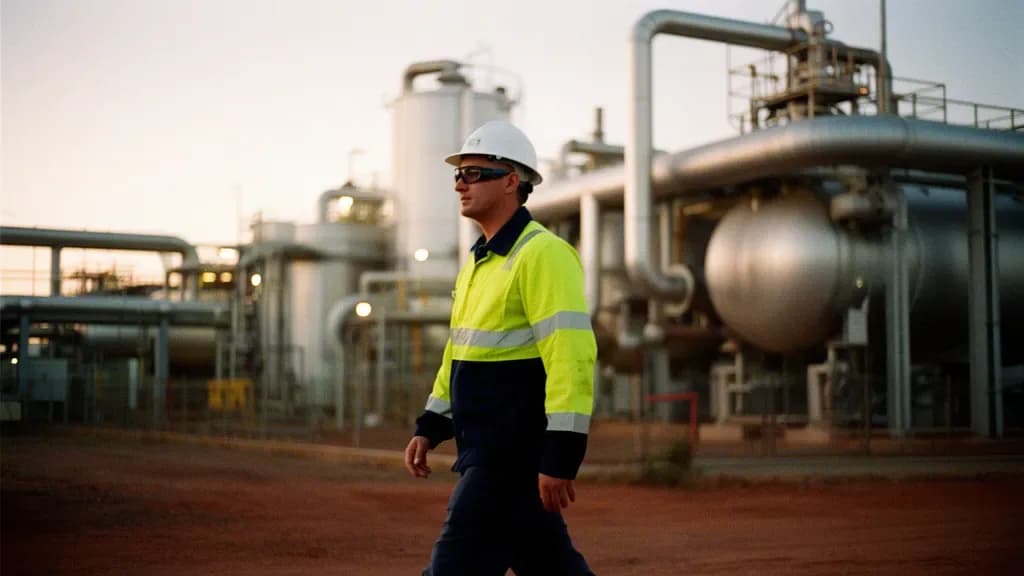
The Australian exploration spend exceeded AUD $4 billion in 2024-25 and remains historically elevated. Critical minerals — lithium, rare earths, nickel sulphide, copper — are driving a wave of greenfields drilling in WA, the NT and SA. Mine geology roles are concentrated near operating mines and run on FIFO rosters of 8/6, 2/1 or even-time schedules. Perth is the corporate base, followed by Brisbane for the eastern states' coal and copper operations.
ANZSCO Code 234411
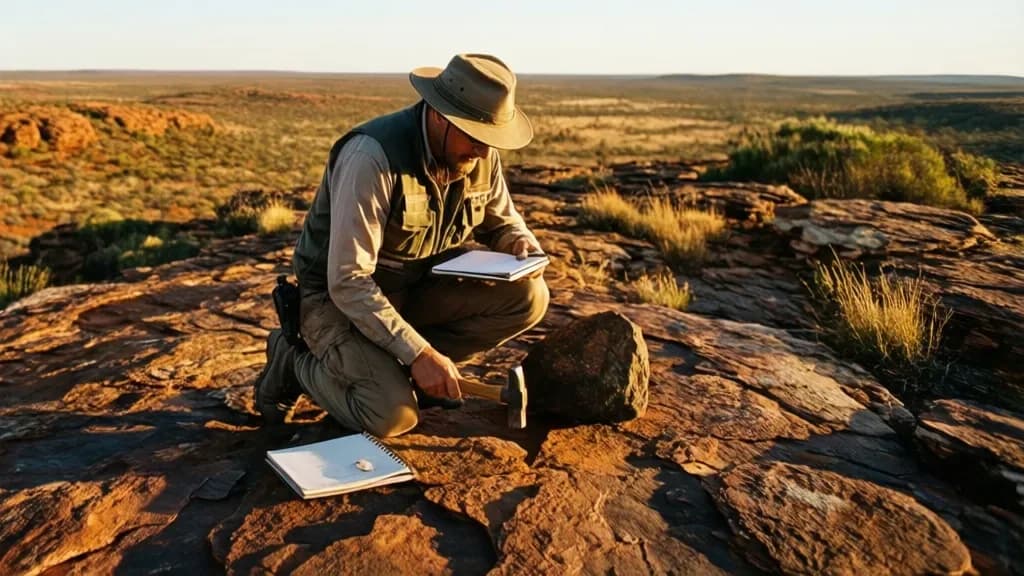
The official ANZSCO description for 234411 covers professionals who study the composition, structure and other physical aspects of the earth to locate mineral, water and petroleum resources, identify geological hazards, and contribute to projects in construction, mining and environmental management. Typical tasks include geological mapping, core logging, sampling and assay interpretation, resource modelling, and supervision of drill programs.
Adjacent codes that sometimes fit better:
- 234412 Geophysicist — for those who specialise in seismic, magnetic, gravity or electromagnetic survey interpretation. See the geophysicist pathway.
- 234413 Hydrogeologist — for groundwater specialists. See the hydrogeologist pathway.
- 233611 Mining Engineer — for those whose duties have shifted into mine planning and engineering. See the mining engineer pathway.
- 234999 Other Spatial Scientist — for niche roles in remote sensing or geomatics. See the other spatial scientist pathway.
For most overseas-trained geologists with field, exploration or mine-site experience, 234411 is the cleanest fit.
Skills Assessment
VETASSESS Assessment
VETASSESS classifies Geologist as a Group A occupation: the qualification field must be highly relevant.
Requirements:
- Qualification assessed as comparable to an Australian Qualifications Framework (AQF) Bachelor degree or higher
- Field of study highly relevant — geology, earth science, geoscience, mining geology, exploration geology
- At least one year of highly relevant post-qualification employment at an appropriate skill level in the last five years
- Honours-level or postgraduate qualification strengthens employment assessment, especially for resource geology roles
Assessment Cost: AUD $1,096 offshore (excl. GST) / AUD $1,205.60 onshore (incl. GST), effective from 22 October 2025 Priority Processing Fee: AUD $825 offshore / AUD $907.50 onshore (additional) Processing Time: 7 weeks standard; 10 business days under Priority Processing
Common rejection reasons: Field-of-study issues with environmental science or geography degrees that include only minor geology content. The other recurring issue is employment evidence that describes drilling supervision or sample collection without enough technical interpretation work — VETASSESS expects analysis, modelling and recommendation, not just data collection.
VETASSESS also offers Points Test Advice (qualifications only) for AUD $311-$342, which can be useful if a 190 or 491 path is being pursued. Confirm the current fees at the VETASSESS professional occupations fees page. The full skills assessment bodies list covers related earth-science occupations.
Visa Pathways
Geologist is on the CSOL and STSOL but not the MLTSSL, which closes the 189 visa. The 190 and 491 are open via state nomination; 482 and 186 are open via employer sponsorship.
Subclass 482 — Skills in Demand (Core Skills Stream)
The most common route for experienced geologists with a job offer in hand.
- Visa fee: AUD $3,210 (primary applicant)
- Salary threshold: Core Skills Income Threshold AUD $76,515; rising to AUD $79,499 for nominations lodged from 1 July 2026
- Processing time: Median 4-7 months for Core Skills
- Duration: Up to 4 years, with pathway to 186 PR after 2 years on the same employer
- Occupation quirk: Most mine and exploration geologist roles clear the Specialist Skills threshold (AUD $141,210, rising to AUD $146,717 from 1 July 2026). Specialist Skills processing is around 7-day median, materially faster than Core Skills.
Subclass 190 — Skilled Nominated Visa
Permanent residency through state nomination. Requires nomination from a state that lists 234411.
- Visa fee: AUD $6,140 (primary applicant)
- Points boost: +5 from state nomination
- Processing time: Median around 6-8 months for 190; 90% within 11-14 months
- Obligation: Live and work in the nominating state for 2 years
- State picture: Western Australia lists 234411 on WASMOL Schedule 2 (general stream), with mining as the industry sector. South Australia includes geology in regional nomination streams targeted at the resource sector. Other states' inclusion is intermittent — verify against current published lists.
Subclass 491 — Skilled Work Regional Visa
Provisional regional visa, valid 5 years, with a pathway to 191 PR after 3 years.
- Visa fee: AUD $6,140 (primary applicant)
- Points boost: +15 from regional nomination
- Processing time: Median 6-20 months; 90% within 15-28 months (April 2026)
- Geography: Regional Australia covers all of WA except Perth, all of SA except metro Adelaide, and most of NSW, VIC and QLD outside the capitals. Many mining centres (Kalgoorlie, Karratha, Mount Isa) are inside the regional definition.
Subclass 186 — Employer Nomination Scheme
Permanent residency through employer sponsorship.
- Visa fee: AUD $6,140 (primary applicant)
- Streams: Direct Entry or Temporary Residence Transition (TRT, after 2+ years on a 482)
- Processing time: 90% of Direct Entry applications finalised within 15-19 months in early 2026; TRT around 13 months median
- Occupation quirk: Major mining companies use TRT as the standard PR route for sponsored geologists, lifting them from 482 to 186 after the two-year qualifying period.
See the subclass 482 hub for the broader employer-sponsored framework.
Points Test Strategy
Geologist is not on the MLTSSL, so subclass 189 (independent points-tested) is not available. The relevant points-tested pathways are 190 and 491. Standard points factors apply: age, qualification, English, experience after VETASSESS assessment, state nomination (+5 for 190, +15 for 491), partner skills, and any Australian study or work history.
Realistic Score Scenarios
Scenario 1: Mid-career mine geologist seeking 190 WA Age 33 (25 points) + Bachelor (15) + Proficient English (10) + 5+ years skilled experience (10) + 190 nomination (5) = 65 points. Competitive for WA mining-stream invitations when paired with a Perth or regional WA job offer or commitment.
Scenario 2: Senior exploration geologist seeking 491 regional WA or SA Age 38 (15 points) + Master's (15) + Superior English (20) + 8+ years experience (15) + 491 nomination (15) + partner skills (5) = 85 points. Strong position; regional employment commitment usually required.
For most geologists with a confirmed job offer, the 482 → 186 TRT pathway is faster and lower-risk than the 190/491 route. Reserve points-tested visas for cases where employer sponsorship is not yet secured.
State Nomination
Western Australia
Geologist is listed on WASMOL Schedule 2 (the general nomination list) with Mining specified as the industry sector. Schedule 2 occupations are lower priority than Schedule 1 but still receive nominations, particularly for applicants already in WA with a job offer or commitment. The WA Skilled Migration program emphasises actual employment in the state. WA hosts the bulk of Australian mining geology demand and is the primary destination for international mining geologists.
South Australia
South Australia's nomination program includes earth-science occupations in support of the state's growing critical minerals sector (Olympic Dam, Carrapateena, Prominent Hill, plus rare earths and copper plays in the Gawler Craton). Both 190 and 491 streams are available depending on regional commitment. SA runs frequent invitation rounds — the May 2026 round issued 509 invitations across 190 and 491.
Northern Territory
The NT nominates geologists under its regular skilled migration program and through the Designated Area Migration Agreement framework. Demand is driven by uranium, gold, manganese and the McArthur River zinc-lead operation. NT typically issues smaller numbers of nominations but with less competition.
Tasmania, Victoria and NSW include geology occasionally on regional priority lists, with timing tied to specific projects. Always verify against the live state lists. See the 2026 SOL hub.
Salary and Employment Outlook
What Geologists Earn in Australia
| Role | Typical Salary Range (2026) |
|---|---|
| Graduate Geologist | AUD $80,000-$110,000 plus FIFO allowance |
| Mine Geologist (mid) | AUD $123,000-$155,000 plus site allowance |
| Senior Mine Geologist | AUD $155,000-$200,000 plus bonus |
| Exploration Geologist (mid) | AUD $110,000-$150,000 plus field allowance |
| Resource / Modelling Geologist | AUD $150,000-$200,000 |
| Principal / Chief Geologist (WA) | AUD $200,000-$250,000+ |
| Consulting Geologist (rate) | AUD $1,200-$2,000 per day |
Sources: SEEK April 2026 data showing average AUD $110,000-$130,000 across geologist roles, Mine Geologist 25th-75th percentile AUD $123,000-$155,000; Hays Resources & Mining 2026 salary commentary; WA chief geologist benchmarks at AUD $250,000 (highest in Australia).
Total package context
FIFO rosters typically add a site allowance, accommodation and travel covered by the employer. Long-distance commute equivalents include 8 days on / 6 off, 2 weeks on / 1 off, and even time. Bonuses range from 10-25% of base in larger mining houses, with project-tied incentives more common in junior explorers. Superannuation at the statutory 11.5% applies; some employers pay higher rates as part of the package.
Highest-paying employers
- Major iron ore producers — Rio Tinto, BHP, Fortescue Metals Group (WA Pilbara)
- Gold majors — Newmont, Northern Star, Evolution Mining, Gold Fields
- Diversified miners — South32, IGO, Mineral Resources
- Critical minerals — Pilbara Minerals, Liontown Resources, Allkem, Lynas
- Coal — BHP Mitsubishi Alliance, Glencore, Whitehaven (QLD and NSW)
- Mid-tier explorers and consultancies — SRK, AMC, CSA Global, RSC Mining and Mineral Exploration
Tips for a Successful Application
1. Front-load technical interpretation evidence
VETASSESS wants to see geological analysis, resource modelling and recommendation — not just sample collection. Reference letters should describe core logging interpretation, structural analysis, resource estimation involvement, JORC compliance work, or supervision of drilling programs with reporting outputs.
2. Target WA-based sponsors first
WA accounts for the majority of Australian geology employment. Roles in Perth corporate offices and at major Pilbara, Goldfields and Mid-West operations dominate the sponsor pool. Even if your long-term preference is the east coast, securing a WA-based 482 first is often the fastest route in.
3. Decide on FIFO versus residential before applying
FIFO postings pay more and are more numerous, but the lifestyle is divisive. Residential roles in Perth, Kalgoorlie, Karratha, Mount Isa and Mackay are fewer but exist. Be explicit in cover letters about which you accept.
4. Maintain Joint Ore Reserves Committee (JORC) familiarity
The JORC Code governs public reporting of mineral resources and ore reserves in Australia. Familiarity with JORC 2012 and the imminent JORC 2026 update is expected for resource and mining geology roles. Membership of the AusIMM (Australasian Institute of Mining and Metallurgy) or AIG (Australian Institute of Geoscientists) supports Competent Person status.
5. Use Specialist Skills stream if salary qualifies
Mine geologist salaries from mid-career upward frequently exceed the Specialist Skills threshold (AUD $141,210 in 2025-26; AUD $146,717 from 1 July 2026). Specialist Skills 482 processing is 7-day median compared to 4-7 months Core Skills — a major difference if the employer is ready to lodge.
Step-by-Step Migration Roadmap
- Confirm ANZSCO 234411 fits your duties — review against 234412 Geophysicist, 234413 Hydrogeologist via the ANZSCO code finder
- Confirm CSOL and STSOL status — geologist is on both the Core Skills Occupation List and the Short-Term Skilled Occupation List
- Compile qualifications — transcripts, honours thesis, postgraduate work, AusIMM or AIG membership
- Prepare employment evidence — statements detailing technical interpretation, deposit type, JORC involvement, dates, hours, salary
- Sit an English test — aim for at least Proficient (IELTS 7.0 each band) to optimise points scoring
- Lodge VETASSESS assessment — Standard or Priority depending on timeline
- Decide visa strategy — employer-sponsored 482/186 if a job offer is realistic; 190/491 if pursuing state nomination independently
- For 190/491: submit EOI in SkillSelect — and apply for state nomination via WA, SA or NT portals
- For 482: secure a sponsoring employer — Tier-1 miner, mid-tier explorer or consultancy
- Lodge visa application — within 60 days of invitation (190/491) or nomination (482)
- Complete health and character checks
- Receive visa grant and relocate — usually to WA, SA, NT or QLD mining regions
Frequently Asked Questions
Why is geologist not on the MLTSSL?
The MLTSSL is restricted to occupations with sustained long-term national shortages where the workforce is broadly distributed. Geology demand is acute but heavily cyclical and concentrated in resource-sector states — Western Australia in particular. The CSOL and STSOL designations capture this by enabling employer-sponsored and state-nominated visas without opening points-tested independent (189) migration.
Should I choose geologist (234411) or geophysicist (234412)?
The code follows your actual day-to-day work, not your title or degree. If you log core, map outcrop, model resources and interpret assay data, you are 234411 Geologist. If you process seismic, magnetic, gravity or electromagnetic survey data and interpret subsurface structure from that data, you are 234412 Geophysicist. Many practitioners straddle both — choose the code that matches the bulk of your last 3-5 years of employment.
Is FIFO really mandatory for mining geology in Australia?
Not mandatory, but it is the default. Mine geologists living in Perth and flying to Pilbara iron ore sites or Goldfields gold operations are the common pattern. Residential roles exist in Kalgoorlie, Karratha, Mount Isa and Mackay for those who want to live on-site. Exploration roles often involve camp-based field work for weeks at a time.
Can my UK or Canadian geology qualification be recognised?
UK BSc Hons Geology and Canadian BSc Geology degrees from accredited universities are routinely assessed as equivalent to an AQF Bachelor by VETASSESS, provided the geological content is sufficient. UK Master's by research and Canadian MSc theses also map cleanly. Provide full transcripts and module descriptions, not just the degree certificate.
What's the demand outlook for geologists in Australia in 2026?
Strong. Critical minerals exploration spend remains historically high in WA, SA and the NT. Iron ore replacement projects in the Pilbara continue to drive mine geology demand. Gold operations are expanding production. Lithium and rare earths are in capex build-out phases requiring resource modelling and mine geology teams. Jobs and Skills Australia flags shortages in the geosciences across the resource sector.