Financial Investment Adviser Visa Pathway to Australia: Complete 2026 Guide
Updated: 16 August 2026
Australia classifies Financial Investment Adviser under ANZSCO 222311, a Skill Level 1 occupation. VETASSESS conducts the skills assessment as a Group A occupation. The role sits on both the Core Skills Occupation List (CSOL) and the Short-Term Skilled Occupation List (STSOL), opening subclasses 190, 491, 482, and 186. Typical 2026 salaries range AUD $115,000-$180,000, with senior bank-aligned advisers at the top end.
Quick Facts: Financial Investment Adviser Migration Pathway
| Detail | Information |
|---|---|
| ANZSCO Code | 222311 (Financial Investment Adviser) |
| Skill Level | 1 (Bachelor degree or higher) |
| Skills Assessment | VETASSESS (Group A — Professional) |
| Occupation List | CSOL and STSOL |
| Visa Options | 190, 491, 482, 186 |
| Demand Level | Moderate — strong in self-managed super, wealth, and private banking |
| Salary Range | AUD $115,000-$180,000 base (SEEK May 2026; commission can double total) |
| Typical 190 Score | 80-90 points (state nomination essential) |
| Key Challenge | ASIC professional standards regime requires Australian degree recognition before practising |
What Financial Investment Advisers Do in Australia
A Financial Investment Adviser provides personal financial product advice to retail or wholesale clients. The work covers investment strategy, superannuation, retirement planning, insurance, estate planning, and managed portfolio recommendations. In Australia, advisers operate either as authorised representatives of an Australian Financial Services Licence (AFSL) holder or directly under their own AFSL.
The industry has consolidated sharply since the 2018-19 Hayne Royal Commission. The Big 4 banks largely exited retail financial advice, leaving specialist firms — Insignia Financial (formerly IOOF), AMP, Centrepoint Alliance, and a long tail of boutique practices — to fill the gap. Self-managed super funds (SMSF) have grown to over 600,000 funds collectively holding more than $900 billion. Private banking and high-net-worth advice work concentrates at Macquarie, Morgan Stanley, JBWere, and Crestone.
Demand is steady rather than acute. Australia has roughly 15,000-16,000 registered financial advisers in 2026, down from a 2018 peak above 28,000. The shrinkage was driven by tightened ASIC professional standards — every adviser must now hold an approved degree, pass the FAS exam, and complete a Professional Year. That barrier creates ongoing recruitment pressure on firms that need replacement advisers and an opening for overseas-trained candidates who can meet the standards.
Work concentrates in Sydney and Melbourne, with significant clusters in Brisbane, Perth, and the Gold Coast (a retirement-wealth hotspot). Regional advice practices exist but are typically small and not significant visa sponsors.
ANZSCO Code 222311 — What It Covers
ANZSCO 222311 sits in Unit Group 2223 (Financial Brokers and Dealers, and Investment Advisers). The official description covers developing financial plans and investment strategies for clients, advising on investment instruments and risk management, and managing client portfolios.
Listed tasks include: interviewing clients to determine investment objectives, analysing financial information to develop strategies, advising on the merits of investment products, monitoring investment performance, and ensuring compliance with applicable regulations. The code does not cover general bank lending officers (often coded 222399 or under the loan officer codes) or mortgage brokers (222112 Finance Broker).
If your work is primarily institutional sales-trading, you're more likely to fit 222312 Financial Markets Dealer. If you advise corporates on capital structure or M&A, look at 222112 Finance Broker or the analyst codes. Choose 222311 only if your day-to-day is genuinely personal financial advice — investment, super, retirement, and insurance for individuals.
Skills Assessment — VETASSESS
VETASSESS assesses Financial Investment Adviser as a Group A occupation with relatively prescriptive qualification fields.
Requirements:
- Qualification assessed at Australian Bachelor degree level or higher
- Highly relevant field: Finance or Financial Planning, Economics or Econometrics, Actuarial Studies, Accounting, or General Business/Commerce
- At least one year of post-qualification employment at an appropriate skill level in the last five years
- Proficient English (IELTS 7.0 minimum across all four bands, or PTE 65)
Assessment fee: AUD $1,096 offshore / AUD $1,205.60 onshore (includes GST). Priority Processing adds AUD $825 offshore or $907.50 onshore.
Processing time: 8-10 weeks for standard assessment.
Common rejection reasons: The most frequent failure is field-of-study mismatch — applicants with engineering, marketing, or general management degrees who pivoted into financial advice mid-career. VETASSESS will reject the qualification claim and the application overall. The second common failure is employment evidence that describes the applicant as a "client relationship manager" or "banker" rather than an adviser with authority to recommend specific investments. Detail the regulatory authority you held in your home jurisdiction.
ASIC Professional Standards — A Parallel Requirement
A positive VETASSESS assessment is not enough to practise as a financial adviser in Australia. To actually advise retail clients in Australia, you must also meet ASIC's professional standards:
- Approved degree — Bachelor's level in financial planning or equivalent, on the FASEA Approved Degrees list. Overseas degrees may need additional bridging units
- Financial Adviser Standards (FAS) Exam — administered by ASIC; pass mark is high
- Professional Year — 1,600 hours of supervised work including 100 hours of structured training
- Continuing Professional Development — 40 hours per year ongoing
Overseas-trained advisers from the UK, Hong Kong, Singapore, and Canada often need 1-2 bridging subjects from an Australian university (Kaplan, Deakin, Western Sydney) before being deemed eligible. The Professional Year requirement applies to new entrants; existing advisers transitioning from comparable jurisdictions may be able to compress it.
Plan for ASIC requirements in parallel with the migration pathway — many applicants land in Australia on a 482 visa and complete the bridging study and Professional Year while working for their sponsoring employer.
Visa Pathways for Financial Investment Advisers
Subclass 190 — Skilled Nominated Visa
Permanent residency through state nomination, plus 5 points. The cleanest route for offshore-applying advisers.
- Visa fee: AUD $6,140 (primary applicant)
- Minimum points: 65 — realistically 80-90 with state nomination
- Obligation: Live and work in the nominating state for at least 2 years
- Quirk: NSW and Victoria nominate this occupation due to the concentration of advice firms; check current state lists before lodging
Subclass 491 — Skilled Work Regional Visa
Regional nomination adds 15 points. A 5-year provisional visa with subclass 191 permanent residency available after 3 years.
- Visa fee: AUD $6,140 (primary applicant)
- Quirk: Financial advice practices in the Gold Coast, Newcastle, Hobart, and Wollongong regions occasionally sponsor; metropolitan Sydney and Melbourne are excluded from 491
Subclass 482 — Skills in Demand Visa
Employer-sponsored temporary visa, up to 4 years. The practical route for advisers moving to a specific firm.
- Visa fee: AUD $4,015 (primary applicant)
- Salary requirement: Above the Core Skills Income Threshold of AUD $79,423 from 1 July 2026 (previously AUD $76,515)
- Processing time: 1-3 months for accredited sponsors
- Quirk: Many advice firms haven't sponsored before — the 482 sponsorship setup is unfamiliar. Macquarie, AMP, the larger wealth dealerships, and Big 4 accounting firms with financial advice arms have established sponsorship pathways
Subclass 186 — Employer Nomination Scheme
Permanent residency through employer sponsorship.
- Visa fee: AUD $6,140 (primary applicant)
- Streams: TRT after 2+ years on 482, or Direct Entry with 3+ years experience
Financial Investment Adviser is not on the MLTSSL, so subclass 189 is not available. State nomination or employer sponsorship is required for permanent residency.
Points Test Strategy
| Points Factor | Points | Notes |
|---|---|---|
| Age (25-32) | 30 | Maximum bracket |
| Age (33-39) | 25 | Common for mid-career advisers |
| Qualification (Bachelor's) | 15 | Standard |
| Qualification (Master's) | 15 | Most advice degrees are postgrad in Australia |
| English (Superior — 8.0+) | 20 | High-value boost |
| English (Proficient — 7.0) | 10 | Practical minimum |
| Overseas Experience (5-7 years) | 10 | After VETASSESS confirmation |
| State Nomination (190) | 5 | Required |
| Regional (491) | 15 | Strong option for non-metropolitan applicants |
| Partner Skills | 5-10 | If partner has skilled occupation |
Realistic Score Scenarios
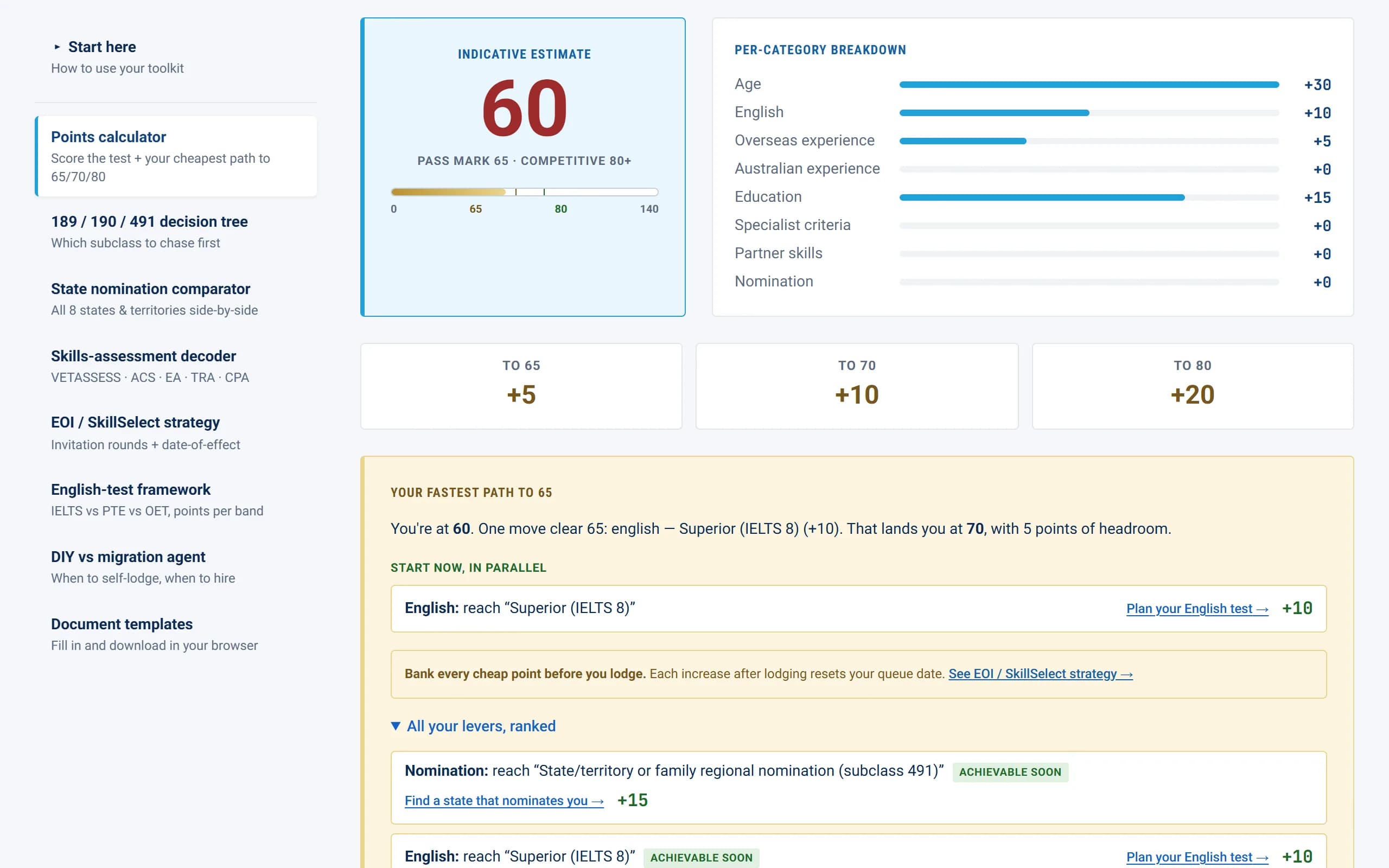
Scenario 1 — Senior wealth adviser from London: Age 32 (30) + Master's (15) + Superior English (20) + 8 years experience (15) + 190 nomination (5) = 85 points. Competitive for invitation.
Scenario 2 — Mid-career adviser from Singapore: Age 35 (25) + Bachelor's (15) + Proficient English (10) + 5 years experience (10) + 491 regional nomination (15) = 75 points. Workable with employer sponsorship as a parallel path.
State Nomination
New South Wales
Sydney hosts the largest concentration of financial advice firms — Macquarie's wealth division, Morgan Stanley Wealth Management, JBWere, Crestone, and most boutique private client practices. NSW nominates Financial Investment Adviser in 2026, with priority for candidates holding current Australian job offers or 3+ years of comparable Hong Kong, Singapore, UK, or US wealth advisory experience.
Victoria
Melbourne is home to Insignia Financial, MLC Wealth, and a strong cluster of mid-tier advice dealerships. Victoria nominates this occupation and prioritises candidates aligned with priority sectors — financial services counts. The 2025-26 Victorian program allocates 2,700 places for 190 and 700 for 491.
Queensland
Brisbane and the Gold Coast host a substantial retirement-wealth and SMSF advice market. Queensland occasionally nominates Financial Investment Adviser, typically for candidates with Queensland job offers in regional centres.
Other States
South Australia and the Australian Capital Territory have nominated this occupation in some years; verify the current 2026 list before lodging an Expression of Interest. Tasmania, Western Australia, and the Northern Territory have small advice markets and rarely nominate.
Salary and Employment Outlook
| Role Level | Salary Range (AUD) |
|---|---|
| Paraplanner / Associate Adviser | $75,000-$110,000 |
| Financial Adviser (Authorised Representative) | $110,000-$160,000 base + commission |
| Senior Adviser (HNW / Private Wealth) | $150,000-$220,000 base + 30-50% bonus |
| Private Banker (HNW) | $180,000-$300,000 OTE |
| Practice Principal / Partner | $250,000-$500,000+ |
| Self-Employed AFSL Holder | Variable; top performers $400,000+ |
SEEK's May 2026 data places the typical Financial Adviser base salary at $120,000-$140,000. Indeed reports $114,850 across all experience levels. Glassdoor shows wider variance because senior private wealth advisers report total compensation including commission, which can match or exceed base salary.
Total packages: 11.5% superannuation, performance bonus (varies hugely — Macquarie's wealth advisers can earn 50%+ of base in good years), and equity in privately-held advice practices.
Highest-paying sectors: private banking (Macquarie Private Bank, Morgan Stanley, JBWere, Crestone, UBS Australia), self-managed super fund specialists, and estate planning practices serving high-net-worth families.
Tips for a Successful Application
1. Verify Your Degree Is on the FASEA Approved List
Even with a positive VETASSESS skills assessment, you cannot legally provide personal advice to retail clients in Australia until your degree is recognised under the ASIC professional standards regime. Check the Approved Degrees list early — many international finance degrees need 1-2 bridging units from Kaplan Professional, Deakin, or Western Sydney University. Plan the bridging study around your visa pathway.
2. Choose the Right ANZSCO Code
If your work is institutional, capital markets, or commercial broking, 222311 is not the right code — VETASSESS will reject you. Genuine retail/HNW personal advice work fits 222311. Institutional dealing fits 222312 Financial Markets Dealer. Lending and mortgage advice fits 222112 Finance Broker. Picking the wrong code is one of the most common application failures.
3. Build Australian Compliance Familiarity Before Arriving
Australian advisers operate under Chapter 7 of the Corporations Act, the ASIC professional standards, and the Tax Practitioners Board regime for advisers giving tax advice. Familiarise yourself with the Best Interests Duty, fee disclosure requirements, and the Compensation Scheme of Last Resort before interviewing. Hiring managers test for this in early conversations.
4. Target Established Sponsors
Most boutique advice practices have never sponsored a 482 visa. The realistic employer-sponsored pool sits at the larger end: Insignia, AMP, Centrepoint Alliance, Big 4 firms with advice divisions (KPMG, EY, PwC, Deloitte), and the larger private banks (Macquarie, Morgan Stanley, JBWere). Focus job applications there rather than chasing small practices that lack sponsorship capacity.
5. Document Your AUM Track Record
For senior wealth roles, Australian employers want hard numbers — assets under advice, client retention rates, average client size, and revenue contribution. UK, Singapore, and Hong Kong advisers typically have these figures from internal reporting. Build them into your CV and interview narrative. They matter more than generic experience descriptions.
Step-by-Step Migration Roadmap
- Confirm ANZSCO 222311 fits your duties — read the official description and align references
- Check FASEA Approved Degree status — identify any bridging units you'll need from Kaplan or a university
- Sit your English test — IELTS 7.0+ minimum; aim for 8.0 for points
- Lodge VETASSESS Group A assessment — pay $1,096 offshore or $1,205.60 onshore
- Submit EOI in SkillSelect — for 190 or 491
- Apply for state nomination — NSW or Victoria for 190; verify regional state for 491
- Alternatively, apply directly to Australian employers — Macquarie, Insignia, AMP, Big 4 advice teams
- Receive invitation or job offer with sponsorship
- Lodge visa application — 190/491 ($6,140) or 482 ($4,015)
- Plan bridging study and Professional Year — for ASIC registration once in Australia
- Sit the Financial Adviser Standards Exam — administered by ASIC
- Complete Professional Year and full registration — typically 1-2 years after arrival
Frequently Asked Questions
Can I work in Australia as a financial adviser straight after my visa is granted?
Not for retail personal advice. ASIC's professional standards regime requires an approved degree, the FAS exam, and a Professional Year. Most overseas-trained advisers need to complete bridging units and the FAS exam before they can give regulated personal advice. Many start in associate adviser or paraplanner roles for the first 12-18 months while completing the requirements, then transition to authorised representative status.
Is wholesale advice easier than retail advice?
Yes, regulatory-wise. Advice to wholesale clients (sophisticated investors above asset/income thresholds, or businesses) is outside the professional standards regime that applies to retail advice. Private banking, family office work, and corporate wealth advisory can sometimes be structured around wholesale clients, which avoids the FAS exam and Professional Year obligations. Most senior overseas advisers find this pathway natural.
How does Australia's adviser market compare to the UK or Hong Kong?
Smaller and less commission-driven. Australia banned commissions on most investment and super advice in 2013 (the Future of Financial Advice reforms), forcing the market onto fee-for-service. The Hayne Royal Commission tightened standards further. The result: fewer advisers, higher per-client revenue, more regulatory load. The remaining market is professional, well-paid, and growing — but the days of high-volume commission-based advice are over.
Will the OSCA classification replace ANZSCO 222311?
OSCA 2024 Version 1.0 was released in December 2024 with a new code for Financial Investment Adviser, but the Department of Home Affairs has not adopted OSCA for migration purposes. ANZSCO 222311 remains operative for visa applications throughout 2026. Watch the skilled occupation list updates for transition timing.
What are the most common reasons financial adviser applications fail?
Three failure modes recur: (1) qualification field mismatch — a non-finance degree assessed as not highly relevant; (2) duties mismatch — applicants whose actual work was banking, lending, or institutional dealing rather than personal advice; (3) underestimating ASIC requirements — applicants land in Australia and discover they cannot practise without 6-18 months of bridging study and a Professional Year. Address all three before lodging.