Building and Engineering Technicians nec Visa Pathway to Australia: Complete 2026 Guide
Updated: 16 August 2026
Australia classifies Building and Engineering Technicians nec under ANZSCO 312999. VETASSESS conducts the skills assessment for AUD $1,096. The occupation sits on the Core Skills Occupation List (CSOL) and the Regional Occupation List (ROL), unlocking subclasses 491, 494, 482 and 186. Typical 2026 salaries range AUD $75,000-$130,000 depending on specialisation. The "nec" classification means duties must not fit an existing technician code.
Quick Facts: Building and Engineering Technicians nec Migration Pathway
| Detail | Information |
|---|---|
| ANZSCO Code | 312999 (Building and Engineering Technicians not elsewhere classified) |
| Skill Level | 2 (AQF Associate Degree, Diploma or Advanced Diploma) |
| Skills Assessment | VETASSESS (Vocational Education and Training Assessment Services) |
| Occupation List | CSOL and ROL |
| Visa Options | 482, 491, 494, 186 |
| Demand Level | Moderate — sustained construction and infrastructure pipeline drives technical support roles |
| Salary Range | AUD $75,000-$130,000 (SEEK / Jobs and Skills Australia 2025-26) |
| Typical 189 Score | Not eligible — 189 requires MLTSSL listing |
| Key Challenge | Proving duties don't fit a more specific 3129xx or 3122xx code |
What This Role Looks Like in Australia
Building and Engineering Technicians nec is the catch-all unit group for technicians whose work supports building and engineering professionals but does not align with the more specific codes — Architectural Draftsperson (312111), Civil Engineering Draftsperson (312211), Electrical Engineering Technician (312312), Mechanical Engineering Technician (312512), Mine Deputy (312912), or Surveying Technician (312116).
In practice, applicants in this code work as energy assessors, building information modelling (BIM) coordinators on engineering teams, asset management technicians, materials testing technicians, or specialist drafting roles that combine building and engineering work. The Australian construction and infrastructure pipeline — particularly transport megaprojects in NSW and Victoria, renewable energy build-out in regional QLD and SA, and defence infrastructure in WA and SA — has kept demand steady for technical support staff.
Most jobs sit with engineering consultancies (Aurecon, Arup, GHD, Beca, Mott MacDonald), tier-one contractors (Lendlease, CPB, John Holland), or government infrastructure authorities (Transport for NSW, Major Road Projects Victoria, Cross River Rail Delivery Authority in Queensland). Regional concentrations follow major project locations: Western Sydney for airport and metro projects, Geelong-to-Melbourne corridor for road and rail, and the Pilbara and Hunter Valley for resources work.
ANZSCO 312999 in Detail
The 312999 code captures Building and Engineering Technicians whose duties don't squarely fit a more specific sub-code. The ABS ANZSCO 2022 rev 1 description lists tasks such as conducting field tests on engineering materials, preparing technical drawings and reports, monitoring building work to verify compliance with plans, assisting in research, and inspecting installations.
Because this is a "not elsewhere classified" code, VETASSESS scrutinises whether your duties could have been assigned to one of the dedicated technician codes. If your work clearly aligns with a more specific code — for instance, civil drafting under 312211 or electrical engineering technician under 312312 — you must nominate that code instead. Using 312999 as a fallback when a specific code applies is the single most common reason for a negative assessment outcome.
Sub-roles That Typically Fit 312999
- Energy efficiency assessors and rating technicians
- BIM technicians working across multiple disciplines
- Asset condition assessment technicians
- Specialist materials testing roles (acoustics, geotechnics, structural materials)
- Coordination roles between building and engineering teams that don't fit drafting codes
Skills Assessment — VETASSESS
VETASSESS is the assessing authority for 312999. Because the code is at Skill Level 2 and sits under the broader VETASSESS General Occupations stream, applicants face a slightly different track than the professional occupations stream.
Requirements:
- An AQF Associate Degree, Advanced Diploma or Diploma (or equivalent) in a relevant field — building, construction, engineering, drafting, energy assessment, or building surveying
- At least one year of post-qualification employment at an appropriate skill level in the five years before applying
- Tasks performed must align closely with the official ANZSCO 312999 description
- For applicants without a closely related qualification, additional employment may be required to demonstrate equivalence
Assessment Cost: AUD $1,096 (offshore standard, from 22 October 2025). Onshore applicants pay AUD $1,205.60 including GST. Priority processing adds approximately AUD $825.
Processing Time: 8-12 weeks standard. Priority processing aims for 10 business days.
Common rejection reasons: VETASSESS routinely rejects 312999 applications where the duties match a specific technician code (e.g. drafting work that should fit 312111 or 312211). The second-most common reason is insufficient depth in employment references — a payslip plus a one-line letter doesn't establish that you actually performed Skill Level 2 tasks. Detailed duty statements from a senior referee are essential.
Visa Pathways
Subclass 482 — Skills in Demand (Core Skills Stream)
The dominant pathway for this occupation. CSOL listing unlocks the Core Skills stream of the 482.
- Visa fee: AUD $4,015 (primary applicant, Core Skills stream)
- Salary threshold: Core Skills Income Threshold (CSIT) currently AUD $79,423
- Duration: Up to 4 years
- Pathway to PR: Eligible for 186 transition after meeting work and employer requirements
Employer sponsorship is straightforward where a project sponsor — typically a tier-one contractor or engineering consultancy — is already set up as a Standard Business Sponsor. Many infrastructure employers run continuous 482 sponsorship pipelines for project staff.
Subclass 494 — Skilled Employer Sponsored Regional (Provisional)
For technicians taking up roles outside Sydney, Melbourne and Brisbane metropolitan areas.
- Visa fee: AUD $4,910 (primary applicant)
- Duration: 5 years provisional, with permanent residency pathway via subclass 191 after 3 years
- Reality: Regional infrastructure projects — wind farms, transmission lines, regional hospitals, freight rail — are the strongest 494 channel for 312999 holders
Subclass 491 — Skilled Work Regional (state or family nominated)
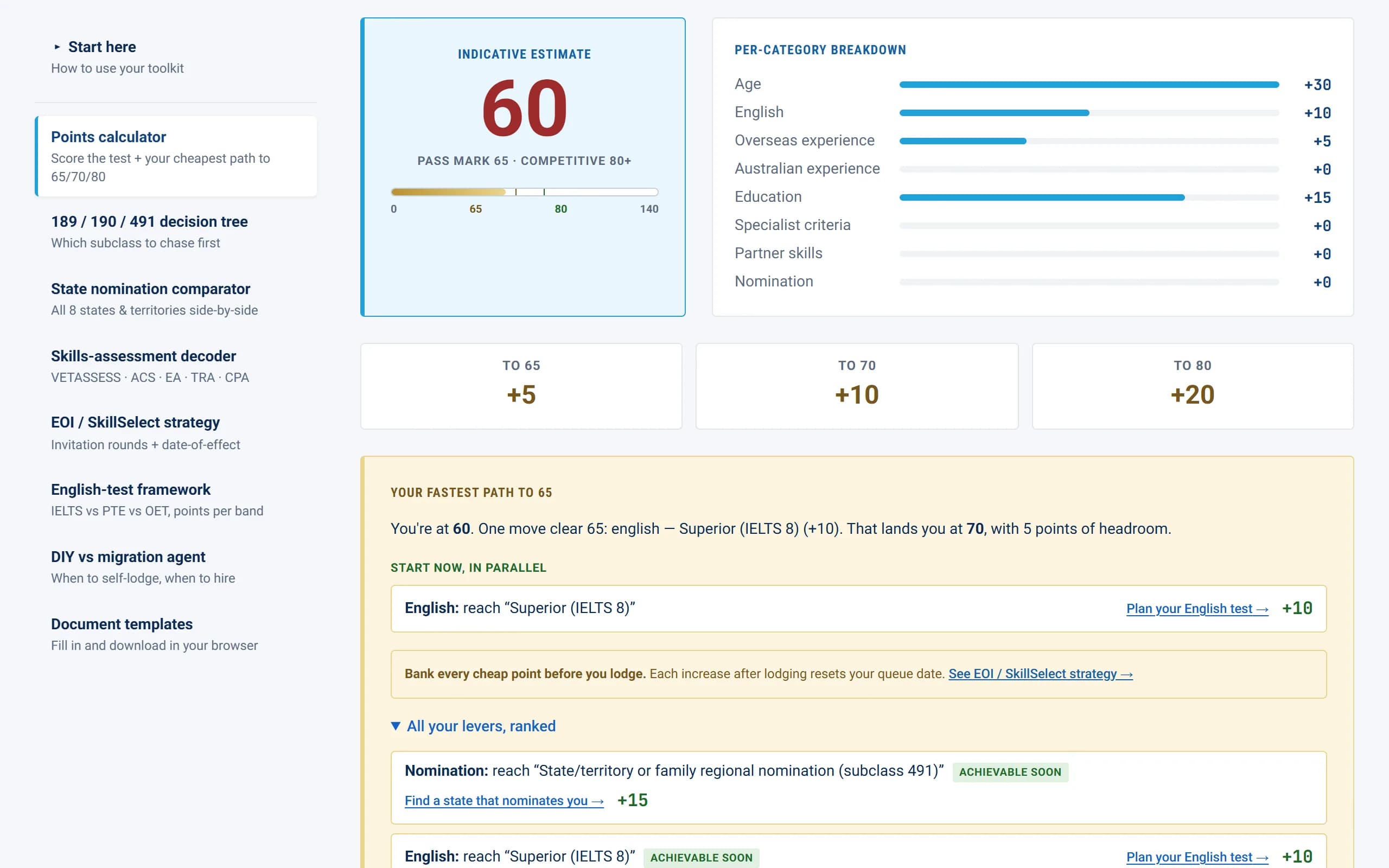
Points-tested regional visa. State nomination adds 15 points.
- Visa fee: AUD $6,140
- Points boost: +15 from regional state or eligible family nomination
- Duration: 5 years, PR via subclass 191 after meeting income and residence requirements
- Note: Few states currently nominate 312999 directly. Check the state lists each program year.
Subclass 186 — Employer Nomination Scheme
Permanent residency through employer sponsorship.
- Visa fee: AUD $6,140
- Streams: Direct Entry (for applicants with 3+ years skilled experience and a positive skills assessment) or Temporary Residence Transition (after 2+ years on the 482)
- Reality: The TRT stream is the realistic route for most 312999 applicants — start on a 482, transition after 2 years
State Nomination
Because 312999 is on the CSOL and not on the MLTSSL, the primary route is employer-sponsored (482/494/186). State nomination for the points-tested 491 is available where states include the code on their published list.
Victoria
Victoria draws its 190 and 491 selection from the Commonwealth Skilled Occupation List rather than publishing a separate list. ICT and engineering occupations are listed as priority sectors. Selection is by invitation following a Registration of Interest. Recent invitation rounds have included building and engineering technicians where applicants demonstrated Victorian employment or a strong link to a priority sector project.
South Australia and Tasmania
Both states periodically include construction and engineering technician roles where regional employer demand exists. Eligibility shifts each program year — check the South Australia Skilled Migration list and the Tasmania Skilled Occupation List before submitting an EOI.
Salary and Employment Outlook
What 312999 Roles Pay in 2026
| Role | Typical Salary Range |
|---|---|
| BIM Technician (junior) | AUD $75,000-$95,000 |
| BIM Coordinator | AUD $95,000-$125,000 |
| Energy Efficiency Assessor | AUD $75,000-$100,000 |
| Materials Testing Technician | AUD $80,000-$110,000 |
| Asset Management Technician | AUD $85,000-$115,000 |
| Specialist (acoustics, geotechnics) | AUD $100,000-$130,000 |
Total packages include the legislated 12% Superannuation Guarantee (rate from 1 July 2025). Tier-one contractors typically add project allowances for site-based roles, and consultancy firms add charge-out bonuses for billable utilisation.
Highest-Paying Sectors
- Tier-one infrastructure contractors — Lendlease, CPB, John Holland, Acciona, Webuild
- Engineering consultancies — Aurecon, Arup, GHD, AECOM, Jacobs, Mott MacDonald
- Government delivery authorities — Transport for NSW, Major Road Projects Victoria, Cross River Rail
- Resources sector — BHP, Rio Tinto, Fortescue (high pay, FIFO patterns)
- Defence and utilities — Snowy Hydro, Transgrid, NBN Co, Defence estate work
Tips for a Successful Application
1. Confirm 312999 is the Right Code Before Lodging
VETASSESS rejects roughly one in five 312999 applications because the work clearly fits a specific code instead. Read the ANZSCO descriptions for 312111, 312211, 312312, 312512 and 312911 before nominating 312999. If 70% of your day-to-day work fits one of those, nominate that code.
2. Write Duty Statements That Match the ANZSCO Tasks
Your employer references must describe duties using language that mirrors the official ANZSCO 312999 task list. Vague statements like "supported engineering team" fail; specific statements like "prepared technical drawings and reports for a $40m transmission upgrade, conducted field testing of structural materials, and inspected installation works against design documentation" pass.
3. Document the AQF-Equivalent Qualification Properly
VETASSESS verifies that overseas qualifications meet the AQF Diploma or Associate Degree level. Submit the full transcript, syllabus or course outline, and any professional body recognition (e.g. RICS, ICE Technician grade) alongside the testamur.
4. Use a Standard Business Sponsor With Real History
For the 482 and 494 routes, an employer that is already an active Standard Business Sponsor and has lodged successful nominations in the prior 12 months will move your application significantly faster than a first-time sponsor.
5. Plan English Test Timing Around the Skills Assessment
VETASSESS does not require an English test for the skills assessment itself, but the visa stage requires Competent English (IELTS 6.0 in each band or equivalent) at minimum, and Proficient (IELTS 7.0) significantly boosts your points-tested 491 EOI. Book the test as soon as the skills assessment is lodged.
Step-by-Step Migration Roadmap
- Confirm ANZSCO 312999 fits — review the ANZSCO code finder and rule out specific 3129xx codes
- Verify CSOL listing — confirm 312999 remains on the Core Skills Occupation List for the current program year
- Compile evidence — qualification documents, employment references with duty statements, payslips, contracts
- Lodge VETASSESS application — AUD $1,096 offshore, 8-12 week processing
- Sit your English test — IELTS, PTE Academic, or equivalent
- Find a sponsor (482/494 route) — target Standard Business Sponsors in infrastructure or consulting
- Or submit an EOI in SkillSelect — for 491 if a state lists 312999
- Apply for state nomination — Victoria, SA, or Tasmania if listed that program year
- Lodge the visa application — 482, 491, 494 or 186 depending on pathway
- Complete health and character checks — Bupa Medical Visa Services for the medical
- Receive grant and relocate — for 491/494, you must live and work in the nominated region
- Plan transition to PR — 186 TRT stream after 2 years on 482, or 191 after 3 years on 491/494
Frequently Asked Questions
Why is 312999 only on the CSOL and not the MLTSSL?
The Department of Home Affairs and Jobs and Skills Australia review occupation list placements annually. Building and Engineering Technicians nec is treated as a residual category, so it tends to fall on the broader CSOL alongside other technician roles where shortages are sector-specific rather than national. Without an MLTSSL listing, the points-tested 189 is unavailable, but the 482 employer-sponsored stream remains a strong pathway.
Can I nominate 312999 if my role is "Building Inspector" or "Energy Assessor"?
Possibly. Building inspectors with statutory functions usually fit ANZSCO 312113 Building Inspector, not 312999. Energy assessors generally do fit 312999 where the role combines building and engineering knowledge without a dedicated code. The decisive factor is whether your duties match the ANZSCO 312113 description first; if not, 312999 is the fallback.
How long does the full VETASSESS-to-visa-grant timeline take for 312999?
Realistically 9-15 months end-to-end. VETASSESS skills assessment takes 8-12 weeks (or 10 business days with priority). English test, employer onboarding, and 482 nomination plus visa application add another 4-8 months. State nomination for the 491 route can stretch the timeline to 18 months in slower invitation cycles.
Is the 482 employer-sponsored route easier than the 491 for this occupation?
For most applicants, yes. 312999 isn't currently a competitive code on the points-tested system because few states actively nominate it. The 482 doesn't require points; it requires a Standard Business Sponsor, a positive skills assessment, English at Vocational level (IELTS 5.0 each band), and a salary at or above the AUD $79,423 Core Skills Income Threshold. Tier-one contractors and consultancies are well-versed in sponsoring this occupation.
What are the most common reasons 312999 applications fail?
Three reasons dominate VETASSESS refusals: (1) duties that should have been nominated under a more specific 3129xx code, (2) thin employer references that don't establish Skill Level 2 work, and (3) qualifications below AQF Associate Degree equivalence with insufficient additional employment to bridge the gap. Each is fixable before lodgement — the failure mode is usually not getting independent advice before paying the assessment fee.
For a wider view of skilled migration options, see the most in-demand occupations in Australia for 2026 and the complete skills assessment bodies list.