Quantity Surveyor Visa Pathway to Australia: Complete 2026 Guide
Updated: 16 August 2026
Australia classifies Quantity Surveyor under ANZSCO 233213 (OSCA 241932). The Australian Institute of Quantity Surveyors (AIQS) conducts the skills assessment. The occupation sits on both the MLTSSL and the Core Skills Occupation List, unlocking subclasses 189, 190, 491, 482, and 186. Typical 2026 SEEK salaries range AUD $95,000-$140,000, with regional construction-heavy markets paying significantly more. Queensland flags Quantity Surveyor under its Building and Construction Pathway, giving applicants priority in 190 and 491 rounds.
Quick Facts: Quantity Surveyor Migration Pathway
| Detail | Information |
|---|---|
| ANZSCO Code | 233213 (Quantity Surveyor) — now mapped to OSCA 241932 |
| Skill Level | 1 (Bachelor degree or higher in quantity surveying or construction economics) |
| Skills Assessment | AIQS (Australian Institute of Quantity Surveyors) |
| Occupation List | MLTSSL and CSOL |
| Visa Options | 189, 190, 491, 482, 186 |
| Demand Level | High — flagged in Queensland's Building and Construction Pathway and on the Jobs and Skills Australia Occupation Shortage List |
| Salary Range | AUD $95,000-$140,000+ (SEEK, 2026) |
| Typical 189 Score | 80-90 points, with most invitations at 85+ |
| Key Challenge | AIQS processing can take up to five months, and pathway selection turns on the right mix of qualifications and documented experience |
What Quantity Surveyors Do in Australia
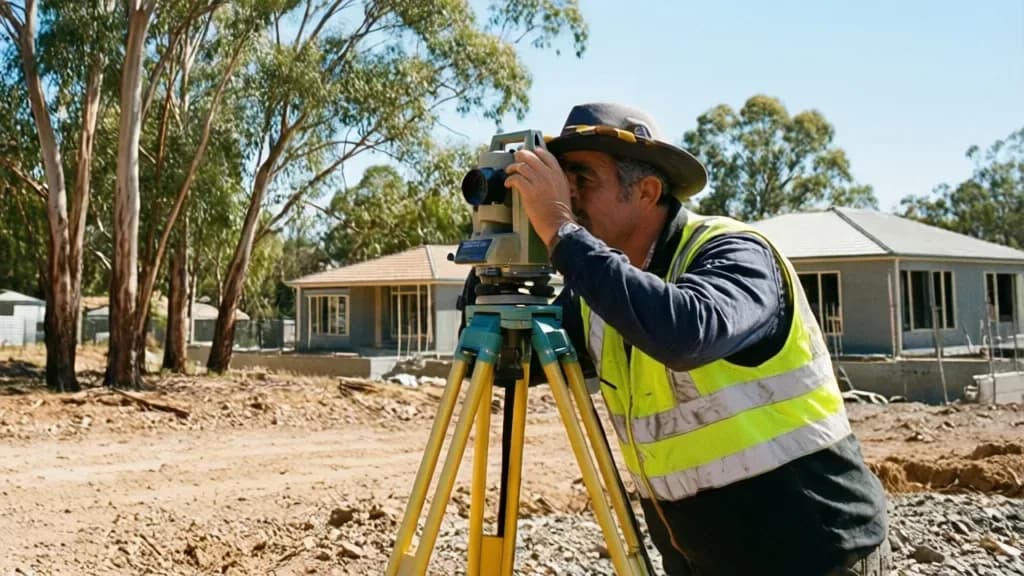
Australian quantity surveyors price, control, and manage the cost of construction projects from concept design through final account. The work splits across consultancy practice (cost-planning advisory firms), contractor side (commercial managers inside head contractors), client side (estimators inside government bodies, developers, and asset owners), and dispute and claims work. Major employers include Turner & Townsend, Rider Levett Bucknall, WT Partnership, Slattery, AECOM, Mitchell Brandtman, and the cost-management arms of the Big 4.
Demand is anchored to Australia's federal and state infrastructure pipelines — the Western Sydney Airport build-out, Brisbane 2032 Olympic infrastructure, Melbourne Metro Tunnel, Suburban Rail Loop, Snowy 2.0, transmission upgrades under the Integrated System Plan, and the social and defence housing programs running across every state. Building cost escalation, project complexity, and the disputes pipeline have all pushed the demand curve up.
Geographically, work concentrates in Sydney, Melbourne, Brisbane, and Perth, with strong regional pockets in mining services (Pilbara, Bowen Basin, Goldfields), the Snowy region, and the LNG corridors of Queensland and the Northern Territory.
ANZSCO Code Mapping
Quantity Surveyor sits at ANZSCO 233213, within the broader unit group of Other Engineering Professionals. The Australian Bureau of Statistics is in the process of migrating ANZSCO to the new OSCA classification — AIQS now references OSCA 241932 in its assessment paperwork, but the Department of Home Affairs continues to publish occupation lists against ANZSCO 233213 for visa purposes. Applicants list 233213 on their EOI.
Core duties recognised under the code include preparing bills of quantities, cost plans, tender documents, and contract administration paperwork; advising on procurement strategy; preparing progress claims and variations; managing contracts including NEC, AS 4000, AS 2124, AS 4902, and GC21; and providing expert evidence on quantum and delay matters.
There is no separate code for cost estimator, construction economist, building economist, or commercial manager — all map to 233213 if duties align with the ANZSCO statement.
Skills Assessment with AIQS
AIQS is the Department of Home Affairs-nominated authority for Quantity Surveyor. It runs a structured pathway-based system, not a single one-size assessment.
The Five AIQS Assessment Pathways
- Pathway 1 — Accredited Australian degree. The shortest route; AIQS recognises a defined list of accredited Australian quantity surveying programs.
- Pathway 2 — Accredited overseas degree from an RICS-accredited or AIQS-accredited program plus documented experience.
- Pathway 3 — Non-accredited degree with substantial assessed experience and continuing professional development evidence.
- Pathway 4 — Holders of full membership (MRICS, MAIQS, MNZIQS, or equivalent) with the relevant professional body.
- Qualifications Only — A reduced-scope assessment confirming qualification but not experience, often used by graduates who lack the post-qualification years required for Pathways 1-4.
Requirements
- A bachelor degree (or higher) in quantity surveying, construction economics, or a closely related construction discipline.
- Detailed evidence of post-qualification experience, including project lists, role descriptions, and signed employer references.
- Continuing professional development records covering recent years.
- English language evidence at IELTS 6.0 (or equivalent) for assessment purposes — visa English thresholds are higher and assessed separately.
Cost and Processing Time
- Pathways 1-4: AUD $655 (ex GST). Qualifications Only: AUD $555 (ex GST).
- Reassessment: AUD $350 (ex GST). Appeals: AUD $400 (ex GST).
- Processing time: AIQS publishes a guide of up to five months. Straightforward applications often clear in 8-12 weeks; complex ones, particularly Pathway 3, run longer.
Common Rejection Reasons
The two recurring failure modes are reference letters that describe project-management or general construction duties rather than the cost, contract, and quantum work the ANZSCO statement requires, and qualification gaps where the applicant holds a civil-engineering or construction-management degree without the dedicated quantity surveying or construction economics content AIQS expects. Sit a pre-assessment review with a migration agent before lodging Pathway 3 if your degree is borderline.
Visa Pathways
Subclass 189 — Skilled Independent Visa
The points-tested permanent visa, available because Quantity Surveyor is on the MLTSSL.
- Visa application charge: AUD $6,135 (primary applicant)
- Realistic invitation score: 85+ points in 2026 SkillSelect rounds; 189 invitations have been thin for several quarters, so most applicants pair the EOI with a 190 or 491 strategy.
- Processing time: Home Affairs publishes service standards by stream; allow 6-12 months from invitation in practice.
Subclass 190 — Skilled Nominated Visa
State nomination adds 5 points and remains the most common permanent pathway for quantity surveyors in 2026.
- Visa application charge: AUD $6,140
- Points boost: +5 from state nomination
- Obligation: Commit to live and work in the nominating state for 2 years
- State activity: Queensland flags Quantity Surveyor under its Building and Construction Pathway, which carries elevated invitation priority. NSW and South Australia have both invited 233213 in 2026 rounds.
Subclass 491 — Skilled Work Regional Visa
Regional nomination from a state or territory adds 15 points. A 5-year provisional visa with a defined pathway to permanent residency via subclass 191.
- Visa application charge: AUD $6,140
- Points boost: +15 from regional nomination
- Pathway: 3 years of regional residence and qualifying income, then 191 PR
Subclass 482 — Skills in Demand Visa
Employer-sponsored temporary visa, replaced the old TSS framework in late 2024.
- Visa application charge: AUD $3,210 (Core Skills stream, primary applicant)
- Core Skills income threshold: AUD $76,515 — quantity surveyor salaries clear this comfortably from mid-level upward
- Specialist Skills threshold: AUD $141,210 — senior consultancy and contractor commercial roles often qualify
- Duration: Up to 4 years, with a permanent pathway via subclass 186
Subclass 186 — Employer Nomination Scheme
Employer-sponsored permanent residency.
- Visa application charge: AUD $6,140
- Streams: Direct Entry, or Temporary Residence Transition after two years on a qualifying 482
Points Test Strategy
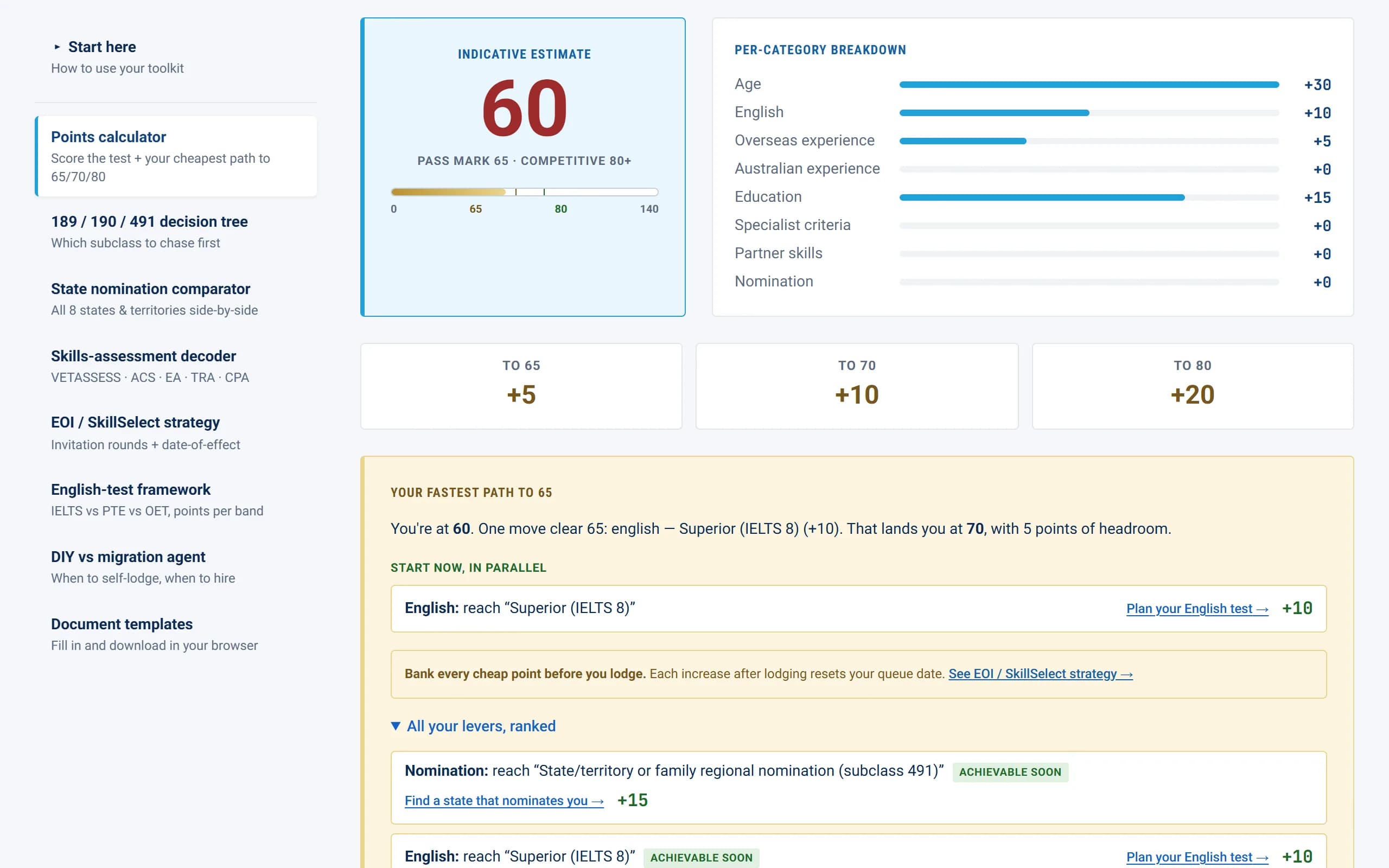
Quantity Surveyor is a sub-competitive niche compared with ICT — meaning invitations land at lower scores than software engineering, but higher than nursing. Build your points sheet honestly.
| Points Factor | Points | Notes |
|---|---|---|
| Age (25-32) | 30 | Maximum bracket |
| Age (33-39) | 25 | Common for senior QS migrants |
| English (Superior, 8.0+) | 20 | The single biggest controllable lever |
| English (Proficient, 7.0) | 10 | More realistic for many applicants |
| Bachelor degree | 15 | Skill Level 1 baseline |
| Master's degree | 15 | Same band as bachelor |
| PhD | 20 | Rare in QS but it counts |
| Overseas experience 8+ years | 15 | After any AIQS experience deductions |
| Overseas experience 5-7 years | 10 | Common mid-career band |
| Australian experience 3+ years | 15 | If you are already onshore |
| State nomination (190) | 5 | Adds 5 |
| Regional nomination (491) | 15 | Adds 15 |
| Partner skills | 5-10 | If partner is also assessed |
Realistic Score Scenarios
Scenario 1: Mid-career UK MRICS holder, 34 years old, IELTS 7.0
- Age (33-39): 25 + Proficient English: 10 + Bachelor: 15 + Overseas experience 8+ years: 15 = 65 points
- Add 190 nomination: 70 points — competitive in Queensland Building and Construction Pathway rounds for 233213
- Push English to Superior: 80 points — comfortable across most states
Scenario 2: South African quantity surveyor, 30 years old, single, Proficient English, 6 years experience
- Age: 30 + Proficient English: 10 + Bachelor: 15 + Overseas experience 5-7: 10 = 65 points
- Add 491: 80 points — strong for regional Queensland or South Australia
State Nomination
Queensland
Quantity Surveyor (233213) sits inside Queensland's Building and Construction Pathway, which the state government has signalled as a priority through the lead-up to Brisbane 2032. The pathway lifts invitation likelihood materially. Both onshore and offshore applicants are eligible for 190 and 491, with onshore applicants needing to evidence Queensland employment.
New South Wales
NSW has the largest construction pipeline in the country and continues to invite Quantity Surveyor in 2026 rounds, with infrastructure and tier-one construction employers driving demand. Cut-off scores for 190 sit in the high 80s for construction occupations. Sydney-based candidates with documented local experience clear at lower scores than offshore applicants.
South Australia
South Australia includes Quantity Surveyor on its skilled list, with engineering and construction flagged as priority sectors. The state has historically been one of the more accessible 190 routes for QS migrants with verifiable mid-career experience. SA prioritises offshore applicants with strong English where the role addresses regional shortages.
Western Australia
WA's resource and infrastructure pipeline supports demand for quantity surveyors across mining services, oil and gas, and the metro rail program. WA's 2025-26 program lists Quantity Surveyor for both 190 and 491. The Pilbara and Goldfields regional 491 routes pay top-of-market salaries.
Salary and Employment Outlook
What Quantity Surveyors Earn in Australia (2026)
| Role / Seniority | Typical Salary Range (SEEK, 2026) |
|---|---|
| Graduate Quantity Surveyor | AUD $70,000-$85,000 |
| Quantity Surveyor (2-4 yrs) | AUD $90,000-$115,000 |
| Senior Quantity Surveyor | AUD $120,000-$150,000 |
| Associate Director / Cost Manager | AUD $150,000-$190,000 |
| Commercial Manager (Tier 1 contractor) | AUD $170,000-$220,000+ |
| Director / Partner | AUD $220,000-$350,000+ |
| Contract QS (Mining / LNG) | AUD $1,100-$1,800/day |
Total packages typically include 12% superannuation (per the 2025-26 increase), vehicle or vehicle allowance at director level, and 10-20% bonuses in tier-one contractor roles. Sydney and Perth sit at the top of metro pay; Tumut and the Snowy region top SEEK's regional pay table for QS roles at AUD $182,500.
Highest-Paying Sectors
- Mining and resources — Pilbara iron ore, Bowen Basin coal, lithium, and the LNG corridors all pay premiums for QS contract work
- Major infrastructure — Tier-one contractors (CIMIC, Lendlease, Multiplex, John Holland, Acciona, Laing O'Rourke) running rail, road, and energy projects
- Cost consultancy — Rider Levett Bucknall, Turner & Townsend, WT Partnership, Slattery, Mitchell Brandtman, AECOM, Arcadis
- Government client side — Transport for NSW, Major Transport Infrastructure Authority, Queensland Government, Defence Estate Group
- Disputes and claims — A growing niche driven by post-pandemic project disputes and energy-transition contract complexity
Tips for a Successful Application
1. Pick the Right AIQS Pathway Before You Lodge
Pathway 2 and Pathway 4 are the fastest if you qualify. Holders of MRICS, MNZIQS, or MAIQS should lead with Pathway 4 — it relies on the membership audit your professional body has already done. Lodging Pathway 3 with thin experience evidence is the single most common cause of refusal.
2. Write Project-Level Reference Letters
AIQS wants project-level detail, not job descriptions. Each reference should list at least three named projects with project value, your specific role on each (cost planning, tender, contract administration, final account, claims), and the standard forms of contract used. Vague "responsible for cost management" wording fails.
3. Use the Right ANZSCO Description on Day One
Your employment references must use language drawn directly from ANZSCO 233213 — bills of quantities, cost plans, contract administration, variations, progress claims, and final account. Do not let referees describe your work in project management terms. The skills assessment will fail if duties read like 133111 Construction Project Manager.
4. Bank Superior English Points Early
A Superior English score (IELTS 8.0 across all bands, or PTE equivalent) adds 20 points. For quantity surveyors competing in 190 and 491 rounds, this is often the difference between an invitation and a wait. Sit it before you submit AIQS — most candidates need two attempts.
5. Target Queensland Building and Construction Pathway
If you have flexibility on where to live, Queensland's Building and Construction Pathway carries the highest invitation probability for 233213 in 2026. Brisbane 2032 infrastructure has created a multi-year demand window that is unlikely to close before 2030.
Step-by-Step Migration Roadmap
- Confirm your ANZSCO mapping — verify your duties align with 233213 using the ANZSCO code finder
- Choose your AIQS pathway — Pathway 4 if MRICS/MAIQS; Pathway 2 if accredited overseas degree; Pathway 1 if Australian-accredited
- Sit your English test — push for Superior on at least one attempt
- Gather project-level references — three or more projects per role, with values and contract forms
- Lodge AIQS assessment — pay AUD $655 ex GST and budget up to five months
- Confirm CSOL/MLTSSL status — Quantity Surveyor sits on both per the SOL 2026
- Submit EOI in SkillSelect — lodge for 189, 190, and 491 in parallel
- Apply for state nomination — Queensland Building and Construction Pathway first; NSW, SA, WA as parallel options
- Receive invitation and lodge visa — within 60 days
- Complete health, character, and biometrics checks
- Receive visa grant and relocate
Frequently Asked Questions
Is Quantity Surveyor still on the 2026 MLTSSL?
Yes. ANZSCO 233213 Quantity Surveyor sits on both the MLTSSL and the Core Skills Occupation List in 2026, which means all five skilled visas — 189, 190, 491, 482, and 186 — are open. The occupation has been a stable migration target since 2017 and the construction pipeline through Brisbane 2032 has reinforced its position.
Do I need to be MRICS to migrate as a Quantity Surveyor?
No, MRICS is not a requirement. AIQS offers five assessment pathways. MRICS, MAIQS, or MNZIQS membership opens Pathway 4, which is faster, but applicants with a recognised degree and documented experience can use Pathways 1-3 without any professional body membership.
How is the OSCA code change going to affect my application?
AIQS now references OSCA 241932 internally and on its assessment paperwork, but the Department of Home Affairs continues to publish skilled occupation lists against ANZSCO 233213. Applicants should use 233213 on the EOI and visa application. AIQS will assess under the OSCA code; the two are functionally aligned.
Will my construction-management or civil-engineering degree pass AIQS?
It can, but the assessment is more demanding. AIQS expects substantial quantity surveying and construction economics content in the degree. If your transcript is light on cost planning, bills of quantities, contract administration, and construction law, Pathway 3 with weighted experience evidence is usually the route — and a pre-assessment review is worth the cost.
Can I work in mining or oil and gas as a Quantity Surveyor on a 491?
Yes. Regional Queensland, the Pilbara, Bowen Basin, and the LNG corridors all sit inside designated regional areas for 491 purposes. Day rates for contract QS work on resource projects are among the highest in the country, and most major resources employers have sponsored 482 and 491 visas for QS roles since 2020.
What's the demand outlook through 2030?
Strong. The federal infrastructure pipeline, Brisbane 2032 build-out, the energy-transition program under the Integrated System Plan, and chronic residential construction undersupply have created a multi-year demand window. Jobs and Skills Australia continues to list quantity surveying-adjacent construction professions on its Occupation Shortage List, and the related most in-demand occupations list for 2026 shows construction roles across every state.