Registered Nurse (Surgical) Visa Pathway to Australia: Complete 2026 Guide
Updated: 16 August 2026
Australia classifies Registered Nurse (Surgical) under ANZSCO 254424. The Australian Nursing and Midwifery Accreditation Council (ANMAC) conducts the migration skills assessment, and the Nursing and Midwifery Board of Australia (via AHPRA) handles professional registration. The occupation sits on the MLTSSL and CSOL, opening subclasses 189, 190, 491, 482 and 186. Typical 2026 salaries range AUD $80,000-$115,000 base, with surgical specialty roles trending higher.
Quick Facts: Registered Nurse (Surgical) Migration Pathway
| Detail | Information |
|---|---|
| ANZSCO Code | 254424 (Registered Nurse (Surgical)) |
| Skill Level | 1 (Bachelor degree or higher) |
| Skills Assessment | ANMAC (Australian Nursing and Midwifery Accreditation Council) |
| Professional Registration | AHPRA / Nursing and Midwifery Board of Australia (mandatory before practising) |
| Occupation List | MLTSSL and CSOL |
| Visa Options | 189, 190, 491, 482, 186 |
| Demand Level | Critical — Jobs and Skills Australia confirms nurse shortage across every state and territory |
| Salary Range | AUD $80,000-$115,000 base (SEEK Salary Hub, 2026); senior surgical specialty roles can reach $140,000+ |
| Typical 189 Score | 70-85 points |
| Key Challenge | Two parallel processes — ANMAC for migration, AHPRA for the right to work |
What a Surgical Registered Nurse Does in Australia
Registered Nurse (Surgical) is one of fifteen nursing specialty codes recognised by the Australian Bureau of Statistics. The role covers nursing care in surgical wards, day surgery units and post-anaesthetic recovery. It is distinct from ANZSCO 254423 Registered Nurse (Perioperative), which covers intra-operative scrub, scout and anaesthetic nursing inside the operating theatre.
Surgical RNs in Australia typically work across acute surgical wards in public tertiary hospitals (NSW Health, Royal Melbourne, Royal Brisbane, RPA, the Alfred), private hospital groups (Ramsay Health Care, Healthscope, St Vincent's, Epworth, Mater), and the growing day-procedure sector. The work involves pre-operative preparation, wound management, surgical drain monitoring, post-operative pain assessment, early-mobilisation support, and discharge education for patients recovering from orthopaedic, general, vascular, urological, plastic and ENT surgery.
Demand is high because Australia's surgical caseload is climbing. The ageing population has driven sustained growth in joint replacement, cataract, and cardiac procedures, while elective-surgery waitlists from the pandemic backlog remain elevated in several states. Jobs and Skills Australia lists Registered Nurses in shortage nationally on the 2024 Occupation Shortage List, and that status carried through to the 2025-26 review.
ANZSCO 254424 — Code Mapping
The ABS describes Registered Nurse (Surgical) as providing nursing care to patients with injuries or illnesses requiring surgical intervention. Tasks paraphrased from the ANZSCO 2022 v1.0 description include:
- Assessing patients pre- and post-operatively
- Planning and delivering nursing care to surgical patients
- Managing surgical wounds, dressings and drains
- Monitoring vital signs and recognising post-operative deterioration
- Administering prescribed medication and analgesia
- Coordinating discharge planning with allied health and medical teams
If your day-to-day work is dominated by scrubbing, instrument handling, or anaesthetic assistance inside the operating theatre, ANZSCO 254423 Registered Nurse (Perioperative) is usually the more accurate code. If you rotate across multiple specialties without a clear surgical focus, ANZSCO 254499 Registered Nurses nec may apply. Read how to find your ANZSCO code before lodging.
Skills Assessment — ANMAC
ANMAC is the assessing authority for all 254xxx nursing codes. The ANMAC assessment is a migration document only — it does not authorise practice. Practising in Australia requires separate AHPRA registration through the Nursing and Midwifery Board.
Requirements
- Qualification equivalent to a three-year Australian Bachelor of Nursing
- Current nursing registration in your country of qualification
- English at IELTS Academic 7.0 each band, OET B in each section, or equivalent PTE/TOEFL iBT
- Practice currency — recent post-qualification experience as a registered nurse
Assessment types and fees (2026)
- Modified Skills Assessment: AUD $395 — for nurses already AHPRA-registered or holding eligibility for registration
- Full Skills Assessment: AUD $595 — for nurses not yet AHPRA-registered
- GradReady Skills Assessment (seasonal window): AUD $395
Processing time: 6-8 weeks once the application is complete. GradReady applications inside the seasonal window are faster.
Common rejection reasons
ANMAC most often refuses applications where the underlying qualification is not equivalent to an Australian Bachelor of Nursing (some hospital-based diplomas from older training systems fall short), or where English evidence is below the published standard. Practice currency gaps of more than five years also trigger refusals or requests for further evidence.
Professional Registration — AHPRA
AHPRA registration through the Nursing and Midwifery Board of Australia is mandatory before you can work as a nurse in Australia. The process runs in parallel to ANMAC — start it early.
The Internationally Qualified Registered Nurse (IQRN) pathway was streamlined from April 2025. Nurses from comparable jurisdictions with substantial recent experience can now be assessed in 1-3 months under the fast-tracked stream; nurses requiring additional assessment work to 3-6 months.
Indicative fees (2025-26): application AUD $151, provisional registration AUD $226, plus an annual renewal in the AUD $175-$200 band depending on registration type. NSW-principal practice attracts an additional Pharmacy/Nursing Council levy — verify on the AHPRA fee schedule before applying.
The two processes are independent. A positive ANMAC outcome does not grant AHPRA registration, and AHPRA approval is not accepted in place of an ANMAC certificate for visa purposes.
Visa Pathways for Registered Nurse (Surgical)
Subclass 189 — Skilled Independent
Permanent residency through the points test. The 189 is achievable for nurses because the points-test threshold is not as competitive as ICT occupations.
- Visa fee: AUD $6,135 primary applicant (Home Affairs 2025-26 schedule)
- Realistic invitation score: 70-85 points
- Processing: 8-14 months
- Quirk: Nursing invitations have historically cleared at lower scores than software engineering — a 75-point profile is competitive in most rounds
Subclass 190 — State Nominated
State nomination adds 5 points and grants permanent residency conditional on living in the nominating state for the early years of the visa.
- Visa fee: AUD $6,140
- Strongest states for surgical RNs in 2026: NSW, Victoria, Queensland, South Australia — all include Registered Nurse codes on their 2025-26 skilled lists
- Processing: 9-19 months (state nomination is a separate step before Home Affairs assessment begins)
Subclass 491 — Skilled Work Regional
Five-year provisional visa with a pathway to PR via subclass 191 after meeting income and residence thresholds.
- Visa fee: AUD $6,140
- Points boost: +15 from regional nomination
- Processing: 12-15 months
- Quirk: Regional hospitals (Bendigo Health, Townsville Hospital, Tamworth Base) often sponsor and nominate offshore surgical nurses directly
Subclass 482 — Skills in Demand (Core Skills Stream)
Employer-sponsored temporary visa, four-year duration.
- Visa fee: AUD $4,015 (Core Skills stream, primary)
- Core Skills Income Threshold: AUD $79,423 (Core Skills) — most public-system surgical RN roles clear this
- Processing: Median 21-47 days; priority processing is faster
- Quirk: Major hospital groups have standing 482 sponsorship arrangements and run direct overseas recruitment campaigns
Subclass 186 — Employer Nomination Scheme
Permanent residency via employer sponsorship.
- Visa fee: AUD $6,140
- Streams: Direct Entry or Temporary Residence Transition (after 2 years on a 482)
- Processing: 12-20+ months in 2026 — backlog is significant
Points Test Strategy
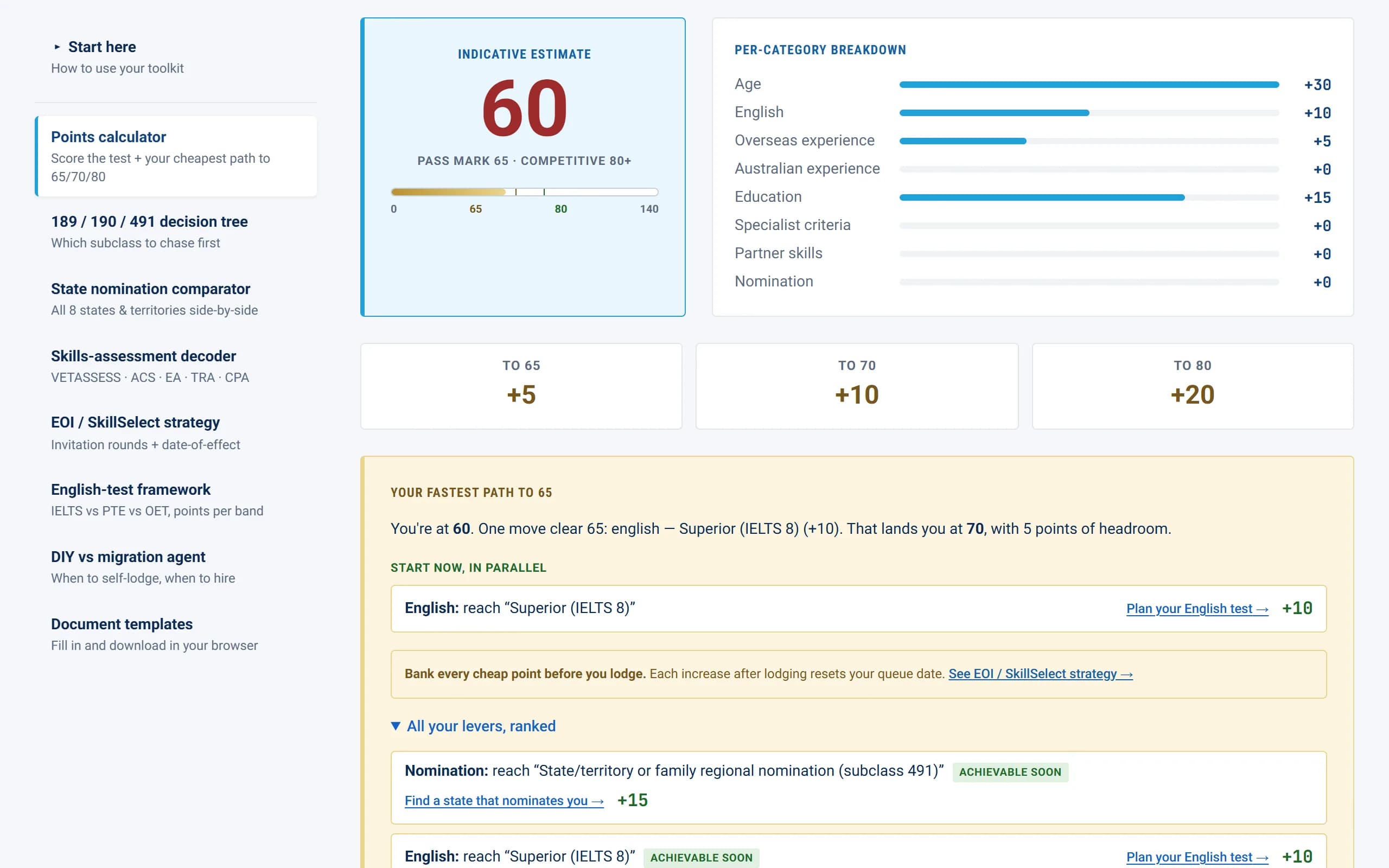
A typical surgical RN profile in 2026 looks like this:
| Points Factor | Points | Notes |
|---|---|---|
| Age 25-32 | 30 | Maximum bracket |
| Bachelor of Nursing | 15 | Skill Level 1 minimum |
| Master's | 15 | No change vs bachelor unless combined with Australian study |
| English Superior (IELTS 8.0 / OET A) | 20 | Strong if achievable |
| English Proficient (IELTS 7.0 / OET B) | 10 | The realistic benchmark for most IQRNs |
| Overseas experience 5-8 years | 10 | Common bracket for ward-experienced nurses |
| State nomination (190) | 5 | Multiple states nominate RNs |
| Regional nomination (491) | 15 | Strong route for regional hospital placement |
| Partner skills | 5-10 | If partner has a skilled occupation |
| Australian study | 5 | If you completed an Australian postgrad bridging year |
Realistic Scenarios
Scenario 1: Mid-career RN, Philippines
Age 31 (30) + Bachelor of Nursing (15) + OET B / Proficient (10) + 6 years experience (10) = 65 points. Add 190 nomination from Victoria (+5) = 70 points. Competitive in most 2026 invitation rounds for nursing.
Scenario 2: Senior RN, UK, regional preference
Age 34 (25) + Master's (15) + OET A / Superior (20) + 8+ years experience (15) + 491 regional (+15) = 90 points. Strong invitation profile, with regional health services often nominating directly.
State Nomination
New South Wales
NSW Health is the single largest employer of nurses in Australia. Registered Nurses are on the NSW 2025-26 skilled list for both subclasses 190 and 491. NSW typically prioritises onshore candidates with current Australian work experience, but offshore applicants with strong English and surgical specialty experience are nominated when targeted shortages exist.
Victoria
Victoria's 2025-26 skilled migration program (3,400 places — 2,700 for the 190 and 700 for the 491) explicitly prioritises healthcare. Registered Nurse roles were invited under the 491 stream in early rounds, and Pharmacist roles followed. Submit a Registration of Interest through Live in Melbourne and wait for an invitation to apply.
Queensland
Queensland Health is actively recruiting offshore, and surgical RNs feature on QLD's 2025-26 nomination list under both 190 and 491. Queensland is one of the better choices for offshore applicants because the state runs targeted overseas recruitment campaigns through Queensland Health.
South Australia
South Australia allocated 3,800 nomination places for 2025-26 and lists Registered Nurse on its Skilled Occupation List. The state is known for accepting applicants with shorter Australian experience histories and is a viable option for offshore candidates with strong qualifications.
Tasmania, ACT, NT
Smaller programs, but all three nominate registered nurses given the universal shortage. Tasmania and NT often have less competition and faster processing.
Salary and Employment Outlook
Typical 2026 Earnings
| Role | Salary Range (AUD, base) |
|---|---|
| Graduate RN (Year 1) | $70,000-$75,000 |
| Registered Nurse (3-5 yrs ward) | $85,000-$95,000 |
| Senior Surgical RN (6-10 yrs) | $95,000-$110,000 |
| Clinical Nurse Specialist (Surgical) | $105,000-$120,000 |
| Clinical Nurse Consultant | $115,000-$135,000 |
| Nurse Unit Manager (Surgical Ward) | $130,000-$155,000 |
| Agency / locum surgical RN | $55-$95/hour |
Figures reflect SEEK Salary Hub 2026 data for Registered Nurse, with surgical-specialty premiums applied based on listed positions. Public-system roles follow transparent state award scales and add 11.5% superannuation, penalty rates for nights, weekends and public holidays, plus salary packaging benefits worth around $9,000-$15,000 per year for not-for-profit and public-sector employers.
Where Surgical RNs Earn Most
- NSW and Victoria tertiary hospitals — highest base scales, deepest specialist pathways
- Western Australia — mining-state remote-area premiums; surgical RNs in Perth metro pay scales sit above the national median
- Northern Territory — significant remote-area allowances and isolation loadings
- Private hospital groups — Ramsay Health Care, Healthscope, St Vincent's Private; pay scales similar to public, but with more variable workloads
- Agency contracts — short-notice cover and travel-nursing roles can lift effective hourly rates significantly
Tips for a Successful Application
1. Run ANMAC and AHPRA in parallel from day one
These are two independent processes and most rejections come from applicants who assume one feeds the other. Start AHPRA's self-check at the same time you submit your ANMAC documents. The AHPRA outcome can sit waiting for two months while ANMAC processes — if you serialise them you add months of dead time.
2. Choose between 254424 and 254423 carefully
Surgical (254424) and Perioperative (254423) are easy to confuse. If your role involves wound care, ward-based recovery and discharge planning, 254424 fits. If your role is theatre-based scrub/scout/anaesthetic nursing, lodge under 254423. Your employer references must match the chosen code's task description.
3. Take OET, not IELTS
The Occupational English Test is calibrated to clinical settings and most nurses score better than on IELTS Academic. OET B = Proficient (10 points). OET A = Superior (20 points). The 10-point delta between Proficient and Superior is often the difference between an invitation in 6 months versus 18 months.
4. Build practice currency before you apply
ANMAC and AHPRA both look for recent practice. Gaps of more than two years trigger requests for evidence of continuing practice or supervised practice on arrival. If you have been out of clinical work for parenting, postgraduate study or other reasons, return to bedside practice for at least 6-12 months before lodging.
5. Consider regional nomination if your points are tight
The 15-point regional bonus is the single biggest lever in the points test. Regional Local Health Districts (Hunter New England, Western NSW, Central Queensland, Loddon Mallee) routinely sponsor and nominate surgical RNs and often offer relocation packages.
Step-by-Step Migration Roadmap
- Confirm your ANZSCO code — 254424 vs 254423 vs 254499. Review how to find your ANZSCO code.
- Begin AHPRA self-check on the Nursing and Midwifery Board portal
- Sit OET (or IELTS Academic) — target B / 7.0 minimum, aim for A / 8.0
- Lodge ANMAC Modified or Full Skills Assessment — $395 or $595, allow 6-8 weeks
- Lodge AHPRA registration application — application $151 + provisional $226
- Check the Skilled Occupation List 2026 to confirm current status
- Submit Expression of Interest in SkillSelect for 189, 190 or 491
- Apply for state nomination (NSW, VIC, QLD or SA recommended)
- Receive invitation — lodge visa within 60 days
- Submit visa application with skills assessment, AHPRA outcome, English evidence
- Complete health and character checks — police clearances from each country lived in for 12 months
- Receive visa grant, finalise AHPRA full registration, relocate
Frequently Asked Questions
How is Registered Nurse (Surgical) different from Registered Nurse (Perioperative)?
Surgical (254424) covers ward-based and recovery-room care of surgical patients — pre-op preparation, post-op observation, wound and drain management, discharge planning. Perioperative (254423) covers intra-operative work inside the operating theatre — scrub, scout, anaesthetic and post-anaesthetic recovery nursing. Pick the code that matches the bulk of your daily duties.
Do I need AHPRA registration before I lodge my visa?
You need ANMAC skills assessment to lodge most skilled visas. AHPRA registration is required before you can practise as a nurse in Australia, but you can lodge your visa with provisional or pending AHPRA status in many cases. The smart approach is to run both in parallel so AHPRA is finalised by the time your visa is granted.
Which state offers the best pathway for offshore surgical nurses in 2026?
Queensland Health runs the most active offshore recruitment campaigns and nominates RNs under both 190 and 491. Victoria's 2025-26 program also prioritises healthcare with 3,400 total nomination places. NSW has the largest absolute volume but tends to favour onshore candidates.
Will my nursing qualification from India, Philippines or Africa be recognised?
ANMAC and AHPRA assess case-by-case against the Australian Bachelor of Nursing benchmark. Three-year university nursing degrees from accredited institutions in India, the Philippines, the UK, Ireland, South Africa and most other major source countries are routinely recognised. Two-year diploma qualifications and hospital-based training programs often need bridging study. Submit a self-check on the AHPRA portal first — it is free and gives you a clear answer in weeks.
What are the most common reasons surgical RN applications fail?
The three recurring failure modes are: insufficient English (sitting OET / IELTS without preparation and missing the 7.0/B minimum in a single band); qualification mismatch (a three-year diploma assessed below Australian Bachelor level); and inadequate employer references (references that describe generic ward duties rather than surgical-specific tasks aligned to ANZSCO 254424). Each is preventable with a few months of preparation before lodging.