Software Tester Visa Pathway to Australia: Complete 2026 Guide
Updated: 16 August 2026
Australia classifies software testers under ANZSCO 261314. The Australian Computer Society (ACS) is the assessing body. The occupation sits on the Core Skills Occupation List (CSOL) and Short-term Skilled Occupation List (STSOL), unlocking subclasses 190, 491, 482 and 186. Typical 2026 salaries range AUD $80,000-$140,000. Automation testing skills are in shortage; manual-only roles are not.
Quick Facts: Software Tester Migration Pathway
| Detail | Information |
|---|---|
| ANZSCO Code | 261314 (Software Tester) |
| Skill Level | 1 (Bachelor degree or higher with ICT major) |
| Skills Assessment | ACS (Australian Computer Society) |
| Occupation List | CSOL and STSOL — not on MLTSSL |
| Visa Options | 190, 491, 482, 186 |
| Demand Level | Moderate to High — automation/SDET in shortage; manual-only steady or declining |
| Salary Range | AUD $80,000-$140,000 (SEEK and Glassdoor, 2026) |
| Typical 189 Score | Not applicable — 189 access is not available for 261314 |
| Key Challenge | State nomination availability has narrowed; ACT, NT and Tasmania are the dominant state routes |
What Software Testers Do in Australia
Software testers in Australia work across the full spectrum of QA practice — from manual exploratory testing of business applications through to automated end-to-end testing, performance testing, security testing and Site Reliability Engineering adjacent work. Day-to-day work involves test planning, test case design, defect reporting, regression cycles and increasingly, building and maintaining automated test suites in tools like Selenium, Cypress, Playwright, Appium, Postman, JMeter and Robot Framework.
The Australian market is concentrated in five sectors. Financial services (banks, insurance, superannuation) employ the largest single block of testers, with the Big 4 banks running internal QA teams in the hundreds. Government and quasi-government employers — Services Australia, the ATO, state digital agencies and the Defence Materiel sector — run sustained QA hiring with security clearance requirements. Telecommunications (Telstra, Optus, TPG), retail and e-commerce, and consulting (Accenture, Deloitte, EY, KPMG, Cognizant, TCS, Infosys) round out the bulk of demand.
Demand has bifurcated sharply. Automation engineers and Software Development Engineers in Test (SDET) — testers who write code — have seen 8-12% role growth and active shortage. Manual-only testing roles, by contrast, are flat or declining, particularly at the junior end. The migration outlook follows the same split — applicants with strong automation and CI/CD experience have meaningfully better prospects than manual specialists.
ANZSCO Code Mapping
The 6-digit code is 261314 — Software Tester, sitting inside Unit Group 2613 Software and Applications Programmers. ABS defines the role as specifying, developing and writing test plans and test scripts, producing test cases, carrying out regression testing, using automated test software, and documenting the results of tests in defect reports and related documentation.
Two adjacent codes matter. 261313 (Software Engineer) sits on the MLTSSL and is the dominant pathway for developers who happen to do testing as part of a wider engineering role — for example, SDETs who spend most time writing production code with embedded test automation. 261311 (Analyst Programmer) can fit testers who blend BA work and test design. ACS requires that your nominated code matches your day-to-day responsibilities as described in your employment references. Misalignment is the leading cause of assessment failure.
If you are a QA Lead or Test Manager with management responsibility, 135112 (ICT Project Manager) or 263111 (Computer Network and Systems Engineer) may fit better depending on your scope. Avoid forcing 261314 if your actual role is broader or different.
Skills Assessment
ACS Migration Skills Assessment
ACS conducts the migration skills assessment for all ANZSCO codes in unit group 2613, including 261314 Software Tester.
Requirements:
- ICT qualification at AQF Bachelor level or higher with an ICT major closely related to the nominated occupation, OR
- ICT qualification with content less closely related (assessed at minor or non-ICT levels), OR
- Recognition of Prior Learning (RPL) if no ICT qualification
Employment must be assessed as "closely related" to the ANZSCO description for 261314 — testing, test planning, test execution, defect management and automation, ideally with documented evidence of the tools and methodologies used.
ACS experience deduction:
ACS deducts a set number of years from total post-qualification experience before counting it as "skilled" experience for points purposes:
- 2 years if your ICT qualification is closely related to your nominated occupation
- 4 years if your ICT qualification is not closely related
- 6 years if your qualification is non-ICT (RPL pathway)
For software testers, this matters. Many testers come from non-ICT degrees (Engineering, Science, Commerce) and lose 4-6 years of experience for points purposes.
Fees:
- Standard skills assessment application: AUD $550
- Review or appeal application: AUD $395
- Post-Australian Study Skills Assessment (for Australian graduates): AUD $475
Processing time: 6-8 weeks for standard applications; priority processing available at additional cost.
Common rejection reasons: employment references that describe development or business analyst work rather than testing duties; insufficient evidence of automation tools when claiming as a senior tester; qualification documentation gaps; mismatch between job title and actual duties.
For a side-by-side view of all ICT assessing bodies and their differences, see the skills assessment bodies complete list.
Visa Pathways for Software Testers
Software Tester sits on the CSOL and STSOL only — the 189 independent visa is closed. The dominant pathways are 482 and 190/491 through state nomination.
Subclass 482 — Skills in Demand Visa
The most realistic entry route for offshore software testers given the narrowed state nomination availability.
- Visa fee: AUD $3,210 (Core Skills stream, primary applicant)
- Salary threshold: AUD $76,515 CSIT (rising to AUD $79,499 from 1 July 2026); Specialist Skills threshold AUD $141,210
- Processing: 75% of Core Skills cases within 2 months
- Reality: Senior automation engineers and QA Leads can clear the Specialist Skills stream threshold. Most mid-level software testers sit in the Core Skills stream.
Subclass 190 — Skilled Nominated Visa
State-nominated permanent residency. Currently the ACT, Northern Territory and Tasmania are the most reliable nomination routes for 261314.
- Visa fee: AUD $6,140 (primary applicant)
- Points boost: +5 from state nomination
- Processing: 75% within 6 months
- Obligation: Live in the nominating state for 2 years
Subclass 491 — Skilled Work Regional (Provisional)
Regional state-nominated route. ACT, NT, TAS and regional South Australia have nominated 261314 candidates within the 2025-26 program year.
- Visa fee: AUD $6,140 (primary applicant)
- Points boost: +15 from regional nomination
- Duration: 5 years provisional with subclass 191 PR pathway after 3 years
- Processing: 75% within 11 months
Subclass 186 — Employer Nomination Scheme
Permanent residency through employer sponsorship. Direct Entry stream requires three years of post-qualification skilled experience; the TRT stream applies after 2+ years on a 482.
- Visa fee: AUD $6,140 (primary applicant)
- Processing: 75% within 5 months
- Quirk: Tech employers in Sydney and Melbourne increasingly use TRT for testers who transition from 482 to PR.
Points Test Strategy
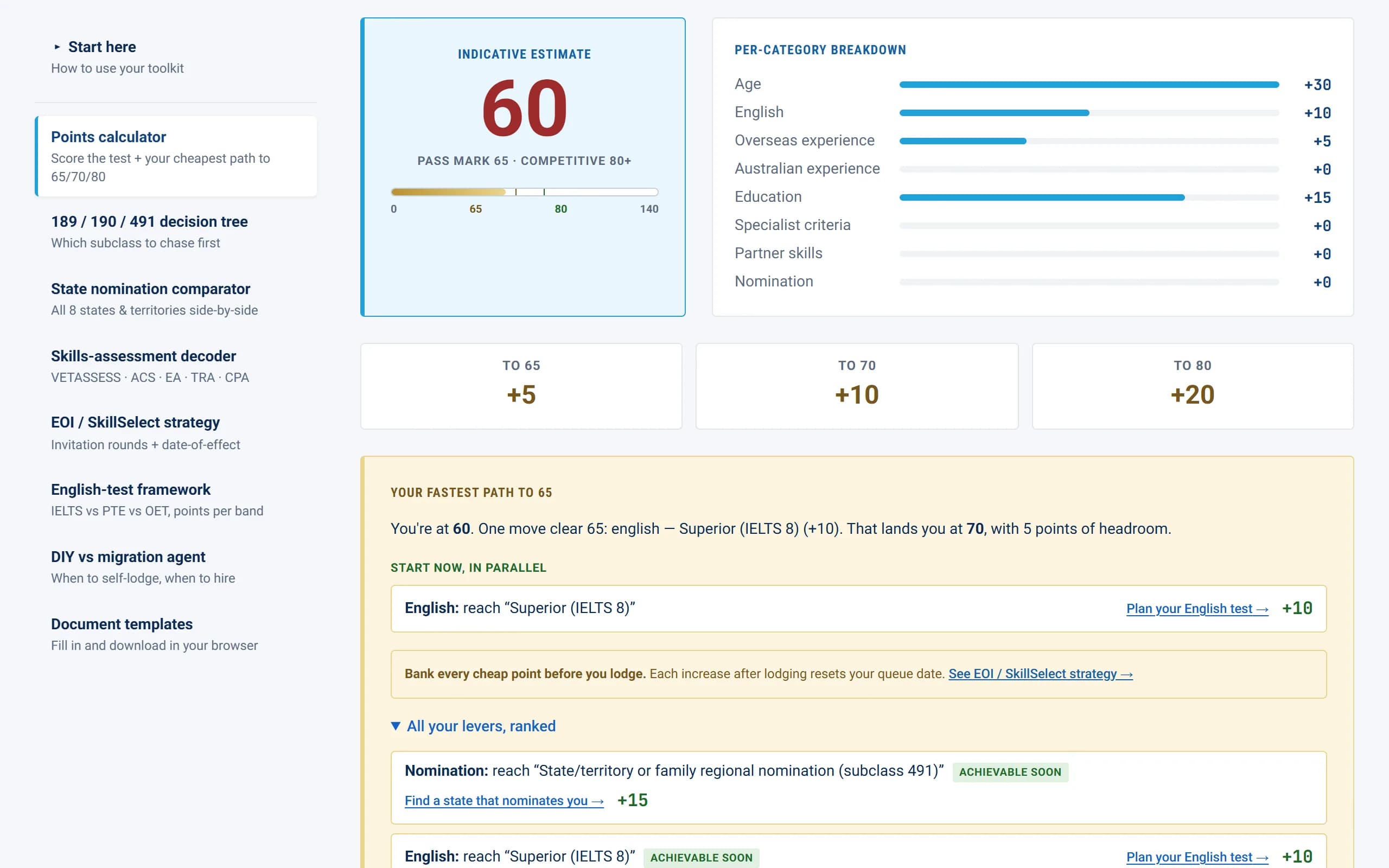
Because 189 is closed, points still matter for 190 and 491 state pathways and for accessing competitive state nomination rounds.
| Points Factor | Points | Notes |
|---|---|---|
| Age 25-32 | 30 | Maximum bracket |
| Age 33-39 | 25 | Common for senior testers |
| Bachelor with ICT major | 15 | Required for closely-related assessment |
| Master's (ICT or related) | 15 | Common for Australian-studied testers |
| PhD | 20 | Rare for testers |
| English Superior (IELTS 8) | 20 | Decisive for state nomination |
| English Proficient (IELTS 7) | 10 | Realistic baseline |
| Overseas experience 8+ years (after ACS deduction) | 15 | Senior testers |
| Overseas experience 5-7 years (after deduction) | 10 | Mid-level testers |
| Australian experience 1-2 years | 5 | If already on a 482 |
| State nomination (190) | 5 | ACT, NT, TAS run programs |
| Regional nomination (491) | 15 | Regional ACT, NT, TAS, SA |
| Professional Year | 5 | ACS Professional Year (Australian graduates) |
| Partner skills | 5-10 | Common where partner has ICT or related occupation |
| NAATI/CCL | 5 | Useful uplift |
Realistic Score Scenarios
Scenario 1 — Indian senior automation engineer (32, Bachelor in CS, 9 years total experience, IELTS 8) ACS deducts 2 years for closely-related ICT qualification, leaving 7 years skilled experience. Age 30 + Bachelor 15 + English 20 + Experience 10 = 75 points. Add 491 regional (+15) = 90 points. Strongly competitive for ACT or TAS regional rounds.
Scenario 2 — Filipino mid-level manual tester (28, non-ICT Bachelor, 6 years experience, IELTS 7) ACS deducts 6 years for non-ICT qualification, leaving 0 years skilled experience. Age 30 + Bachelor 15 + English 10 + Experience 0 = 55 points. Adding 491 (+15) = 70 points — below most invitation thresholds. The realistic strategy is 482 employer sponsorship through a consulting firm or in-house QA team.
State Nomination
State availability for 261314 has narrowed in recent program years. Confirm the current state portal before lodging.
Australian Capital Territory
The ACT runs the most accessible 190 and 491 program for software testers in 2025-26, primarily for applicants with ACT residence and employment. The Canberra Matrix awards points for ACT job offers, ACT residence and ACT study. See ACT state nomination 2026 and Canberra Matrix.
Northern Territory
The NT runs 190 and 491 nominations for software testers, typically requiring an NT job offer or evidence of intent to relocate. Darwin's growing public-sector digital footprint and the broader NT economic development push generate demand.
Tasmania
Tasmania nominates software testers under both 190 and 491 streams where applicants have lived, studied or worked in Tasmania. The Tasmanian Government's digital transformation initiatives and a growing private-sector tech footprint in Hobart and Launceston support consistent nomination. See Tasmania state nomination 2026.
South Australia
SA includes software tester on its supplementary lists for the 491 visa in regional South Australia. Adelaide-based applicants with a confirmed local offer may qualify under the General Stream. See South Australia state nomination 2026.
NSW, Victoria, Queensland and WA
These states have historically nominated 261314 but allocations have been restricted in 2025-26. NSW and Victoria prioritise ICT roles aligned with their priority sectors — typically software engineers, cybersecurity, data and DevOps rather than test specialists. Confirm directly through the current state portal: NSW state nomination 2026, Victoria state nomination 2026, Queensland state nomination 2026, Western Australia state nomination 2026.
Salary and Employment Outlook
Typical 2026 Salary Ranges
| Role | Typical Salary Range |
|---|---|
| Junior Tester (1-3 yrs) | AUD $65,000-$85,000 |
| Mid-Level Manual Tester | AUD $85,000-$105,000 |
| Automation Test Engineer | AUD $100,000-$135,000 |
| Senior Automation / SDET | AUD $130,000-$160,000 |
| QA Lead | AUD $135,000-$170,000 |
| Test Manager | AUD $155,000-$200,000 |
| Performance / Security Tester | AUD $120,000-$160,000 |
| Contract Tester (daily rate) | AUD $700-$1,100/day |
SEEK's April 2026 data places the average Tester salary band at AUD $80,000-$100,000 nationally, with Sydney 9% above the national average and Melbourne similar. Glassdoor's Sydney median is AUD $82,003 with a 25th-75th percentile range of AUD $65,661-$108,596. Senior automation engineers and SDETs sit well above the national average.
Total packages typically include superannuation (currently 11.5%, rising to 12% from July 2026), discretionary bonuses (5-15% in finance and consulting), and in larger tech employers, equity or RSUs.
Highest-Paying Locations and Sectors
- Sydney and Melbourne — financial services, technology and consulting concentrate here
- Canberra — government and defence digital programs pay well, particularly for cleared candidates
- Brisbane — growing public-sector digital footprint and resources adjacent tech
- Perth — mining tech and FIFO-adjacent IT
- Defence-cleared roles — Baseline, NV1 and NV2 clearance can add 10-30% to base salary
Demand Outlook
Jobs and Skills Australia carries Software Testers (261314) as an occupation in moderate to high demand, with automation testing skills explicitly flagged as in shortage. Digital transformation programs in banking, healthcare, government and retail drive the sustained baseline. The shift to platform engineering, DevOps and quality-as-code is reducing demand for manual-only specialists and increasing demand for testers who code.
For broader context on ICT migration trends, see most in-demand occupations Australia 2026 and the data scientist and AI specialist visa pathway.
Tips for a Successful Application
1. Document Automation Experience Clearly in Your Employment References
Your employment references must specifically describe automated test design, scripting in languages like Java, Python, JavaScript or C#, and use of CI/CD pipelines. Generic descriptions of "manual testing" or "QA work" are the leading cause of weak ACS outcomes for senior applicants. Have your referees include tool names — Selenium, Cypress, Playwright, Appium, JUnit, TestNG, Postman — and concrete project examples.
2. Calculate Points After the ACS Experience Deduction
Non-ICT graduates routinely lose 6 years of skilled experience under the ACS deduction. Run the points calculation with the deduction applied before deciding which visa pathway is realistic. If your post-deduction score sits below 75 even with state nomination, the 482 employer-sponsored route is usually the better strategy.
3. Target ACT, NT and Tasmania for State Nomination
State availability for 261314 has narrowed in 2025-26 — the ACT, NT and Tasmania are the most reliable routes. Targeting Sydney or Melbourne for state nomination with this code is unlikely to succeed in current rounds. Plan to live or work in a smaller state for the 2-year (190) or 3-year (491) commitment period.
4. Push English to Superior Level
For software testers, the difference between Proficient (10 points) and Superior (20 points) is often the gap between an invitation and a stall. IELTS Academic 8 in every band, or PTE 79+ in every band, is achievable with focused practice and adds materially to your competitiveness in any state round.
5. Build Australian Tech Networks Before You Arrive
Most QA roles fill through professional networks and contractor agencies — not job boards. Australian Testing Days, the Sydney Testers meetup, Ministry of Testing Australia, and LinkedIn networks tied to specific tools (Selenium, Cypress, Playwright, Appium) all run active community channels. Building these connections 6-12 months before arrival materially improves your conversion from offer to start date.
Step-by-Step Migration Roadmap
- Confirm your ANZSCO mapping — 261314 for dedicated testing roles. See how to find your ANZSCO code.
- Audit your qualifications against ACS criteria — closely related ICT major, related ICT major, or non-ICT (RPL).
- Sit IELTS Academic, PTE or OET — aim for Superior level scores.
- Prepare employment references that explicitly describe testing duties, automation tools and CI/CD experience.
- Apply for ACS Migration Skills Assessment — AUD $550 standard fee.
- Calculate points with the ACS experience deduction applied.
- Choose your pathway — 482 employer-sponsored, 190 state-nominated, 491 regional, or 186 permanent.
- Lodge EOI in SkillSelect if pursuing 190 or 491.
- Apply for state nomination through the ACT, NT, TAS or SA portal where eligible.
- Alternatively, seek employer sponsorship through tech consulting firms, banks, government digital services or specialist QA providers.
- Lodge visa application in ImmiAccount — see the ImmiAccount guide.
- Receive grant and relocate — start at your sponsoring employer or begin job search in your nominating state.
Frequently Asked Questions
Why isn't Software Tester on the MLTSSL?
The MLTSSL prioritises occupations with structural long-term shortage signals. Software testing as a category is well-supplied at the junior and mid-level manual end, with shortage concentrated in automation and SDET specialisations. Inclusion on the CSOL and STSOL preserves access to 482, 190, 491 and 186 routes — the pathways aligned with where the actual demand sits — without opening the independent 189 to a broader pool than the labour market needs.
Should I nominate Software Tester or Software Engineer if I do both?
The honest answer matters most. If you spend more than 50% of your time writing production code with embedded test automation, 261313 Software Engineer is usually the stronger nomination — it sits on the MLTSSL, unlocks the 189, and ACS assesses it routinely. If you spend more than 50% of your time on test planning, test execution, defect management and automation frameworks specifically, 261314 Software Tester is the accurate code. Your employment references must match whichever you choose.
Is the ACS deduction really 6 years for non-ICT graduates?
Yes — and it catches many testers. Engineering, Science, Commerce and Mathematics graduates without an ICT major are assessed under the RPL pathway and lose 6 years of experience for points purposes. Six years of work as a tester counts as zero skilled years after the deduction. The fix is either employer sponsorship (which does not apply the deduction the same way) or pursuing a Master's in IT to bring your qualification into the closely-related band, which reduces the deduction to 2 years.
Which state has the easiest nomination for software testers in 2026?
The ACT, Northern Territory and Tasmania have run the most accessible programs for 261314 in 2025-26. The trade-off is a smaller job market in Canberra, Darwin and Hobart compared to Sydney or Melbourne. Many migrants spend the 2 or 3 year obligation period in the nominating state and then move to a larger market once unrestricted.
How long does the whole migration take for a software tester?
Allow 9-18 months end-to-end. ACS skills assessment typically takes 6-8 weeks, English testing 4-8 weeks of preparation and one or two sittings, state nomination 8-12 weeks per round, and visa processing 6 months (190) or 11 months (491). The 482 employer-sponsored route can be considerably faster — 2-3 months for the whole process if the employer's sponsorship is in place.
Can my testing experience from a service-based IT consultancy be assessed positively?
Yes, with strong documentation. ACS routinely assesses experience from large Indian, Filipino and Eastern European IT services firms (TCS, Infosys, Wipro, HCL, Cognizant, Accenture, Deloitte). What matters is the employment reference clearly describing testing duties, tools used and the level of responsibility. Generic templates are flagged; specific project examples and tool lists pass cleanly.