Database Administrator Visa Pathway to Australia: Complete 2026 Guide
Updated: 16 August 2026
Australia classifies Database Administrator under ANZSCO 262111. The Australian Computer Society (ACS) conducts the skills assessment. The occupation sits on both the Core Skills Occupation List (CSOL) and the Short-Term Skilled Occupation List (STSOL), unlocking subclasses 190, 491, 482 and 186. Typical 2026 base salaries run AUD $115,000-$135,000 (SEEK, April 2026), with senior DBAs in financial services and government cloud platforms earning $150,000-$175,000.
Quick Facts: Database Administrator Migration Pathway
| Detail | Information |
|---|---|
| ANZSCO Code | 262111 (Database Administrator) |
| Skill Level | 1 (Bachelor degree or higher, plus relevant experience) |
| Skills Assessment | ACS (Australian Computer Society) |
| Occupation List | CSOL and STSOL |
| Visa Options | 190, 491, 482, 186 |
| Demand Level | Strong — banks, government, healthcare and resources are recruiting |
| Salary Range | AUD $115,000-$135,000 base (SEEK 2026); seniors $150k-$175k |
| Typical 190 Score | 70-85 points realistic in 2026 nomination rounds |
| Key Challenge | No MLTSSL access — 189 independent route closed |
What a Database Administrator Does in Australia
Database Administrator (DBA) covers the engineers who design, install, configure, secure, tune, back up, recover, and audit the production database systems that keep Australian organisations running. The work spans Oracle, Microsoft SQL Server, PostgreSQL, MySQL, MariaDB, and increasingly cloud-managed services on AWS (RDS, Aurora), Azure (SQL Database, Cosmos DB), and Google Cloud (Cloud SQL, BigQuery, Spanner).
Demand in Australia clusters in the four major banks, federal and state government departments, large healthcare providers, insurers, and the resources sector. Sydney concentrates the financial services roles. Canberra runs a steady DBA market across federal departments, with a notable salary premium for candidates holding or eligible for security clearance (Baseline, NV1, NV2, Positive Vetting). Brisbane and Perth pick up resources sector work. The shift to cloud-managed databases has expanded the DBA role rather than shrunk it — Australian employers want database engineers who can run Oracle on-premise and design RDS architectures and migrate workloads to the cloud without data loss.
ANZSCO 262111 — Code Mapping
Code 262111 belongs to Unit Group 2621 (Database and Systems Administrators, and ICT Security Specialists). The official description covers planning, developing, configuring, maintaining and supporting an organisation's database management systems consistent with information architecture. Key tasks include performance tuning, backup and recovery, data integrity, security, capacity planning, and supporting data migrations.
If your day-to-day is closer to building data pipelines and warehouses with Snowflake, Databricks, or BigQuery, you may be a stronger fit for 261313 Software Engineer or one of the data engineering interpretations under ACS guidance. If you focus on operating system administration alongside database work, Systems Administrator (262113) sometimes fits better. Read the ANZSCO code finder guide before locking in.
Skills Assessment — ACS
ACS is the assessing authority for 262111 and every other ICT code in Unit Group 2621.
Requirements:
- Bachelor degree or higher with an ICT major (computer science, software engineering, information systems, information technology)
- Post-qualification work experience in database administration that closely matches the duty profile (installation, configuration, tuning, backup, recovery, security)
- Employment references describing the specific database technologies and the actual DBA responsibilities held
ACS experience deduction (this matters for points):
- 2 years deducted — if your qualification is closely related to the nominated occupation and has a major ICT content
- 4 years deducted — if ICT major but not closely related
- 6 years deducted — if non-ICT qualification (a business or commerce degree typically falls here)
- 8 years deducted — if you have no relevant qualification and rely on the RPL (Recognition of Prior Learning) pathway
Common rejection reasons:
- References describe generic "database support" or "data entry" rather than design, tuning, and architecture
- Mix of part-time and contract work without clear evidence of full-time equivalent hours
- ICT content of the qualification assessed as Minor rather than Major
Assessment cost: AUD $1,498 (General Skills pathway, 2026) Processing time: ~12 weeks standard. Priority and Express services are available for applicants whose Australian visas expire within 12 weeks.
Visa Pathways for Database Administrators
Because 262111 is on both CSOL and STSOL but not MLTSSL, the 189 independent route is closed. The working pathways are state-nominated 190, regional 491, employer-sponsored 482 and 186.
Subclass 482 — Skills in Demand Visa
The most common pathway for offshore DBAs.
- Visa fee: AUD $4,015 (primary applicant)
- Streams: Core Skills ($79,423 minimum salary) and Specialist Skills ($146,576 minimum)
- Duration: Up to 4 years
- Processing: Specialist Skills stream — median 7 days. Core Skills — 6 to 14 months end-to-end
Senior DBAs in banking and government typically clear the Specialist Skills threshold and benefit from the much faster processing time.
Subclass 190 — State Nominated Visa
Permanent residency through state nomination. NSW and Victoria nominate ICT occupations including database roles in 2025-26, with strong demand in Sydney and Melbourne tech sectors.
- Visa fee: AUD $6,140 (primary applicant — verify current charge before lodgement)
- Points boost: +5 from state nomination
- Obligation: Live and work in the nominating state for at least 2 years
- Typical clearance: 70-85 points in 2026 invitation rounds
Subclass 491 — Skilled Work Regional (Provisional) Visa
A 5-year provisional visa with pathway to permanent residency via subclass 191 after 3 years of regional residence.
- Visa fee: AUD $6,140 (primary applicant — verify current charge)
- Points boost: +15 from regional nomination
- Regional areas: All of Australia except Sydney, Melbourne, and Brisbane metro
- Strength for DBAs: Strong demand in Perth, Adelaide, Canberra (ACT regional postcodes), and Hobart for government and resources DBA work
Subclass 186 — Employer Nomination Scheme
Permanent residency through employer sponsorship.
- Visa fee: AUD $6,140 (primary applicant)
- Streams: Direct Entry, Temporary Residence Transition (TRT)
- Common move: 482 first, then TRT to 186 after 2 years with the sponsoring employer
Points Test Strategy
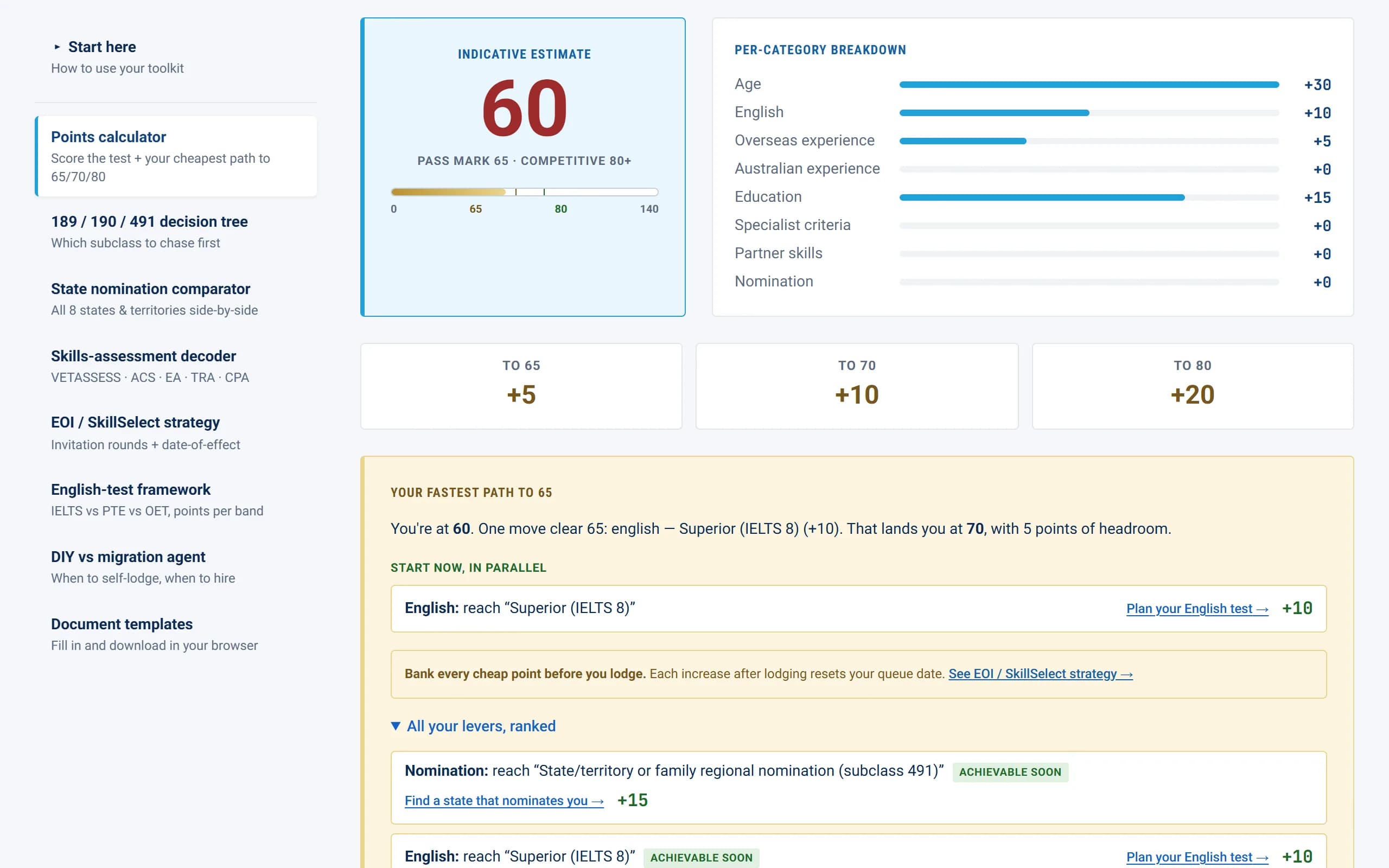
The 190 and 491 routes are points-tested via SkillSelect. Here's the standard points table:
| Points Factor | Points | Notes |
|---|---|---|
| Age 25-32 | 30 | Maximum bracket |
| Age 33-39 | 25 | Still strong |
| English — Superior (IELTS 8.0 / PTE 79) | 20 | Major difference-maker |
| English — Proficient (IELTS 7.0 / PTE 65) | 10 | More common |
| Qualification — PhD | 20 | Rare for DBAs |
| Qualification — Bachelor or Master | 15 | Standard |
| Overseas experience 8+ years (after ACS deduction) | 15 | |
| Overseas experience 5-7 years | 10 | |
| Overseas experience 3-4 years | 5 | |
| Australian work experience 8+ years | 20 | |
| State nomination (190) | 5 | |
| Regional nomination (491) | 15 | |
| Partner skills | 5-10 | |
| Australian study | 5 | Two-year Australian qualification |
Realistic Scenarios
Scenario 1: Offshore DBA, 30 years old, 7 years experience, Master's, Proficient English
- Age 30 + Master's 15 + English 10 + Experience 5 (after 2-year ACS deduction = 5 years skilled) = 60 points
- Add 190 nomination: 65 points — likely too low for NSW or VIC in 2026
- Add 491 regional: 75 points — competitive for ACT, SA, TAS
Scenario 2: Onshore DBA, 32 years old, 6 years experience (2 in Australia), Bachelor, Superior English
- Age 30 + Bachelor 15 + English 20 + Overseas 5 + Australian 5 = 75 points
- Add 190 nomination: 80 points — competitive
- Add 491 regional: 90 points — very strong
State Nomination
New South Wales
NSW historically nominates database and systems administration roles through Stream 1 (Living and Working in NSW) and Stream 2 (Skilled Worker Living Overseas). The state targets ICT skills shortages in Sydney's financial services and tech corridors. Recent rounds have cleared at 80+ points for ICT occupations under stream pressures. NSW Health and the Department of Customer Service are consistent DBA employers.
Victoria
Victoria publishes ROI (Registration of Interest) based nominations through Live in Melbourne. ICT roles are routinely invited at lower point scores than less-prioritised codes. Victoria charges no nomination fee, which makes it the most cost-effective state for ICT applicants. Melbourne's tech ecosystem, including the major banks' Victorian operations, drives steady DBA demand.
Australian Capital Territory
The ACT runs the Canberra Matrix system. Federal government departments are major DBA employers, and applicants with security clearance eligibility receive priority. ACT often nominates ICT occupations through the regional 491 pathway because Canberra outer suburbs qualify as regional. The Department of Defence, Services Australia, and ATO are routine sponsors.
South Australia
SA's program targets offshore applicants where the state lacks local supply. Database Administrator has appeared on SA's nomination list in recent years. The state's lower cost of living and faster nomination decisions make it a sensible alternative for mid-career DBAs not committed to a specific city.
Tasmania
Tasmania's program is small but accessible. The state nominates ICT roles where state government and university clients have demonstrated demand. Hobart's University of Tasmania and state health systems are common sponsors.
Salary and Employment Outlook
Base Salary by Seniority
| Role | Base Salary Range (AUD, 2026) |
|---|---|
| Junior DBA (0-2 yrs) | $85,000-$105,000 |
| Mid-Level DBA | $110,000-$135,000 |
| Senior DBA | $135,000-$160,000 |
| Lead / Principal DBA | $155,000-$185,000 |
| Cloud Database Engineer (AWS / Azure / GCP) | $130,000-$175,000 |
| DBA Contractor day rate | $850-$1,300 per day |
Source: SEEK Salary Hub (April 2026), Talent.com Australia, Robert Half 2026 IT Salary Guide.
Total Package Context
- Superannuation — 11.5% on top of base (rises to 12% from 1 July 2025 onwards)
- On-call allowance — DBAs on production rotations typically earn $5,000-$15,000 in on-call payments annually
- Bonus — 5-15% in financial services
- Cloud certification premium — AWS Solutions Architect Professional, Azure Database Administrator Associate, or Oracle Cloud certifications add $10,000-$25,000 to negotiable base
Highest-Paying Sectors
- Banking and financial services — CBA, NAB, ANZ, Westpac, Macquarie, AMP. Highest base salaries.
- Government (federal) — Defence, ATO, Services Australia, Department of Home Affairs. Cleared candidates earn a meaningful premium.
- Health — eHealth NSW, Queensland Health, Cerner, Epic. Steady mid-to-senior demand.
- Resources and mining — BHP, Rio Tinto, Fortescue. Perth-concentrated.
- Consulting — DXC, Accenture, Deloitte, KPMG database practices.
Tips for a Successful Application
1. Make sure your references describe DBA work specifically
ACS rejections often come from references that read like generic IT support. Push your referees to use language like "designed and maintained Oracle 19c production environment", "led migration from on-premise SQL Server to Azure SQL Database", "implemented backup and disaster recovery using RMAN and AlwaysOn Availability Groups". Specific technologies and DBA-specific verbs matter.
2. Calculate the ACS deduction before assuming a points score
A non-ICT degree triggers a 6-year experience deduction. A DBA with 10 years of experience and a B.Com background finishes with only 4 skilled years for points. Calculate this before lodging an EOI — many candidates lose months chasing a 189/190 score that was never realistic.
3. Cloud certifications change the math
The market increasingly distinguishes between traditional DBAs and cloud database engineers. AWS Solutions Architect, Azure Database Administrator Associate, and Google Cloud Professional Cloud Database Engineer are the high-value certifications in 2026. Two or three current cloud credentials materially shift both salary and sponsorship interest.
4. ACT is underrated for DBAs
Canberra's federal department demand is large, well-funded, and consistently active. ACT nomination is often faster than NSW or VIC, the cost of living is lower than Sydney, and security clearance unlocks a salary tier that Sydney and Melbourne markets simply don't have. Worth serious consideration if you're flexible on location.
5. Consider the 482 first, 186 later sequence
The 482 Specialist Skills stream often clears in under two weeks. The 186 Direct Entry route requires 3+ years of post-qualification experience and is materially slower. Many DBAs land in Australia faster by accepting a 482 first, then transitioning to 186 TRT after 2 years.
Step-by-Step Migration Roadmap
- Confirm 262111 is the right code — compare against Systems Administrator (262113) and Software Engineer
- Sit your English test — aim for Proficient (IELTS 7.0) minimum; Superior (8.0) for full points
- Lodge the ACS assessment — nominate 262111 and up to two alternates, AUD $1,498
- Calculate points realistically — factor the ACS experience deduction
- Decide the route — 190/491 (state-nominated) or 482/186 (employer-sponsored)
- Submit EOI in SkillSelect — for 190 or 491
- Apply for state nomination — separate state portal once EOI is in
- Alternative: secure sponsoring employer — focus on approved sponsors with active DBA roles
- Receive invitation, lodge visa — within the invitation window (60 days)
- Complete health and character checks — police clearances for every country lived in 12+ months since age 16
- Receive visa grant — relocate
- For 482 holders: lodge 186 TRT after 2 years — convert to permanent residency
Frequently Asked Questions
Is Database Administrator on the Skilled Occupation List for 189 visas?
No. ANZSCO 262111 Database Administrator is on the CSOL (Core Skills Occupation List) and STSOL (Short-Term Skilled Occupation List), but not the MLTSSL (Medium and Long-Term Strategic Skills List). Because the 189 Skilled Independent visa draws only from MLTSSL, DBAs cannot apply for the 189. The available routes are 190, 491, 482 and 186. See the SOL 2026 guide for context.
Which states are most likely to nominate Database Administrators in 2026?
NSW, Victoria, ACT, South Australia, and Tasmania have all included database and systems administrator roles in their nomination programs during the 2025-26 year. Victoria's no-fee policy and ACT's federal government demand are the most consistent. NSW competes with the highest point thresholds because of Sydney market depth. State lists update annually, so verify the current state list before lodging an EOI.
Do I need cloud experience to migrate as a DBA in 2026?
It's not a formal requirement, but practically, yes. Almost every Australian DBA job listing in 2026 expects familiarity with at least one cloud database platform — typically Azure SQL Database, AWS RDS or Aurora, or Google Cloud SQL. Candidates with only on-premise Oracle or SQL Server experience are now harder to place. Either build cloud experience before applying or be prepared to negotiate accepting a Core Skills stream offer rather than Specialist Skills.
Can I include cloud database engineering as DBA experience for ACS?
Generally yes, provided your duties match the 262111 description. ACS assesses by duty, not by job title. Time spent designing, deploying, and operating production databases on AWS, Azure or GCP counts toward DBA experience as long as the references describe DBA-level work (architecture, tuning, security, recovery) rather than only software development.
What's the ACS experience deduction for a non-ICT degree?
ACS deducts 6 years of relevant experience from your assessable total if your qualification is not in an ICT field. This deduction matters because it directly reduces the points you can claim under the Overseas Experience or Australian Experience headings on the points test. For a DBA with 10 years of experience and a Bachelor of Commerce, only 4 years counts as skilled. Plan for this before lodging an EOI.
Is the 482 Skills in Demand visa good for DBAs?
Yes — it's the dominant pathway in 2026. Senior DBAs in financial services and government often clear the $146,576 Specialist Skills Income Threshold, putting them in the Specialist Skills stream where processing currently runs around 7 days. Core Skills stream processing is much slower (6 to 14 months total), so negotiate hard on the offer salary to land in the Specialist stream where possible.