Telecommunications Technician Visa Pathway to Australia: Complete 2026 Guide
Updated: 16 August 2026
Australia classifies Telecommunications Technician under ANZSCO 342414. Trades Recognition Australia conducts the skills assessment via the Offshore Skills Assessment Program. The occupation sits on the Core Skills Occupation List, unlocking subclasses 482 and 186. Typical 2026 salaries range AUD $75,000-$103,000. Employer sponsorship is the dominant route because state nomination is closed for this code.
Quick Facts: Telecommunications Technician Migration Pathway
| Detail | Information |
|---|---|
| ANZSCO Code | 342414 (Telecommunications Technician) |
| Skill Level | 3 (AQF Certificate III + 2 years on-the-job training, or Certificate IV) |
| Skills Assessment | TRA (Trades Recognition Australia) |
| Occupation List | CSOL (Core Skills Occupation List) |
| Visa Options | 482, 186 |
| Demand Level | High — national rollout of 5G, NBN remediation, and data-centre buildout |
| Salary Range | AUD $75,000-$103,000 (SEEK, 2026) |
| Typical 482 Salary Threshold | Core Skills stream AUD $76,515 minimum |
| Key Challenge | No 189 or 190 access; requires a sponsoring employer |
What a Telecommunications Technician Does in Australia
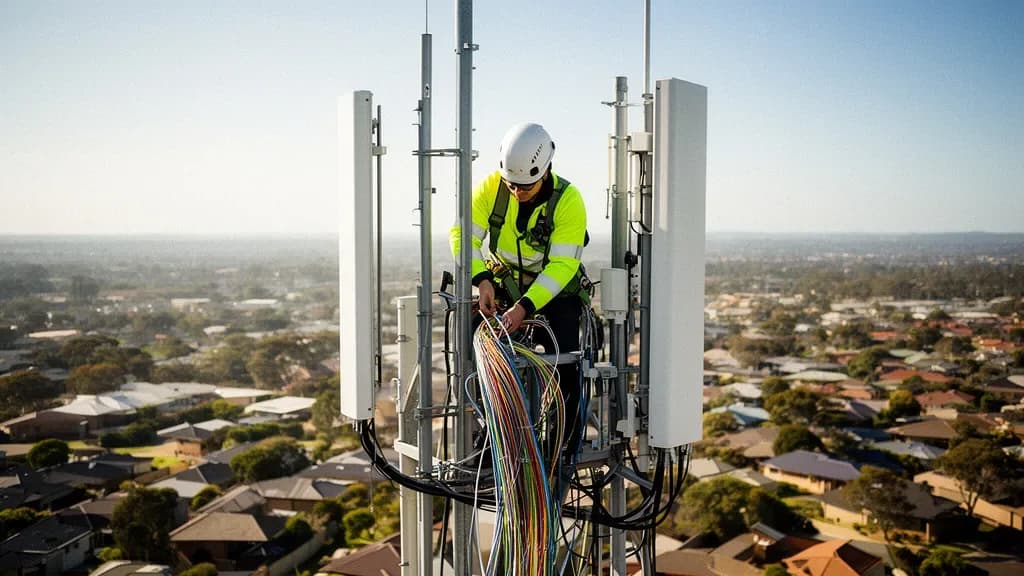
The role covers installation, fault diagnosis, and maintenance of fixed-line, mobile, and data-transmission equipment. Day-to-day this means terminating fibre, configuring switches, troubleshooting customer premises equipment, and erecting aerial or underground cabling. Work splits across telcos (Telstra, Optus, TPG, Vocus), NBN Co contractors, transport networks (rail signalling, road tunnels), and an expanding set of hyperscale data-centre operators in Sydney and Melbourne.
Demand sits firmly in the high band. Jobs and Skills Australia continues to list the occupation in shortage thanks to the 5G mid-band rollout, NBN's Fibre Connect program, and the data-centre construction wave funded by AWS, Microsoft Azure, and NextDC. The work is geographically concentrated around metropolitan exchanges and regional fibre routes, but technicians who hold open-cable licences are mobile across the country.
ANZSCO Code Mapping
The exact code is 342414 Telecommunications Technician, sitting within Unit Group 3424 Telecommunications Trades Workers. The ABS task list covers locating faults using ohmmeters, voltmeters, ammeters and transmission-test equipment; erecting, testing and maintaining aerial and underground wires and cables; installing telephones, switchboards and data-transmission equipment; and reading drawings to determine positioning and connections.
Related codes inside the same unit group include 342411 Cabler (Data and Telecommunications) and 342413 Telecommunications Linesworker. If your duties focus on customer-premises cabling under the ACMA registration regime rather than fault diagnosis and equipment configuration, Cabler may fit better. Match the duties on your employment references to the description for the code you nominate — this is the single most common reason TRA assessments fail.
Skills Assessment
TRA Offshore Skills Assessment Program (OSAP)
TRA is the assessing authority. Offshore applicants apply through OSAP; onshore applicants completing the formal Australian apprenticeship route use the Migration Skills Assessment (MSA). The pathway depends on where you trained and where you currently live.
Requirements:
- A qualification at least comparable to AQF Certificate III in telecommunications, electronics, or a closely related trade
- At least three years of post-qualification employment performing the ANZSCO 342414 task set
- Documentary evidence of training transcripts, employer references, payslips, and tax records
- For some applicants, a practical assessment at a TRA-approved Registered Training Organisation
Assessment cost: OSAP fees vary by country and trade — confirm the current legislative instrument schedule on the TRA site before applying. Migration Skills Assessment documentary stage starts from AUD $1,000.
Processing time: OSAP typically takes 12-16 weeks from registration to outcome, longer if a practical test is required.
Common rejection reasons: weak employment evidence (no payslips, no employer letterhead, vague duty descriptions), qualifications below AQF III equivalence, or duties that align more closely with an electrician (341111) or cabler (342411) than a technician. Get the duty wording on your references right before submitting.
For a wider view of which body assesses what, see the skills assessment bodies complete list.
Visa Pathways
Subclass 482 — Skills in Demand Visa
The dominant pathway. Telecommunications Technician is on the CSOL, which makes it eligible for the Core Skills stream of the 482.
- Visa fee: AUD $3,210 (primary applicant, July 2025 indexation)
- Salary threshold: AUD $76,515 (Core Skills Income Threshold)
- Duration: Up to 4 years
- Processing time: Core Skills stream is currently running 3-6 months from lodgement; accredited sponsors lodge nominations under a 10-day service standard introduced in March 2026
- Pathway to PR: After 2 years on the 482 with the same employer, transition to 186 (Temporary Residence Transition stream)
For more on the visa, see the subclass 482 visa guide.
Subclass 186 — Employer Nomination Scheme
Permanent residency through employer sponsorship. Two streams apply:
- Direct Entry: for applicants with a positive TRA assessment and 3+ years of post-qualification experience. Visa fee AUD $6,140. Processing 12-19 months at the 90th percentile.
- Temporary Residence Transition: for applicants who have held a 482 with the nominating employer for at least 2 years. Faster decisions in practice.
The Direct Entry stream is the only viable PR option for offshore telecommunications technicians because the occupation is not on the MLTSSL.
State Nomination
Telecommunications Technician is not currently nominated for the 190 or 491 by NSW, Victoria, Queensland, South Australia, Western Australia, or Tasmania in the 2025-26 program year. The occupation's CSOL-only status restricts it to employer-sponsored pathways. Check the state lists annually — programs do open and close, and the priority sectors review at the start of each financial year.
If state nomination opens for a related code (Electronic Engineering Draftsperson 312411, ICT Customer Support Officer 313112), and your duties realistically fit that code, that may become an alternative. Do not change codes without re-verifying that your references describe the duties for the new code.
Salary and Employment Outlook
| Role | Typical Salary Range |
|---|---|
| Entry Technician (1-3 yrs) | AUD $60,000-$72,000 |
| Technician (3-7 yrs) | AUD $75,000-$95,000 |
| Senior / Lead Technician | AUD $95,000-$115,000 |
| Field Engineer (5G / data centre) | AUD $100,000-$130,000 |
| Specialist Contractor (day rate) | AUD $600-$900/day |
Source: SEEK Career Advice, March-May 2026; cross-referenced against Indeed and Glassdoor for the same period.
Total packages on permanent roles add superannuation at 11.5% plus on-call allowances and vehicle entitlements for field positions. The highest-paying segments are hyperscale data-centre commissioning (Sydney's western suburbs, Melbourne's Tullamarine corridor), critical infrastructure (defence, rail, utilities), and senior NBN remediation roles. Regional fibre and 5G work pays competitive rates but is concentrated in coastal NSW, southeast Queensland, and the Latrobe Valley.
Tips for a Successful Application
1. Get Your References on Letterhead with Specific Duty Wording
TRA rejects applications where references say "worked as a technician" without describing the task set. Your reference must list at least 4-5 duties drawn directly from the ANZSCO 342414 description — fault location, installation, testing, maintenance, erection of cabling. Pair every reference with payslips and tax records covering the same period.
2. Verify Qualification Equivalence Before Lodging
A Bachelor's in Electronics Engineering from outside Australia does not automatically equate to an AQF Certificate III in Telecommunications. TRA assesses against the unit-of-competency content of the Australian qualification. If your training is theory-heavy and light on practical hours, expect to be directed into the Job Ready Program.
3. Time Your Skills Assessment with the Sponsor Search
A positive TRA outcome is valid for 3 years. Start the search for a sponsoring employer in parallel with your TRA application — there is no penalty for both running concurrently, and waiting until TRA clears before approaching employers adds 3-4 months to your timeline.
4. Target Accredited Sponsors
Accredited sponsors get 10-day nomination service standards under the March 2026 reforms. Telstra, Optus, Downer Group, Ventia, and several NBN delivery partners hold accredited status. Job listings on SEEK that mention "482 sponsorship considered" are usually filtered for accredited sponsors first.
5. Hold Your ACMA Open Cabler Registration Documents
If you have an ACMA Open or Restricted cabling registration from a previous Australian work assignment, include it. It is not mandatory for the skills assessment but signals employability and reduces onboarding friction for sponsors.
Step-by-Step Migration Roadmap
- Confirm ANZSCO 342414 fits your duties — read the description on the how to find ANZSCO code guide
- Verify the occupation is on the CSOL — see the Core Skills Occupation List hub
- Gather qualification and employment evidence — transcripts, references on letterhead, payslips, tax records
- Sit your English test — IELTS 5.0 average (or equivalent) is the 482 minimum
- Lodge the TRA application — OSAP or MSA depending on training country and current location
- Search for a sponsoring employer — target accredited sponsors in telco and data-centre delivery
- Receive nomination from the sponsor — under the 10-day accredited service standard
- Lodge the 482 visa — within the validity window of your nomination
- Work in Australia for 2 years on the 482 — meeting the Core Skills Income Threshold
- Transition to 186 via TRT stream — for permanent residency
- Complete health and character checks
- Receive visa grant and continue working
For broader context, see the most in-demand occupations in Australia 2026 page.
Frequently Asked Questions
Can I get permanent residency directly as a Telecommunications Technician?
Yes, through the 186 Direct Entry stream if you hold a positive TRA assessment and a willing employer. Direct Entry processing currently runs 12-19 months at the 90th percentile, so most applicants prefer to enter on a 482 and transition after 2 years of qualifying service.
Why isn't Telecommunications Technician on the MLTSSL?
Home Affairs designated the occupation CSOL-only in the December 2024 list reform. That means it carries full 482 and 186 access but no 189 or 491 entitlement. The reform reflected Jobs and Skills Australia's view that demand was strong but concentrated in employer-driven channels, making sponsored pathways the appropriate mechanism.
Will a Bachelor's degree in Electronics Engineering satisfy TRA?
Not automatically. TRA assesses against the AQF Certificate III in Telecommunications Cabling or equivalent. A theoretical Electronics Bachelor without documented practical training and supervised work hours often results in a Job Ready Program direction, which adds 12+ months and around AUD $3,300 in fees.
Which Australian employers actively sponsor Telecommunications Technicians?
Telstra, Optus, TPG Telecom, NBN Co delivery partners (Downer, Ventia, Service Stream), and the major data-centre operators sponsor 482 visas for this occupation. Specialist contractors working on rail signalling and defence projects (Siemens Mobility, BAE Systems, Thales) also recruit internationally.
What if my duties overlap with Cabler or Telecommunications Linesworker?
Pick the code that describes the majority of your work over the last 3 years. If you split time between customer-premises cabling and equipment configuration, lean toward 342414 if equipment work dominates and 342411 Cabler if cabling and registration work dominates. TRA cross-checks references against the code you nominate, so do not stretch the fit.