Electrician & Plumber Visa Pathway to Australia: Complete 2026 Guide
Electricians and plumbers are among the most sought-after tradespeople in Australia right now. With a construction boom that shows no signs of slowing down and a domestic skills shortage that's been building for years, qualified electricians and plumbers have access to every major skilled visa pathway — and the earning potential is excellent. If you're a licensed sparky or plumber thinking about Australia, here's your complete roadmap.
Quick Facts: Electrician & Plumber Migration Pathway
| Detail | Electrician (341111) | Plumber (334111) |
|---|---|---|
| ANZSCO Code | 341111 (Electrician General) | 334111 (Plumber General) |
| Skill Level | 3 (Certificate III / IV) | 3 (Certificate III / IV) |
| Skills Assessment | TRA (Trades Recognition Australia) | TRA (Trades Recognition Australia) |
| Occupation List | MLTSSL — full visa access | MLTSSL — full visa access |
| 189 (Independent) | Yes | Yes |
| 190 (State Nominated) | Yes | Yes |
| 491 (Regional) | Yes | Yes |
| 482 (Employer Sponsored) | Yes | Yes |
| 186 (Permanent Employer) | Yes | Yes |
| Demand Level | Critical shortage — nationwide | Critical shortage — nationwide |
Why Australia Can't Get Enough Electricians and Plumbers
The Construction Boom
Australia is in the middle of the largest infrastructure investment period in its history. Billions of dollars are flowing into road projects, rail networks, airports, renewable energy installations, and — most urgently — housing. The federal government has committed to building 1.2 million new homes by 2029 to address the housing affordability crisis, and every single one of those homes needs electrical wiring and plumbing.
Domestic Supply Gap
Australia simply isn't training enough tradespeople locally. Apprenticeship completion rates have been declining for over a decade, and many experienced electricians and plumbers are approaching retirement age. The result? A structural deficit that can't be filled domestically.
Here's what the data shows:
- Electricians have been on the national skills shortage list continuously for over 5 years
- Plumbers face similar persistent shortages, especially in regional areas
- Average time to fill an electrician vacancy exceeds 6 weeks in most states
- Wages have increased 15-25% in the past three years due to competition for workers
Renewable Energy Transition
The shift to renewable energy is creating entirely new demand categories. Solar panel installations, battery storage systems, EV charging infrastructure, and smart home technology all require qualified electricians. This isn't temporary demand — it's a structural shift that'll keep growing for decades.
Skills Assessment: TRA (Trades Recognition Australia)
Both electricians and plumbers are assessed by TRA. The assessment process varies depending on where you qualified and gained your experience.
Offshore Applicants (Trained Overseas)
If you trained and worked as an electrician or plumber outside Australia, TRA will assess your qualifications and experience against Australian trade standards.
What You Need:
- Trade qualification (must be equivalent to Australian Certificate III or higher)
- Detailed employment references covering at least 3 years of post-qualification experience
- References must be on company letterhead, signed by your supervisor, and describe specific duties performed
- Passport and identity documents
- English language test results
Assessment Cost: AUD $500-$3,000 depending on the assessment type. See the skills assessment complete guide for current fee details.
Processing Time: 8-16 weeks on average, though complex cases may take longer.
Onshore Applicants (Australian-Trained)
If you completed your trade qualification in Australia (for example, through an apprenticeship on a student or temporary visa), you'll go through TRA's Job Ready Program:
- Provisional Skills Assessment (PSA) — confirms your qualification
- Job Ready Employment (JRE) — complete 1,170 hours of paid work
- Job Ready Workplace Assessment (JRWA) — on-site assessment by TRA assessor
- Job Ready Final Assessment (JRFA) — final skills confirmation
Total JRP cost ranges from AUD $1,800 to $3,000 across all stages, and the program takes 12-18 months to complete.
English Language Requirements
TRA requires at least Competent English for the skills assessment:
- IELTS: 6.0 in each band
- PTE Academic: 50 in each component
- TOEFL iBT: L12, R13, W21, S18
Higher scores earn more points in the points test — aim for Proficient (IELTS 7.0 each) or Superior (IELTS 8.0 each) if possible.
The Licensing Question: What You Must Know
Here's something that catches many migrant tradespeople off guard: a positive TRA skills assessment does NOT give you a licence to work in Australia. You must obtain a state or territory electrical or plumbing licence after arrival.
Electrician Licensing
Electrical work in Australia is heavily regulated for safety reasons. Each state and territory has its own licensing authority:
| State/Territory | Licensing Authority |
|---|---|
| NSW | NSW Fair Trading |
| VIC | Energy Safe Victoria |
| QLD | Electrical Safety Office |
| WA | Building and Energy (EnergySafety) |
| SA | Office of the Technical Regulator |
| TAS | Consumer, Building and Occupational Services |
| NT | NT WorkSafe |
| ACT | Access Canberra |
Most states require you to sit a Capstone Assessment or equivalent trade test to demonstrate your competency against Australian Standards. The Australian/New Zealand Wiring Rules (AS/NZS 3000) are the backbone of electrical work in Australia, and you'll need to be familiar with them.
Plumber Licensing
Plumbing is similarly regulated state by state. You'll typically need to:
- Apply through the state's plumbing regulator
- Provide evidence of your qualifications (your TRA assessment helps)
- Sit a trade competency test in some states
- Demonstrate knowledge of Australian plumbing standards (AS/NZS 3500)
How Long Does Licensing Take?
Plan for 2-6 months to get fully licensed after arriving in Australia. During this period, you may be able to work under supervision in some states, but you can't perform unsupervised work until your licence is granted.
Pro Tip: Start researching your destination state's licensing requirements before you arrive. Some states allow you to begin the application process from overseas, which saves time.
Visa Pathways for Electricians and Plumbers
Because both occupations are on the MLTSSL, electricians and plumbers have access to every major skilled visa.
Subclass 189 — Skilled Independent Visa
Permanent residency without needing a sponsor. You apply through SkillSelect with a points-based expression of interest.
Key Details:
- Visa fee: AUD $6,135
- Minimum points: 65 (realistically 80+ for an invitation in 2026)
- Processing: 6-12 months after lodgement
- Benefit: Complete freedom to live and work anywhere in Australia
Subclass 190 — State Nominated Visa
Permanent residency with state sponsorship. The nominating state adds 5 points to your score.
Key Details:
- Visa fee: AUD $6,140
- Points required: 65 (including the 5 nomination points)
- Obligation: Live and work in the nominating state for 2 years
- Benefit: 5 extra points make it more accessible than 189
Subclass 491 — Skilled Work Regional Visa
A 5-year provisional visa for regional areas with a pathway to permanent residency (subclass 191).
Key Details:
- Visa fee: AUD $6,140
- Points required: 65 (including 15 regional points)
- Bonus: +15 points from regional nomination
- Pathway: Eligible for 191 after 3 years of regional residence
For tradespeople who find the 189 score competitive, the 491 is often the smartest play. The 15-point bonus makes the threshold much more achievable, and regional areas are where tradespeople are needed most.
Subclass 482 — Temporary Skill Shortage Visa
Employer-sponsored temporary visa. Your employer applies for you.
Key Details:
- Visa fee: AUD $3,210 (SID stream)
- Salary threshold: Core stream AUD $76,515 / Specialist stream AUD $141,210
- Duration: Up to 4 years
- Pathway: Can lead to 186 permanent visa after 2 years
The good news for electricians and plumbers? Employer-sponsored wages in these trades routinely exceed the salary threshold, especially in construction, mining, and infrastructure sectors.
Subclass 186 — Employer Nomination Scheme
Permanent residency through employer sponsorship.
Key Details:
- Visa fee: AUD $6,140
- Streams: Direct Entry (skills assessment + 3 years experience) or TRT (after 2+ years on 482)
- Benefit: Immediate permanent residency
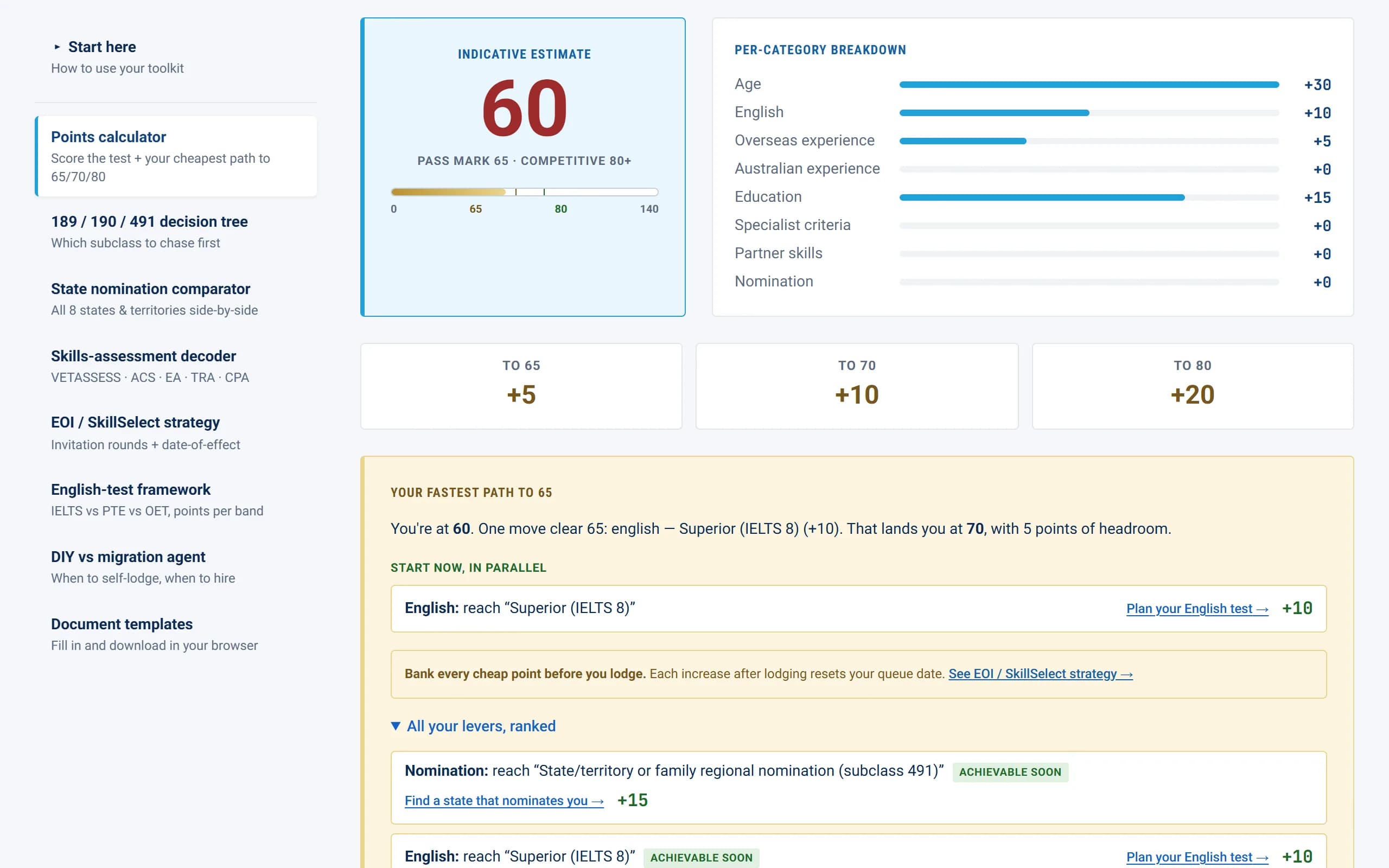
Points Test Strategy for Tradespeople
Skilled trades workers sometimes find the points test challenging because trade qualifications score fewer points than a bachelor's degree. Here's how to build a competitive score:
| Points Factor | Points | Strategy |
|---|---|---|
| Age (25-32) | 30 | Maximum bracket |
| English (Superior — IELTS 8.0) | 20 | Biggest points booster for tradespeople |
| English (Proficient — IELTS 7.0) | 10 | Minimum recommended target |
| Trade Qualification | 10 | Certificate III / Diploma |
| Overseas Experience (8+ years) | 15 | Maximise your experience points |
| Australian Experience (3+ years) | 10 | If you've worked in Australia |
| State Nomination (190) | 5 | Apply if eligible |
| Regional (491) | 15 | Best for points-short candidates |
| Partner Skills | 5-10 | If your partner has a skilled occupation |
| NAATI/CCL | 5 | Community language credential |
| Professional Year | 5 | Not available for trades |
The English Advantage: For tradespeople, investing heavily in English test preparation is often the most effective way to boost your points. The difference between Competent (0 points) and Superior (20 points) English is enormous. Many successful trade migration applicants report spending 3-6 months on intensive English study before their test.
State Nomination: Where Should You Go?
Strongest States for Electricians and Plumbers
Western Australia — WA's mining and construction sectors create relentless demand for both electricians and plumbers. Perth's building boom and regional mining operations mean consistent employment opportunities and premium wages.
Queensland — Infrastructure projects, population growth in South-East Queensland, and the ongoing development of regional centres make QLD a top destination. The 2032 Brisbane Olympics preparations are adding further demand.
South Australia — SA actively recruits tradespeople and often has lower points thresholds for state nomination. Adelaide's growing defence and construction sectors need workers.
Northern Territory — Lower competition for nomination and strong demand in Darwin and remote areas. Willing to go remote? The NT will welcome you with open arms.
New South Wales — Sydney's massive construction pipeline (metro projects, housing estates, commercial developments) means high demand, but higher living costs.
Victoria — Melbourne's infrastructure boom (Suburban Rail Loop, housing developments) creates strong demand, with the state actively nominating both occupations.
Salary and Employment Outlook
What Can You Expect to Earn?
| Role | Typical Salary Range |
|---|---|
| Electrician (Employee) | AUD $75,000-$95,000 |
| Electrician (Experienced/Leading Hand) | AUD $95,000-$120,000 |
| Electrician (Mining/FIFO) | AUD $120,000-$180,000+ |
| Plumber (Employee) | AUD $75,000-$95,000 |
| Plumber (Experienced/Leading Hand) | AUD $90,000-$115,000 |
| Plumber (Mining/FIFO) | AUD $110,000-$160,000+ |
| Self-Employed (Either) | AUD $100,000-$200,000+ |
Overtime is common in construction and infrastructure, and penalty rates for weekends and public holidays add up quickly. Some electricians and plumbers working on major infrastructure projects report total packages exceeding $150,000 per year.
The Self-Employment Path
One major attraction of trade migration to Australia is the potential to eventually run your own business. Once you're licensed and established, many electricians and plumbers start their own contracting businesses. Self-employed tradespeople with a solid client base can earn significantly more than employees.
You can't start a business on most temporary visas, but once you have permanent residency (189, 190, or 186), the option opens up.
Step-by-Step Migration Roadmap
- Confirm your ANZSCO code — Electrician General 341111 or Plumber General 334111 using the ANZSCO code finder
- Prepare your documents — qualification certificates, employment references, identity documents
- Sit your English test — aim for Proficient (IELTS 7.0) or Superior (IELTS 8.0)
- Apply for TRA skills assessment — allow 8-16 weeks for processing
- Calculate your points — determine your competitiveness for 189, 190, or 491
- Submit EOI in SkillSelect — select the visa subclass(es) you're targeting
- Apply for state nomination — if pursuing 190 or 491
- Receive invitation and lodge visa application — within 60 days
- Complete health and character checks — medical exam and police clearances
- Arrive and apply for state licence — research licensing requirements before arrival
- Start working — once licensed in your state
Frequently Asked Questions
Can I work as an electrician or plumber in Australia immediately after my visa is granted?
Not without a state or territory licence. Your TRA skills assessment and visa grant give you permission to live and work in Australia, but electrical and plumbing work requires a state-issued licence. Plan for 2-6 months to complete the licensing process after arrival. Some states allow you to work under supervision while your licence application is being processed.
Do I need to sit a trade test in Australia?
It depends on the state. Most states require electricians to sit a Capstone Assessment or similar competency test that covers Australian standards (AS/NZS 3000 for electricians, AS/NZS 3500 for plumbers). Study materials are available online, and some states offer preparation courses.
Is my UK/US/European electrical or plumbing licence recognised in Australia?
Not directly. Australia has its own standards, and you'll need to meet state-specific licensing requirements regardless of where you trained. However, qualifications from countries with similar standards (UK, New Zealand, Ireland) are generally assessed more favourably by TRA, and the transition to Australian licensing may be smoother.
What's the realistic points score for a 189 invitation?
In 2026, most electricians and plumbers receiving 189 invitations have scores of 80-85 points. If you're below that, the 190 (+5 points) or 491 (+15 points) are strong alternatives. Employer sponsorship via the 482 visa sidesteps the points test entirely.
Can my spouse work in Australia while I'm on a visa?
Yes. Partners included on 189, 190, and 186 visa applications receive full work rights. Partners on 482 and 491 visas also receive work rights. There are no restrictions on the type of work your partner can do — they don't need to work in a skilled occupation.