Living in Adelaide as an Immigrant: Affordable, Welcoming & PR-Friendly
Adelaide has built a reputation as one of the most accessible Australian capitals for new arrivals. South Australia runs a state nomination program with a broad occupation list, the whole metropolitan area sits inside the Department of Home Affairs Designated Regional Area, and the city is now anchoring two long-term federal commitments: the AUKUS nuclear-powered submarine build at Osborne and the Australian Space Agency at Lot Fourteen. As of the March 2026 quarter, Adelaide house rents sit at $640 per week and unit rents at $550 per week (Domain), meaningfully below Sydney and Melbourne. For skilled migrants weighing affordability, permanent residency pathways, and lifestyle, Adelaide warrants serious consideration.
Quick Stats
- Population (Greater Adelaide): approximately 1.49 million (ABS, 30 June 2025 estimate, after 1.3% growth in 2024-25)
- State: South Australia
- Climate: Mediterranean (Koppen Csa) - hot dry summers, cool wet winters
- Time zone: ACST (UTC+9:30) - 30 minutes behind east coast
- Distance to airport: 6 km from the CBD, 10 to 15 minutes by car off-peak
- Key industries: defence (AUKUS), health, education, wine, space, advanced manufacturing
Why Immigrants Move to Adelaide
The single biggest pull factor is the South Australia state nomination program. For the 2025-26 program year, SA was allocated 1,350 places under the Skilled Nominated subclass 190 visa and 900 places under the Skilled Work Regional subclass 491 visa, for a total of 2,250 nomination places (Move to South Australia). While that is a reduction from 2024-25 (when SA had 3,800 places), the SA occupation lists remain among the most generous in the country, with 393 onshore occupations and 427 offshore occupations open for 2025-26.
The second factor is regional designation. The Department of Home Affairs categorises Adelaide as a Category 2 city, alongside Perth, Hobart, Newcastle, Wollongong, Geelong, the Gold Coast and the Sunshine Coast. Living in a designated regional area unlocks the subclass 491 visa, the subclass 191 permanent residency pathway after three years of regional residence and tax compliance, and 15 extra points for state nomination through Skill Select.
The third factor is federal investment. Australia will build five SSN-AUKUS class nuclear-powered submarines at Osborne Naval Shipyard through an incorporated joint venture between ASC and BAE Systems, with the program expected to support around 20,000 direct jobs across industry, the Australian Defence Force and the Australian Public Service over the next 30 years (Australian Submarine Agency). At peak, 4,000 to 5,000 direct jobs are expected on the submarine build alone.
The fourth factor is the cost of living. Adelaide house and unit rents track well below Sydney, Melbourne and Brisbane, and grocery, transport and utility costs sit closer to the national average than to capital-city peaks.
The fifth factor is integration. Adelaide is compact, easy to navigate, has well-established Asian, European and African migrant communities, and the city itself was the first home of the Australian Space Agency, which opened its headquarters at Lot Fourteen in February 2020.
Jobs and Economy
The Adelaide economy has shifted decisively toward defence, health, advanced manufacturing and knowledge industries. Salary ranges below are 2025-26 estimates; verify any specific role against current SEEK and Hays guides.
| Sector | Major employers | Indicative salary range (AUD) | Notes |
|---|---|---|---|
| Defence (AUKUS submarines) | ASC, BAE Systems, Babcock, Lurssen | $90,000 to $180,000 | Five SSN-AUKUS submarines to be built at Osborne. Joint ASC-BAE venture confirmed. |
| Health | SA Health, Calvary, Healthscope | $75,000 to $140,000 | Royal Adelaide, Flinders Medical Centre, Lyell McEwin, Womens and Childrens. |
| Higher education and research | Adelaide University (merged 2026), Flinders University, Torrens University | $80,000 to $160,000 | New Adelaide University opened 29 January 2026 with around 70,000 students. |
| Space and tech | Australian Space Agency, Saber Astronautics, Fleet Space, Inovor | $85,000 to $150,000 | Lot Fourteen innovation precinct headquarters since 2020. |
| Wine and agribusiness | Treasury Wine Estates, Pernod Ricard, Accolade | $70,000 to $130,000 | Barossa, McLaren Vale, Adelaide Hills, Clare. |
| Software and engineering | SEEK Adelaide listings show software engineer averages of around $100,000+ depending on source (Glassdoor, Levels.fyi) | $80,000 to $145,000 | Pay generally trails Sydney and Melbourne. |
Adelaide salaries are typically 5 to 15% below east-coast equivalents for the same role, partly offset by lower rent and shorter commutes.
Cost of Living Snapshot
| Item | Adelaide (2026) | Source / note |
|---|---|---|
| Median house rent | $640 per week (March quarter 2026) | Domain Rent Report |
| Median unit rent | $550 per week (March quarter 2026) | Domain Rent Report |
| Rental vacancy rate | 0.7% (April 2026) | SQM Research |
| Two-hour public transport fare | Around $4 single trip on metroCARD (as of 1 July 2025, CPI-linked uplift) | Adelaide Metro |
| Tram in CBD free zone | $0 | Adelaide Metro |
| Glenelg by tram from CBD | Around $4, journey 28 minutes | Adelaide Metro / Rome2Rio |
For a deeper breakdown including groceries, utilities, childcare and entertainment, see the dedicated Cost of Living in Adelaide 2026 guide.
Best Neighbourhoods for New Arrivals
Young professionals
- North Adelaide: walkable, heritage stone cottages, close to Adelaide Oval, the city, and the parklands.
- Norwood: cafe strip on The Parade, mid-range rents, eastern-suburbs access.
- Unley: King William Road retail, leafy streets, close to the CBD.
Families
- Mawson Lakes: planned community in the north, close to UniSA Mawson Lakes campus and Technology Park.
- Golden Grove: north-eastern family suburb served by the O-Bahn busway.
- Hallett Cove: coastal southern suburb with conservation park and train line to the CBD.
Students
- Adelaide City Centre (CBD): walking distance to Adelaide University campuses, Lot Fourteen and Adelaide Central Market.
- Thebarton and Mile End: just west of the CBD, near the Adelaide University West Campus.
- Bedford Park: directly adjacent to Flinders University and Flinders Medical Centre in the south.
Budget-conscious
- Salisbury: northern suburb on the Gawler train line, established migrant communities.
- Elizabeth: further north, historically affordable, close to Lyell McEwin Hospital.
- Munno Para: outer north on the train line, newer housing stock.
Transport
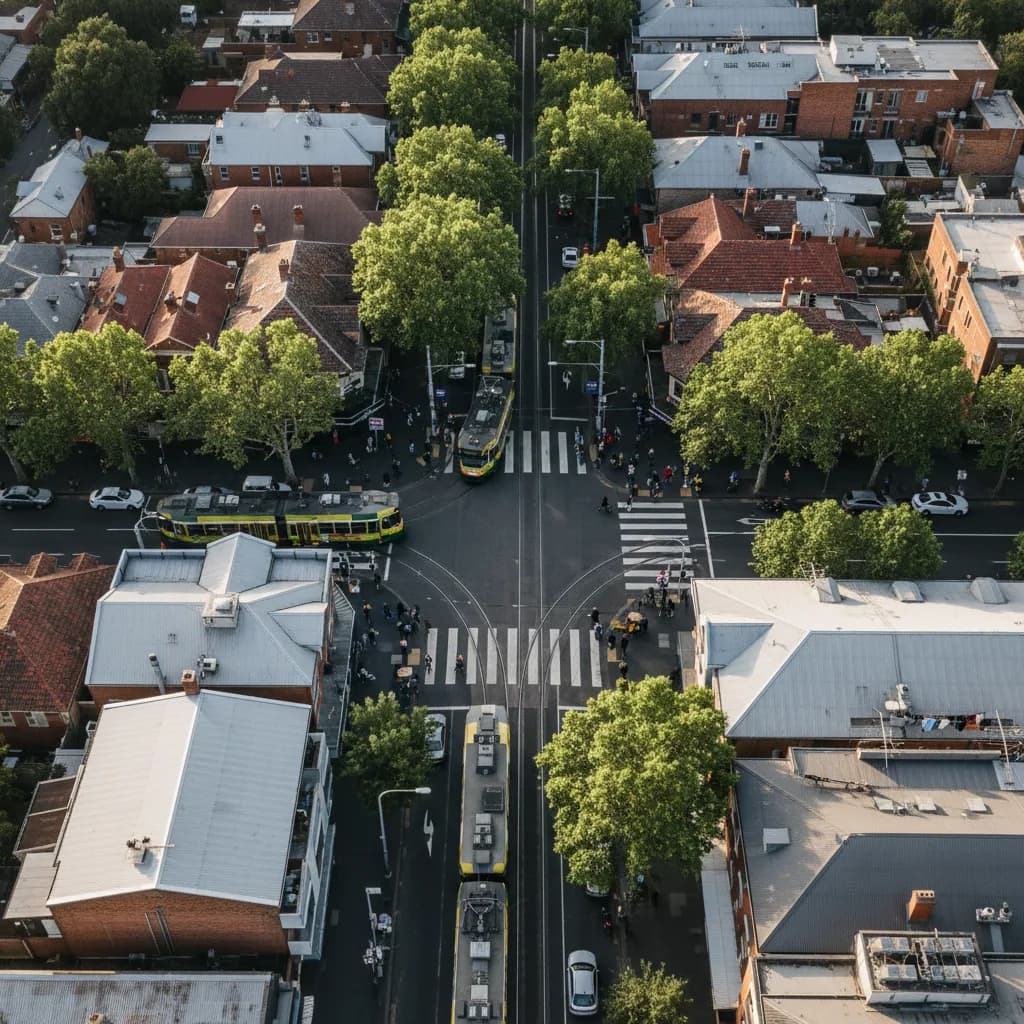
Adelaide Metro runs an integrated bus, train and tram network under a single fare. A single trip on a regular metroCARD allows two hours of unlimited travel on any combination of modes (Adelaide Metro). Fares rose by around 3% from 1 July 2025 in line with CPI.
Public transport highlights:
- O-Bahn busway: an internationally rare guided busway connecting the north-eastern suburbs to the CBD through a 670-metre tunnel under Rundle Park and Rymill Park. High-frequency, traffic-free.
- Glenelg tram: connects the city to Glenelg beach in around 28 minutes for about $4.
- Free city tram zone: the inner-city section between South Terrace, the Adelaide Entertainment Centre, Festival Plaza and the Botanic Gardens is fare-free.
- Free City Connector bus: runs Monday to Friday from around 7:00 am to 7:15 pm (until 9:15 pm Fridays), linking city attractions and education precincts.
Adelaide Airport sits 6 km from the CBD, 10 to 15 minutes by car off-peak. The Torrens to Darlington (T2D) project will complete a 78 km traffic-light-free North-South Corridor from Gawler to Old Noarlunga; tunnelling is set to begin in the second half of 2026, with the motorway scheduled to open to traffic by 2031 (Department for Infrastructure and Transport).
Car ownership remains common, but Adelaide's grid layout, modest size and active rail and busway network make it more car-optional than Brisbane or Perth.
Education
Universities
The biggest education story in Adelaide is the merger of the University of Adelaide and the University of South Australia into the new Adelaide University, which officially opened on 29 January 2026. The merged institution launched with around 70,000 students (roughly one in four international) and debuted at number 82 in the QS World Rankings (Higher Education Strategy Associates; Adelaide University). The Kaurna name Tirkangkaku ("place of learning") was assigned in July 2025.
Other higher education providers include Flinders University (south of the city, near Flinders Medical Centre) and Torrens University Australia.
Carnegie Mellon University ran a Heinz College Australia campus in the Torrens Building from 2006 until it was wound down in 2022, so it is no longer an active option in Adelaide.
Schools
South Australian schooling is split across the Department for Education (public), Catholic Education SA, and independent schools. Children of most temporary visa holders are eligible to enrol in SA public schools, often with international student fees depending on visa subclass. See the related school enrolment guide for visa-specific rules.
Healthcare
Adelaide's public hospital network is run by SA Health and centred on three tertiary facilities and one specialist hospital:
- Royal Adelaide Hospital (RAH): SA's largest public acute care teaching hospital, Level 1 Adult Major Trauma Centre, located on North Terrace.
- Flinders Medical Centre: southern Adelaide's largest hospital, also a Level 1 Adult Major Trauma Centre, attached to Flinders University at Bedford Park.
- Lyell McEwin Hospital: northern Adelaide tertiary hospital serving more than 300,000 residents across the northern suburbs, Level 3 Metropolitan Trauma Centre.
- Women's and Children's Hospital: specialist tertiary care for women, newborns and children.
Medicare-eligible visa holders can access these public hospitals without out-of-pocket charges for treatment. For Medicare eligibility by visa type, see Medicare for Australian Visa Holders. Bulk-billing GPs are common in outer suburbs and less common in the inner east; expect to pay a gap of $40 to $60 if a GP does not bulk bill.
Climate
Adelaide has a Mediterranean climate (Koppen Csa). The figures below are 1991-2020 averages from the Bureau of Meteorology Kent Town station (2 km east of the CBD).
| Season | Months | Avg high °C | Avg low °C | Rainfall mm/month range |
|---|---|---|---|---|
| Summer | Dec to Feb | 27.6 to 30.0 | 15.8 to 17.6 | 20 to 28 |
| Autumn | Mar to May | 19.0 to 26.6 | 10.2 to 15.3 | 25 to 59 |
| Winter | Jun to Aug | 15.6 to 16.7 | 7.7 to 8.3 | 67 to 78 |
| Spring | Sep to Nov | 19.3 to 25.4 | 9.9 to 14.1 | 31 to 60 |
Source: Bureau of Meteorology (Adelaide Kent Town, station 023090).
A few practical notes:
- Adelaide is the driest Australian capital. June is the wettest month, summer is reliably dry.
- Summer heatwaves are real. Adelaide hit 47.7 °C on 24 January 2019 at West Terrace, the highest temperature ever recorded at the official reporting site of any Australian state or territory capital. Strings of 40 °C+ days are common (the 2009 heatwave saw six consecutive days above 40 °C).
- Winters are cool and damp rather than cold. Frost in inner suburbs is rare; the Adelaide Hills can drop a few degrees lower.
- Bushfire risk rises in summer in the Adelaide Hills and the Mount Lofty Ranges.
Culture and Lifestyle
Adelaide trades on a few clear identities. It is known nationally as the Festival State, anchored by three overlapping events held during "Mad March": the Adelaide Festival (one of Australia's oldest international arts festivals), the Adelaide Fringe (the world's second-largest annual arts festival after Edinburgh, with more than 7,000 artists), and WOMADelaide (the four-day open-air world music festival held in the Adelaide Botanic Park).
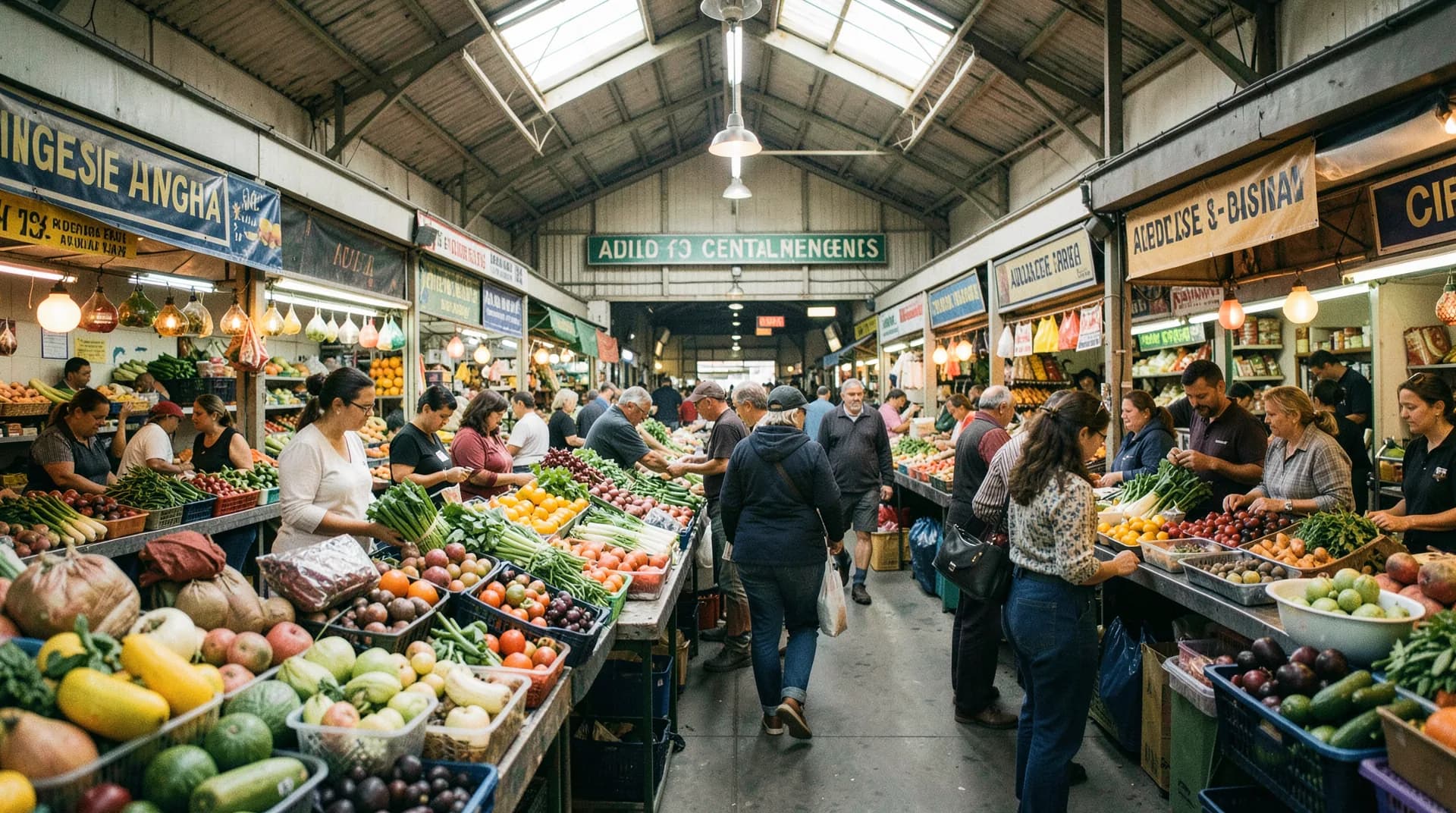
Food and produce sit at the centre of daily life. The Adelaide Central Market, between Grote and Gouger Streets, is one of the oldest fresh-produce markets in Australia. Immediately adjacent on Moonta Street, Chinatown and the wider Gouger Street precinct run Chinese, Vietnamese, Japanese, Korean, Thai, Malaysian and Indian restaurants alongside food courts that grew out of post-1970s migration.
Wine surrounds the city. Adelaide Hills is roughly 20 minutes from the CBD, McLaren Vale about 40 km south, the Barossa Valley around 76 km and an hour's drive north-east, and Clare Valley 145 km and around 1 hour 45 minutes north.
Sport is dominated by the AFL Showdown between the Adelaide Crows and Port Adelaide Power, played at the 53,500-seat Adelaide Oval on the northern bank of the Torrens. The Adelaide Oval also hosts test cricket and a Big Bash League team (Adelaide Strikers), and Adelaide United plays in the men's and women's A-League.
The coast is close. Glenelg is on the tramline, 28 minutes from the CBD. Henley Beach, Semaphore, Brighton and Largs Bay sit along the same continuous western coastline.
Immigration Pathways to Adelaide
Adelaide's PR pathways are unusually layered because the entire metropolitan area is treated as regional.
1. SA state nomination (subclass 190, permanent)
For 2025-26, South Australia has 1,350 subclass 190 nomination places (Move to South Australia). State nomination adds 5 points to your Expression of Interest. The minimum points test score is 65, but real-world nomination typically requires more, especially in competitive occupations.
2. SA state nomination (subclass 491, provisional)
For 2025-26, South Australia has 900 subclass 491 nomination places. State nomination on a 491 adds 15 points, the highest single state-based points contribution. The 491 is a five-year provisional visa.
3. Subclass 491 to subclass 191 (permanent)
After three years of living and working in a designated regional area on a 491 (or 494) and meeting the income threshold, a holder can apply for the subclass 191 permanent visa. Adelaide qualifies as a Category 2 designated regional area (Department of Home Affairs), so all of Greater Adelaide counts toward this requirement, not just outer suburbs.
4. Skilled occupation lists
For 2025-26, SA opened 393 onshore occupations (down from 464 the prior year, with 71 occupations removed) and 427 offshore occupations. Priority sectors named by SA include health, engineering, ICT, education, business, defence and trades. Always verify your specific ANZSCO code on migration.sa.gov.au before applying.
5. Streams
SA runs four nomination streams: skilled migrants already living and working in SA; international graduates of SA universities (fast-tracked); applicants in outer regional SA (outside Greater Adelaide); and an offshore stream where SA can invite candidates from overseas through SkillSelect.
The practical takeaway: SA is widely regarded as one of the more accessible states for state nomination thanks to a broad occupation list and a designated-regional bonus that other capital-city programs (Sydney, Melbourne, Brisbane) cannot offer.
Pros and Cons
| Pros | Cons |
|---|---|
| One of the most accessible state nomination programs in Australia | 2025-26 places cut by around 41% versus the prior year |
| Whole city is a Category 2 designated regional area (491, 191) | Salaries typically 5 to 15% below Sydney and Melbourne |
| Lower rent and house prices than east-coast capitals | Rental vacancy still tight at 0.7% (April 2026) |
| AUKUS submarine build will run for decades | Some sectors (finance, tech) have shallower job markets |
| Compact city, short commutes, good airport access | Summers include genuine extreme-heat days |
| Strong universities, with the new Adelaide University post-merger | Quieter nightlife and arts scene outside festival season |
| Established multicultural food and migrant networks | Public transport is good for a city this size but not 24/7 |
FAQ
Why is Adelaide considered easier for state nomination?
Because South Australia maintains a wider occupation list than NSW, Victoria or Queensland and the whole metropolitan area is treated as a regional area. The 2025-26 program is smaller than 2024-25 (2,250 places versus 3,800), but the breadth of eligible occupations remains a structural advantage.
How does the cost of living compare to Melbourne?
Rent is the biggest gap. As of March 2026, Adelaide house rents are around $640 per week and units around $550 per week, both materially below Melbourne. Groceries, utilities and transport are closer, but the rent differential alone usually saves a household several hundred dollars per week.
Is Adelaide too quiet?
Outside the February to March festival period the pace is calmer than Sydney or Melbourne. For many families and skilled professionals this is the appeal. For those who want club-and-late-night culture five nights a week, Adelaide is smaller and quieter.
What are the cheapest suburbs for a new arrival?
Salisbury, Elizabeth and Munno Para in the north are historically the most affordable, all on the Gawler train line. Hackham and Christie Downs in the south are similar. Verify against current Domain or realestate.com.au listings before committing.
Can immigrants get AUKUS jobs?
Many AUKUS roles, particularly nuclear-related and security-cleared work, require Australian citizenship and Defence security clearances, which take time to obtain. However, ASC, BAE Systems and the broader supply chain hire across engineering, project management, IT and trades, and have published apprentice and trainee pathways. Permanent residency is typically the practical minimum for most cleared positions.
Can I live in Adelaide without a car?
Yes, in the CBD, North Adelaide, Norwood, Unley and along the train lines and tram corridor. In outer suburbs a car is close to essential. The free city tram zone, free City Connector bus and metroCARD network make car-free CBD living realistic.
How hot does Adelaide really get?
Hot. The official West Terrace site recorded 47.7 °C on 24 January 2019, the highest reading at any Australian state or territory capital's official site. Multi-day strings above 40 °C happen most summers. Air conditioning is standard, not optional.
Is the new Adelaide University going to disrupt my study plans?
The University of Adelaide and UniSA officially merged into Adelaide University on 29 January 2026. Existing students of both institutions transitioned into the merged university; intending students should apply directly under the new Adelaide University name. Verify any course-specific transition rules on adelaide.edu.au.
Sources
- ABS Regional population 2024-25 - Greater Adelaide ERP and 2024-25 growth.
- ABS Regional population 2023-24 - 30 June 2024 Greater Adelaide figure (1.469 million).
- Move to South Australia: 2025-26 allocations - 1,350 (190) and 900 (491) nomination places.
- Migration SA: Occupation Lists - 2025-26 onshore (393) and offshore (427) occupation counts.
- Department of Home Affairs: Designated regional areas - Adelaide Category 2 classification.
- Australian Submarine Agency: Jobs and careers - ~20,000 direct jobs over 30 years; AUKUS workforce.
- ASC: Sovereign Submarine Partner - ASC and BAE Systems joint venture, Osborne build.
- Lot Fourteen: Official opening of the Australian Space Agency - February 2020 HQ opening.
- Adelaide University (merged institution) - 29 January 2026 opening, around 70,000 students.
- Bureau of Meteorology: Adelaide Kent Town climate averages - 1991-2020 monthly means.
- Climate of Adelaide (Wikipedia, citing BOM) - Heatwave history and 47.7 °C record.
- Adelaide Metro: Fares and tickets - metroCARD structure, two-hour fare.
- Adelaide Metro: 1 July 2025 fare change - CPI-linked uplift.
- SA Health: Hospitals overview - RAH, FMC, Lyell McEwin.
- Department for Infrastructure and Transport: T2D project - North-South Corridor completion timeline.
- Domain Rent Report (via Property Update commentary) - Adelaide March 2026 quarter house and unit rents.
- SQM Research: Adelaide weekly rents - April 2026 vacancy 0.7%.
- Adelaide Fringe - World's second-largest annual arts festival.