How Many Points Do You Need for 189, 190, and 491 Visas?
The minimum points score for Australian skilled visas is 65, but the competitive score you actually need to receive an invitation is much higher. For the Subclass 189, most occupations require 80-90+ points. The Subclass 190 typically requires 65-80 points depending on the state and occupation. The Subclass 491 has the lowest effective thresholds at 65-75 points. These numbers fluctuate with each invitation round based on occupation demand, applicant pool size, and government quotas.
Quick Facts
| Visa | Minimum Points | Competitive Points (2026) |
|---|---|---|
| 189 (Skilled Independent) | 65 | 80-95 (most occupations) |
| 190 (State Nominated) | 65 (including 5 for nomination) | 65-85 (varies by state) |
| 491 (Skilled Regional) | 65 (including 15 for nomination) | 65-75 (most occupations) |
Understanding the Points System
Minimum vs Competitive
The government sets 65 as the minimum points score to submit an Expression of Interest (EOI). But having 65 points doesn't mean you'll receive an invitation — it means you're eligible to enter the queue.
Think of it like university admissions. The entry requirement might be a certain score, but the actual cutoff for popular programs is much higher. Your EOI competes against everyone else in the same occupation pool.
How Invitations Work
Every invitation round, the Department selects EOIs from the pool based on:
- Points score — highest first
- Date of effect — among equal scores, the earliest EOI gets priority
If there are 100 places for software engineers and 500 EOIs, only the top 100 by points (and date of effect as a tiebreaker) receive invitations. This is why the competitive score is much higher than the minimum.
Current Competitive Scores by Visa
Subclass 189 (Skilled Independent)
The 189 is the most competitive because it offers direct permanent residence without state nomination.
High-demand occupations (80-90+ points needed):
- Accountants: 90-95 points
- Software Engineers: 85-90 points
- ICT Business Analysts: 85-90 points
- Mechanical Engineers: 80-85 points
- Auditors: 90-95 points
Moderate-demand occupations (75-85 points needed):
- Civil Engineers: 75-80 points
- Electrical Engineers: 75-80 points
- Registered Nurses: 80-85 points
- Medical Practitioners: 75-80 points
Lower-demand occupations (65-75 points needed):
- Some niche engineering specialisations
- Certain medical specialists
- Some trades (depending on supply/demand)
Critical insight: For popular occupations like accounting and software engineering, even 85 points may not be enough due to the volume of high-scoring applicants. The queue at 85 points can be months long.
Subclass 190 (State Nominated)
The 190 adds 5 points for state nomination, making the effective minimum 60 points of your own (plus 5 from the state = 65 total). But each state sets its own criteria.
State-by-state competitiveness (approximate):
| State | Typical Points Needed | Focus Areas |
|---|---|---|
| NSW | 70-85 | IT, engineering, healthcare |
| VIC | 65-80 | Broad range of occupations |
| QLD | 65-75 | Healthcare, engineering, trades |
| SA | 65-75 | Broad — encourages regional settlement |
| WA | 65-75 | Mining, engineering, healthcare |
| TAS | 65-70 | Broad — actively recruits |
| ACT | 65-80 | Must live in ACT, matrix-based |
| NT | 65-70 | Broad — strong regional focus |
States publish their own occupation lists and nomination criteria, which change frequently.
Subclass 491 (Skilled Regional)
The 491 adds 15 points for state/territory nomination, making the effective minimum just 50 points of your own. This makes it the most accessible points-tested visa.
Most occupations can be invited at 65-75 total points, though some states require higher scores for competitive occupations. The trade-off is the 3-year regional residence requirement before accessing permanent residence through the 191.
Points Breakdown
| Factor | Points Available |
|---|---|
| Age (25-32) | 30 |
| Age (33-39) | 25 |
| Age (18-24 or 40-44) | 15 |
| English: Superior (IELTS 8+) | 20 |
| English: Proficient (IELTS 7+) | 10 |
| English: Competent (IELTS 6+) | 0 |
| Overseas experience (3-4 years) | 5 |
| Overseas experience (5-7 years) | 10 |
| Overseas experience (8+ years) | 15 |
| Australian experience (1-2 years) | 5 |
| Australian experience (3-4 years) | 10 |
| Australian experience (5-7 years) | 15 |
| Australian experience (8+ years) | 20 |
| PhD | 20 |
| Bachelor's/Master's | 15 |
| Diploma/Trade | 10 |
| Australian study requirement | 5 |
| Specialist education (STEM PhD in Aus) | 10 |
| NAATI credentialed community language | 5 |
| Regional study | 5 |
| Partner skills | 5-10 |
| Single applicant (no partner) | 10 |
| State nomination (190) | 5 |
| State/family nomination (491) | 15 |
Maximum theoretical score without nomination: 130+ points. In practice, most applicants score 65-100.
What's Realistic?
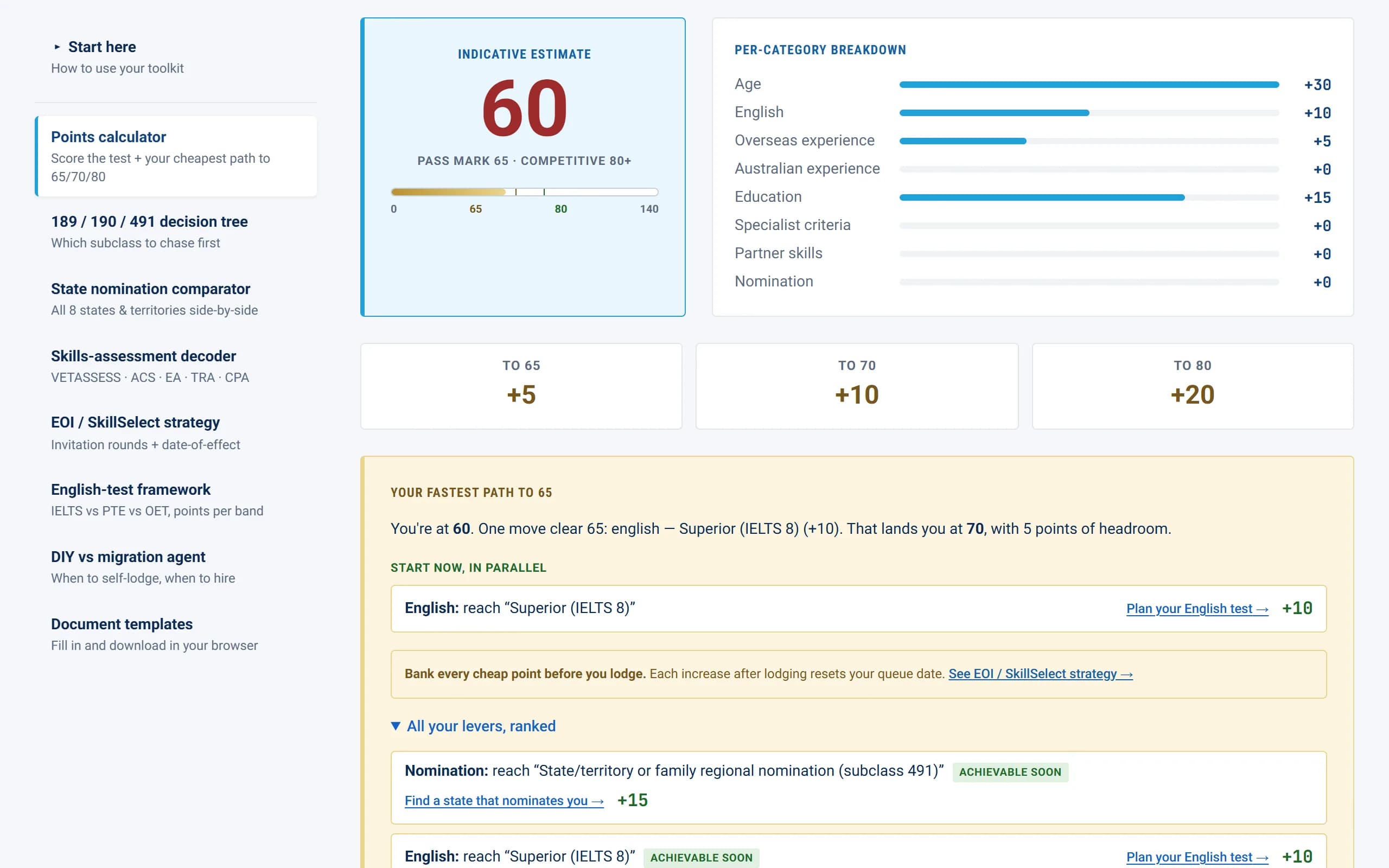
Typical Applicant: 30-Year-Old with Master's Degree
| Factor | Points |
|---|---|
| Age (30) | 30 |
| English (IELTS 7.0) | 10 |
| Master's degree | 15 |
| 3 years overseas experience | 5 |
| Total | 60 |
This applicant needs 5 more points for the 189 minimum (65), but realistically needs 20-35 more for a competitive 189 score. Options: improve English to 8+ (gain 10 points), gain Australian experience, or apply for 190/491 with state nomination points.
Typical Applicant: 28-Year-Old with Australian Study
| Factor | Points |
|---|---|
| Age (28) | 30 |
| English (IELTS 8.0) | 20 |
| Bachelor's degree | 15 |
| Australian study | 5 |
| 1 year Australian experience | 5 |
| Total | 75 |
Competitive for 190 and 491. Borderline for 189 in some occupations — may need additional strategies to maximise points.
Tips for Improving Your Invitation Chances
-
Maximise English. The difference between IELTS 7 (10 points) and IELTS 8 (20 points) is 10 points — the equivalent of 3-4 years of additional work experience.
-
Consider the 190/491 if 189 is out of reach. State nomination adds 5 (190) or 15 (491) points, often making the difference.
-
Check your date of effect. Among applicants with the same score, earlier EOIs are invited first.
-
Don't wait to submit your EOI. Submit as soon as you have enough points. Your date of effect starts from submission.
-
Update your EOI immediately when circumstances change (new English score, more experience, birthday). But understand that updates can reset your date of effect.
Frequently Asked Questions
Is 65 points enough for a 189 invitation?
In theory, yes — 65 is the minimum. In practice, virtually no 189 invitations are issued at 65 points. Most occupations require 80+ for a realistic chance.
Do invitation scores change every round?
Yes. Each round selects the highest-scoring EOIs. If many high-scoring applicants submit EOIs, the cutoff rises. If the applicant pool shrinks, the cutoff may drop.
How often are invitation rounds held?
Rounds are typically held monthly, though the schedule can vary. The Department doesn't publish a fixed calendar — rounds are announced as they occur.
Can I get invited for the 189 and 190 from the same EOI?
Your EOI can indicate interest in both 189 and 190. You can receive a state nomination (190) while waiting for a 189 invitation. However, accepting a 190 nomination usually requires withdrawing your 189 EOI.
What happens if I'm never invited?
EOIs remain in the system for 2 years. If you're not invited within that period, the EOI expires. You can submit a new one. During the 2 years, focus on gaining more points.