Australian Visa for Japanese Citizens: Complete 2026 Guide
Updated: 16 August 2026
Japan and Australia enjoy one of the closest bilateral relationships in the Asia-Pacific, built on decades of economic partnership, cultural exchange, and mutual defence cooperation. Japanese passport holders benefit from streamlined visa access to Australia, including ETA eligibility and one of the longest-standing Working Holiday arrangements in the world. Here's your complete guide to every visa pathway available.
Quick Facts: Australian Visas for Japanese Citizens
| Detail | Information |
|---|---|
| Tourist/Business Visa | ETA (subclass 601) — electronic application |
| Student Visa | Subclass 500 — growing enrolments |
| Working Holiday | Subclass 417 — up to age 35 |
| Skilled Migration | Subclass 189, 190, 491 — points-tested |
| Employer Sponsored | Subclass 482, 494, 186 |
| Health Exam | Required for stays over 3 months |
| Police Clearance | Certificate of No Criminal Record from prefectural police |
| Embassy | Australian Embassy, Tokyo |
ETA (Subclass 601) for Japanese Citizens
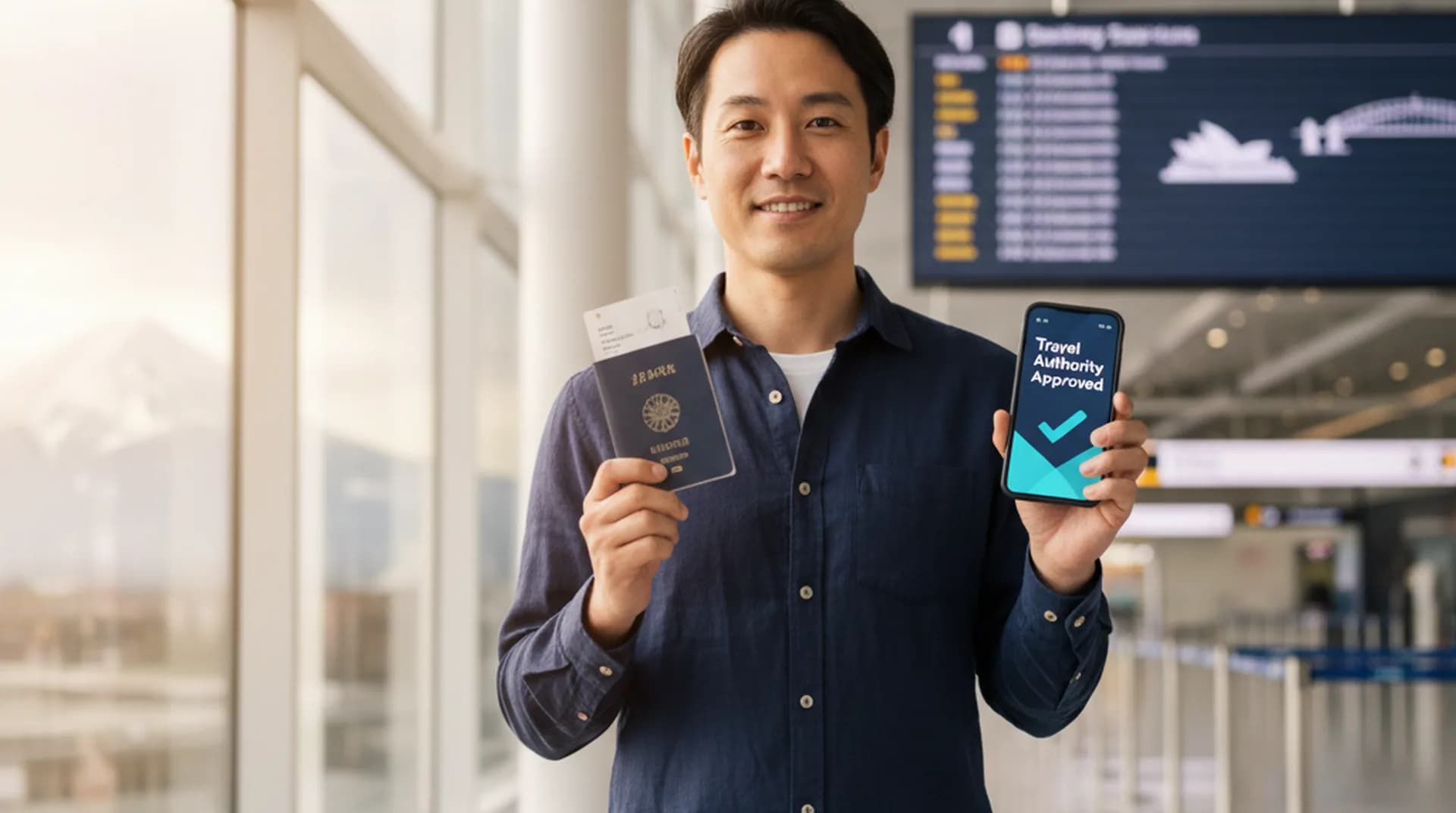
Japanese passport holders are eligible for the Electronic Travel Authority, making short visits to Australia straightforward. The ETA allows multiple entries over 12 months, with each stay capped at three months.
Application Process
The ETA is applied for through the Australian ETA app:
- Download the Australian ETA app on your smartphone
- Scan your Japanese passport using NFC
- Complete the biometric selfie verification
- Pay the AUD $20 service charge
- Receive approval — usually within minutes, occasionally up to 24 hours
No paper documents need to be submitted. The ETA is electronically linked to your passport, so there's no visa label or sticker.
What You Can Do on an ETA
The ETA covers tourism, visiting family and friends, and short-term business activities like attending meetings, conferences, or exploring business partnerships. You cannot work or study for more than three months on an ETA.
For longer stays, you'd need a Visitor visa (subclass 600) at AUD $250, which can grant stays of up to 12 months depending on your circumstances.
Working Holiday Visa (Subclass 417) for Japanese Citizens
The Japan-Australia Working Holiday arrangement was one of the earliest established, dating back to 1980. It remains one of the most popular pathways for young Japanese nationals to experience life in Australia.
Eligibility
- Aged 18 to 35 (inclusive) at the time of application
- Hold a valid Japanese passport
- Have approximately AUD $5,000 in available funds plus return airfare
- Meet health and character requirements
- Not have dependent children accompanying you
- Not have previously held a 417 visa (for first-year applications)
The age limit was increased from 30 to 35 for Japanese citizens, reflecting the strength of the bilateral relationship.
Work and Study Conditions
The 417 visa allows you to:
- Work for any employer in Australia, with a six-month limit per employer
- Study or train for up to four months
- Travel freely in and out of Australia during the 12-month visa period
Extending Your Stay
- Second year: Complete 88 days of specified work in regional Australia (farming, mining, construction, etc.)
- Third year: Complete 179 days of specified work during your second-year visa
The first Working Holiday application costs AUD $840; second and third-year applications are AUD $1,000 each. Many Japanese Working Holiday makers find agricultural work in Queensland, Victoria, and Western Australia to qualify for their second year.
Cultural Exchange Opportunities
Beyond standard employment, Japanese WHV holders frequently participate in cultural exchange activities — working in Japanese restaurants, participating in sister-city programs, teaching Japanese language, or working in tourism roles that leverage bilingual skills. Australia's strong Japanese tourism market means there are consistent opportunities in hospitality and tourism, particularly in Queensland and the Northern Territory.
Student Visa (Subclass 500) for Japanese Citizens
While Japan's domestic higher education system is world-class, a growing number of Japanese students are choosing to study in Australia for English language development, internationally recognised qualifications, and career diversification.
Popular Study Pathways
Japanese students in Australia are concentrated in:
- English language (ELICOS) programs — the most common initial pathway
- University undergraduate and postgraduate degrees — particularly business, international relations, and environmental science
- Vocational education (VET) — hospitality, tourism, and creative arts
- Study abroad and exchange programs — many Japanese universities have partnerships with Australian institutions
Genuine Student Requirement
Your GS statement should explain why you've chosen to study in Australia rather than Japan, how the course connects to your career plans, and your financial capacity. Japanese applicants with a clear academic trajectory and strong institutional choices generally receive smooth processing.
Costs and Processing
The student visa costs AUD $2,500. Processing for Japanese applicants is typically 4 to 8 weeks. You'll need to demonstrate access to AUD $29,710 per year for living costs, plus tuition and travel expenses.
Skilled Migration from Japan
Japanese professionals, particularly in engineering, IT, healthcare, and specialised manufacturing fields, can access Australia's skilled migration program.
Points-Tested Pathways
- Subclass 189 (Skilled Independent) — no nomination needed, highest points bar
- Subclass 190 (Skilled Nominated) — state nomination adds 5 points
- Subclass 491 (Skilled Work Regional) — regional nomination adds 15 points
You'll need your occupation on the skilled occupation list, a positive skills assessment, and competitive English scores.
Skills Assessment for Japanese Qualifications
Japanese degrees from recognised universities are well-regarded by Australian assessing bodies. Japan is a signatory to the Washington Accord (engineering) and the Seoul Accord (computing), which facilitates recognition of these qualifications.
Key assessing bodies:
- Engineers Australia — streamlined pathway for Japanese engineering degrees under the Washington Accord
- ACS — IT qualifications from Japanese universities
- VETASSESS — general professional and trade occupations
- ANMAC — nursing qualifications (additional bridging requirements may apply)
English Language Considerations
English proficiency is often the main challenge for Japanese skilled migration applicants. The minimum requirement is IELTS 6.0 in each band (or equivalent PTE, TOEFL, or Cambridge score), but higher scores significantly boost your points. Investing in English preparation before applying can make a substantial difference to your competitiveness.
Partner and Family Visas
Japanese nationals in relationships with Australian citizens or permanent residents can apply for:
- Subclass 309/100 (Partner visa offshore) — lodged from Japan
- Subclass 820/801 (Partner visa onshore) — lodged from within Australia
The application fee is AUD $11,710. Processing for the temporary stage is approximately 8 to 14 months. Relationship evidence requirements are the same as for all nationalities: communication records, photos, joint finances, cohabitation evidence, and statutory declarations.
Frequently Asked Questions
Do Japanese citizens need a visa to visit Australia?
Yes, but the process is very simple. Japanese passport holders can apply for an ETA (subclass 601) through the Australian ETA app, which is typically approved within minutes.
What is the age limit for Japanese Working Holiday applicants?
The age limit is 35 years old at the time of application. Japan was one of the countries granted the increased age limit from the previous cap of 30.
Can I work in Australia on an ETA?
No. The ETA does not permit any form of employment. For work rights, you'll need a Working Holiday visa, student visa (with work conditions), or an employer-sponsored visa.
How long does a Japanese student visa take to process?
Typically 4 to 8 weeks. Applications with a Confirmation of Enrolment from a well-established Australian university tend to process at the faster end of this range.
Is the Working Holiday visa uncapped for Japanese citizens?
Yes. The subclass 417 Working Holiday visa for Japanese nationals has no annual cap, unlike the subclass 462 which applies to some other countries.
Do I need to translate my Japanese documents?
Yes. All documents not in English must be accompanied by certified translations from a NAATI-accredited translator. This includes academic transcripts, police certificates, and any supporting documents in Japanese.