Chemical Engineer Visa Pathway to Australia: Complete 2026 Guide
Updated: 16 August 2026
Australia classifies Chemical Engineer under ANZSCO 233111. Engineers Australia conducts the migration skills assessment. The occupation sits on the MLTSSL and CSOL, opening subclasses 189, 190, 491, 482 and 186. Typical 2026 salaries range AUD $90,000-$160,000+, with sustained demand across LNG, mining, hydrometallurgy, water treatment and the emerging green hydrogen and carbon capture sectors keeping qualified chemical engineers in short supply.
Quick Facts: Chemical Engineer Migration Pathway
| Detail | Information |
|---|---|
| ANZSCO Code | 233111 (Chemical Engineer) |
| Skill Level | 1 (Bachelor degree or higher in chemical engineering) |
| Skills Assessment | Engineers Australia (Migration Skills Assessment) |
| Occupation List | MLTSSL and CSOL |
| Visa Options | 189, 190, 491, 482, 186 |
| Demand Level | High — Jobs and Skills Australia tracks chemical and materials engineers as a persistent shortage occupation; LNG, mining and energy transition drive structural demand |
| Salary Range | AUD $90,000-$160,000+ (SEEK, May 2026; senior process engineers and FIFO roles toward the upper end) |
| Typical 189 Score | 85-90 |
| Key Challenge | CDR career episodes that describe chemistry research or laboratory work rather than applied chemical engineering design and operations |
What Chemical Engineers Do in Australia
Chemical engineers in Australia design, commission, operate and improve processes that transform raw materials into useful products — fuels, refined metals, fertilisers, food and beverages, pharmaceuticals, plastics and water treatment outputs. The role straddles design office and plant floor. Day-to-day work includes process simulation in Aspen or HYSYS, mass and energy balances, P&ID review, hazard and operability (HAZOP) studies, equipment specification, troubleshooting plant upsets, debottlenecking, and safety case authorship under the Major Hazard Facility framework.
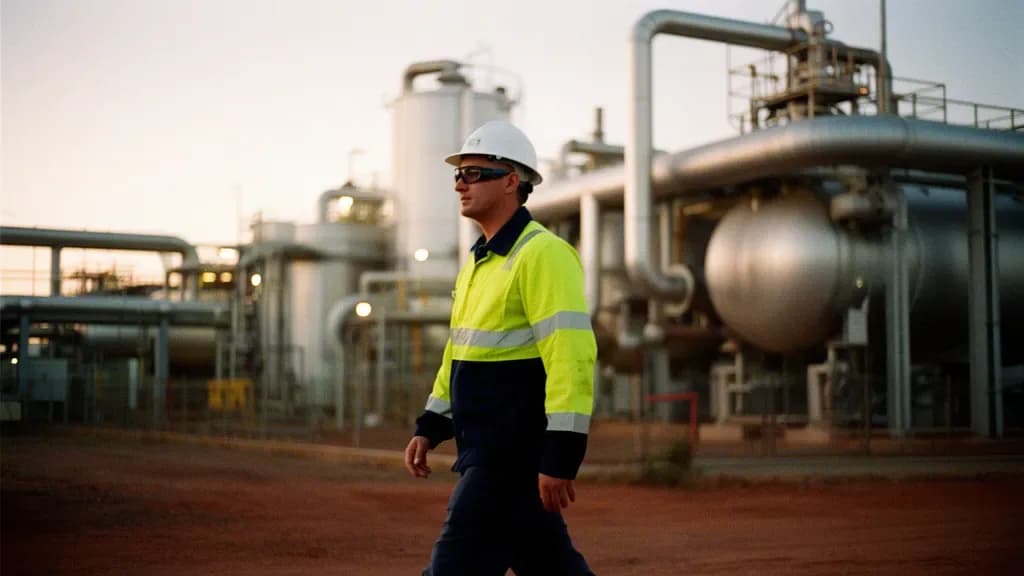
The sector mix is distinct from the US or UK. LNG dominates Western Australia (Woodside, Chevron, Inpex), iron ore and lithium processing dominate the Pilbara and Goldfields (Rio Tinto, BHP, Fortescue, Pilbara Minerals, IGO), alumina refining sits in Queensland and WA (Rio Tinto Yarwun, Alcoa Pinjarra), and a growing renewables and hydrogen pipeline is concentrated around Gladstone, the Hunter, Whyalla and the Pilbara. Mining and metals process engineers, hydrometallurgists and FIFO commissioning engineers are the highest-paid niches.
Major employers include the resources majors (BHP, Rio Tinto, Fortescue, Woodside, Santos, Inpex, Chevron), EPCs and consultancies (Worley, Wood, Hatch, Fluor, GHD, Aurecon, KBR), water utilities, food and beverage manufacturers (Fonterra, Bega, Lion) and chemical manufacturers (Incitec Pivot, Orica, Qenos, Dyno Nobel).
ANZSCO 233111 — Code Mapping
ANZSCO 233111 covers professionals who design chemical plant and equipment, develop chemical processes, and supervise plant operations. Tasks include conducting research into chemical reactions, designing process control systems, monitoring quality and yield, ensuring safety and environmental compliance, and providing technical advice on chemical processes.
Sub-specialties that all sit inside 233111 include process engineer, hydrometallurgical engineer, polymer engineer, food process engineer, pharmaceutical process engineer, water treatment engineer and biochemical engineer. The most common adjacent code is 233112 Materials Engineer, used for engineers focused on metallurgy, polymers and ceramics rather than process design. The 2331 unit group also catches some niche roles through the 233999 Engineering Professionals nec fallback, but chemical engineers proper belong squarely in 233111.
Petroleum engineering is a separate code (233612 Petroleum Engineer), as is mining engineering. Some applicants whose career has covered oil and gas process work choose between 233111 and 233612 — the deciding factor is whether the bulk of the work is upstream reservoir engineering (petroleum) or downstream processing (chemical).
Skills Assessment
Engineers Australia Migration Skills Assessment
Engineers Australia is the only assessing body for chemical engineering roles for migration purposes.
- Body: Engineers Australia
- Pathways: Australian-accredited qualification, Washington Accord (or Sydney/Dublin Accord), or Competency Demonstration Report (CDR)
- CDR requirement: Three career episodes (1,500-2,500 words each), a CPD summary and a summary statement mapped to Stage 1 Competencies
- Assessment cost (2026): Australian-accredited AUD $335.50; Washington/Sydney/Dublin Accord AUD $539; Standard CDR AUD $1,001; Fast Track add-on AUD $385. Fees rise 3-4% from 1 July 2026.
- Processing time: Standard CDR 10-16 weeks; Washington Accord 8-12 weeks; Fast Track assigns to assessor within 20 business days
- Common rejection reasons: Career episodes that read as chemistry research or pure laboratory analysis rather than engineering design; weak coverage of process safety competencies; insufficient first-person ownership in the episode narrative; plagiarism detected via Turnitin (Engineers Australia is strict and recurrent CDR templates trigger immediate rejection)
For 233111, Engineers Australia expects evidence of applied chemical engineering design or operations work. Pure analytical chemistry or QC lab roles will not pass. Where your career mixes lab and process work, choose episodes that highlight process design, plant troubleshooting, scale-up or safety case authorship.
Recognition of Foreign Qualifications
Washington Accord signatories include the US, UK, Canada, Ireland, Singapore, South Africa, Pakistan, India (post 2014 cohorts), Hong Kong, Japan, Korea, Malaysia, Sri Lanka and others. If your degree is from a Washington Accord-accredited program, you can use the faster, cheaper Washington Accord pathway and skip the CDR. India presents complications because only IIT/NIT programs accredited under the Accord from 2014 onwards qualify automatically — many Indian chemical engineers still use the CDR route.
Visa Pathways for Chemical Engineers
Subclass 482 — Skills in Demand Visa (Common Pathway)
The Australian resources sector and EPC contractors regularly sponsor chemical and process engineers, particularly for commissioning and operations roles in WA, the NT and Queensland.
- Visa fee: AUD $4,015
- Core Skills Income Threshold: AUD $79,423 (from 1 July 2026; previously AUD $76,515)
- Specialist Skills Income Threshold: AUD $146,576 (from 1 July 2026; previously AUD $141,210)
- Processing time: 2-4 months
- Reality: Senior process engineers and FIFO roles routinely sit in the Specialist Skills stream. Junior and mid-level applicants typically go through Core Skills.
Subclass 189 — Skilled Independent Visa
Available because 233111 is on the MLTSSL. Competitive but achievable for strong candidates.
- Visa fee: AUD $6,135
- Minimum points: 65 (realistically 85-90 for chemical engineering invitations in 2026)
- Processing time: 6-12 months
Subclass 190 — Skilled Nominated Visa
State nomination grants permanent residency with a 2-year commitment to the nominating state.
- Visa fee: AUD $6,140
- Points boost: +5
- Best states: WA and QLD for resources and LNG; SA for defence chemistry; VIC for advanced manufacturing and renewables
Subclass 491 — Skilled Work Regional Visa
Regional nomination adds 15 points. Most chemical engineering work in Australia happens in regional postcodes — the Pilbara, the Hunter Valley, Gladstone, Whyalla, the LaTrobe Valley.
- Visa fee: AUD $6,140
- Points boost: +15
- Pathway to PR: 191 after 3 years of compliant residence and income
Subclass 186 — Employer Nomination Scheme
Permanent residency through employer sponsorship.
- Visa fee: AUD $6,140
- Streams: Direct Entry (skills assessment + 3 years experience) or TRT (after 2 years on 482)
- Reality: Resources majors and EPCs frequently sponsor mid-career process engineers to 186 Direct Entry
Points Test Strategy
| Points Factor | Points | Notes |
|---|---|---|
| Age (25-32) | 30 | Maximum bracket |
| Age (33-39) | 25 | Common for mid-career applicants |
| Bachelor's degree | 15 | Minimum |
| Master's | 15 | Same band |
| PhD | 20 | Common in process and catalysis research roles |
| English (Superior — IELTS 8) | 20 | Worth the effort for STEM applicants |
| English (Proficient — IELTS 7) | 10 | Baseline |
| Skilled employment overseas (3-4 yrs) | 5 | |
| Skilled employment overseas (5-7 yrs) | 10 | |
| Skilled employment overseas (8+ yrs) | 15 | |
| State nomination (190) | 5 | |
| Regional nomination (491) | 15 | |
| Partner skills | 5-10 |
Realistic Scenarios
Scenario 1: Indian process engineer, age 29, 6 years at refinery, Master's
Age 29 (30) + Master's (15) + IELTS 7 (10) + 5-7 years overseas (10) = 65 points. Add 190 nomination (+5) = 70 points. Add 491 instead (+15) = 80 points. Strong invitation chance via 491 with WA or QLD.
Scenario 2: South African chemical engineer, age 36, 13 years in mining and metals, IELTS 8
Age 36 (25) + Bachelor's (15) + IELTS 8 (20) + 8+ years overseas (15) = 75 points. Add 491 (+15) = 90 points. Comfortable invitation territory.
State Nomination
Western Australia
WA is the natural home for chemical engineers because LNG, iron ore, lithium and alumina dominate the state economy. The WA 190 quota for 2025-26 is approximately 1,000 places, with chemical and process engineers reliably included. Perth and FIFO postings (Pilbara, Goldfields) drive most opportunities.
Queensland
Queensland nominates chemical engineers under its 190 and 491 streams. Gladstone hosts a cluster of LNG, alumina refining and hydrogen development. Brisbane carries the policy and engineering consultancy work, while Townsville and Mount Isa run base metal processing.
South Australia
SA nominates chemical engineers, particularly for defence-related chemistry (DST Group, Lockheed Martin Australia at Edinburgh) and emerging hydrogen projects around Whyalla and Port Bonython. SA's 491 program is particularly accessible for offshore applicants.
Victoria
Victoria nominates chemical engineers tied to manufacturing, advanced materials, food and beverage, and pharmaceutical production. The state typically requires demonstrated commitment to Victoria, often through onshore study or a job offer.
New South Wales
NSW nominates chemical and process engineers tied to water utilities, food and beverage processing, and the Hunter Valley industrial cluster. Sydney consultancies (Worley, Wood, Hatch, GHD) sponsor offshore engineers regularly.
Salary and Employment Outlook
| Role | Typical Salary Range |
|---|---|
| Graduate / Early-Career (0-2 years) | AUD $75,000-$95,000 |
| Process Engineer (3-7 years) | AUD $100,000-$140,000 |
| Senior Process Engineer (8+ years) | AUD $140,000-$180,000 |
| FIFO Process Engineer (Pilbara, LNG) | AUD $160,000-$220,000 + LAFHA |
| Hydrometallurgist (lithium, nickel, copper) | AUD $150,000-$220,000 |
| Principal / Lead Engineer | AUD $180,000-$240,000 |
Source: SEEK Australia (May 2026), with cross-check against ERI SalaryExpert and Hays Salary Guide FY25/26. SEEK reports an average base of AUD $80,000-$100,000 across all listed roles; this skews lower because it captures large numbers of graduate and metropolitan postings. Mid-career and resources-sector salaries sit materially higher.
Total packages typically include 11.5% superannuation, performance bonuses (10-20% in resources), FIFO loadings, LAFHA, and equity in listed mining and energy companies.
Highest-Paying Sectors
- LNG operations and project commissioning — Woodside, Chevron, Inpex, Santos pay top-of-market for commissioning engineers
- Battery metals processing — lithium hydroxide, nickel sulphate, copper refining
- Iron ore processing and beneficiation — Pilbara majors
- EPC contracting — Worley, Wood, Fluor, KBR (project-driven premiums)
- Hydrogen and green ammonia — Fortescue, Origin, Stanwell at Gladstone, the Pilbara and Bell Bay
Tips for a Successful Application
1. Write CDR career episodes that show engineering design, not just operations
Engineers Australia rejects CDRs where the chosen episodes describe operator-level work — sampling, monitoring, logging. Choose episodes where you specified equipment, ran process simulations, authored HAZOPs, designed control philosophy, or led commissioning. Show ownership of engineering decisions, not just observation of plant behaviour.
2. Use Washington Accord pathway if eligible
Washington Accord pathway is cheaper (AUD $539 vs AUD $1,001) and faster (8-12 weeks vs 10-16). If your degree is from a Washington Accord-accredited program, use this pathway. Check Engineers Australia's accredited program list before defaulting to CDR.
3. Decide between 233111 and 233612 carefully if you have oil and gas experience
If your work has been upstream — reservoir, wellsite, drilling fluids — Petroleum Engineer 233612 is correct. If downstream — refining, LNG processing, plant operations — 233111 fits. Mixing the two in a single application weakens both.
4. Plan for IELTS 8 to unlock 20 points
Most STEM applicants can hit Superior English with focused preparation. The 10-point gap between Proficient and Superior is often the difference between sitting in the EOI pool for a year and getting invited in the next round.
5. Target 491 if your points score is 70-80
The Pilbara, Hunter Valley, Gladstone and Whyalla are all 491-eligible. These are precisely the regions where chemical engineering work is concentrated. Regional nomination (+15) makes 70-point candidates invitation-competitive without compromising on career opportunity.
Step-by-Step Migration Roadmap
- Confirm 233111 is the correct code — review the how to find your ANZSCO code guide
- Sit IELTS Academic or PTE — target Superior level
- Determine eligible assessment pathway — Washington Accord or CDR
- Prepare CDR or accord documentation
- Submit Engineers Australia Migration Skills Assessment
- Receive assessment outcome
- Submit EOI in SkillSelect for 189, 190 or 491
- Apply for state nomination if pursuing 190 or 491
- Alternatively, pursue 482 (Specialist Skills if salary clears AUD $146,576) or 186 Direct Entry through an employer
- Receive invitation and lodge visa within 60 days
- Complete health, character and biometrics
- Receive visa grant and relocate
Frequently Asked Questions
Is a chemical engineering degree from India accepted by Engineers Australia?
Yes. Indian chemical engineering degrees are widely assessed and routinely deliver positive outcomes. Programs accredited under the Washington Accord (post-2014 IIT, NIT and select private institution intakes) can use the faster Washington Accord pathway. All other Indian programs use the Competency Demonstration Report (CDR) pathway, which costs AUD $1,001 standard and takes 10-16 weeks.
Which code suits a refinery process engineer best — 233111 or 233612?
233111 Chemical Engineer is correct for downstream refining and petrochemicals work. 233612 Petroleum Engineer applies to upstream reservoir, drilling and production engineering. Both sit on the MLTSSL and both are assessed by Engineers Australia. The choice should follow your documented day-to-day duties, not the perceived demand level of each code.
Do chemical engineering jobs in Australia routinely sponsor 482 visas?
Yes. Resources majors (BHP, Rio Tinto, Fortescue, Woodside, Chevron, Inpex), Tier 1 EPCs (Worley, Wood, Hatch, Fluor, KBR) and mid-sized consultancies regularly hold accredited sponsor status and recruit internationally for process and commissioning engineers. Specialist Skills 482 grants frequently issue within three months for senior candidates whose salary clears the AUD $146,576 threshold.
What is the demand outlook for chemical engineers in Australia in 2026?
Demand is strong and structurally underpinned. Jobs and Skills Australia tracks chemical and materials engineers as a national shortage occupation. LNG operations, iron ore and battery metals processing, alumina refining, water utilities and emerging hydrogen and carbon capture projects all sustain hiring. Engineers Australia has flagged the broader engineering workforce shortfall peaking in 2026-27, with no near-term supply-side fix.
How long does the full migration process take for a chemical engineer?
Realistic end-to-end timelines run 12-18 months from CDR preparation to visa grant. CDR preparation and Engineers Australia assessment take three to five months. EOI submission and state nomination add three to six months. Visa decision adds three to twelve months depending on subclass. Employer-sponsored 482 Specialist Skills routes can compress the overall timeline to six to nine months for senior candidates with a confirmed job offer.