Intellectual Property Lawyer Visa Pathway to Australia: Complete 2026 Guide
Updated: 16 August 2026
Australia classifies the Intellectual Property Lawyer occupation under ANZSCO 271214. VETASSESS conducts the migration skills assessment, which is separate from admission to practise law in Australia. The occupation sits on the Core Skills Occupation List (CSOL) and the regional occupation list, giving access to subclasses 491, 494, 482 and 186. Typical 2026 salaries run AUD $100,000-$150,000.
Quick Facts: Intellectual Property Lawyer Migration Pathway
| Detail | Information |
|---|---|
| ANZSCO Code | 271214 (Intellectual Property Lawyer) |
| Skill Level | 1 (Bachelor degree or higher) |
| Skills Assessment | VETASSESS (Vocational Education and Training Assessment Services) |
| Occupation List | CSOL + regional list (ROL) |
| Visa Options | 491, 494, 482, 186 |
| Demand Level | Moderate — specialised work concentrated in Sydney and Melbourne; no national shortage flag |
| Salary Range | AUD $100,000-$150,000 (SEEK + PayScale, 2026) |
| Typical 189 Score | Not applicable — regional list status closes 189 and 190 |
| Key Challenge | Migration skills assessment is separate from admission to practise law |
What an Intellectual Property Lawyer Does in Australia
An Intellectual Property Lawyer advises on and protects the legal rights attached to inventions, brands, designs and creative work. The work covers patents, trade marks, registered designs, copyright, licensing, IP transactions and litigation. The ABS describes the role as providing legal advice, preparing and drafting legal documents, and conducting negotiations to protect intellectual capital, drawing on patent law, copyright law and licensing. Practitioners receive instructions from clients and solicitors, write opinions on points of IP law, prepare pleadings and affidavits, and research statutes and prior decisions.
IP legal work in Australia concentrates in Sydney and Melbourne, with Brisbane a smaller centre. The market includes specialist IP firms, the IP groups within full-service law firms, and in-house counsel at technology, pharmaceutical, consumer-goods and media companies. The work is technical and specialised, often pairing legal training with a science or engineering background, particularly in patent practice.
Jobs and Skills Australia does not flag Intellectual Property Lawyer as a national shortage occupation in its most recent assessment. Combined with the regional list status, that shapes the migration route toward regional and employer-sponsored pathways rather than the capital-city points race.
ANZSCO 271214 Mapping
The official ANZSCO description for 271214 covers professionals who advise on and protect intellectual property rights. Typical tasks include:
- Giving written and oral opinions on points of intellectual property law
- Advising clients and agents on legal and technical IP matters
- Preparing and drafting legal documents, pleadings and affidavits
- Conducting negotiations on behalf of clients to protect intellectual capital
- Researching statutes, prior court decisions and patent and trade mark records
The ANZSCO record lists Patent Attorney and Trade Mark Attorney as specialisations and notes that registration or licensing is required for legal practice. This is the central complication for migrants. The migration skills assessment and the right to practise law are two different things, handled by two different sets of bodies. The next two sections separate them.
Skills Assessment — VETASSESS (For Migration)
VETASSESS is the assessing authority for the migration skills assessment of Intellectual Property Lawyer, and it is a Group A occupation. Group A means VETASSESS assesses both your qualification and your employment, and both must be positive for a successful outcome. See the skills assessment bodies complete list for how this fits among the assessors.
Qualification requirement: A qualification assessed as comparable to an AQF Bachelor degree or higher, in a highly relevant field. VETASSESS names legal study with a major in patents and trade marks, or a science or engineering qualification where it is relevant to the area of legal practice. Skill Level 1 applies.
Employment requirement: At least 1 year of post-qualification employment at an appropriate skill level within the past 5 years, of at least 20 hours per week, in tasks that match the 271214 description.
Pathway: A single pathway requiring both a positive qualification assessment and a positive employment assessment.
Assessment cost: AUD $1,096 for the standard full skills assessment if you are a non-resident for tax purposes (AUD $1,205.60 including GST for applicants in Australia). Priority processing adds AUD $825.
Processing time: VETASSESS publishes a window of roughly 12 to 20 weeks for this type of assessment. Priority processing shortens it.
Common rejection reasons: Employment that reads as general legal practice rather than intellectual property work; a qualification major that VETASSESS does not accept as highly relevant; and references that do not describe IP-specific duties.
Passing the VETASSESS assessment lets you claim the occupation for a visa. It does not, on its own, allow you to practise as a lawyer in Australia. That is a separate process.
Admission to Practise — A Separate Process
To work as a lawyer in Australia, you must be admitted to the legal profession and hold a practising certificate. These steps sit outside the migration system, and foreign-qualified lawyers should plan for them in parallel.
Qualification assessment by a state admissions board. A foreign-qualified lawyer applies to a state admissions body, such as the Legal Profession Admission Board in New South Wales or the Victorian Legal Admissions Board, to have prior legal qualifications assessed. The board decides which Australian academic subjects you must complete.
Priestley 11 academic areas. Every Australian jurisdiction requires applicants to have studied 11 mandated areas of legal knowledge, known as the Priestley 11. Foreign-trained applicants are commonly directed to complete the gaps, which can range from a couple of subjects to more than half a law degree, depending on where and what they studied.
Practical Legal Training. After the academic requirements, applicants complete Practical Legal Training, a structured program covering the practical skills of legal practice. If you were admitted abroad, the board also assesses your prior practical training.
Admission and a practising certificate. Once the academic and practical requirements are met, you apply for admission to the Supreme Court of the relevant state or territory. To practise, you then obtain a practising certificate from the relevant regulator, such as the Law Society of New South Wales or the Victorian Legal Services Board.
Patent and trade marks attorneys are a separate credential. A registered patent or trade marks attorney is not the same as an IP lawyer. Registration is administered by the Trans-Tasman IP Attorneys Board and requires, for patents, a science or technology degree in a field with patentable subject matter, prescribed IP knowledge, and qualifying experience. A registered attorney need not be an admitted lawyer, and an admitted IP lawyer is not automatically a registered patent attorney. The two credentials cover different work: legal advice and litigation on one side, and filing and prosecuting patents and trade marks on the other.
Visa Pathways for Intellectual Property Lawyers
Because 271214 sits on the regional occupation list rather than the MLTSSL, the general skilled pathways are regional. The order below reflects what is realistic for this code.
Subclass 482 — Skills in Demand
A practical pathway, since 271214 is on the CSOL and law firms and in-house teams can sponsor.
- Visa fee: AUD $3,210 (Core Skills stream)
- Salary thresholds: Core Skills Income Threshold AUD $76,515; Specialist threshold AUD $141,210 (1 July 2025 to 30 June 2026)
- Processing time: Core Skills stream around two months for most applications
- Quirk: Experienced IP lawyer salaries often clear the Core threshold comfortably, and senior practitioners may approach the Specialist threshold.
Subclass 491 — Skilled Work Regional
The main general-skilled route for this code. A five-year provisional visa that adds 15 points and leads to permanent residency through subclass 191.
- Visa fee: AUD $6,140
- Points boost: +15
- Quirk: A designated regional area covers everywhere except Sydney, Melbourne and Brisbane, where most IP work sits, so regional nomination usually requires a regional employer.
Subclass 494 — Skilled Employer Sponsored Regional
A five-year provisional, employer-sponsored regional visa with a pathway to permanent residency through subclass 191.
- Visa fee: AUD $4,910
- Quirk: It needs a regional employer and a positive skills assessment, which is a narrower fit for a Sydney and Melbourne centred field.
Subclass 186 — Employer Nomination Scheme
Permanent residency through employer sponsorship, via Direct Entry or the Temporary Residence Transition stream after a 482.
- Visa fee: AUD $6,140
- Quirk: Direct Entry requires three years of relevant experience and a positive skills assessment.
Subclasses 189 and 190 are not available, because 271214 sits on the regional list rather than the MLTSSL.
Points Test Strategy
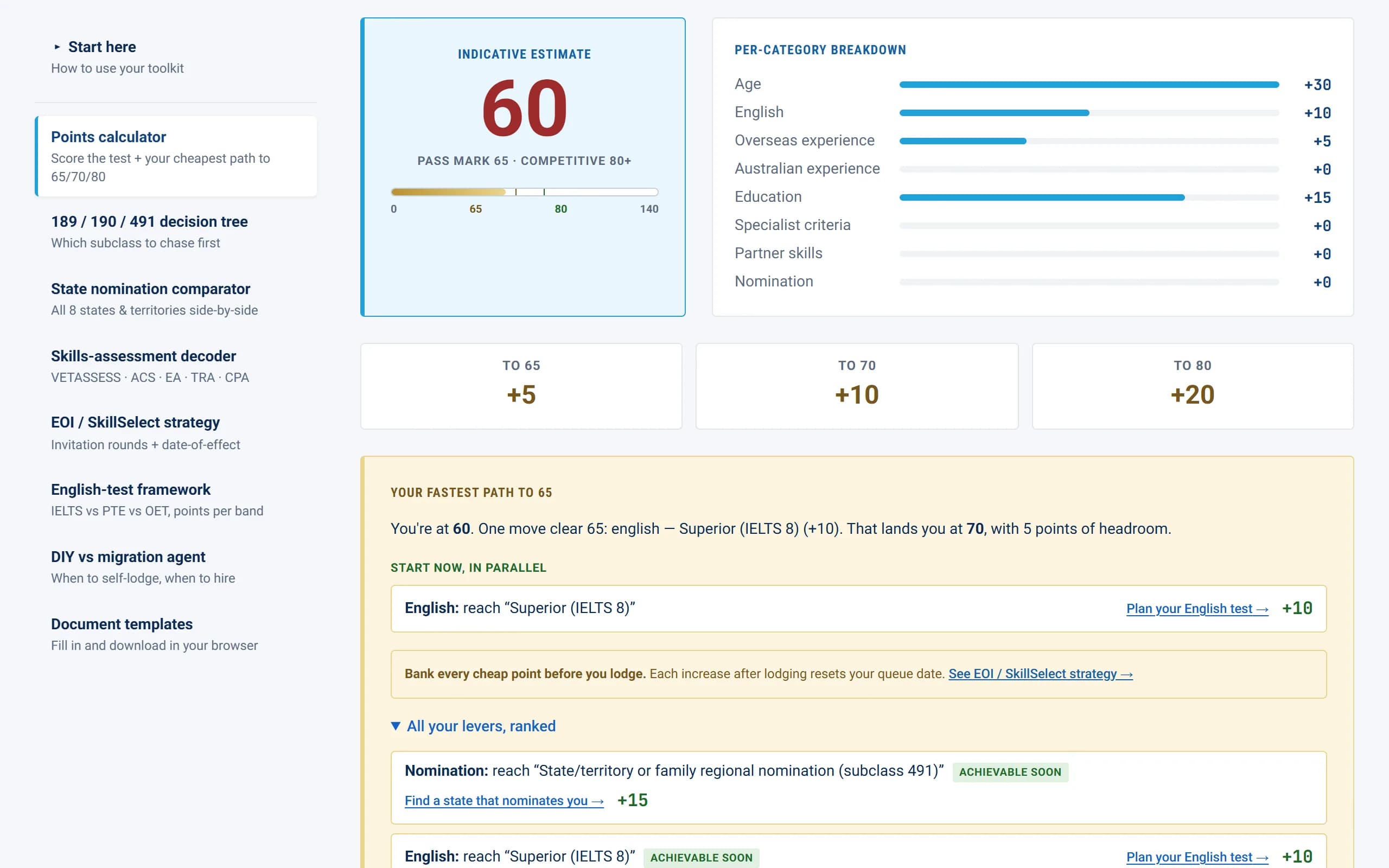
The points test applies to the 491 pathway. Regional nomination through 491 is the only nomination route for general skilled migration on this code.
| Points Factor | Maximum | Notes |
|---|---|---|
| Age (25-32) | 30 | Peak band |
| Age (33-39) | 25 | Strong |
| English (Superior 8.0) | 20 | Highest-value single factor |
| English (Proficient 7.0) | 10 | Floor for a competitive score |
| Qualification (PhD) | 20 | Common among patent specialists |
| Qualification (Bachelor/Master law) | 15 | Typical |
| Skilled experience overseas | 5-15 | Depends on assessed years |
| Skilled experience Australia | 5-20 | If you have worked locally |
| Regional nomination (491) | 15 | The only nomination route for this code |
| Partner skills | 5-10 | |
| Professional Year / NAATI CCL | 5 | Where applicable |
Scenario 1 — Offshore IP lawyer with a science background, 7 years experience
Age 32 (30) + Master's in law (15) + Proficient English (10) + skilled experience (10) = 65. Add 491 regional nomination (15) = 80. Workable for a regional state listing 271214 with a regional job offer.
Scenario 2 — Onshore lawyer with Australian study
Age 30 (30) + PhD in a science field plus law (20) + Australian study (5) + Superior English (20) = 75. Add 491 (15) = 90. Strong for a regional invitation, assuming admission to practise is being completed in parallel.
State and Regional Nomination for IP Lawyers
General skilled migration for 271214 runs through regional 491 nomination, because the code is not on the MLTSSL and 190 is not available. State and regional lists turn over each program year, so verify the current status of 271214 directly on the relevant state's published list before lodging an Expression of Interest.
Most IP work sits in Sydney and Melbourne, which do not count as regional. That tension is worth planning around. A regional employer offer, supporting a 491 or 494 application, is the most reliable position, even if it means starting your Australian career outside the largest IP markets. Remember that admission to practise is jurisdiction-based, so coordinate your admission with the state where you intend to work.
Confirm the code's status on the skilled occupation list for 2026 and the Core Skills Occupation List before committing.
Salary and Employment Outlook
| Role | Typical Salary Range (AUD) |
|---|---|
| Junior IP Lawyer | $80,000-$110,000 |
| IP Lawyer (mid-level) | $110,000-$140,000 |
| Senior IP Lawyer / Special Counsel | $150,000-$200,000+ |
| In-house IP Counsel | $130,000-$180,000 |
| Registered Patent Attorney | $120,000-$200,000+ |
Source: SEEK June 2026 data and PayScale Australia, cross-referenced with Talent.com Australia. SEEK reports an average near AUD $125,000 for intellectual property law roles. PayScale reports an IP lawyer base average near AUD $102,750, with a range from roughly AUD $61,000 to AUD $147,000. Talent.com Australia puts the general lawyer average near AUD $151,000. Superannuation adds 11.5% to base pay. Specialist patent practice, especially with a science or engineering background, sits at the upper end.
Highest-paying contexts:
- Specialist IP firms in Sydney and Melbourne
- IP groups within large full-service firms
- In-house counsel at technology, pharmaceutical and consumer-goods companies
- Patent prosecution roles for candidates with a science or engineering degree
- IP litigation practices handling Federal Court disputes
The market is specialised, so demand favours candidates who pair legal training with a technical background.
Tips for a Successful Application
-
Treat the migration assessment and admission as two separate projects. VETASSESS clears you for the visa. The state admissions board clears you to practise. Start the admissions assessment early, because completing the Priestley 11 gaps and Practical Legal Training can take a year or more.
-
Match your evidence to IP work, not general law. VETASSESS assesses the occupation, not your law degree alone. References and duties must describe patents, trade marks, copyright, licensing or IP litigation. General commercial or litigation experience without an IP focus risks a negative assessment.
-
Use a science or engineering background to your advantage. For patent work, a technical degree is valuable both for VETASSESS, which accepts a relevant science or engineering qualification, and for the separate patent attorney registration administered by the Trans-Tasman IP Attorneys Board.
-
Plan around regional pathways. With no MLTSSL access and no 190, the general skilled route is the regional 491. Because IP work concentrates in Sydney and Melbourne, a sponsoring employer on 482, or a regional employer on 494, is often more realistic than independent regional nomination.
-
Coordinate admission with your destination state. Admission is granted by a state Supreme Court, and you need a practising certificate from that state's regulator. Align your admission, your employer and your visa nomination around the same jurisdiction to avoid duplication.
Step-by-Step Migration Roadmap
- Confirm your duties match 271214 rather than a general solicitor or barrister code using the ANZSCO code finder
- Check list status on the 2026 skilled occupation list and the CSOL
- Lodge the VETASSESS skills assessment (AUD $1,096 offshore) and wait roughly 12 to 20 weeks
- In parallel, apply to a state admissions board to assess your foreign legal qualifications
- Complete any Priestley 11 academic subjects and Practical Legal Training the board requires
- Sit your English test, aiming for Superior bands
- Calculate your points across age, English, qualification and experience
- Submit an Expression of Interest in SkillSelect for 491 — see how SkillSelect works
- Apply for regional nomination, or pursue 482 or 494 employer sponsorship
- Receive your invitation and lodge the visa within 60 days
- Apply for admission and a practising certificate in your destination state
- Complete health checks and police certificates, then receive the grant and relocate
Frequently Asked Questions
Does passing the VETASSESS assessment let me practise law in Australia?
No. The VETASSESS skills assessment is for migration only. It confirms that your qualification and experience match the occupation for visa purposes. To practise law, you must separately have your qualifications assessed by a state admissions board, complete any required Priestley 11 subjects and Practical Legal Training, gain admission to the Supreme Court, and obtain a practising certificate. The two processes run on different timelines and through different bodies.
Is an IP lawyer the same as a registered patent attorney?
No. They are distinct credentials with different regulators. An IP lawyer is admitted to the legal profession and can advise and litigate on intellectual property matters. A registered patent or trade marks attorney is registered with the Trans-Tasman IP Attorneys Board and can file and prosecute patents and trade marks. Patent attorney registration requires a relevant science or technology degree and qualifying experience, and the attorney need not be an admitted lawyer.
Can an Intellectual Property Lawyer apply for the subclass 189 or 190 visa?
No. 271214 sits on the regional occupation list, not the MLTSSL, so both the independent 189 and the state-nominated 190 are closed. General skilled migration for this code runs through the regional 491 visa, while 494, 482 and 186 cover the employer-sponsored routes. Confirm current list status on the skilled occupation list page.
How long does the admission process take for a foreign-qualified lawyer?
It varies widely. The qualifications assessment itself often takes a few months, but completing the Priestley 11 academic gaps and Practical Legal Training can extend the timeline to a year or more, depending on how much top-up study the board requires. Start the admissions process as early as possible, ideally in parallel with your skills assessment, so it does not delay your ability to work once you arrive.
What is the demand outlook for IP lawyers in Australia in 2026?
Specialised and steady. Jobs and Skills Australia does not flag the occupation as a national shortage, and the work concentrates in Sydney and Melbourne. Demand is strongest for candidates who combine legal training with a science or engineering background, particularly in patent practice. Because the code is regional for general migration, employer sponsorship is often the more practical route.