Carpenter Visa Pathway to Australia: Complete 2026 Guide
Updated: 16 August 2026
Australia classifies Carpenter under ANZSCO 331212. Trades Recognition Australia (TRA) conducts the skills assessment via the Job Ready Program (onshore) or the Offshore Skills Assessment Program (OSAP). Carpenter sits on the Core Skills Occupation List and MLTSSL, unlocking subclasses 189, 190, 491, 482, and 186. Typical 2026 salaries range AUD $80,000-$95,000. NSW listed Carpenter as a targeted occupation in its March 2026 nomination round.
Quick Facts: Carpenter Migration Pathway
| Detail | Information |
|---|---|
| ANZSCO Code | 331212 (Carpenter) |
| Skill Level | 3 (Australian Certificate III or IV, or three years on-the-job training) |
| Skills Assessment | TRA (Trades Recognition Australia) — Job Ready Program or OSAP |
| Occupation List | CSOL and MLTSSL |
| Visa Options | 189, 190, 491, 482, 186 |
| Demand Level | Critical — trades are 51% of all persistent shortages in Australia (Jobs and Skills Australia) |
| Salary Range | AUD $80,000-$95,000 (SEEK Salary Hub, 2026) |
| Typical 189 Score | 65-80 points (lower than ICT thresholds) |
| Key Challenge | Onshore JRP takes 12-15 months; offshore OSAP requires a technical interview at an approved RTO |
What a Carpenter Does in Australia
A 331212 Carpenter constructs, erects, installs, renovates, and repairs structures and fixtures made from timber and timber substitutes. The Australian residential building system runs on timber-framed construction — every house frame, roof truss, floor system, and most internal walls go through a carpenter's hands. On commercial sites, carpenters set up formwork for concrete pours, install structural steel-and-timber composite elements, and erect temporary works.
The work is concentrated in NSW and Victoria, where the largest housing pipeline sits, but Western Australia, Queensland, and Tasmania have all reported acute shortages. The Federal Government's Housing Accord targets 1.2 million new homes by 2029, against current build rates that are running materially below that pace. The shortfall is what's driving wage growth and the priority status across nearly every state nomination program.
Major employers span national builders (Metricon, Simonds, McDonald Jones), commercial general contractors (Multiplex, Lendlease, John Holland), and a long tail of regional and sub-contracting firms.
ANZSCO Code Mapping
ANZSCO 331212 is the pure carpentry code — structural timber work, framing, roof carcassing, formwork, and on-site construction. It sits beside two related codes:
- 331211 Carpenter and Joiner — the dual-skilled tradesperson covering both site carpentry and fitted joinery
- 331213 Joiner — workshop-based fabrication of cabinetry, doors, and fitted timber components
Use 331212 when your work history is dominated by on-site structural carpentry — framing houses, fitting roof trusses, building decks and pergolas, installing formwork. TRA examines employment evidence against the code description, so a carpenter who claims 331212 should show payslips and references describing framing, roof-carcassing, and site-based work — not workshop cabinetry.
Typical 331212 tasks include studying drawings, calculating dimensions, cutting and shaping timber, joining timber sections, erecting wall and roof frames, installing fixed cupboards and shelving where structural, and using nail guns, power saws, and circular saws.
Skills Assessment with TRA
Trades Recognition Australia assesses all 331212 applicants. There are two routes.
Job Ready Program (Onshore Pathway)
For applicants already in Australia — typically on a Temporary Graduate (485) visa after completing an Australian Certificate III in Carpentry. The JRP is the dominant onshore pathway and runs across four stages.
- Stage 1 — Provisional Skills Assessment: AUD $370. Confirms eligibility to enter the program.
- Stage 2 — Job Ready Employment: AUD $450. Twelve months of paid full-time work (1,725 hours) in the nominated trade.
- Stage 3 — Job Ready Workplace Assessment: AUD $2,310. An approved RTO conducts an on-site workplace assessment.
- Stage 4 — Job Ready Final Assessment: AUD $360. TRA issues the final outcome.
Total approximate cost: AUD $3,490. End-to-end timeline: 12-15 months. Carpentry is on the prioritised construction-trades list for 2024-2026, which means TRA fast-tracks Stage 1 and Stage 4 processing where capacity exists.
Offshore Skills Assessment Program (OSAP)
For applicants outside Australia. OSAP consists of a documentary review and a technical interview conducted by a TRA-approved Registered Training Organisation in your country (or in Australia if you travel). Total cost is typically AUD $1,000-$3,000 depending on the RTO and country. Processing time is 12-26 weeks.
Common rejection reasons across both routes: employment references that describe general construction rather than specific carpentry duties; qualifications that don't map cleanly to AQF Certificate III; and (for OSAP) self-employment evidence without arms-length verification.
Visa Pathways for Carpenters
Subclass 482 — Skills in Demand Visa
The fastest entry route for offshore carpenters with an employer offer. Employer-sponsored, no points test.
- Visa fee: AUD $3,210 (primary applicant)
- Salary threshold (Core Skills): AUD $76,515 (pre-1 July 2026), rising to AUD $79,499 from 1 July 2026
- Processing time: 3-6 months
- Reality: Most metro and FIFO carpenter roles clear the Core Skills threshold easily. Some regional residential roles sit below CSIT — confirm before signing.
Subclass 491 — Skilled Work Regional Visa
Provisional five-year visa with a pathway to PR via subclass 191 after three years of regional residence and meeting income thresholds. Regional nomination adds 15 points.
- Visa fee: AUD $6,140 (primary applicant)
- Processing time: 7-13 months
- Reality: The most realistic points-tested route for trades. Queensland's Building and Construction Pathway and SA's regional streams both invite carpenters actively.
Subclass 190 — Skilled Nominated Visa
Permanent residency with state nomination. Adds 5 points and requires two years' residence in the nominating state.
- Visa fee: AUD $6,140 (primary applicant)
- Processing time: 7-13 months
- Reality: NSW added Carpenter to its targeted occupations list in March 2026 — the state's largest 190 round of the year went to construction and digital occupations.
Subclass 186 — Employer Nomination Scheme
Permanent residency through employer sponsorship.
- Visa fee: AUD $6,140 (primary applicant)
- Processing time: 6-12 months
- Reality: Most commonly accessed via TRT after holding a 482 for two years; Direct Entry is possible with a positive TRA assessment.
Subclass 189 — Skilled Independent Visa
Points-only PR, no nomination.
- Visa fee: AUD $6,135 (primary applicant)
- Processing time: 6-9 months (post-March 2026 overhaul)
- Reality: Open to carpenters but invitation rounds for non-priority trades are smaller. Most carpenters take the 190/491 route instead.
Points Test Strategy
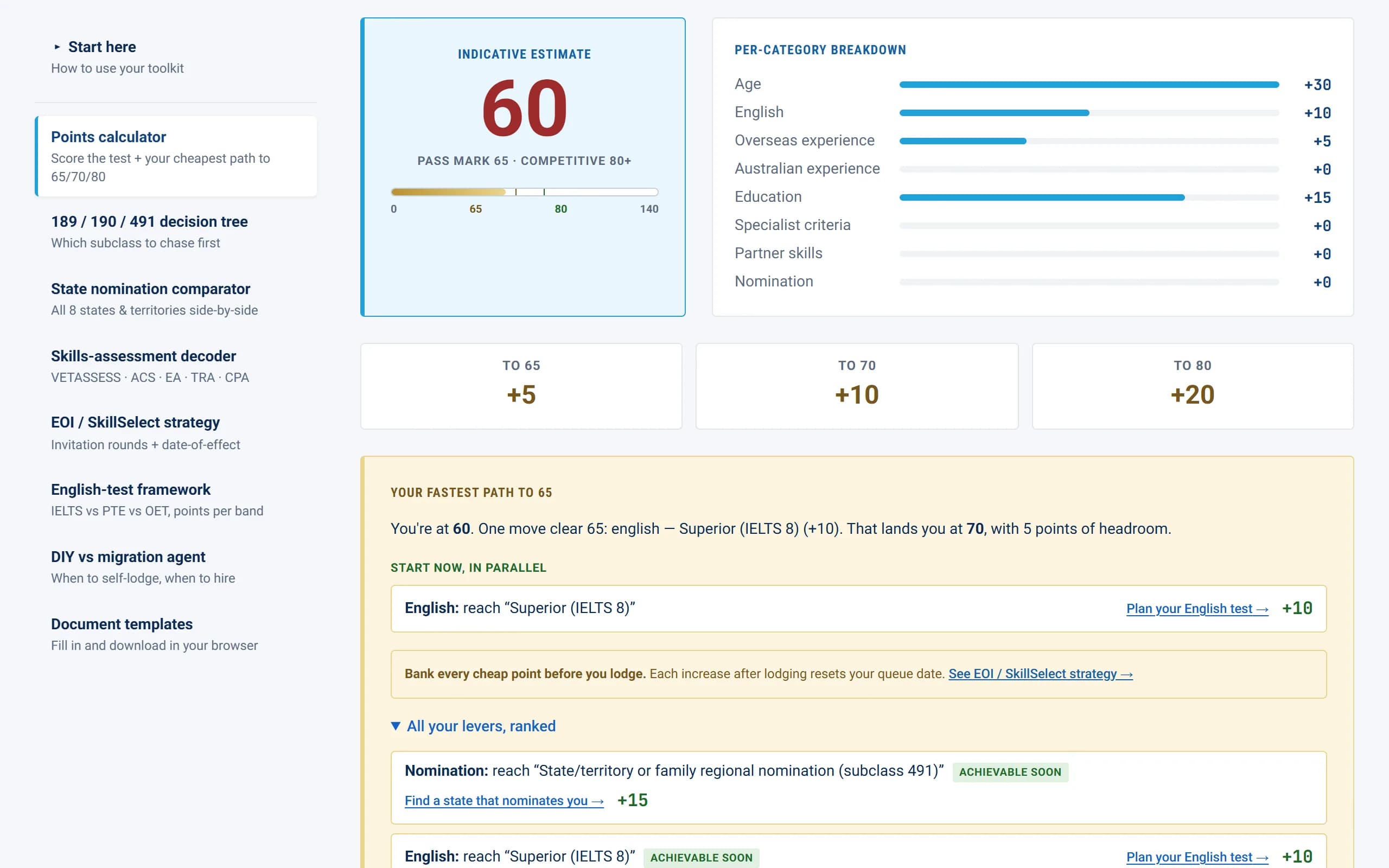
Carpenters typically score 65-80 points. The standard table:
| Points Factor | Points | Notes |
|---|---|---|
| Age (25-32) | 30 | Top bracket |
| Age (33-39) | 25 | Still strong |
| English (Competent — IELTS 6.0) | 0 | Visa minimum, no points |
| English (Proficient — IELTS 7.0) | 10 | Significant for trades applicants |
| English (Superior — IELTS 8.0) | 20 | Hard but high-leverage |
| Qualification (Cert III/IV) | 10 | Standard trades band |
| Australian Study | 5 | Cert III or higher completed onshore |
| Overseas Experience (8+ years) | 15 | Skilled-level work only |
| Australian Experience | 5-20 | Counted post-assessment |
| State Nomination (190) | 5 | |
| Regional (491) | 15 | Biggest single boost |
| Partner Skills | 5-10 | If partner has skilled occupation |
Realistic Scenarios
Scenario 1: Offshore, age 28, IELTS 6.5, 6 years experience, no Australian study Age 30 + English 0 + Cert III 10 + Experience 10 = 50 points. Needs 491 (+15) to reach 65, the minimum for an invitation. Realistic.
Scenario 2: Onshore graduate, age 26, IELTS 7.0, Australian Cert III, 1 year work post-graduation Age 30 + English 10 + Cert III 10 + Australian Study 5 = 55 points. Plus 190 (+5) = 60, or 491 (+15) = 70. Both viable.
State Nomination for Carpenters
New South Wales
NSW listed Carpenter as a targeted occupation in its March 2026 nomination round, the strongest signal of the year. The state's 190 allocation is 2,100 places, and construction sits inside its six priority sectors. Onshore applicants generally clear at 75 points; offshore at 70.
Queensland
Queensland runs a dedicated Building and Construction Pathway giving carpenters priority in invitation rounds. Both 190 and 491 streams accept carpentry. Registrations of Interest opened 19 September 2025 for 2025-26.
Victoria
Victoria accepts the federal CSOL for state nomination and lists construction as one of six priority sectors. The state allocation is approximately 3,400 places (2,700 × 190 + 700 × 491). Applicants must submit a Registration of Interest through the Live in Melbourne portal alongside their SkillSelect EOI.
South Australia
SA refreshed its Skilled Occupation List on 30 September 2025 and continues to nominate construction trades. The state runs onshore and offshore streams separately and is competitive for applicants without NSW or VIC ties.
Western Australia
WA prioritises construction trades, especially in regional and mining-adjacent locations. Applicants with a current WA job offer or WA work history have the strongest pathway.
Tasmania
Tasmania's Skilled Graduate Pathway accepts carpentry qualifications obtained at Tasmanian institutions with at least two years of Tasmanian residence. The 2025-26 allocation is 1,200 (190) + 650 (491).
Salary and Employment Outlook
Typical Carpenter Earnings
| Role | Annual Range (2026) |
|---|---|
| Apprentice (4th year) | AUD $50,000-$60,000 |
| Qualified Carpenter | AUD $80,000-$95,000 |
| Senior Carpenter | AUD $95,000-$115,000 |
| Leading Hand / Foreman | AUD $110,000-$135,000 |
| Self-employed contractor (day rate) | AUD $500-$750/day |
| FIFO mining/resources | AUD $130,000-$170,000+ |
Sources: SEEK Salary Hub (April 2026) shows AUD $80,000-$95,000 average; PayScale 2026 shows AU$34.14/hour average. Sydney NSW rates run AU$33.72/hour but with strong overtime loadings. Talent.com Australia data aligns with these bands.
Highest-Paying Sectors
- FIFO mining sites — WA iron-ore, gold projects, Queensland coal
- Commercial high-rise construction — Sydney and Melbourne towers, form-work specialists earning premium rates
- Infrastructure projects — Western Sydney Airport, Snowy 2.0, Sydney Metro
- Defence and government — Defence Housing Australia, Department of Defence works
- Heritage restoration — niche but well-paid
Total package includes 11.5% superannuation, site allowances on commercial work, and overtime loadings under most EBAs.
Tips for a Successful Application
1. Distinguish Yourself From the Carpenter and Joiner Code
If you've only done framing and structural work, choose 331212 — not 331211. Claiming the broader Carpenter and Joiner code without joinery evidence is the most common reason TRA workplace assessments fail. Pull your employment history out and audit it before selecting your code.
2. Get Australian Trade Recognition Before You Lodge
Even within the JRP, your overseas qualifications need to map cleanly to AQF Certificate III in Carpentry. Some applicants are required to complete gap training at a registered RTO before TRA will accept the assessment. Plan and budget for this — gap training fees can run AUD $3,000-$8,000.
3. Use the State Nomination Calendar Strategically
NSW's targeted round in March 2026 went to Carpenter and Civil Engineer. State invitations move with the construction cycle. Lodge ROIs with QLD, NSW, and SA in parallel — there's no penalty for applying to multiple states, and your odds compound.
4. Push for IELTS 7.0 Before Lodging
A 6.0 satisfies the visa English requirement but scores zero points. Pushing to 7.0 unlocks 10 points — frequently the difference between a 60-point profile and a 70-point invitable one. For a trade applicant, that's the highest-leverage prep time you can invest.
5. Document Self-Employment Carefully
If you're a self-employed carpenter or a small contractor, TRA needs arms-length verification — client testimonials, building permit records, photographs, tax records, invoices. Build a contemporaneous evidence file rather than scrambling at lodgement.
Step-by-Step Migration Roadmap
- Confirm 331212 is the right code — review the ANZSCO code finder
- Check list status — Carpenter currently sits on the CSOL and MLTSSL
- Choose your TRA pathway — Job Ready Program (onshore) or OSAP (offshore)
- Prepare evidence pack — qualifications, payslips, signed duty statements, work photos
- Sit your English test — IELTS 7.0 unlocks the 10-point band
- Lodge skills assessment with TRA — see the skills assessment guide
- Complete 12 months of trade employment if on JRP
- Submit EOI in SkillSelect for 189, 190, or 491
- Lodge state/regional ROI with priority states (NSW, QLD, SA, VIC)
- Receive invitation, lodge visa within 60 days
- Complete health, character, biometric checks
- Receive grant and relocate
Frequently Asked Questions
Why is Carpenter (331212) a separate code from Carpenter and Joiner (331211)?
ANZSCO recognises that carpentry and joinery are distinct skills in some labour markets. A Carpenter (331212) primarily works on-site building structures; a Joiner (331213) works in a workshop fabricating fitted components. A Carpenter and Joiner (331211) does both. TRA assessment is tighter on the chosen code than on the broader category — your evidence must match.
Can I switch from 482 to 186 as a carpenter?
Yes. Most carpenters who arrive on a 482 transition to a subclass 186 (Employer Nomination Scheme) via the Temporary Residence Transition stream after two years with the same employer. This is the dominant PR pathway for sponsored trades.
Do I need a builder's licence to work as a carpenter in Australia?
No — not as an employed carpenter under a builder's licence. If you intend to operate as a principal contractor or run your own business, you'll need state-specific licensing (NSW Fair Trading, QBCC in Queensland, VBA in Victoria). Each regulator has its own qualifying experience requirement, usually two years post-trade.
Which state has the fastest 491 pathway for offshore carpenters?
Queensland's Building and Construction Pathway and South Australia's regional streams are the most accessible offshore routes for carpenters in 2026. NSW takes 491 applicants too, but its invitation thresholds run higher.
What if my Cert III isn't recognised in Australia?
You may need to complete gap training at an approved RTO before TRA accepts your assessment. The gap is usually 1-3 units of competency rather than a full requalification. Budget AUD $3,000-$8,000 and 3-6 months for gap training.
How does carpentry pay compare to other Australian trades?
Carpenters sit mid-band among construction trades. Electricians and plumbers earn 10-20% more on average, but carpentry has a wider pipeline of work and a more open path to self-employment. FIFO carpenters earn comparably to FIFO electricians once site allowances are included.