Electronics Engineer Visa Pathway to Australia: Complete 2026 Guide
Updated: 16 August 2026
Australia classifies Electronics Engineer under ANZSCO 233411. Engineers Australia conducts the migration skills assessment. The occupation sits on the MLTSSL and CSOL, opening subclasses 189, 190, 491, 482 and 186. Typical 2026 salaries range AUD $85,000-$165,000, with the AUKUS submarine program, broader defence electronics spending and the structural electronics shortage in semiconductors and embedded systems sustaining strong demand.
Quick Facts: Electronics Engineer Migration Pathway
| Detail | Information |
|---|---|
| ANZSCO Code | 233411 (Electronics Engineer) |
| Skill Level | 1 (Bachelor degree or higher in electronics, electrical or related engineering) |
| Skills Assessment | Engineers Australia (Migration Skills Assessment) |
| Occupation List | MLTSSL and CSOL |
| Visa Options | 189, 190, 491, 482, 186 |
| Demand Level | High — defence prime hiring (BAE Systems, Lockheed Martin, Thales, ASC, Raytheon) plus structural global electronics shortage in embedded systems and RF |
| Salary Range | AUD $85,000-$165,000 (SEEK, May 2026; senior defence and RF roles toward upper end) |
| Typical 189 Score | 85-95 (competitive engineering pool) |
| Key Challenge | Many of the best-paying roles require Australian security clearance — accessible only after citizenship or extended residency |
What Electronics Engineers Do in Australia
Electronics engineers design, develop, test and maintain electronic systems and components — circuit boards, embedded systems, RF and microwave hardware, communications equipment, sensors, control systems and consumer electronics. The Australian sector is smaller than the US, China or Europe but concentrates around defence, communications, mining automation, medical devices and aerospace.
Defence is the dominant employer of senior electronics engineers in Australia. The AUKUS Pillar 2 program — covering advanced capabilities such as undersea autonomy, quantum technologies, electronic warfare and hypersonics — has triggered a sustained recruitment surge across BAE Systems Australia, Lockheed Martin Australia, Thales Australia, Raytheon Australia, ASC, Babcock, Saab Australia and a long tail of mid-sized defence SMEs. Engineers in these roles typically need (or will need) baseline security clearance, which restricts the talent pool to Australian citizens and long-term residents. International migrants often start in non-cleared roles and progress to cleared work after citizenship.
Outside defence, the major employers are communications and satellite operators (Optus, Telstra, NBN Co, Saber Astronautics, Gilmour Space, Inovor), mining automation specialists (Rio Tinto autonomous haulage, BHP autonomous trains, Caterpillar Australia), medical devices (Cochlear, ResMed, EBR Systems), and a small but growing semiconductor cluster (Morse Micro, Silanna, Archer Materials).
ANZSCO 233411 — Code Mapping
ANZSCO 233411 covers engineers who design, develop, adapt, install, test and maintain electronic components, circuits, products and systems. Tasks include analysing customer requirements, designing electronic circuits and systems, supervising prototype manufacture and testing, troubleshooting field issues, and providing technical support during installation and commissioning.
The closest adjacent code is 233311 Electrical Engineer, used for power systems, high-voltage and substation work. The distinction matters because Engineers Australia assesses the two codes against different competency expectations. Electronics is signal-level, low-power, board-and-system design; Electrical is power-level, high-voltage, transmission and distribution. Some applicants with mixed backgrounds (instrumentation, control systems, low-voltage electronics inside a high-voltage facility) choose between 233411 and 233311 — pick the code that matches your dominant recent documented work.
Other adjacent codes include 263111 Computer Network and Systems Engineer (ICT/network focused, assessed by ACS not Engineers Australia) and 233512 Mechatronics Engineer (mechanical-electronic integration). Telecommunications engineers belong in 263311 or 263312 and are also ACS-assessed.
Skills Assessment
Engineers Australia Migration Skills Assessment
- Body: Engineers Australia
- Pathways: Australian-accredited qualification, Washington Accord (or Sydney/Dublin Accord), or Competency Demonstration Report (CDR)
- CDR requirement: Three career episodes, CPD summary, summary statement mapped to Stage 1 Competencies
- Assessment cost (2026): Australian-accredited AUD $335.50; Washington/Sydney/Dublin Accord AUD $539; Standard CDR AUD $1,001; Fast Track add-on AUD $385. Fees rise 3-4% from 1 July 2026.
- Processing time: Standard CDR 10-16 weeks; Washington Accord 8-12 weeks; Fast Track assigns to assessor within 20 business days
- Common rejection reasons: Episodes that describe software development (better assessed by ACS for 261313 Software Engineer), pure firmware work without hardware context, or technician-level testing rather than engineering design; CDR plagiarism
For 233411 specifically, Engineers Australia expects evidence of electronic circuit design, system integration, embedded systems development, RF/communications work, or sensor and instrumentation design. Pure software, pure technician/installation, or pure laboratory test work will not satisfy the engineering content expectations.
Choosing Between 233411 and 261313
Migrants with mixed hardware and software backgrounds frequently weigh 233411 against 261313 Software Engineer. The decision rule: if your career has been firmware, embedded systems with hardware design, RF/communications hardware, sensor design or analog and mixed-signal circuit design, 233411 is correct. If your career has been application software, web, cloud, machine learning or pure C++ on commodity hardware, 261313 (assessed by ACS) is correct. Choose based on documented work, not perceived demand level.
Visa Pathways for Electronics Engineers
Subclass 482 — Skills in Demand Visa
Defence primes and tech companies sponsor electronics engineers regularly. Cleared roles are restricted to citizens but the broader engineering pipeline is open to international applicants.
- Visa fee: AUD $3,210
- Core Skills Income Threshold: AUD $76,515 (rising to AUD $79,499 on 1 July 2026)
- Specialist Skills Income Threshold: AUD $141,210 (rising to AUD $146,717 on 1 July 2026)
- Processing time: 2-4 months
- Reality: Senior RF, embedded and defence engineering roles clear the Specialist Skills threshold; junior and mid-level applicants typically use Core Skills
Subclass 189 — Skilled Independent Visa
- Visa fee: AUD $6,135
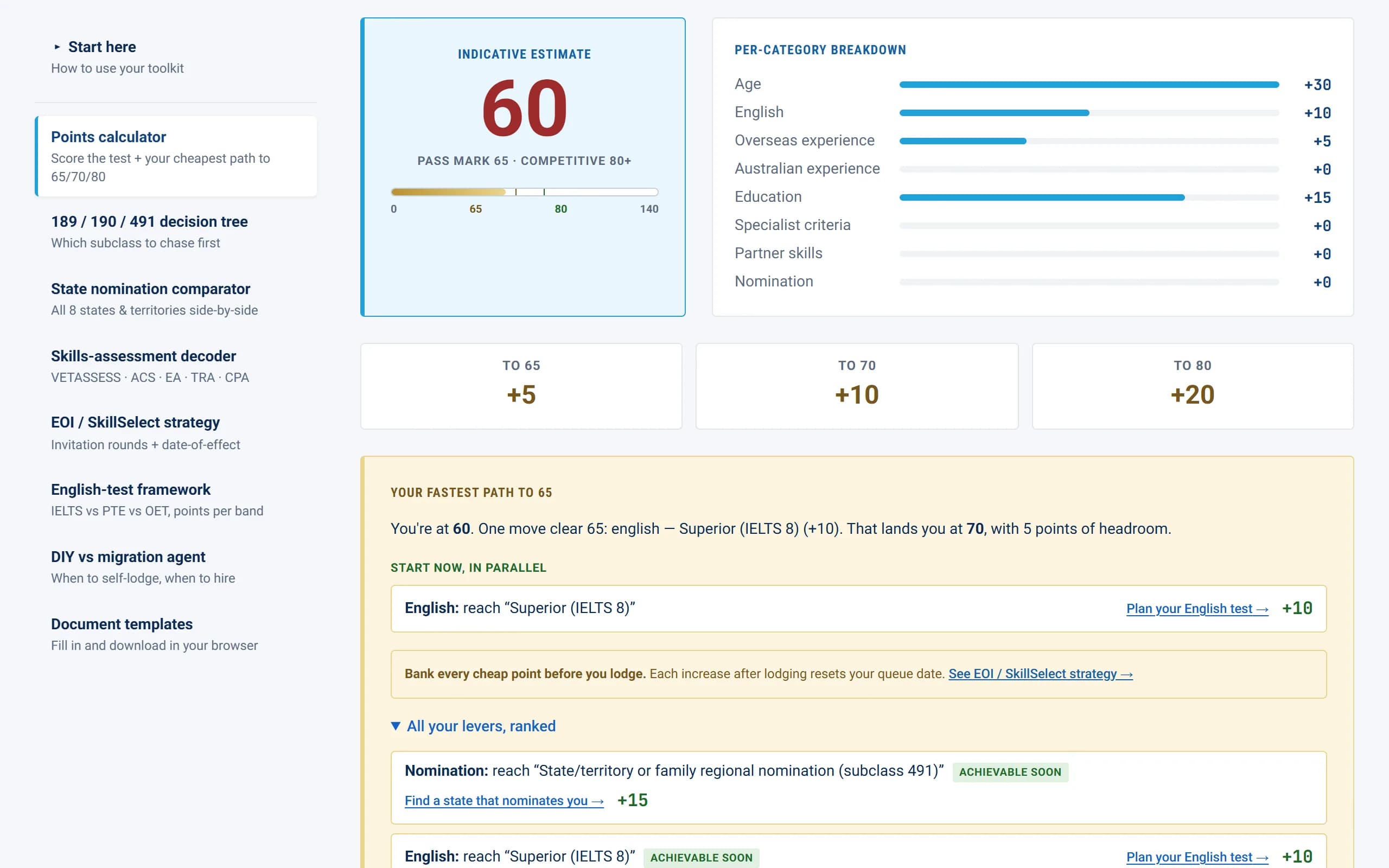
- Minimum points: 65 (realistically 85-95 for engineering invitations in 2026)
- Processing time: 6-12 months
Subclass 190 — Skilled Nominated Visa
- Visa fee: AUD $6,140
- Points boost: +5
- Best states: SA (defence and AUKUS), VIC (medical devices, aerospace), NSW (defence, comms, satellites)
Subclass 491 — Skilled Work Regional Visa
Regional nomination adds 15 points. Most defence electronics work in Adelaide qualifies as regional; mining automation work in regional WA and QLD also qualifies.
- Visa fee: AUD $6,140
- Points boost: +15
- Pathway to PR: 191 after 3 years
Subclass 186 — Employer Nomination Scheme
- Visa fee: AUD $6,140
- Streams: Direct Entry or TRT (after 2 years on 482)
- Reality: Defence primes and medical device companies sponsor mid-career electronics engineers to 186 Direct Entry
Points Test Strategy
| Points Factor | Points | Notes |
|---|---|---|
| Age (25-32) | 30 | Maximum bracket |
| Age (33-39) | 25 | Common for mid-career |
| Bachelor's degree | 15 | Minimum |
| Master's | 15 | Same band |
| PhD | 20 | Common in semiconductors, RF, signal processing |
| English (Superior — IELTS 8) | 20 | Strongly recommended |
| English (Proficient — IELTS 7) | 10 | Baseline |
| Skilled employment overseas (3-4 yrs) | 5 | |
| Skilled employment overseas (5-7 yrs) | 10 | |
| Skilled employment overseas (8+ yrs) | 15 | |
| State nomination (190) | 5 | |
| Regional nomination (491) | 15 | |
| Partner skills | 5-10 |
Realistic Scenarios
Scenario 1: Indian RF engineer, age 30, 7 years experience, IELTS 7
Age 30 (30) + Bachelor's (15) + IELTS 7 (10) + 5-7 years overseas (10) = 65 points. Add 190 nomination (+5) = 70 points. Push English to Superior (+10) and add 491 nomination (+15) instead = 90 points. Strong invitation territory.
Scenario 2: Chinese embedded systems engineer with PhD, age 33, 8 years industry
Age 33 (25) + PhD (20) + IELTS 8 (20) + 8+ years overseas (15) = 80 points. Add 190 nomination (+5) = 85 points. Competitive at the current invitation cut-offs.
State Nomination
South Australia
SA is the largest concentrated demand for electronics engineers because of the AUKUS submarine program, Hunter-class frigate combat systems, the Edinburgh Defence Precinct (DST Group, Lockheed Martin Australia, BAE Systems Australia) and the satellite cluster around Lot Fourteen (SmartSat CRC, Saber Astronautics, Inovor Technologies). SA's 190 and 491 programs prioritise defence engineering and treat Adelaide and Whyalla favourably.
Victoria
Victoria nominates electronics engineers tied to medical devices (Cochlear, EBR Systems, Cyclotek), defence (BAE Systems Williamstown, Marand), and advanced manufacturing. Melbourne hosts the largest medical device cluster in the country.
New South Wales
NSW nominates electronics engineers tied to defence (Lockheed Martin Australia Mascot, Thales Sydney), satellites and space (Saber Astronautics, Gilmour Space — also Queensland), telecoms (Optus, Telstra, NBN Co) and a small but real semiconductor cluster (Morse Micro). Sydney's 190 invitations typically require 85-100 points.
Queensland
Queensland nominates electronics engineers tied to defence (Boeing Australia, Rheinmetall Defence Australia at Redbank), mining automation (Caterpillar, Rio Tinto autonomous operations), and space (Gilmour Space at Bowen). Brisbane and Toowoomba host most non-Bowen postings.
Western Australia
WA nominates electronics engineers tied to mining automation, communications (Optus regional infrastructure), and defence sustainment at Henderson. The 2025-26 WA 190 quota is approximately 1,000 places.
Salary and Employment Outlook
| Role | Typical Salary Range |
|---|---|
| Graduate Electronics Engineer | AUD $75,000-$95,000 |
| Electronics Engineer (3-7 years) | AUD $100,000-$130,000 |
| Senior Electronics Engineer (8+ years) | AUD $130,000-$165,000 |
| RF / Communications Engineer (senior) | AUD $140,000-$190,000 |
| Embedded Systems Engineer (senior) | AUD $130,000-$180,000 |
| Cleared Defence Electronics Engineer | AUD $140,000-$200,000+ |
| Medical Device Senior Engineer (Cochlear, ResMed) | AUD $140,000-$190,000 |
Source: SEEK Australia (May 2026), ERI SalaryExpert (mean AUD $163,582 across the role nationally), and PayScale. SEEK reports an average base of AUD $85,000-$105,000 across all posted roles; this skews lower because of graduate and metropolitan postings. Senior, cleared and specialist niche salaries sit materially higher.
Total packages typically include 11.5% superannuation, performance bonuses (10-20%), defence prime equity-equivalent retention bonuses, and in medical devices a meaningful share option component.
Highest-Paying Sectors
- Defence primes (cleared) — BAE Systems Australia, Lockheed Martin Australia, Thales Australia, Raytheon, ASC, Saab Australia, Northrop Grumman
- Medical devices — Cochlear, ResMed, EBR Systems, Polynovo
- Satellites and space — Saber Astronautics, Gilmour Space, Inovor Technologies, Skykraft
- Mining automation — Rio Tinto Autonomous Haulage, BHP, Caterpillar Australia
- Semiconductors (emerging) — Morse Micro, Silanna, Archer Materials
Tips for a Successful Application
1. Choose CDR career episodes that show hardware design, not just software or testing
Engineers Australia rejects 233411 CDRs that describe pure firmware development without hardware context, technician-level testing, or production support without engineering design. Choose episodes that show schematic capture, PCB design, RF analysis, signal integrity work, EMC compliance design, sensor characterisation, or embedded systems with explicit hardware design ownership.
2. Plan around defence security clearance limitations
Many of the highest-paying electronics roles in Australia require an Australian Government security clearance — Baseline, NV1, NV2 or PV. Clearances are restricted to Australian citizens (and in some cases long-term residents). International migrants typically start in non-cleared roles at the same employer and progress to cleared work after citizenship (usually four years after permanent residency). Plan your career trajectory accordingly.
3. Distinguish 233411 from 233311 Electrical Engineer cleanly
If your work is signal-level, low-power, board-and-system design, 233411 is correct. If it's power systems, transmission, distribution or high-voltage industrial, 233311 Electrical Engineer is correct. Engineers Australia will refuse 233411 applications dominated by power systems content.
4. Get IELTS 8 — the 10-point gap is decisive
Electronics is competitive in the 189 pool. Most invited candidates are at 90+ points in 2026. The most reliable lever for STEM applicants is Superior English. Invest in IELTS or PTE preparation.
5. Consider 491 if your specialty area is in a regional cluster
Adelaide (defence, satellites), Whyalla (shipbuilding), Bowen (space launch), regional WA (mining automation) — these are 491-eligible and align with electronics engineering demand. The regional pathway often outperforms 190 for candidates with 70-80 points.
Step-by-Step Migration Roadmap
- Confirm 233411 is the correct code — review the how to find your ANZSCO code guide
- Sit IELTS Academic or PTE — target Superior level
- Determine eligible assessment pathway — Washington Accord or CDR
- Prepare CDR career episodes focused on electronics hardware design
- Submit Engineers Australia Migration Skills Assessment
- Receive assessment outcome
- Submit EOI in SkillSelect for 189, 190 or 491
- Apply for state nomination if pursuing 190 or 491 — see the skilled occupation list
- Alternatively, pursue 482 (Specialist Skills if salary clears AUD $141,210) or 186 Direct Entry via an Australian employer
- Receive invitation and lodge visa within 60 days
- Complete health, character and biometrics
- Receive visa grant and relocate
Frequently Asked Questions
Can I get cleared work in defence as a migrant?
Not initially. Australian Government security clearances (Baseline, NV1, NV2, PV) require Australian citizenship for most positions and extended residency at minimum for some Baseline roles. New migrants typically start in non-cleared engineering work at the same defence primes, then progress to cleared positions after citizenship — usually four years after permanent residency. Defence primes plan around this and continue to hire international electronics engineers into the non-cleared pipeline.
Which code is right for an embedded systems engineer with mixed software and hardware work?
It depends on the balance of work. If schematic design, PCB layout, hardware integration and bring-up dominate your career, 233411 Electronics Engineer is correct and Engineers Australia assesses you. If the bulk of work is firmware in C/C++ on commodity microcontrollers without hardware design ownership, 261313 Software Engineer is closer and ACS assesses you. Read both ANZSCO descriptions carefully and choose based on documented work.
Are there structural shortages of electronics engineers in Australia?
Yes. Engineers Australia, Jobs and Skills Australia and the defence primes have repeatedly flagged electronics, embedded systems and RF engineering as among the hardest-to-fill engineering disciplines. The AUKUS Pillar 2 capability build-out, the broader Defence Strategic Review hiring, and global semiconductor industry pressure all sustain demand. The shortage is particularly acute in cleared roles, but flows through to the entire pipeline.
What's the demand outlook in medical devices for electronics engineers?
Strong and concentrated in Sydney and Melbourne. Cochlear, ResMed, EBR Systems, Polynovo and a long tail of medical device startups recruit electronics engineers continuously. The sector pays well (AUD $140,000+ for senior roles) and offers equity components in listed and pre-IPO companies. Regulatory experience with FDA, TGA and IEC 60601 is highly valued.
Does Engineers Australia accept degrees from non-Washington Accord countries for 233411?
Yes, through the Competency Demonstration Report (CDR) pathway. CDR is the standard route for applicants whose engineering degree is from a country or program not covered by the Washington/Sydney/Dublin Accord. Standard CDR processing takes 10-16 weeks; Fast Track shortens initial assignment to 20 business days. The CDR must demonstrate Stage 1 Competencies through three career episodes — pure academic content without industry application is typically insufficient.