Apiarist Visa Pathway to Australia: Complete 2026 Guide
Updated: 16 August 2026
Australia classifies Apiarist under ANZSCO 121311. VETASSESS conducts the skills assessment. The occupation sits on the Core Skills Occupation List and the Short-term Skilled Occupation List, unlocking subclasses 190, 491, 482 and 186. It is not on the MLTSSL, so there is no subclass 189 route. Typical 2026 salaries run AUD $65,000-$90,000, with crop-pollination contractors at the upper end.
Quick Facts: Apiarist Migration Pathway
| Detail | Information |
|---|---|
| ANZSCO Code | 121311 (Apiarist) |
| Skill Level | 1 (Bachelor degree or higher, or five years of relevant experience in lieu) |
| Skills Assessment | VETASSESS (Vocational Education and Training Assessment Services) |
| Occupation List | CSOL and STSOL — not on MLTSSL or ROL |
| Visa Options | 190, 491, 482, 186 |
| Demand Level | Moderate but strategically valued — pollination services underpin almond, canola and horticulture crops |
| Salary Range | AUD $65,000-$90,000 (SEEK/Jora 2026); pollination contractors and queen breeders higher |
| Typical 189 Score | Not applicable — no 189 access |
| Key Challenge | Small occupation with thin nomination allocations; proving management-level duties to VETASSESS |
What an Apiarist Does in Australia
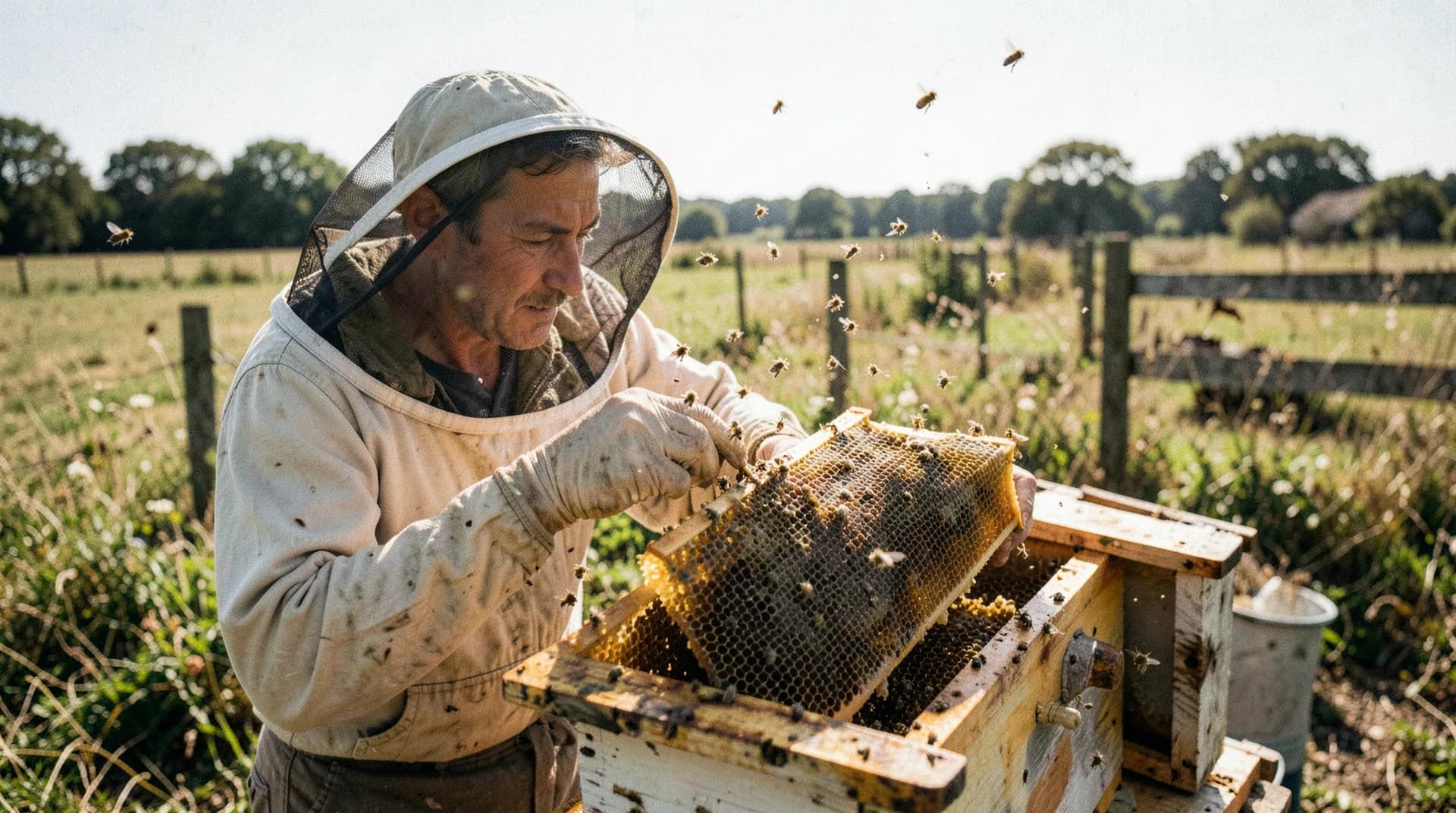
An apiarist manages bee colonies to produce honey, beeswax, pollen, propolis and royal jelly, breeds and sells queen bees, and provides paid pollination services to horticulture and broadacre crops. The job is part livestock husbandry, part logistics. You plan hive placement across the season, monitor colony health, manage disease and pests, extract and process honey, and move hives to follow floral sources or fulfil pollination contracts.
Pollination is where the economics get interesting. Australian almond, canola, blueberry and apple growers pay for managed hives during flowering, and the value of that service often exceeds honey income. Commercial apiarists run mobile operations, trucking hundreds or thousands of hives between regions. The sector also lives with a permanent biosecurity threat. The 2022 Varroa mite incursion in New South Wales reshaped the industry and made experienced, biosecurity-literate beekeepers more valuable, not less.
Honey production concentrates in New South Wales, Victoria, Queensland and Western Australia, with WA's disease-free status supporting a strong queen-bee export trade. If your background is research into bee genetics or pollination ecology rather than running hives commercially, the closer fit is an agricultural science role such as Agricultural Scientist.
ANZSCO Code 121311
Apiarist sits in ANZSCO unit group 1213, Livestock Farmers. The official description covers planning, organising, controlling and coordinating the operation of apiaries to produce honey and related products, breed queen bees, and pollinate crops.
Indicative tasks include establishing and maintaining apiaries; assessing colony strength and requeening as needed; controlling diseases and pests such as American foulbrood and Varroa; extracting, processing and packing honey and other hive products; breeding and rearing queen bees; and arranging hive transport for pollination contracts. ANZSCO sets Apiarist at Skill Level 1, with a bachelor degree or higher as the benchmark and five years of relevant experience accepted as a substitute where no formal qualification exists. If you are weighing this against a related farming code, work through how to find your ANZSCO code before lodging anything.
Skills Assessment
VETASSESS (Vocational Education and Training Assessment Services)
VETASSESS assesses Apiarist as a professional occupation. It evaluates whether your qualification is comparable to the required Australian level and in a highly relevant field, and whether your employment sits at the right skill level in the nominated occupation.
Requirements. The standard benchmark is a qualification assessed as comparable to an Australian Bachelor degree or higher in a highly relevant field, plus at least one year of post-qualification highly relevant employment in the last five years. Highly relevant fields cover apiculture, animal husbandry and related agricultural study. VETASSESS publishes alternative pathways for applicants with lower-level qualifications who hold longer relevant experience, and five years of relevant experience can substitute for the formal qualification.
Assessment cost. AUD $1,205.60 for a full skills assessment covering both qualifications and employment (standard online application, applicants in Australia, GST inclusive). Priority Processing is available for an additional AUD $825.
Processing time. Standard processing currently averages around 7 weeks. Priority Processing targets 10 business days from a complete application.
Common rejection reasons. Apiarist is a small occupation where many applicants learned the trade through family operations rather than formal study, so qualification mismatches are common. The second recurring issue is employment evidence that reads as seasonal hive labour rather than the planning, breeding and business-management duties the occupation requires. References that describe only honey extraction and hive moving, without colony-management decision-making, frequently draw a "not suitable" outcome.
A full comparison of assessors sits on the skills assessment bodies complete list.
Visa Pathways
Apiarist's place on the CSOL and STSOL gives it something the regional-only farming codes lack: access to subclass 190 state nomination. The pathways below are ordered by how useful they are for this occupation.
Subclass 190 — Skilled Nominated Visa
Permanent residency through state or territory nomination. This is the standout route for an apiarist because it grants permanent residency directly rather than a provisional period.
- Visa fee: AUD $6,140 (primary applicant)
- Points boost: +5 for state nomination
- Obligation: Live and work in the nominating state for two years
- Quirk: Allocations for niche primary-industry codes are small, so a genuine connection to the state and a job offer materially help
Subclass 491 — Skilled Work Regional (Provisional)
A five-year provisional visa via state nomination or eligible family sponsorship in a designated regional area, with a pathway to permanent residency through subclass 191.
- Visa fee: AUD $6,140 (primary applicant)
- Points boost: +15 for regional nomination
- Quirk: Most commercial apiaries are regional, so the residence obligation rarely conflicts with the work
Subclass 482 — Skills in Demand Visa
The employer-sponsored temporary route. Apiarist falls in the Core Skills stream.
- Visa fee: AUD $3,210 (primary applicant)
- Salary requirement: The nominated salary must meet or exceed the Core Skills Income Threshold of AUD $76,515 (2025-26; rising to AUD $79,499 from 1 July 2026)
- Quirk: Sponsors are usually larger commercial honey or queen-bee operations; clearing the income threshold can be the binding constraint
Subclass 186 — Employer Nomination Scheme
Permanent residency through employer nomination, via Direct Entry or the Temporary Residence Transition stream after time on a 482.
- Visa fee: AUD $6,140 (primary applicant)
- Eligibility note: Direct Entry requires a positive skills assessment and at least three years of relevant experience
Points Test Strategy
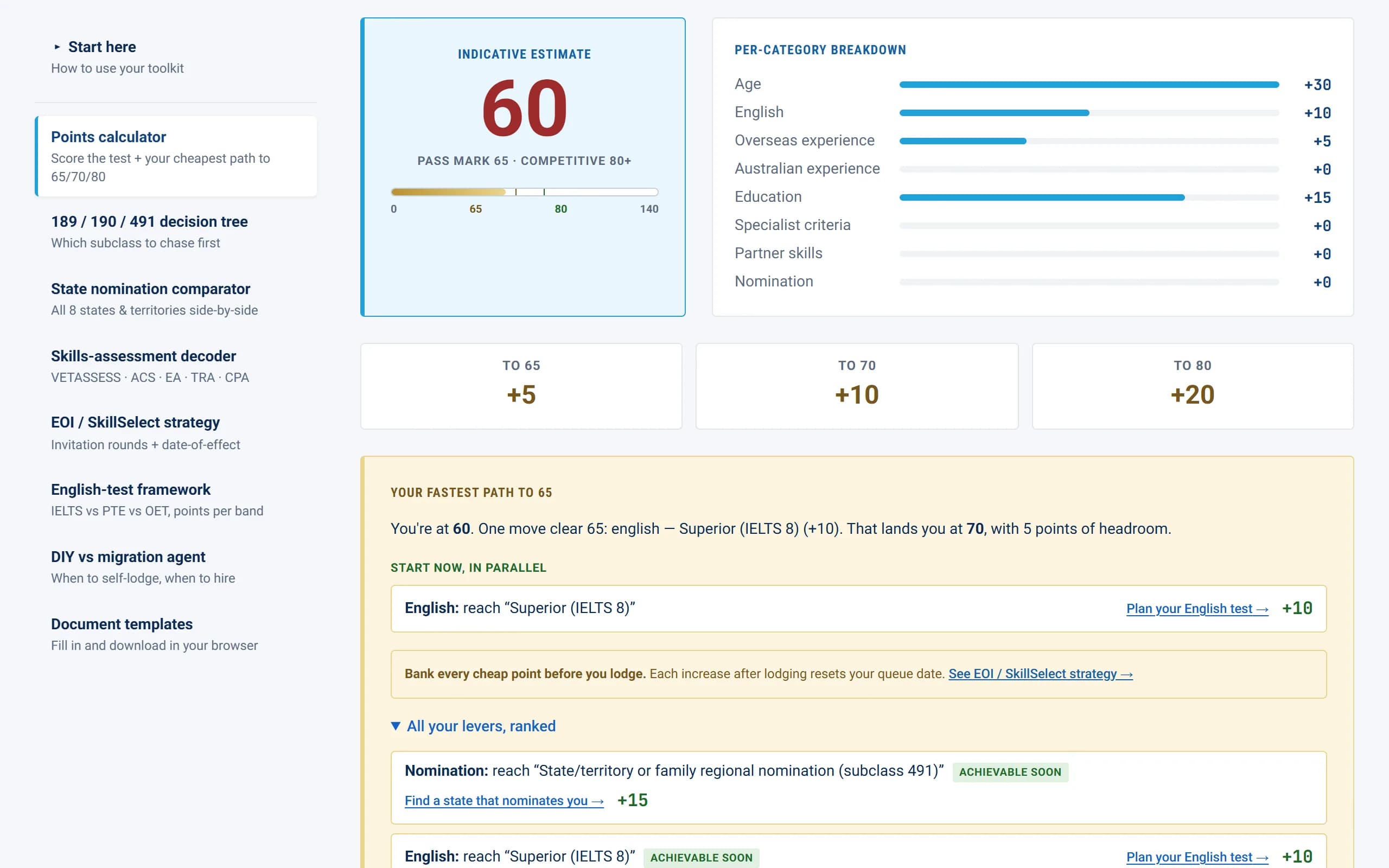
Because Apiarist reaches 190 and 491, the points test is live for this occupation. The standard factors apply: age, qualification, English, skilled employment, state or regional nomination, and partner skills.
| Points Factor | Points | Notes |
|---|---|---|
| Age (25-32) | 30 | Maximum bracket |
| Age (33-39) | 25 | Common for experienced apiarists |
| Bachelor degree | 15 | Skill Level 1 benchmark |
| English (Proficient, 7.0) | 10 | Realistic target |
| English (Superior, 8.0+) | 20 | Strong points boost if achievable |
| Skilled employment (overseas, 8+ yrs) | 15 | After any deduction |
| State nomination (190) | 5 | Permanent residency |
| Regional nomination (491) | 15 | Provisional, highest single boost |
| Partner skills | 5-10 | If partner has a skilled occupation |
Scenario — experienced apiarist, age 35, Proficient English, 8 years experience, no degree (experience-in-lieu pathway): Age 25 + experience 15 + English 10 = 50 points before nomination. Adding 491 (+15) reaches 65, which clears the floor for a nominated regional visa. State nomination on 190 (+5) leaves the score tighter, so regional nomination is often the more realistic route for older candidates without a degree.
State Nomination
Nomination for a small code like Apiarist is allocation-dependent and tends to follow where the industry sits. New South Wales and Victoria run the largest honey and pollination sectors and periodically nominate primary-industry occupations. Western Australia's disease-free status and queen-bee export trade make it a logical home for breeders, and the state nominates agriculture occupations connected to its program. Queensland and South Australia also support beekeeping in their primary-industry streams.
Two practical rules apply. Confirm the code is open on the relevant state list at the time you apply, since niche agriculture codes open and close with allocation. And expect a job offer or strong regional connection to carry weight, because these programs rarely invite niche codes on points alone. Check current status against the skilled occupation list for 2026 and the Core Skills Occupation List.
Salary and Employment Outlook
| Role | Typical Salary Range (AUD) |
|---|---|
| Apiary worker / hand | $50,000-$62,000 |
| Apiarist (commercial) | $65,000-$85,000 |
| Pollination contractor / queen breeder | $80,000-$100,000+ |
Ranges draw on SEEK and Jora 2026 data for beekeeper and apiarist roles, cross-checked against published agricultural salary surveys. Owner-operators earn variably; income tracks honey prices, hive count and pollination contracts rather than a fixed wage. Superannuation at 11.5% applies to employees, and remote operations sometimes add accommodation or vehicle use.
Pollination services and queen-bee breeding pay best because they sell a scarce, time-critical service to high-value crops. Honey alone is more exposed to commodity prices and seasonal floral conditions. Demand is steady, with biosecurity work creating extra need for skilled operators since the Varroa incursion. The occupation is small in absolute numbers, which is the real constraint: there are limited employers and limited nomination slots, so positioning matters more than for high-volume occupations.
Tips for a Successful Application
- Document management duties, not just hive work. VETASSESS needs evidence of planning, breeding decisions, disease control and business management. References describing only honey extraction will struggle.
- Lean on pollination and breeding experience. If you have run pollination contracts or bred queen bees, foreground it. It demonstrates the commercial, decision-making scope the assessment looks for.
- Prioritise the 190 route. Apiarist's STSOL listing gives you direct permanent residency through 190, which most regional-only farming codes cannot access. Target states with active beekeeping sectors.
- Use Points Test Advice if your qualification is borderline. Many apiarists are self-taught. A qualification-only assessment (AUD $342.10) tells you where you stand before committing to the full fee.
- Build five years of clean evidence. If you are using the experience-in-lieu pathway, dated and detailed references covering the whole period at the right skill level are non-negotiable.
Step-by-Step Migration Roadmap
- Confirm your duties map to Apiarist using the ANZSCO code finder.
- Verify current list status on the CSOL hub and the 2026 SOL.
- Compile qualification documents and detailed employment references covering duties and dates.
- Sit an English test at the level your chosen visa requires.
- Lodge the VETASSESS skills assessment (AUD $1,205.60), or Points Test Advice first if your qualification is borderline.
- Submit an Expression of Interest in SkillSelect — see how SkillSelect and the EOI work.
- Apply for state nomination (190) or regional nomination (491) where the code is open.
- Alternatively, secure an employer sponsor for a 482 or 186.
- Receive your invitation or nomination approval.
- Lodge the visa application and pay the relevant charge.
- Complete health examinations and police checks.
- Receive the grant and relocate.
Frequently Asked Questions
Can an Apiarist apply for a subclass 189 visa?
No. Apiarist (121311) is not on the Medium and Long-term Strategic Skills List, and subclass 189 only draws from the MLTSSL. The occupation is on the CSOL and STSOL, so the available routes are subclass 190 state nomination, 491 regional nomination, and the employer-sponsored 482 and 186.
Is the subclass 190 visa really available for beekeepers?
Yes. Apiarist's place on the STSOL gives it access to subclass 190 state nomination, which grants permanent residency directly. The constraint is allocation: nomination places for niche primary-industry codes are limited, so a genuine connection to the nominating state and a relevant job offer materially improve your chances.
Do I need a formal beekeeping qualification?
A bachelor degree or higher in a highly relevant field is the standard benchmark, but VETASSESS accepts five years of relevant experience in place of a formal qualification through its alternative pathways. Because many apiarists are self-taught, detailed and dated employment references showing management-level work are essential when you rely on experience.
Has the Varroa mite outbreak affected demand for apiarists?
The 2022 Varroa mite incursion in New South Wales increased the value placed on experienced, biosecurity-literate beekeepers. Managing colony health, inspections and disease control is now a larger part of the job, which supports steady demand for skilled operators even though the occupation remains small in absolute numbers.
What pays more, honey production or pollination?
Pollination services and queen-bee breeding generally pay more than honey production. Almond, canola and horticulture growers pay for managed hives during flowering, and that contract income is often more reliable than honey, which is exposed to commodity prices and seasonal floral conditions.