Finance Broker Visa Pathway to Australia: Complete 2026 Guide
Updated: 29 October 2026
Australia classifies Finance Broker under ANZSCO 222112. VETASSESS conducts the skills assessment. The occupation sits on the CSOL and STSOL, and Home Affairs lists it for subclasses 190, 491, 494, 482 and 186 — but not 189. Typical 2026 salaries range AUD $80,000-$175,000 base plus commission, with Perth and Canberra paying highest by SEEK city data. Mortgage broking now writes more than 75% of Australian home loans, which keeps demand steady even outside the official shortage list.
Quick Facts: Finance Broker Migration Pathway
| Detail | Information |
|---|---|
| ANZSCO Code | 222112 (Finance Broker) |
| Skill Level | 2 (AQF Associate Degree, Diploma or Advanced Diploma, or three years relevant experience) |
| Skills Assessment | VETASSESS (Vocational Education and Training Assessment Services) — Group C |
| Occupation List | STSOL and CSOL |
| Visas Home Affairs lists | 186, 190, 407, 482, 489, 491 and 494 |
| Demand Level | Moderate — eased from shortage in 2025, but broker-written loans keep growing |
| Salary Range | AUD $80,000-$175,000 base + commission (SEEK 2026) |
| Typical 190 Score | 75-85 (CSOL occupations clear lower than MLTSSL ICT) |
| Key Challenge | No 189 access; almost all applicants need state nomination or employer sponsorship plus ASIC credit licensing |
| Official figures checked | 28 October 2026 (Home Affairs occupation list, visa fees and processing times) |
What Finance Brokers Actually Do in Australia
A Finance Broker arranges loans between lenders and borrowers. In Australia the role is dominated by residential mortgage broking, with commercial finance, asset finance and SME lending as adjacent specialisations. Brokers research products across panels of lenders, assess borrowing capacity, package the application and earn upfront and trail commission from the lender once the loan settles.
The industry is large and growing. IBISWorld puts the 2026 mortgage broking market at around AUD $6.2 billion across roughly 11,500 businesses, and the MFAA reports brokers wrote more than three-quarters of new home loans in FY25. Most brokers operate as authorised credit representatives under an aggregator's Australian Credit Licence — Connective, AFG, Loan Market, Mortgage Choice and Finsure are the largest networks. Work is concentrated in Sydney, Melbourne, Brisbane and the Gold Coast, with strong regional pockets where house prices outpaced wage growth.
Two structural shifts matter for migrants. First, ASIC tightened best-interests duty enforcement after the Royal Commission, which professionalised the field and lifted education requirements. Second, commission resilience has pulled experienced lenders out of the major banks into broker channels, which means more competition but also more aggregator-supplied infrastructure for new entrants.
ANZSCO Code 222112 — What the Description Covers
ANZSCO 222112 sits inside Unit Group 2221 (Financial Brokers). The official description covers professionals who arrange loans for clients, including mortgage brokers, commercial finance brokers and equipment finance brokers. Tasks include interviewing clients, analysing financial position, comparing loan products across lenders, preparing applications and liaising with credit assessors through to settlement.
If you actually sell insurance products rather than arrange loans, ANZSCO 222113 (Insurance Broker) is the correct code — see the Insurance Broker visa pathway. Stockbrokers and other securities-dealing professionals map to 222211 (Financial Market Dealer) or 222213 (Stockbroking Dealer), assessed differently. A "nec" fallback exists at 222199 (Financial Brokers nec) for hybrid roles that don't fit cleanly into 222112 or 222113.
Skill Level 2 means VETASSESS requires at least an AQF Diploma equivalent. A bachelor's degree exceeds the minimum. Three years of recent relevant employment can substitute for a formal qualification under one of the pathways, but this route is harder to evidence.
Skills Assessment — VETASSESS Group C
VETASSESS is the assessing authority for Finance Broker. The body classifies 222112 as a Group C occupation, which means qualifications must reach AQF Diploma level or higher in a highly relevant field.
Authority site: vetassess.com.au/check-my-occupation/professional-occupations/finance-broker
Highly relevant fields of study:
- Finance
- Economics or Econometrics
- Accounting
- Management
- General Commerce
- Business
Four assessment pathways:
- Pathway 1 — Diploma or higher in a highly relevant field plus at least one year of post-qualification highly relevant employment in the last five years.
- Pathway 2 — Diploma or higher in a non-relevant field plus a Certificate IV in a relevant field plus at least one year of post-qualification employment in the last five years.
- Pathway 3 — Diploma or higher in a non-relevant field plus at least two years of post-qualification highly relevant employment in the last five years.
- Pathway 4 — Any diploma or higher plus at least four years of total employment, with at least one year of highly relevant work in the last five years.
All employment evidence must show at least 20 hours per week and tasks aligned to the ANZSCO description — analysing client finances, researching loan products, arranging mortgages or other credit, and assessing borrowing capacity.
Assessment cost: AUD1,260.60 if you apply from within Australia (includes GST) or AUD1,146.00 if you are not an Australian resident for tax purposes; priority processing costs AUD949.30 or AUD863.00 on top.
Processing time: about 7 weeks for professional occupations, or 10 business days with priority processing once the application is confirmed eligible.
Common rejection reasons: Employment references that describe generic banking, retail lending or insurance sales rather than independent broking duties. VETASSESS routinely fails applicants whose role was effectively that of a lender's mobile mortgage manager rather than a multi-lender broker. Pay slips and contracts must corroborate the reference letters, and aggregator authorisation evidence helps.
For a side-by-side of all bodies, see the skills assessment bodies complete list.
ASIC Credit Licensing — A Separate Hurdle
Skills assessment is not the same as the legal right to broke loans in Australia. To actually write residential mortgages once onshore, a broker must:
- Complete the FNS40821 Certificate IV in Finance and Mortgage Broking (ASIC's minimum under RG 206), and within two years the FNS50322 Diploma of Finance and Mortgage Broking Management.
- Operate as an authorised Australian Credit Representative under an existing Australian Credit Licence holder, or hold their own ACL.
- Hold Professional Indemnity insurance — minimum AUD $2 million per claim and in aggregate.
- Complete 20 hours of CPD each year.
- Pass the National Credit Act fitness and propriety test.
The Cert IV is short (typically four to six weeks part-time online through providers like Kaplan or the National Finance Institute). Most migrant brokers complete it during the visa wait or after arrival. Membership of the MFAA or FBAA is the industry norm.
Visa Pathways for Finance Brokers
Subclass 482 — Skills in Demand (Core Skills stream)
The 482 is the most realistic entry point for offshore finance brokers because 222112 is not on the MLTSSL.
- Visa fee (Core Skills stream, primary applicant): AUD4,015 for the main applicant
- Salary threshold: Core Skills Income Threshold AUD79,423 (from 1 July 2026); Specialist Skills Income Threshold AUD146,576 (from 1 July 2026)
- Processing time: Core Skills stream: 50% of applications processed within 4 months and 90% within 9 months; Specialist Skills stream: 50% of applications processed within 37 days and 90% within 78 days
- Duration: Up to 4 years
- Quirk: Brokerages prepared to sponsor are usually mid-sized aggregator-aligned firms or commercial lending specialists. Big-bank mobile lending teams rarely use 482 because in-house lender roles are not "broker" roles.
Subclass 190 — Skilled Nominated
State nomination delivers permanent residency with an extra five points.
- Visa fee: AUD6,140 for the main applicant
- Processing time: 50% of applications processed within 4 months and 90% within 16 months
- Realistic invitation points: 75-85 for CSOL occupations like 222112
- Quirk: NSW and Victoria nominate for the 190 from their own state lists, but neither prioritises 222112 the way they prioritise health, engineering and construction. Strong Australian work experience or partner-on-shore status helps materially.
Subclass 491 — Skilled Work Regional
A five-year provisional visa with a pathway to permanent residency via the 191.
- Visa fee: AUD6,140 for the main applicant
- Processing time: State or territory nominated: 50% of applications processed within 5 months and 90% within 18 months
- Points boost: +15 for regional nomination
- Quirk: Employers cannot sponsor a 491, but a job offer from a regional brokerage in cities like Newcastle, Wollongong, Geelong, Ballarat or the Sunshine Coast hinterland can support a state nomination. Those brokerages can also sponsor you directly under the 494, because metro brokers cannot service their clients efficiently. Trail commission books in regional postcodes are also smaller and easier to acquire.
Subclass 186 — Employer Nomination Scheme
Permanent residency through direct employer sponsorship.
- Visa fee: AUD6,140 for the main applicant
- Streams: Direct Entry (three years' relevant experience plus positive VETASSESS) or Temporary Residence Transition after two years on a 482
- Quirk: The TRT pathway is the more common route — many brokerages prefer to test the relationship on a 482 first before committing to permanent sponsorship.
Subclass 189 is not available because 222112 is not on the MLTSSL. Home Affairs also lists Finance Broker for the Skilled Employer Sponsored Regional (subclass 494) visa, an employer-sponsored regional visa (AUD6,140 for the main applicant).
Points Test Strategy
| Points Factor | Points | Notes |
|---|---|---|
| Age 25-32 | 30 | Maximum bracket |
| Age 33-39 | 25 | Still competitive |
| Bachelor's degree | 15 | Standard for VETASSESS Group C |
| Master's | 15 | Same band as bachelor unless PhD |
| PhD | 20 | Rare in broking |
| English Proficient (7.0) | 10 | Realistic target |
| English Superior (8.0+) | 20 | Materially shifts EOI competitiveness |
| Overseas experience (5-8 yrs) | 10 | After VETASSESS deduction if any |
| Australian skilled experience | 5-20 | Bridging onshore work helps |
| State Nomination (190) | 5 | Required — no 189 access |
| Regional Nomination (491) | 15 | Strongest single boost |
| Partner Skills | 10 | If partner has positive assessment |
| Single applicant | 10 | Counts the same as a partner with skilled assessment |
Realistic Score Scenarios
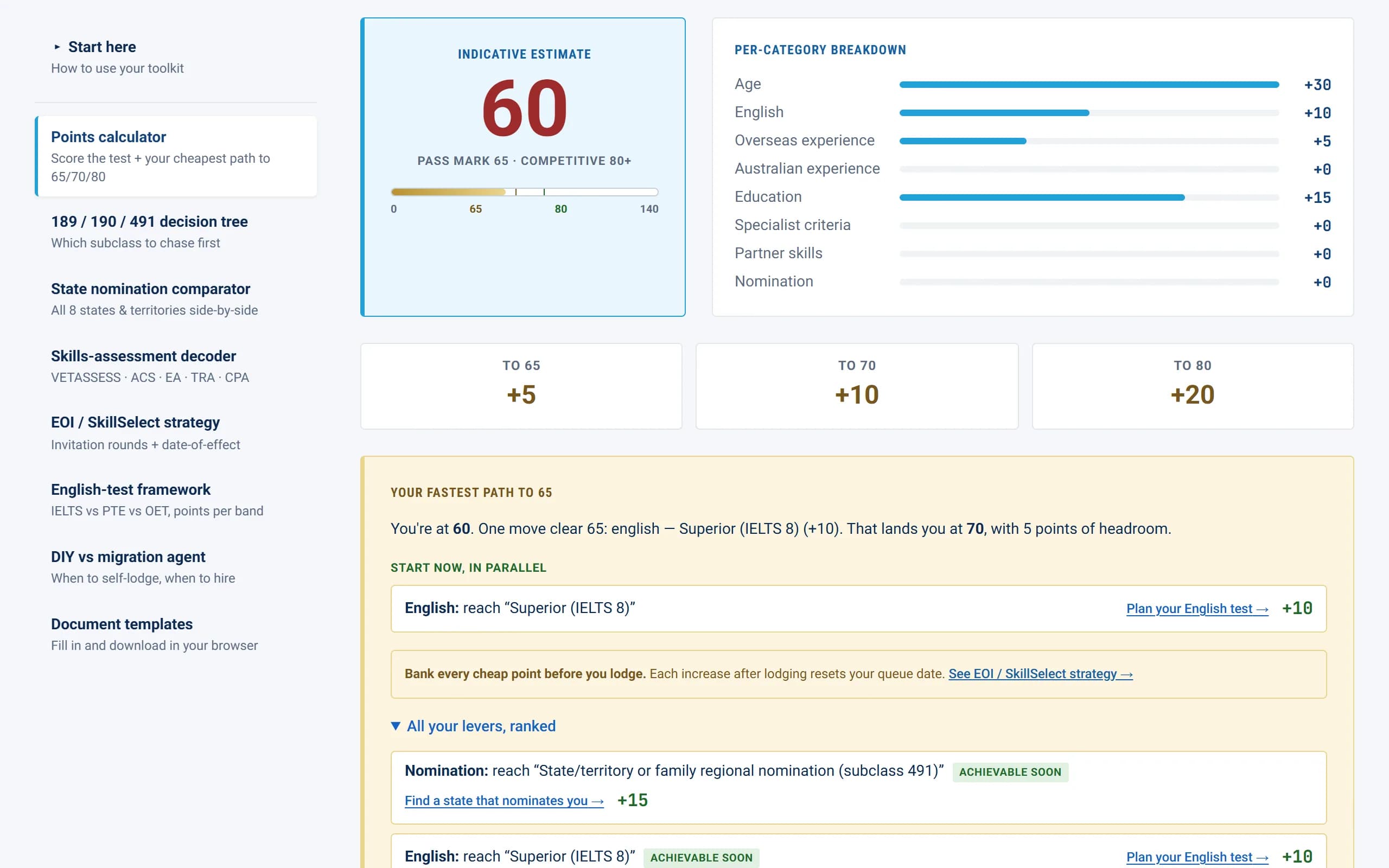
Scenario 1 — Offshore broker, 31, Master's, Proficient English, 6 years experience Age 30 + Bachelor's/Master's 15 + English 10 + Experience 10 = 65 points. Add 190 nomination (+5) = 70 points. Below current competitive levels for non-priority CSOL. Adding regional 491 (+15) gets to 80, which is invitable in regional rounds.
Scenario 2 — Offshore broker, 28, Bachelor's, Superior English, 4 years experience, partner with positive VETASSESS Age 30 + Bachelor's 15 + English 20 + Experience 5 + Partner 10 = 80 points. Add 190 (+5) = 85, which is competitive in 2026 invitation rounds. This is the realistic ceiling without an Australian degree or work history.
For most candidates the maths makes employer-sponsored 482 the faster route and 491 the strongest permanent option.
State Nomination
Finance Broker is on the STSOL, which Home Affairs uses for the 190 and 491, so a state can nominate it if its own list includes 222112. In practice only a handful actively invite 222112.
New South Wales
NSW nominates from its own skills list for the 190 and 491 and prioritises ICT, healthcare, engineering and education. Finance Broker invitations exist but tend to require strong Australian work experience, a job offer with a Sydney brokerage, or substantial points above the standard threshold. Greater Sydney is the largest broker market by volume.
Victoria
Victoria does not publish a separate state occupation list — it accepts the national SOL and prioritises healthcare, education, ICT and engineering. Finance Broker invitations are rare without Melbourne-based employment. Regional Victoria (Geelong, Ballarat, Bendigo, Latrobe Valley) offers stronger 491 odds for candidates willing to commit to two years on the ground.
Queensland
Queensland's Business and Skilled Migration Queensland (BSMQ) program invites occupations on its own list where employer sponsorship or onshore residence is established. South-east Queensland brokerages — particularly on the Gold Coast and Sunshine Coast — are growing fast on the back of interstate migration.
South Australia
South Australia's state list covers a broader set of occupations than most states and has waivers for graduates of SA institutions. For offshore Finance Broker candidates with no Australian ties, SA is often the most realistic 491 destination.
Tasmania and Northern Territory
Both run smaller programs that occasionally invite for 222112 where the candidate demonstrates a committed offer or onshore work history. Allocations are limited and rounds close fast — check the 2026 SOL hub for current state list status.
Salary and Employment Outlook
What Finance Brokers Earn in 2026
| Role | Typical Base Range | Notes |
|---|---|---|
| Trainee / Loan Writer (PAYG) | AUD $60,000-$80,000 | Aggregator-supported entry roles |
| Mortgage Broker (employed) | AUD $80,000-$120,000 | Base + commission split |
| Senior Mortgage Broker | AUD $120,000-$175,000 | Established trail book |
| Commercial Finance Broker | AUD $110,000-$200,000 | Higher ticket sizes, lower volume |
| Asset Finance Broker | AUD $90,000-$160,000 | Equipment, vehicles, plant |
| Brokerage Owner / Principal | AUD $150,000-$400,000+ | Trail book economics |
SEEK's 2026 city averages range from AUD $95,000 in Sydney to AUD $150,000 in Perth (advertised job postings). The Sydney figure understates the market because many Sydney brokers operate as self-employed credit representatives whose actual income is not captured in PAYG job ads.
Most brokers also receive trail commission — typically 0.15% per annum of the loan balance — which compounds over years. A broker with a AUD $100 million trail book earns roughly AUD $150,000 per year in trail alone, before any new business.
Total packages typically include superannuation at 12% (effective 1 July 2025), commission splits running 50-80% of upfront and trail to the broker, and aggregator-funded marketing or CRM access.
Highest-Paying Sectors
- Commercial finance — SME working capital, property development, equipment
- High-net-worth residential — Sydney harbour-side, inner Melbourne, blue-chip Brisbane
- Self-employed and complex income — lower competition, higher commission per deal
- Trail book buyers — brokers acquiring mature loan books from retiring brokers
- Big-four broker subsidiaries — RAMS, Aussie (CBA-owned) for PAYG security
Tips for a Successful Application
1. Match your VETASSESS pathway to your real qualification
Pathway 1 is the cleanest. If your degree is in commerce, finance or business, evidence the major and the year of completion in your transcript. If your degree is in an unrelated discipline (engineering, law, arts), Pathway 2 with a Cert IV in Finance and Mortgage Broking is faster than Pathway 3's two-year experience extension.
2. Frame employment references as broking, not lending
VETASSESS rejects applications where references describe in-house bank lending duties — credit assessment, branch lending, mobile mortgage manager work for a single lender. The references must show you arranged credit across multiple lenders or independently negotiated on the client's behalf. Get your referees to use the exact ANZSCO task language.
3. Plan ASIC licensing before you arrive
You cannot legally write loans in Australia without the Cert IV, an aggregator authorisation and PI cover. Complete the Cert IV online during the visa wait (four to six weeks part-time) so you can start earning from week one onshore.
4. Target a 491 in a regional broker hub
The maths almost always favours regional 491 over metro 190 for 222112. Newcastle, Wollongong, Geelong, the Sunshine Coast and the Gold Coast (regional postcodes) all have active broker employers and easier nomination paths.
5. Consider trail-book economics in your destination choice
Brokerages with mature trail books in growth corridors compound much faster than CBD startups. Ask any potential sponsor for the average book size per broker and the trail run-off rate before you sign.
Step-by-Step Migration Roadmap
- Confirm 222112 fits your actual duties by reading the how to find ANZSCO code guide.
- Verify CSOL status on the 2026 SOL page and the CSOL hub.
- Choose your VETASSESS pathway (1-4) based on qualification fit.
- Sit IELTS or PTE — aim for Superior English (IELTS 8 in each band, or equivalent) for maximum EOI competitiveness.
- Lodge the VETASSESS Skills Assessment with all employment evidence. Fee: AUD1,260.60 if you apply from within Australia (includes GST) or AUD1,146.00 if you are not an Australian resident for tax purposes; priority processing costs AUD949.30 or AUD863.00 on top. Processing: about 7 weeks for professional occupations, or 10 business days with priority processing once the application is confirmed eligible.
- Enrol in the FNS40821 Certificate IV in Finance and Mortgage Broking in parallel.
- Submit EOI in SkillSelect for 190 or 491, or secure a 482-sponsoring brokerage.
- Apply for state nomination if pursuing 190 or 491.
- Receive invitation and lodge the visa within 60 days.
- Complete health, character and biometrics checks.
- Arrive in Australia and join an aggregator (Connective, AFG, Loan Market, Finsure or similar).
- Take out PI insurance, register as an ACR and start writing loans.
Frequently Asked Questions
Is Finance Broker on the MLTSSL or just the CSOL?
222112 sits on the CSOL and the STSOL, not the MLTSSL. That means no subclass 189 access — every Finance Broker route requires either state nomination (190 or 491) or employer sponsorship (482, 494 or 186). Home Affairs uses the CSOL for the 482 and 186, and the MLTSSL, STSOL and ROL for the other skilled visas, including the points-tested 190 and 491.
Can I work as a mortgage broker straight after getting my visa?
Not without finishing the Cert IV in Finance and Mortgage Broking and signing with an aggregator. The skills assessment confirms migration eligibility — ASIC regulates the right to actually arrange credit. The Cert IV is a four-to-six-week course you can complete online during the visa wait.
Why did Finance Broker drop off the shortage list in 2025?
Jobs and Skills Australia's 2025 Occupation Shortage List moved most Business and Finance occupations from "in shortage" to "no shortage" as the post-COVID hiring crunch eased. Mortgage broking remains a growing industry — three-quarters of home loans go through brokers — but employer recruitment is not as desperate as in trades, healthcare or ICT.
Will VETASSESS accept my offshore lending experience?
VETASSESS accepts offshore experience if the duties match the ANZSCO description for an independent multi-lender broker. Single-bank mobile mortgage manager work, retail bank lending, or pure underwriting roles will likely be marked as not highly relevant. Reference letters need to describe broking duties explicitly, with evidence of working across multiple lenders or panels.
Is the 482 worth pursuing if my plan is permanent residency?
For most offshore Finance Brokers, yes. The 482 Core Skills stream lets you start work, build Australian experience, and transition to a 186 ENS via the TRT stream after two years. The combined timeline often beats waiting for a competitive 190 invitation with offshore-only experience.
Which is easier to migrate as — Finance Broker or Insurance Broker?
Both sit on the CSOL and STSOL with VETASSESS as the assessing body and identical visa access (190, 491, 494, 482, 186). The choice depends on your real duties. Insurance Broker (222113) tends to have slightly lower competition in state pools, but Finance Broker has more sponsoring employers thanks to the size of the mortgage industry. Choose the code that matches your actual work history.