Glazier Visa Pathway to Australia: Complete 2026 Guide
Updated: 16 August 2026
Australia classifies Glazier under ANZSCO 333111. Trades Recognition Australia (TRA) conducts the skills assessment via the Job Ready Program (onshore) or the Offshore Skills Assessment Program (OSAP). The occupation sits on the Core Skills Occupation List and MLTSSL, unlocking subclasses 189, 190, 491, 482, and 186. Typical 2026 salaries range AUD $70,000-$85,000. NSW currently lists Glazier on its 491 offshore stream at 80 points.
Quick Facts: Glazier Migration Pathway
| Detail | Information |
|---|---|
| ANZSCO Code | 333111 (Glazier) |
| Skill Level | 3 (Australian Certificate III or IV, or three years on-the-job training) |
| Skills Assessment | TRA (Trades Recognition Australia) — Job Ready Program or OSAP |
| Occupation List | CSOL and MLTSSL |
| Visa Options | 189, 190, 491, 482, 186 |
| Demand Level | High — driven by commercial high-rise construction, residential renovation, and the post-bushfire window replacement cycle |
| Salary Range | AUD $70,000-$85,000 (SEEK Salary Hub, 2026); commercial and structural specialists to AUD $100,000+ |
| Typical 189 Score | 65-80 points |
| Key Challenge | Glazing roles often pay close to the AUD $79,423 Core Skills Income Threshold — sponsor salary confirmation is critical |
What a Glazier Does in Australia
A 333111 Glazier cuts, prepares, fits, and installs glass and similar materials in buildings, vehicles, and other structures. The Australian glazing market has three main streams: commercial high-rise curtain-wall installation (the highest-paying segment), residential window and door glazing (the largest by volume), and auto/vehicle glazing (a distinct subset with overlap into the 899 codes).
Demand is steady. Commercial high-rise construction in Sydney and Melbourne CBDs requires specialised structural glazing, and the residential renovation cycle in NSW and Victoria generates continuous window and shopfront replacement work. After the 2019-2020 bushfires, regional NSW and Victoria saw a multi-year backlog of fire-rated window replacements — much of that work continues into 2026.
Major employers include national commercial glazing contractors (Permasteelisa, GD Mowat, Concept Glass), residential window and door manufacturers with installation arms (Stegbar, A&L Windows, Trend Windows), and a long tail of small commercial and residential glazing firms.
ANZSCO Code Mapping
ANZSCO 333111 is the Glazier code — covering all building and structural glass installation. The code is single and broad, encompassing residential, commercial, structural, and shopfront glazing.
If your work is primarily automotive glazing (windscreens, vehicle side and rear glass), 333111 may still apply, but assessors often look for at least some structural building glazing in the work history. Pure automotive specialists sometimes fit better under 899 codes — check carefully with a migration agent if this describes you.
Typical 333111 tasks include studying drawings, measuring and marking glass, cutting and shaping glass to size, preparing surfaces and frames, applying putty or sealants, lifting and installing glass panels (often with mechanical aids on commercial work), and installing glass-related products such as mirrors and shower screens.
Skills Assessment with TRA
Trades Recognition Australia assesses all 333111 applicants through one of two pathways.
Job Ready Program (Onshore Pathway)
For applicants already in Australia, typically on a Temporary Graduate (485) visa after an Australian Certificate III in Glass and Glazing.
- Stage 1 — Provisional Skills Assessment: AUD $370
- Stage 2 — Job Ready Employment: AUD $450. Twelve months (1,725 hours) of paid full-time glazing work
- Stage 3 — Job Ready Workplace Assessment: AUD $2,310. An approved RTO conducts an on-site assessment
- Stage 4 — Job Ready Final Assessment: AUD $360
Total: approximately AUD $3,490. Timeline: 12-15 months end-to-end. Glazing is included on TRA's prioritised construction trades list for 2024-2026, which fast-tracks Stages 1 and 4 where capacity exists.
Offshore Skills Assessment Program (OSAP)
For applicants outside Australia. OSAP combines a documentary review with a technical interview at a TRA-approved RTO. Total cost is typically AUD $1,000-$3,000. Processing time is 12-26 weeks.
Common rejection reasons: employment evidence that describes general construction labouring or assistant work rather than skilled glass installation; auto-glazing-only experience without building work; and qualifications that don't map to AQF Certificate III equivalent. The narrow nature of glazing as a trade means evidence specificity matters more here than for carpentry.
Visa Pathways for Glaziers
Subclass 482 — Skills in Demand Visa
Employer-sponsored, no points test. Fastest route with an Australian job offer.
- Visa fee: AUD $4,015 (primary applicant)
- Salary threshold (Core Skills): AUD $76,515 (pre-1 July 2026), rising to AUD $79,423 from 1 July 2026
- Processing time: 3-6 months
- Reality: Residential glazing roles often sit close to the Core Skills threshold. Commercial and structural glazing typically clears it comfortably. Always confirm the offered salary in writing against CSIT before lodging.
Subclass 491 — Skilled Work Regional Visa
Five-year provisional with PR pathway via subclass 191. Adds 15 points.
- Visa fee: AUD $6,140 (primary applicant)
- Processing time: 7-13 months
- Reality: NSW currently nominates Glazier on its 491 offshore stream at 80 points. Queensland and SA also run 491 streams for construction trades.
Subclass 190 — Skilled Nominated Visa
State-nominated PR. Adds 5 points.
- Visa fee: AUD $6,140 (primary applicant)
- Processing time: 7-13 months
- Reality: Less common for glaziers than 491 in 2026. Onshore applicants with state work history can access 190.
Subclass 186 — Employer Nomination Scheme
Permanent residency through employer sponsorship.
- Visa fee: AUD $6,140 (primary applicant)
- Processing time: 6-12 months
- Reality: Most glaziers reach 186 through TRT after two years on a 482 with the same sponsor.
Subclass 189 — Skilled Independent Visa
Points-only PR. No nomination.
- Visa fee: AUD $6,135 (primary applicant)
- Processing time: 6-9 months (post-March 2026 overhaul)
- Reality: Open to glaziers but invitation rounds for niche trades are smaller. State nomination is the higher-probability route.
Points Test Strategy
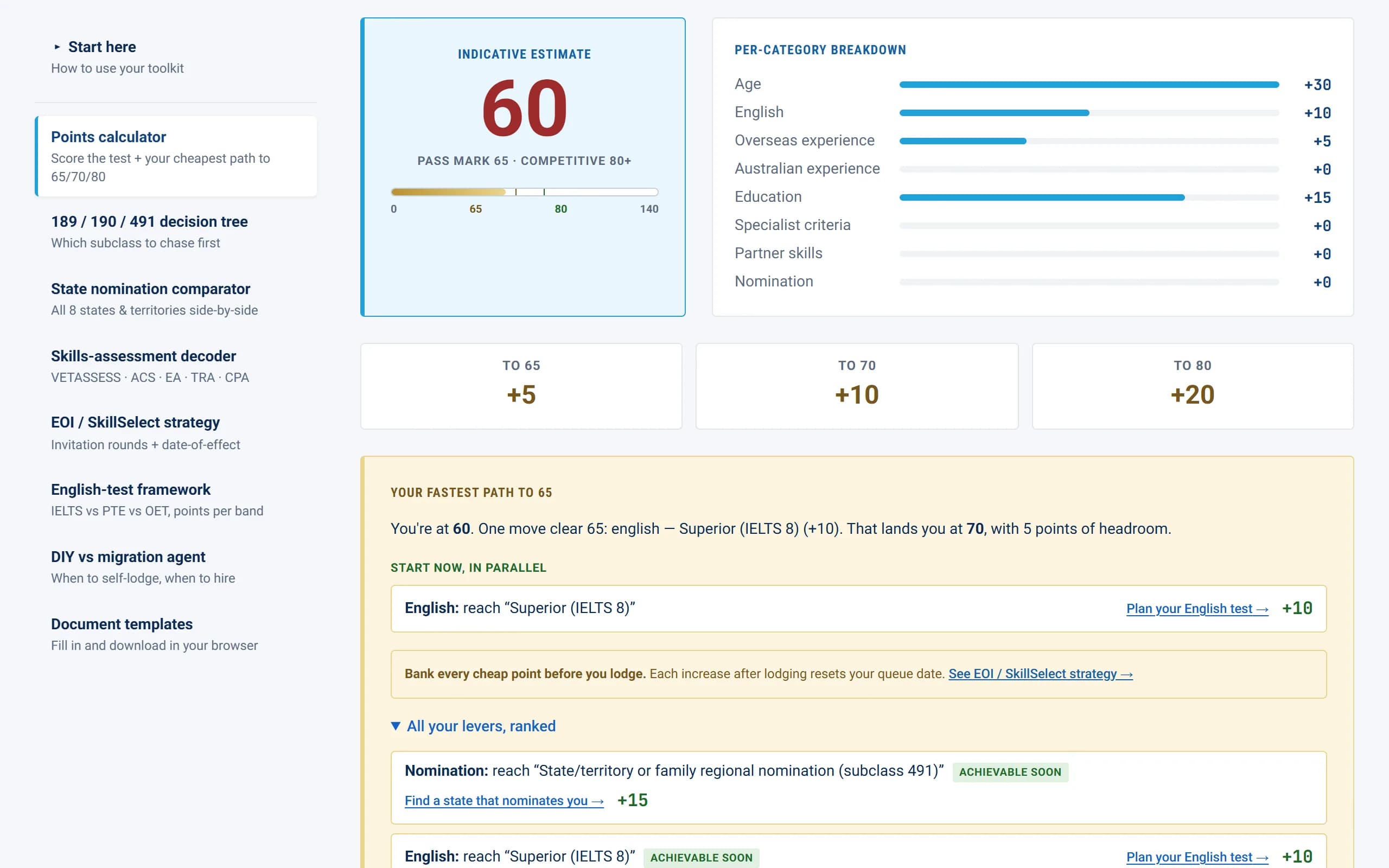
Glaziers typically score 60-80 points. The standard table:
| Points Factor | Points | Notes |
|---|---|---|
| Age (25-32) | 30 | Maximum |
| Age (33-39) | 25 | Strong |
| English (Competent — IELTS 6.0) | 0 | Visa minimum |
| English (Proficient — IELTS 7.0) | 10 | High-leverage |
| English (Superior — IELTS 8.0) | 20 | Rare but unlocks top band |
| Qualification (Cert III/IV) | 10 | Standard |
| Australian Study | 5 | Cert III+ onshore |
| Overseas Experience (8+ years) | 15 | Skilled level only |
| State Nomination (190) | 5 | |
| Regional (491) | 15 | Biggest single boost |
| Partner Skills | 5-10 | If partner has skilled occupation |
Realistic Scenarios
Scenario 1: Offshore, age 30, IELTS 6.5, 8 years experience Age 30 + English 0 + Cert III 10 + Experience 15 = 55 points. Needs 491 (+15) for 70 points, plus possibly partner skills to clear NSW's offshore 80-point bar.
Scenario 2: Offshore, age 28, IELTS 7.0, 10 years experience, skilled partner Age 30 + English 10 + Cert III 10 + Experience 15 + Partner 10 = 75 points. Add 491 (+15) for 90 — comfortably invitable across all priority states.
State Nomination for Glaziers
New South Wales
NSW currently nominates Glazier on its 491 offshore stream at 80 points. Offshore applicants need a strong points profile to clear this bar. The state's 491 allocation prioritises construction and infrastructure trades, particularly applicants with regional NSW work commitments.
Queensland
Queensland's Building and Construction Pathway includes glazing trades. Both 190 and 491 are available. ROIs opened 19 September 2025 for the 2025-26 programme year.
Victoria
Victoria accepts all CSOL occupations for state nomination. Construction is one of six priority sectors for 2025-26. A Registration of Interest through Live in Melbourne is required alongside the SkillSelect EOI.
South Australia
SA updated its Skilled Occupation List on 30 September 2025 and continues to nominate construction trades, including glazing. The state's regional 491 stream is consistently one of the more accessible offshore routes.
Western Australia
WA's Skilled Stream includes Glazier, with preference for applicants holding a current WA job offer or with WA work history. Perth's commercial construction pipeline and regional mining-services work both generate demand.
Tasmania
Tasmania's Skilled Graduate Pathway accepts glazing qualifications completed at Tasmanian institutions with two years of state residence. The 2025-26 allocation is 1,200 (190) + 650 (491).
Salary and Employment Outlook
Typical Glazier Earnings
| Role | Annual Range (2026) |
|---|---|
| Apprentice Glazier (final year) | AUD $45,000-$55,000 |
| Qualified Glazier | AUD $70,000-$85,000 |
| Senior Glazier (8+ years) | AUD $80,000-$95,000 |
| Commercial / Structural Glazier | AUD $90,000-$110,000 |
| Leading Hand / Foreman | AUD $100,000-$125,000 |
| Self-employed contractor (day rate) | AUD $450-$650/day |
| Specialist curtain-wall / high-rise | AUD $110,000-$140,000+ |
Sources: SEEK Salary Hub (March 2026), national average AUD $70,000-$85,000; Indeed Australia (March 2026), AUD $77,942; Jora 2026, AUD $80,000; SalaryExpert 2026, AUD $82,535. Sydney and Melbourne commercial glaziers earn at the upper end of these ranges; regional residential work runs at the lower end.
Highest-Paying Sectors
- Commercial high-rise curtain-wall — Sydney and Melbourne CBD towers; specialist rates and overtime
- Structural and frameless glazing — premium residential, hospitality fit-out, balustrades, pool fencing
- Auto glass and windscreen — niche but stable; usually employed by national brands such as O'Brien
- Mainstream residential — window and door installation, retrofit, shopfront repair
- Heritage glazing — listed buildings, leadlight and stained-glass conservation
Total package context: 11.5% superannuation, height-and-site allowances on commercial work, and overtime loadings under most EBAs. Commercial curtain-wall glaziers regularly clock significant overtime on tower projects.
Tips for a Successful Application
1. Verify Your Salary Against CSIT Before Signing a 482 Offer
Many residential glazing roles pay AUD $70,000-$78,000 — straddling the Core Skills Income Threshold. The threshold rises to AUD $79,423 on 1 July 2026. A nominal offer that fails CSIT cannot sponsor a 482. Get the offered salary in writing and verify it covers the threshold for the nomination lodgement date.
2. Demonstrate Building Glazing Experience, Not Just Auto Glass
OSAP assessors look for evidence of building glazing — windows, doors, shopfronts, structural glass. Pure automotive glazing CVs sometimes fail the 333111 assessment because the code is positioned for building work. If your background is mixed, lead with the building portion.
3. Push English Past IELTS 6.0
Glazing is a quieter trade in invitation rounds than carpentry. A 6.0 visa-minimum English score earns zero points; moving to 7.0 unlocks 10. For NSW's 80-point offshore 491 threshold, this is often the decisive lever.
4. Apply to Multiple States Simultaneously
NSW offshore Glazier sits at 80 points — a high bar. Queensland, SA, and Tasmania all nominate construction trades with lower thresholds. Lodge ROIs in parallel — there's no penalty for applying to several states.
5. Build Project Evidence Before You Lodge
Photographs of finished installations, drawings worked on, supplier invoices for specialist glass, and signed client testimonials all strengthen an OSAP technical interview. Build the file before, not during, the assessment.
Step-by-Step Migration Roadmap
- Confirm 333111 is your code — review the ANZSCO code finder
- Check list status — Glazier sits on the CSOL and MLTSSL
- Choose your TRA pathway — Job Ready Program (onshore) or OSAP (offshore)
- Build your evidence pack — qualifications, payslips, signed duty statements, project photographs
- Sit your English test — IELTS 7.0 unlocks the 10-point band
- Lodge skills assessment — see the skills assessment guide
- Complete 12 months of glazing employment (JRP route)
- Submit EOI in SkillSelect for 189, 190, or 491
- Lodge state nomination ROIs with NSW, QLD, SA, WA, TAS in parallel
- Receive invitation, lodge visa within 60 days
- Complete health, character, biometric checks
- Receive grant and relocate
Frequently Asked Questions
Does Australia recognise overseas auto-glazing experience for the 333111 assessment?
Partially. TRA accepts auto-glazing experience but typically wants to see at least some building glazing in the work history to satisfy the 333111 description. Pure windscreen replacement specialists may face a closer assessment. NAATI-certified translations of qualifications and references are mandatory for OSAP.
What's the difference between Glazier and Window Cleaner in ANZSCO?
Glazier (333111) is a skilled trade involving cutting, fitting, and installing glass. Window Cleaner is a separate semi-skilled occupation. Don't confuse the two on your application — the skill levels and assessing arrangements are entirely different.
Do I need a state glazing licence to work in Australia?
It varies. NSW, Queensland, and Victoria require contractor licensing or trade certification to operate as a principal contractor or run your own business. As an employed glazier under another contractor's licence, no separate licence is needed. Check NSW Fair Trading, QBCC, or VBA for the current rules.
Why is NSW's offshore points threshold so high for Glazier?
NSW receives a high volume of construction-trades applications, and uses points cut-offs to manage volume. The 80-point bar for offshore Glazier in 2026 reflects strong demand on the application side rather than weak demand for the work itself. Other states with lower volumes invite at lower thresholds.
Can I work in commercial high-rise glazing without prior experience?
Most commercial curtain-wall and structural glazing firms require at least three years of building-glazing experience before they'll put you on a high-rise project. Apprentices and recent graduates usually start with residential or low-rise commercial work and progress up. FIFO-style mobilisation to interstate tower projects typically requires the senior-glazier tier.
What's the typical career path after the 482 visa?
Most sponsored glaziers transition to a 186 (Employer Nomination Scheme) via the TRT stream after two years with the same sponsor. The 186 grants permanent residency, after which the four-year wait for citizenship begins. Some glaziers move into supervisory or estimating roles by year five, raising their earnings significantly.