Metal Fabricator Visa Pathway to Australia: Complete 2026 Guide
Updated: 16 August 2026
Australia classifies Metal Fabricator under ANZSCO 322311. Trades Recognition Australia (TRA) conducts the skills assessment. The occupation sits on the CSOL and MLTSSL, unlocking subclasses 189, 190, 491, 482 and 186. Typical 2026 salaries range AUD $71,000-$93,000, with experienced structural fabricators in mining-services and infrastructure earning above that band. Demand spans construction, infrastructure and resources.
Quick Facts: Metal Fabricator Migration Pathway
| Detail | Information |
|---|---|
| ANZSCO Code | 322311 (Metal Fabricator) |
| Skill Level | 3 (AQF Certificate III with two years on-the-job training, or Certificate IV) |
| Skills Assessment | TRA (Trades Recognition Australia) |
| Occupation List | CSOL + MLTSSL |
| Visa Options | 189, 190, 491, 482, 186 |
| Demand Level | Very high — sustained shortage across construction, mining and infrastructure |
| Salary Range | AUD $71,500-$93,000 (SEEK Salary Hub, May 2026) |
| Typical 189 Score | 70-80 points (trades pool smaller than ICT, threshold lower) |
| Key Challenge | Distinguishing fabrication from welding and structural steel erection in employment evidence |
What a Metal Fabricator Does in Australia
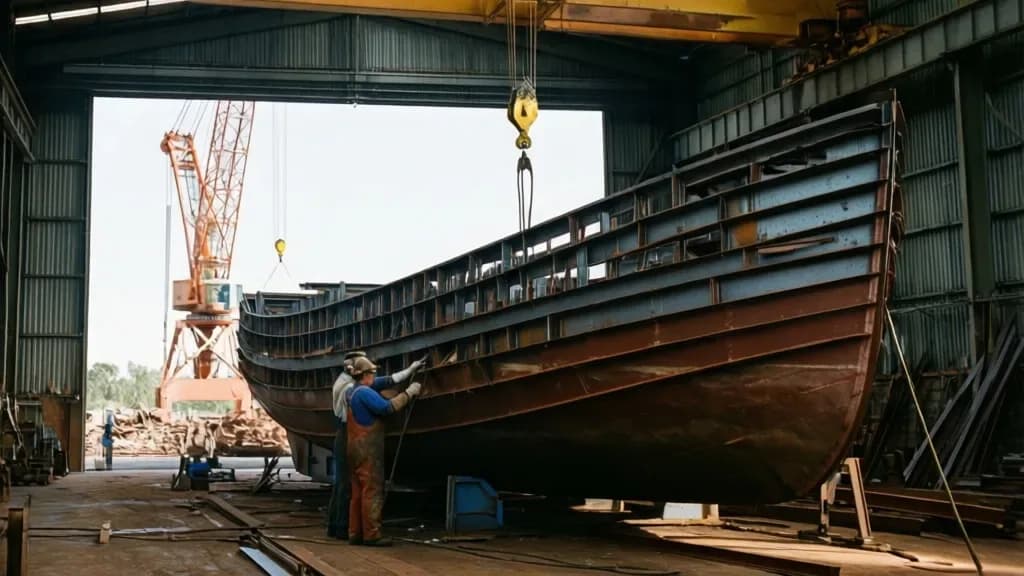
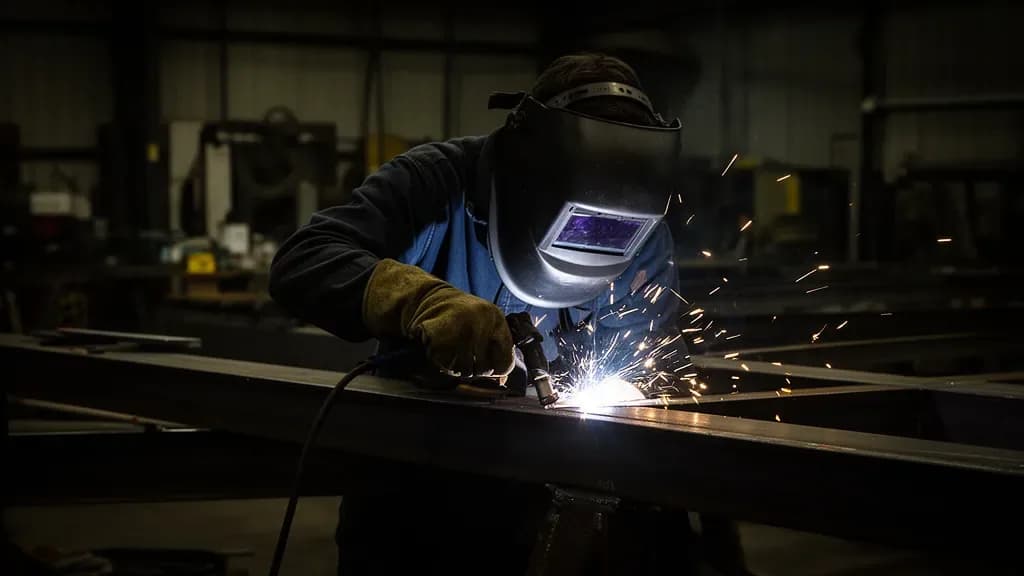
Metal Fabricators interpret drawings and fabricate structural steel, platework and metal products from cutting and rolling through to assembly and finishing. The trade powers Australia's construction and infrastructure sectors, the resources industry, shipbuilding in Western Australia and South Australia, and the heavy manufacturing belt that feeds large infrastructure projects across the country.
Demand concentrates around major project regions and industrial precincts. Western Sydney, Geelong, Newcastle, Gladstone, Mackay-Bowen-Whitsunday in central Queensland, the Pilbara, and Perth's Henderson shipbuilding precinct all run sustained shortages. Major employers include Civmec, Monadelphous, Watpac, Lendlease civil teams, Austal (shipbuilding), BAE Systems (Osborne South Australian shipyard), and the broad ecosystem of subcontract fabrication workshops that feed major energy, transport and defence projects.
The trade overlaps with welder (322313), structural steel erector (821711) and boilermaker work. ANZSCO 322311 specifically covers fabrication: marking out, cutting, shaping, forming and assembling structural steel and metal products — typically heavier gauge than the sheetmetal trades worker (322211).
ANZSCO 322311 — The Code and Tasks
ANZSCO 322311 covers tradespeople who fabricate, assemble and weld structural steel and other metal products. Core tasks include: studying drawings and specifications; marking out metal stock; cutting metal sections using flame, plasma or mechanical cutters; shaping and bending metal using hand and machine tools; aligning components using measuring instruments; joining metal sections via welding, bolting or riveting; and inspecting finished work to drawings and quality standards.
The unit group 3223 (Structural Steel and Welding Trades Workers) covers Metal Fabricator (322311), Pressure Welder (322312) and Welder First Class (322313). Applicants whose primary task is welding — rather than full fabrication — should consider Welder (First Class) or Pressure Welder as the more accurate code.
Skills Assessment: TRA
Trades Recognition Australia (tradesrecognitionaustralia.gov.au) is the assessing authority. The pathway depends on whether you are applying from offshore or onshore.
Offshore applicants — Migration Skills Assessment (MSA) or OSAP
Requirements:
- Qualification equivalent to AQF Certificate III with at least two years of on-the-job training, or AQF Certificate IV
- At least three years of paid full-time experience in the occupation
- Detailed identity, qualification and employment evidence — including payslips, tax records and employer references that describe fabrication-specific tasks
Assessment cost: Documentary stage from AUD $300; full MSA fees vary by stage. Refer to TRA's published fee schedule for current amounts. Processing time: TRA targets 120 days (around 17 weeks) from complete submission. Metal Fabricator may qualify for the construction priority tranche through to June 2026, which can shorten processing.
Applicants from comparable trade systems — UK, Ireland and several European countries — may use the Offshore Skills Assessment Program (OSAP), which involves practical and technical assessment at an approved offshore centre.
Common rejection reasons: Employment references that describe only welding without the broader fabrication context; missing payslip evidence; qualifications from training providers TRA does not recognise as equivalent to AQF Certificate III; insufficient detail about types of materials, joining methods and project scale.
Onshore applicants — Job Ready Program (JRP)
Four stages: Provisional Skills Assessment, Job Ready Employment (12 months of paid Australian work), Job Ready Workplace Assessment, Final Assessment.
JRWA fee: AUD $2,845 per TRA's current schedule. Other stages priced separately. Processing time: 12-18 months end to end.
The JRP suits applicants on student or working holiday visas who can secure local employment with a TRA-approved sponsoring workshop.
Visa Pathways for Metal Fabricators
Subclass 482 — Skills in Demand
The dominant pathway for many metal fabricators. Major construction and resources contractors sponsor international tradespeople regularly, and Metal Fabricator features in many approved sponsor labour agreements.
Visa fee: AUD $4,015 (primary applicant) Salary threshold: Core Skills stream income threshold around AUD $79,423 — fabrication roles in mining-services and infrastructure usually clear this with overtime Processing time: 1-3 months for Core Skills stream nominations Quirk that matters: Labour Market Testing applies, but is well-documented for fabrication trades by major sponsors. The Specialist Skills stream (income above AUD $146,576) does not apply to most metal fabricator roles.
Subclass 491 — Skilled Work Regional (Provisional)
A powerful route for metal fabricators willing to work in regional areas — which captures most of the major project regions outside the capital cities.
Visa fee: AUD $6,140 (primary applicant) Eligibility constraint: Must live and work in a designated regional area for the visa duration Processing time: 7-12 months Quirk that matters: Three years on a 491 plus income above threshold opens transition to subclass 191 permanent residency. Most of the major fabrication employers (Civmec in WA, Austal in WA, BAE in SA, the central Queensland resource hubs) operate from designated regional postcodes.
Subclass 190 — Skilled Nominated
Permanent residency through state nomination plus the points test.
Visa fee: AUD $6,140 (primary applicant) Points boost: +5 from state nomination Processing time: 6-10 months Quirk that matters: SA, WA and NSW are the states most likely to nominate Metal Fabricator under their 190 streams, reflecting shipbuilding, infrastructure and construction demand.
Subclass 186 — Employer Nomination Scheme
Permanent residency via employer sponsorship.
Visa fee: AUD $6,140 (primary applicant) Processing time: 6-12 months (Direct Entry); shorter for Temporary Residence Transition stream Quirk that matters: Major fabrication employers prefer the Temporary Residence Transition stream: candidate arrives on a 482, completes 2-3 years, transitions to 186 with employer support. Direct Entry is rarer but available.
Subclass 189 — Skilled Independent
Points-only permanent residency. Available because the occupation is on the MLTSSL.
Visa fee: AUD $6,135 (primary applicant) Realistic points: 75-80 typically needed for invitation Processing time: 8-12 months once invited Quirk that matters: Trade invitation rounds for 189 have been small in 2026. Most metal fabricators reach PR faster through 482-to-186 or 491-to-191 transitions.
Points Test Strategy
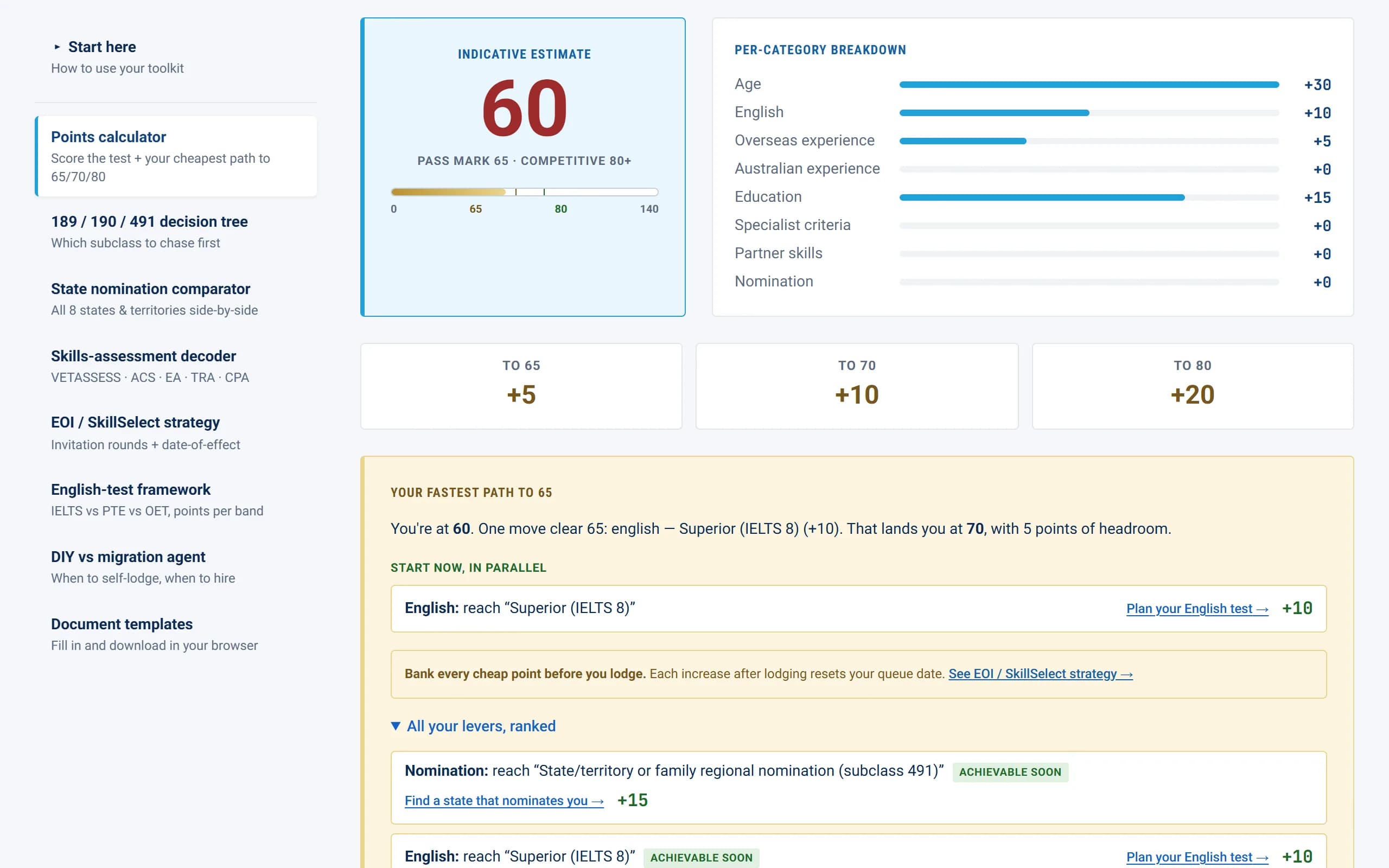
| Points Factor | Points | Notes |
|---|---|---|
| Age (25-32) | 30 | Most favourable bracket |
| Age (33-39) | 25 | Still competitive |
| Trade qualification (AQF III-IV) | 10 | Standard |
| English (Competent 6.0) | 0 | Mandatory minimum |
| English (Proficient 7.0) | 10 | Worth the test prep |
| English (Superior 8.0) | 20 | Strong differentiator |
| Overseas skilled experience (5-7 years) | 10 | Common |
| Overseas skilled experience (8+ years) | 15 | Common ceiling |
| Australian skilled work | 5-20 | Strong lever if you have it |
| State Nomination (190) | 5 | Modest but useful |
| Regional Nomination (491) | 15 | Often the decisive lever |
| Partner skills | 5-10 | Often overlooked |
Realistic Scenarios
Scenario 1: Offshore Filipino fabricator, age 31, ten years experience, Proficient English, WA 491 nomination
- Age 31: 30 + Trade qual: 10 + English Proficient: 10 + Experience 8+ years: 15 + 491: 15 = 80 points
- Strong for invitation in current trade rounds
Scenario 2: Onshore Indian applicant after JRP, age 33, six years experience, Competent English, SA 190 nomination
- Age 33: 25 + Trade qual: 10 + English Competent: 0 + Experience 5-7 years: 10 + 190: 5 + Australian work: 5 = 55 points
- Below typical threshold — needs Proficient English or 491 instead of 190 to clear competitive levels
State Nomination for Metal Fabricators
Western Australia
WA is the most active state for metal fabricator nomination, driven by Henderson shipbuilding (Civmec, Austal, BAE Henderson facility), iron ore infrastructure in the Pilbara, and gas processing in the North West Shelf. WA's 491 program covers all postcodes outside the Perth metro core, and 190 nominations target fabricators with specific welding tickets (e.g. structural welding, pressure pipe qualifications).
South Australia
SA nominates Metal Fabricator on both 190 and 491 streams, with shipbuilding at Osborne (BAE Systems' Hunter-class frigate program) creating sustained demand. SA's defence aligned manufacturing precinct also draws fabricators with high-precision welding and assembly experience.
Queensland
Queensland's 491 program covers Metal Fabricator across regional postcodes including Mackay, Townsville, Cairns, Gladstone and Toowoomba. Central Queensland's resources industry and infrastructure construction generate steady demand. Migration Queensland accepts casual employment of 20+ hours per week as valid skilled experience.
New South Wales
NSW's 491 program targets regional areas — the Hunter, Illawarra, Central West and Riverina — where infrastructure construction and resources support drive demand for fabrication trades. The Sydney metro is excluded from 491 eligibility.
Salary and Employment Outlook
What Can You Expect to Earn?
| Role | Typical Salary Range |
|---|---|
| Apprentice Metal Fabricator | AUD $50,000-$60,000 |
| Qualified Metal Fabricator | AUD $71,500-$80,000 |
| Senior Metal Fabricator | AUD $85,000-$93,000 |
| Shipbuilding Fabricator (WA/SA) | AUD $90,000-$120,000 |
| Mining-Services Fabricator (FIFO) | AUD $110,000-$150,000+ |
| Workshop Foreman | AUD $110,000-$140,000 |
Source: SEEK Salary Hub and SalaryExpert (May 2026 data); Indeed Australia salary explorer.
Total packages typically include 11.5% superannuation. Mining-services and FIFO roles add site allowances, accommodation and travel — often increasing total package by 30-50% over the base rate. Defence-aligned fabrication often involves security clearance requirements, which can lift base rates.
Highest-Paying Sectors
- Mining-services fabrication — particularly FIFO roles in the Pilbara and Bowen Basin
- Shipbuilding — Henderson (WA), Osborne (SA), Williamstown (VIC)
- Defence prime contractors — BAE Systems, Civmec, Austal, Raytheon
- Major civil construction — Lendlease, John Holland, CIMIC subsidiaries
- Oil and gas onshore facilities — Northern Territory, Western Australia, central Queensland
Tips for a Successful Application
1. Describe fabrication, not just welding
TRA reviewers see many applications from welders who present themselves as fabricators. If you nominate 322311, your references must describe the full fabrication cycle — drawing interpretation, marking out, cutting, forming, assembly — not just welding tickets. If welding is your dominant task, switch to Welder First Class (322313).
2. Document your welding tickets and procedure qualifications
Fabricators with WPS (Welding Procedure Specification) qualifications, AS 1554 structural welding certifications, or international equivalents (AWS, ASME, EN ISO) are far more valuable to Australian employers. List your tickets explicitly in CV, employment references and TRA submissions.
3. Provide project-specific evidence
A reference saying "John worked as a metal fabricator from 2018 to 2024" is weaker than a reference describing the specific projects: bridge deck steelwork, LNG module fabrication, structural columns for high-rise construction. Project-level specificity strengthens both the TRA assessment and any subsequent employer applications.
4. Target your state to match your specialisation
Shipbuilding and defence specialists should target SA or WA. Mining-services fabricators with FIFO experience should target WA. Civil-construction fabricators have the broadest options. Choose your nominating state on the basis of demand for your actual specialisation, not theoretical occupation list inclusion.
5. Sit Proficient English even though Competent is the minimum
Trade migrations have lower English thresholds, but Proficient (IELTS 7.0) adds 10 points and makes state nomination committees more comfortable inviting offshore applicants. For Metal Fabricator specifically, English clarity matters for safety-critical drawing interpretation — committees know this.
Step-by-Step Migration Roadmap
- Confirm ANZSCO 322311 fits your duties — distinguish fabrication from welding work using the how to find your ANZSCO code guide
- Audit your qualification against AQF Certificate III — gather syllabus, hours and practical assessment evidence
- Compile project-level employment evidence — payslips, tax records, references describing fabrication tasks and project scope
- List your welding tickets and procedure qualifications — WPS, AS 1554, AWS, ASME, EN ISO
- Sit your English test — aim for Proficient (7.0); Competent (6.0) is the minimum
- Apply to TRA — MSA offshore (may qualify for construction priority through June 2026), JRP onshore, OSAP for comparable-system countries
- Submit your EOI in SkillSelect — note 482, 190 and 491 visa interest
- Apply for state nomination — target the state matching your specialisation
- Or pursue employer sponsorship — particularly 482 with major fabrication contractors
- Receive your invitation or sponsorship offer — lodge visa application within 60 days of invitation
- Complete health and character checks — police certificates from every country lived in for 12+ months
- Receive grant and relocate — start work in your nominated location
See the skills assessment bodies hub and the subclass 491 page for deeper context.
Frequently Asked Questions
Is Metal Fabricator in shortage in Australia in 2026?
Yes. Jobs and Skills Australia identifies Skill Level 3 trades as the most acute national shortage, with fill rates of 54.3%. Metal Fabricator demand is particularly strong in WA shipbuilding and resources, central Queensland infrastructure, and SA defence manufacturing. The 2024-2026 priority skills assessment program for construction trades signals federal government recognition of the shortage.
Should I nominate Metal Fabricator or Welder First Class?
Match the code to your dominant duties. Metal Fabricator (322311) covers the full fabrication cycle — drawing interpretation, cutting, forming, assembly and welding. Welder First Class (322313) covers specialist welding work. If most of your week is welding production rather than fabrication setup and assembly, nominate Welder. TRA cross-checks duty descriptions against payslip evidence, and a mismatched code is a major refusal trigger.
Can I migrate as a metal fabricator without an Australian qualification?
Yes. Offshore qualifications equivalent to AQF Certificate III are recognised through MSA or OSAP. If your country's training system is significantly different — for example, no formal apprenticeship structure — you may rely on substituting three years or more of relevant work experience for the formal qualification, but this requires very detailed employment evidence.
Which Australian visa is fastest for a metal fabricator?
The subclass 482 employer-sponsored visa, where a sponsoring contractor already has approved sponsor status, is typically the fastest route — sometimes 3-6 months from job offer to grant. The 491 regional visa takes 7-12 months once state nomination is secured. The 189 independent visa is slower because invitation rounds for non-priority trades have been small in 2026.
Do I need a White Card to work on Australian construction sites?
Yes. The White Card (general construction induction) is mandatory for anyone working on Australian construction sites. The course takes one day and can be completed in-country after arrival. It is not part of the TRA skills assessment and does not affect visa eligibility.
What's the difference between Metal Fabricator and Boilermaker in Australia?
Boilermaker is a colloquial Australian term that often overlaps with Metal Fabricator (322311) in practice, especially in resources and shipbuilding. ANZSCO does not have a separate Boilermaker code. Job ads using "Boilermaker" typically map to 322311 (Metal Fabricator) for migration purposes, particularly when the work involves structural steel and platework rather than purely welding.