Painter Visa Pathway to Australia: Complete 2026 Guide
Updated: 16 August 2026
Australia classifies Painter (Painting Trades Worker) under ANZSCO 332211. Trades Recognition Australia (TRA) conducts the skills assessment via the Job Ready Program (onshore) or the Offshore Skills Assessment Program (OSAP). The occupation sits on the Core Skills Occupation List and MLTSSL, unlocking subclasses 189, 190, 491, 482, and 186. Typical 2026 salaries range AUD $75,000-$85,000. NSW currently lists Painter for 190 onshore at 75 points.
Quick Facts: Painter Migration Pathway
| Detail | Information |
|---|---|
| ANZSCO Code | 332211 (Painting Trades Worker) |
| Skill Level | 3 (Australian Certificate III or IV, or three years on-the-job training) |
| Skills Assessment | TRA (Trades Recognition Australia) — Job Ready Program or OSAP |
| Occupation List | CSOL and MLTSSL |
| Visa Options | 189, 190, 491, 482, 186 |
| Demand Level | High — sustained by housing pipeline, commercial fit-out cycle, and maintenance backlog |
| Salary Range | AUD $75,000-$85,000 (SEEK Salary Hub, 2026); senior and specialist rates to AUD $93,000+ |
| Typical 189 Score | 65-80 points |
| Key Challenge | Painting roles often pay just above the AUD $76,515 Core Skills Income Threshold — sponsorship eligibility hinges on confirmed salary |
What a Painting Trades Worker Does in Australia
ANZSCO 332211 covers tradespeople who apply paint, varnish, wallpaper, and other finishes to protect and decorate interior and exterior surfaces. The work spans residential repaints (the largest single market), commercial fit-out, industrial protective coatings (mining, marine, infrastructure), and heritage and conservation work. Some painters specialise in spray application, others in decorative finishes, others in industrial coatings — TRA examines whichever stream you've worked in.
Demand is steady rather than acute. The Federal Housing Accord creates a strong residential repaint pipeline (every new home, plus the maintenance cycle of the existing housing stock), and commercial fit-out volumes remain high in Sydney and Melbourne CBDs. Industrial coating work in WA mining and Queensland resources is sustained but cyclical with commodity prices.
Major employers include national paint contractors (Programmed Maintenance, BIC Services in commercial), large residential operators (Higgins, Solver Decor Centre installers), commercial fit-out specialists, and a long tail of small subcontracting firms. Heritage and decorative finish specialists operate as boutique studios in NSW and Victoria.
ANZSCO Code Mapping
ANZSCO 332211 is the Painting Trades Worker code — covering all paint, varnish, lacquer, and similar finish applications on buildings and structures. It is a single, broad code; Australia does not separate residential painters from commercial or industrial painters at the ANZSCO level.
This is your code if your work involves preparing surfaces (cleaning, sanding, filling), applying paint by brush, roller, or spray, applying decorative finishes (wallpaper, stencilling, faux finishes), and finishing protective coatings on industrial or marine surfaces.
If you primarily apply industrial protective coatings on heavy structures (pipelines, vessels, bridges) with specialist surface preparation, you may also fit under specialist coating codes — but for migration purposes, 332211 is almost always the right code unless an Australian regulator or assessor specifies otherwise.
Typical 332211 tasks include studying drawings and consulting on colour selection, preparing surfaces by sanding and filling, mixing and matching paint, applying paint by various methods, applying special-effect finishes, hanging wallpaper, and cleaning up after the work.
Skills Assessment with TRA
Trades Recognition Australia is the only authority that assesses 332211.
Job Ready Program (Onshore Pathway)
For applicants already in Australia, typically on a Temporary Graduate (485) visa after an Australian Certificate III in Painting and Decorating.
- Stage 1 — Provisional Skills Assessment: AUD $370. Reviews qualifications and enters you into the program.
- Stage 2 — Job Ready Employment: AUD $450. Twelve months (1,725 hours) of paid full-time work in painting.
- Stage 3 — Job Ready Workplace Assessment: AUD $2,310. An approved RTO conducts an on-site assessment.
- Stage 4 — Job Ready Final Assessment: AUD $360. TRA issues the outcome.
Total: approximately AUD $3,490. Timeline: 12-15 months end-to-end. Painting is included on TRA's prioritised construction trades list for 2024-2026, which speeds up Stages 1 and 4 where capacity exists.
Offshore Skills Assessment Program (OSAP)
For applicants outside Australia. OSAP combines a documentary review with a technical interview by an approved RTO. Total cost is typically AUD $1,000-$3,000. Processing time is 12-26 weeks.
Common rejection reasons: employment evidence that describes only labouring or assistant work rather than skilled painting; qualifications that don't map to AQF Certificate III equivalent; and self-employment evidence without arms-length verification.
Visa Pathways for Painters
Subclass 482 — Skills in Demand Visa
Employer-sponsored, no points test. The fastest entry route with a job offer.
- Visa fee: AUD $3,210 (primary applicant)
- Salary threshold (Core Skills): AUD $76,515 (pre-1 July 2026), rising to AUD $79,499 from 1 July 2026
- Processing time: 3-6 months
- Reality: Many painting roles sit close to the Core Skills threshold — and from 1 July 2026, the threshold lifts by roughly AUD $3,000. Always confirm the offered salary in writing against the current threshold. A nominal pay rate that falls short kills the application.
Subclass 491 — Skilled Work Regional Visa
Five-year provisional with PR pathway via subclass 191. Adds 15 points.
- Visa fee: AUD $6,140 (primary applicant)
- Processing time: 7-13 months
- Reality: The most realistic invitable route for offshore painters. Queensland, SA, and Tasmania all run active 491 streams for construction trades.
Subclass 190 — Skilled Nominated Visa
State-nominated PR. Adds 5 points.
- Visa fee: AUD $6,140 (primary applicant)
- Processing time: 7-13 months
- Reality: NSW currently lists Painter on its 190 onshore stream at 75 points. Onshore applicants with NSW work history are the dominant cohort here.
Subclass 186 — Employer Nomination Scheme
Permanent residency through employer sponsorship.
- Visa fee: AUD $6,140 (primary applicant)
- Processing time: 6-12 months
- Reality: Most painters reach 186 through the TRT stream after two years on a 482 with the same employer.
Subclass 189 — Skilled Independent Visa
Points-only PR. No nomination required.
- Visa fee: AUD $6,135 (primary applicant)
- Processing time: 6-9 months (post-March 2026 overhaul)
- Reality: Open to painters, but invitation rounds for non-priority trades are smaller than for carpenters or electricians. State nomination is the higher-probability route.
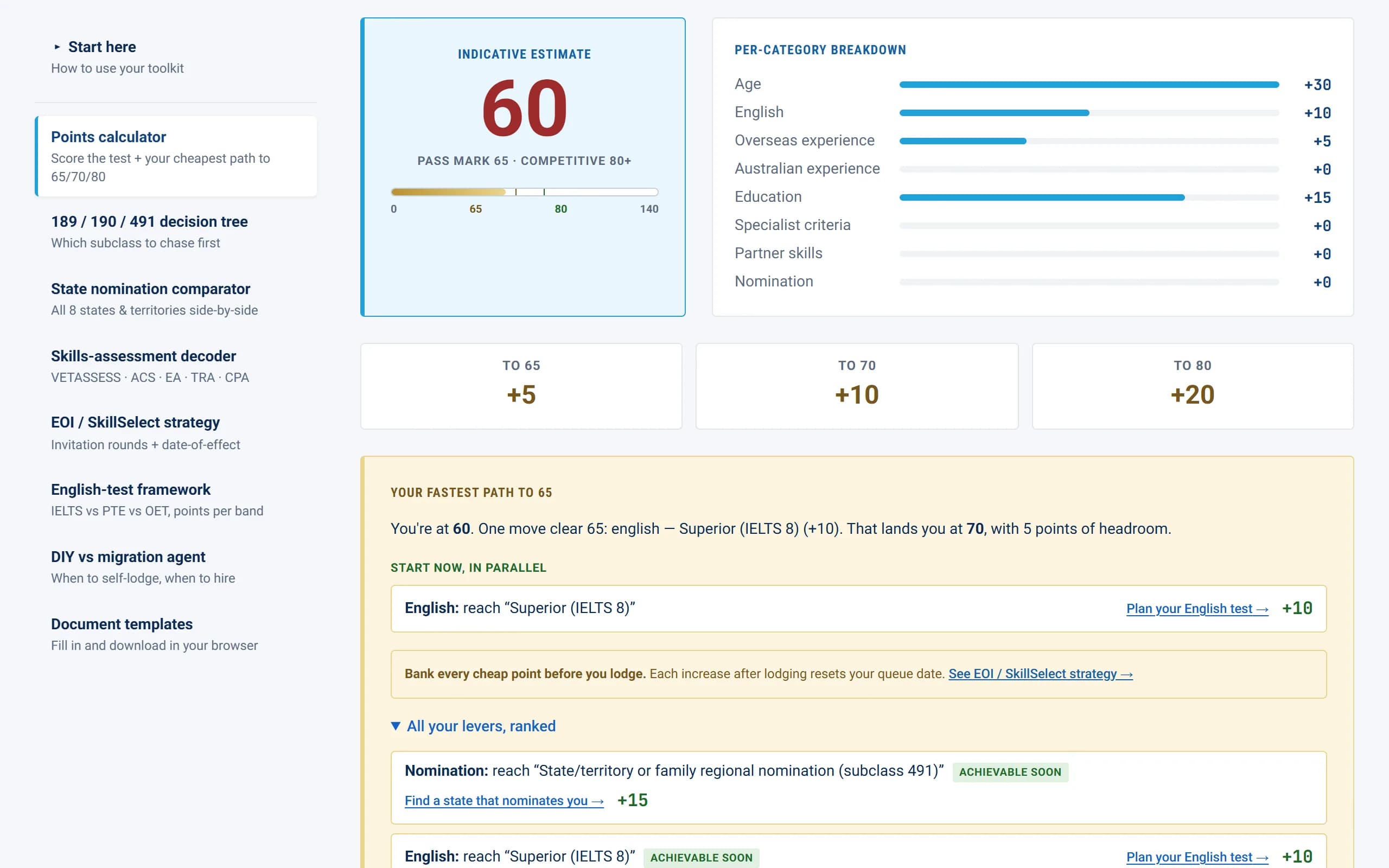
Points Test Strategy
Painters typically score 60-75 points. The standard table:
| Points Factor | Points | Notes |
|---|---|---|
| Age (25-32) | 30 | Maximum |
| Age (33-39) | 25 | Still strong |
| English (Competent — IELTS 6.0) | 0 | Visa minimum |
| English (Proficient — IELTS 7.0) | 10 | High-leverage |
| English (Superior — IELTS 8.0) | 20 | Rare in trades |
| Qualification (Cert III/IV) | 10 | Standard |
| Australian Study | 5 | Cert III+ completed onshore |
| Overseas Experience (8+ years) | 15 | Skilled level only |
| State Nomination (190) | 5 | |
| Regional (491) | 15 | Biggest single boost |
| Partner Skills | 5-10 | If partner has skilled occupation |
Realistic Scenarios
Scenario 1: Offshore, age 32, IELTS 6.5, 10 years experience Age 30 + English 0 + Cert III 10 + Experience 15 = 55 points. Needs 491 (+15) to reach 70 points — invitable in QLD and SA regional streams.
Scenario 2: Onshore graduate, age 27, IELTS 7.0, Australian Cert III, 1 year work Age 30 + English 10 + Cert III 10 + Australian Study 5 = 55 points. Add 190 (+5) for 60, or 491 (+15) for 70. NSW 190 invitations clear at 75 points onshore, so add partner skills or another lever.
State Nomination for Painters
New South Wales
NSW currently nominates Painter on its 190 onshore stream at 75 points and offshore at higher thresholds. The state's 2,100-place 190 allocation prioritises construction, renewable energy, health, digital, agriculture, and advanced manufacturing — painting sits inside the construction priority.
Queensland
Queensland's Building and Construction Pathway includes painting trades alongside carpentry and other CSOL trades. Both 190 and 491 are available. Registrations of Interest opened 19 September 2025 for the 2025-26 programme year.
Victoria
Victoria accepts all CSOL occupations for state nomination. Construction is one of six priority sectors for 2025-26. A Registration of Interest through Live in Melbourne is required alongside the SkillSelect EOI.
South Australia
SA updated its Skilled Occupation List on 30 September 2025 and continues to include construction trades. The state is consistently one of the more accessible jurisdictions for painters, particularly through its regional 491 stream.
Western Australia
WA's Skilled Stream includes Painting Trades Worker, with preference for applicants holding a current WA job offer or with WA work history. Mining-services towns and Perth metro both provide demand.
Tasmania
Tasmania's Skilled Graduate Pathway accepts painting qualifications obtained at Tasmanian institutions with at least two years of state residence. The 2025-26 allocation is 1,200 (190) + 650 (491).
Salary and Employment Outlook
Typical Painter Earnings
| Role | Annual Range (2026) |
|---|---|
| Apprentice Painter (final year) | AUD $48,000-$57,000 |
| Qualified Painter | AUD $75,000-$85,000 |
| Senior Painter (8+ years) | AUD $85,000-$95,000 |
| Leading Hand / Foreman | AUD $95,000-$115,000 |
| Industrial Coatings Specialist | AUD $95,000-$125,000 |
| Self-employed contractor (day rate) | AUD $400-$650/day |
| FIFO industrial coatings | AUD $120,000-$160,000+ |
Sources: SEEK Salary Hub (April 2026), national average AUD $75,000-$85,000; Indeed Australia (April 2026), AUD $77,858; SalaryExpert 2026, AUD $77,009. Entry-level painters with 1-3 years average AUD $57,126; senior painters with 8+ years average AUD $93,850.
Highest-Paying Sectors
- Industrial coatings — mining, oil-and-gas, marine, infrastructure protective work, frequently FIFO
- Heritage and decorative — boutique studios in NSW and VIC working on listed buildings and high-end residential
- Commercial fit-out — corporate, retail, hospitality projects in major-city CBDs
- Mainstream residential — steady demand, mid-band rates, lower variance
- Government infrastructure — bridges, water assets, public buildings; usually contracted via specialist firms
Total package context: 11.5% superannuation, site allowances on commercial work, hazardous-coating allowances on industrial sites, and overtime loadings under most state-based enterprise agreements.
Tips for a Successful Application
1. Confirm the 482 Salary Threshold Before You Sign
The Core Skills Income Threshold sits at AUD $76,515 and rises to AUD $79,499 on 1 July 2026. Painting roles often pay close to this floor. A verbal offer of "around $75k" cannot sponsor a 482. Get the offered salary in writing and check it against CSIT before lodging.
2. Document the Range of Your Work
TRA wants to see breadth — surface preparation, brush and roller application, spray work, decorative finishes if relevant. Employment references that describe only one technique can struggle. Build a job-by-job summary highlighting the full toolkit.
3. Push English to IELTS 7.0
A 6.0 satisfies visa minimums but earns zero points. Moving to 7.0 unlocks 10 points — for a painter sitting at 60 points, that's the difference between stuck and invitable. The prep is typically 2-3 months for a motivated applicant.
4. Target State Nomination Strategically
NSW Painter clears at 75 points onshore. Most offshore painters don't get there without a regional boost. Lodge 491 EOIs with Queensland, SA, and Tasmania in parallel — multiple states maximise odds without penalty.
5. Build Photo and Project Evidence Before You Lodge
Painting is a visual trade, and OSAP technical interviews often reference physical evidence. Photograph finished work, keep client testimonials, retain supplier invoices showing the materials you've worked with. This often shifts a borderline assessment.
Step-by-Step Migration Roadmap
- Confirm 332211 is your code — review the ANZSCO code finder
- Check list status — Painter sits on the CSOL and MLTSSL
- Choose your TRA pathway — Job Ready Program (onshore) or OSAP (offshore)
- Build your evidence pack — qualifications, payslips, signed duty statements, project photographs
- Sit your English test — IELTS 7.0 unlocks the 10-point band
- Lodge skills assessment — see the skills assessment guide
- Complete 12 months of painting employment (JRP route)
- Submit EOI in SkillSelect for 189, 190, or 491
- Lodge state nomination ROIs with NSW, QLD, SA, WA, TAS in parallel
- Receive invitation, lodge visa within 60 days
- Complete health, character, biometric checks
- Receive grant and relocate
Frequently Asked Questions
Why doesn't Australia distinguish between residential and industrial painters in ANZSCO?
ANZSCO 332211 is a single broad code covering all painting trades work. The classification system focuses on the core skill (preparing and applying paint and finishes), not the substrate. In practice, TRA examines your employment evidence against the breadth of the code — a heavily-specialist industrial coatings painter may need to demonstrate building-paint techniques to fit cleanly.
Are painting roles eligible for the 482 Specialist Skills stream?
Unlikely. The Specialist Skills stream requires earnings above AUD $141,210 (rising to AUD $146,717 from 1 July 2026). This sits well above standard painting rates. Specialist industrial coatings supervisors on FIFO sites can occasionally clear this band, but the typical painter route is the Core Skills stream.
Do I need a state painting licence to work in Australia?
It varies by state. NSW, Victoria, Queensland, and Tasmania require contractor licensing or trade certificate registration to operate as a principal contractor or run your own business. As an employed painter under another contractor's licence, no separate licence is needed. Check the relevant state regulator (NSW Fair Trading, VBA, QBCC, CBOS Tasmania).
Which state has the fastest invitation pipeline for offshore painters?
Queensland and South Australia have the most accessible offshore 491 streams for painting in 2026. NSW issues 190 nominations but at higher points thresholds. Western Australia is competitive for applicants with WA job offers.
Can I work for myself as a painter on a 482 visa?
No. The 482 ties you to the nominating employer. To work for yourself, you'd need a 186 (permanent), 887 (after 491), or 191 (after 491), or another visa with full work rights. Some painters arrange a 482 with a related-party sponsor while building their own client base — this is allowed if the sponsorship is genuine.
What's the demand outlook for painters through 2030?
Steady. The Housing Accord target of 1.2 million new homes by 2029 generates a sustained pipeline for residential painting. Commercial maintenance and infrastructure protective coatings provide additional volume. Jobs and Skills Australia classifies construction trades broadly as the largest persistent shortage category — painting sits inside that demand profile, though less acutely than carpentry and electrical trades.