Transport Engineer Visa Pathway to Australia: Complete 2026 Guide
Updated: 16 August 2026
Australia classifies Transport Engineer under ANZSCO 233215. Engineers Australia conducts the skills assessment via the Migration Skills Assessment program. The occupation sits on both the MLTSSL and the Core Skills Occupation List, unlocking subclasses 189, 190, 491, 482, and 186. Typical 2026 salaries range AUD $103,000-$167,000, with senior Sydney transport engineers averaging AUD $156,000. State infrastructure pipelines — Sydney Metro West, Suburban Rail Loop, Brisbane Cross River Rail, Western Sydney Airport — drive sustained demand.
Quick Facts: Transport Engineer Migration Pathway
| Detail | Information |
|---|---|
| ANZSCO Code | 233215 (Transport Engineer) |
| Skill Level | 1 (Bachelor degree in civil, transport, or traffic engineering) |
| Skills Assessment | Engineers Australia (Migration Skills Assessment) |
| Occupation List | MLTSSL and CSOL |
| Visa Options | 189, 190, 491, 482, 186 |
| Demand Level | High — driven by federal and state infrastructure pipelines and the energy-transition logistics build-out |
| Salary Range | AUD $103,000-$167,000 (entry to senior, Australia-wide); Sydney average AUD $156,000 |
| Typical 189 Score | 80-90 points |
| Key Challenge | Smaller talent pool than structural or civil, so reference letters must clearly distinguish transport-specific duties from general civil engineering |
What Transport Engineers Do in Australia
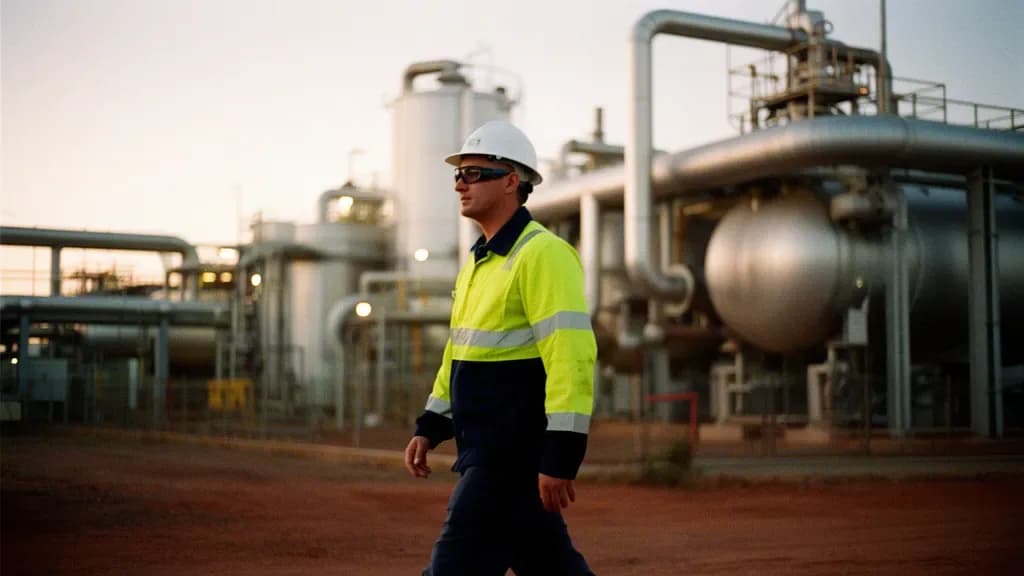
Australian transport engineers plan, design, model, and assess transport networks — road geometry, intersection layout, traffic signals, public transport priority, freight corridors, rail alignment, port and airport land-side infrastructure, active-transport networks, and the modelling that sits behind every business case. Work splits across consultancy practice, state road and rail authorities, local government, and project alliances.
Major employers include WSP, Aurecon, AECOM, Arup, GHD, Jacobs, Mott MacDonald, Beca, SMEC, Cardno (Stantec), Cardiff Lean (Movement & Place), and the in-house engineering groups of Transport for NSW, the Major Transport Infrastructure Authority in Victoria, the Department of Transport and Main Roads in Queensland, the Public Transport Authority in WA, and the Department for Infrastructure and Transport in South Australia. Local councils carry traffic engineering teams across every metro area.
Demand draws on a concurrent set of major programs: Sydney Metro West and Western Sydney Airport access, Brisbane Cross River Rail and the 2032 Olympics transport plan, the Suburban Rail Loop and Melbourne Metro Tunnel completion, Inland Rail through regional NSW and Queensland, METRONET in Perth, and a long pipeline of state road upgrades, intersection signalisation programs, and active-transport networks across every capital.
ANZSCO Code Mapping
Transport Engineer is ANZSCO 233215, within the unit group 2332 Civil Engineering Professionals. The code applies to engineers who plan and design transport systems — road, rail, public transport, freight, and active travel — and who carry out the analytical work (traffic counts, modelling, simulation, safety audits) that supports them.
The boundary between 233215 Transport Engineer and 233211 Civil Engineer comes up often. Civil engineers who design specific assets within transport projects (drainage on a road project, retaining walls on a rail corridor) typically nominate 233211. Engineers whose primary work is transport planning, traffic engineering, transport modelling, road safety auditing, rail alignment, or business-case analysis nominate 233215.
There is no separate code for transport modeller, traffic engineer, road safety auditor, or rail planner — all map to 233215 if duties align with the ANZSCO statement.
Skills Assessment with Engineers Australia
Engineers Australia is the Department of Home Affairs-nominated assessing authority for 233215. EA runs three pathways depending on the qualification origin.
The Three EA Pathways
- Washington Accord pathway — for graduates of programs accredited under the Washington Accord (UK, Ireland, USA, Canada, Hong Kong, Singapore, India NBA-accredited from 2014 onward, and others). Fastest route; no CDR required.
- Sydney/Dublin Accord pathway — for engineering technologist and associate engineer programs from accredited countries.
- Competency Demonstration Report (CDR) pathway — for graduates of programs not covered by the Accords. Requires three career episodes, a summary statement, and a continuing professional development record.
Requirements
- A four-year bachelor degree (or higher) in engineering with a major in civil, transport, traffic, or a closely related discipline
- Curriculum vitae covering the full professional career
- For CDR applicants: three career episodes (each 1,000-2,500 words), a summary statement, and a CPD log
- English language evidence at IELTS 6.0 across each band (or PTE equivalent) for the assessment
Cost and Processing Time
- Standard CDR: AUD $1,001 inc GST (AUD $910 ex GST) through 30 June 2026; increasing 3-4% from 1 July 2026
- Washington/Sydney/Dublin Accord pathway: AUD $539 inc GST (AUD $490 ex GST)
- Fast-track service: Additional AUD $385 inc GST — assigns to an assessor within 20 business days
- Processing time: Washington Accord pathway 8-12 weeks; CDR pathway 10-16 weeks after submission of a complete application
Common Rejection Reasons
The two recurring failure modes are CDR career episodes that read like civil-engineering project work rather than transport-engineering analysis — and references that don't clearly evidence transport-specific outputs (traffic modelling, signal design, road safety audits, transport business cases). A career episode that describes designing the drainage on a road project will fail at 233215 even if it passes at 233211.
Visa Pathways
Subclass 190 — Skilled Nominated Visa
The dominant permanent pathway for transport engineers in 2026.
- Visa application charge: AUD $6,140
- Points boost: +5 from state nomination
- Obligation: Live and work in the nominating state for 2 years
- State activity: NSW, Victoria, Queensland, South Australia, and Western Australia all invite 233215 in 2026 rounds. State infrastructure agencies are the largest single employer group for transport engineers.
Subclass 491 — Skilled Work Regional Visa
Regional nomination adds 15 points. A 5-year provisional visa with a defined pathway to permanent residency via subclass 191.
- Visa application charge: AUD $6,140
- Points boost: +15 from regional nomination
- Pathway: 3 years of regional residence and qualifying income, then 191 PR
- Where the work is: Inland Rail corridor (NSW and Queensland regional centres), regional WA mining haul-road projects, regional Victorian rail upgrades
Subclass 189 — Skilled Independent Visa
Points-tested permanent visa, available because 233215 is on the MLTSSL.
- Visa application charge: AUD $6,135
- Realistic invitation score: 85+ points in 2026; engineering occupations have been invited at lower scores than ICT, but 189 invitation volumes have been thin across the board
- Processing time: 6-12 months from invitation
Subclass 482 — Skills in Demand Visa
Employer-sponsored temporary visa.
- Visa application charge: AUD $3,210 (Core Skills stream, primary applicant)
- Core Skills income threshold: AUD $76,515 — transport engineer salaries clear this from graduate level in most states
- Specialist Skills threshold: AUD $141,210 — senior consultancy and discipline-lead roles
- Duration: Up to 4 years, with a permanent pathway via 186
- Reality: Tier-one consultancies (Aurecon, WSP, Arup, AECOM, GHD) sponsor transport engineers regularly
Subclass 186 — Employer Nomination Scheme
Permanent residency through employer sponsorship.
- Visa application charge: AUD $6,140
- Streams: Direct Entry for senior offshore hires, or Temporary Residence Transition after two years on a 482
Points Test Strategy
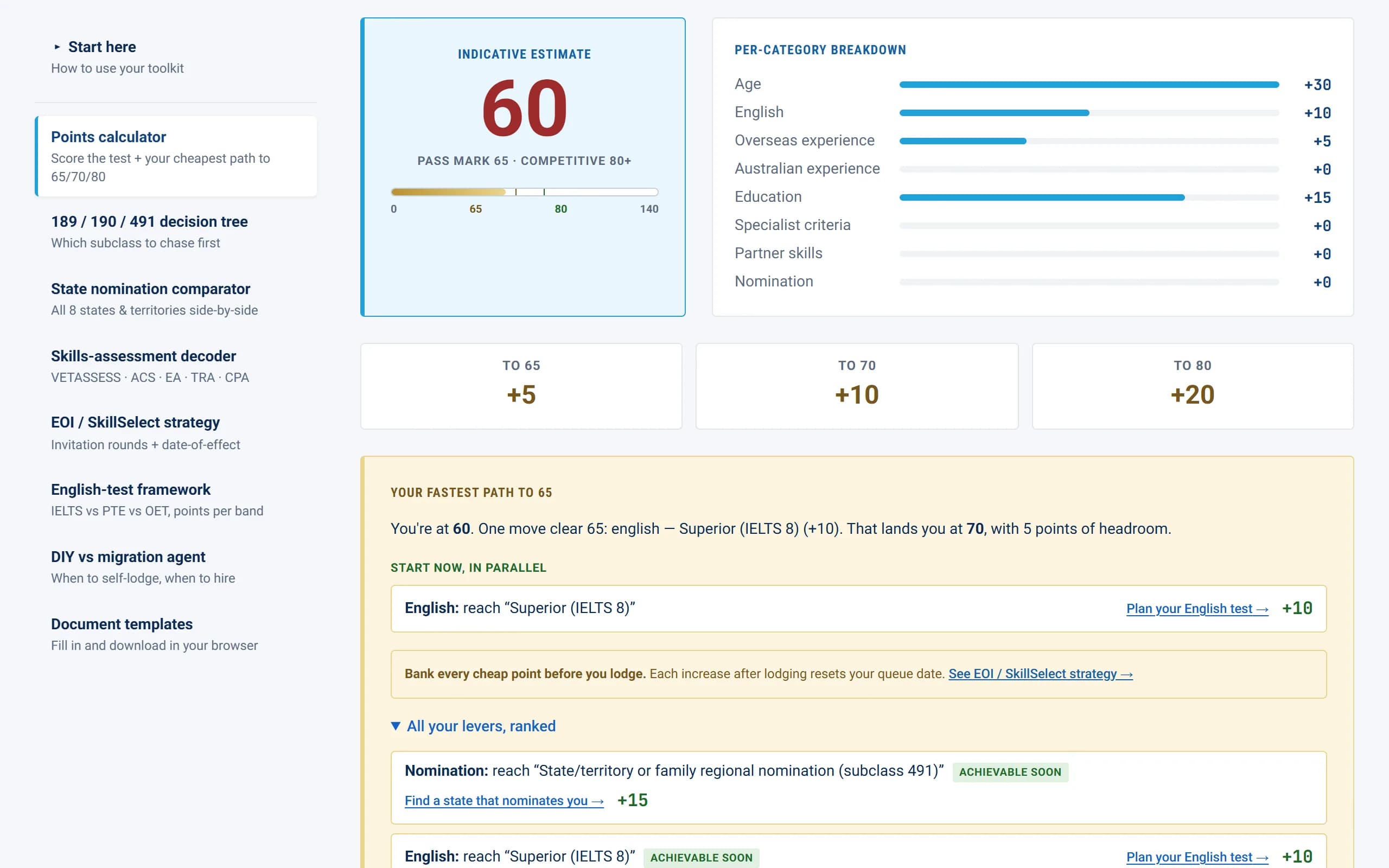
| Points Factor | Points | Notes |
|---|---|---|
| Age (25-32) | 30 | Maximum bracket |
| Age (33-39) | 25 | Common for mid-career engineers |
| English (Superior, 8.0+) | 20 | Biggest controllable lever |
| English (Proficient, 7.0) | 10 | Achievable for most non-native applicants |
| Bachelor degree | 15 | Skill Level 1 baseline |
| Master's degree | 15 | Same band as bachelor |
| PhD | 20 | Common among transport-modelling specialists |
| Overseas experience 8+ years | 15 | After any EA experience deductions |
| Australian experience 3+ years | 15 | If you are already onshore |
| State nomination (190) | 5 | Adds 5 |
| Regional nomination (491) | 15 | Adds 15 |
| Partner skills (assessed) | 10 | If partner is also assessed in a relevant occupation |
Realistic Score Scenarios
Scenario 1: Mid-career UK CEng MICE transport planner, 33 years old, IELTS 7.5
- Age (33-39): 25 + Proficient English: 10 + Bachelor: 15 + Overseas experience 8+: 15 = 65 points
- Add 190: 70 points; push English to Superior: 80 points
Scenario 2: Indian B.Tech with M.Tech in Transportation, 28 years old, 5 years experience, IELTS 7.0
- Age: 30 + Proficient English: 10 + Master's: 15 + Overseas experience 5-7: 10 = 65 points
- Add 491: 80 points — strong for regional NSW or Queensland
State Nomination
New South Wales
NSW carries the largest transport program in the country — Sydney Metro West, Western Sydney Airport access, Inland Rail through regional NSW, plus continuous road upgrade pipelines under Transport for NSW. The state invites Transport Engineer in 2026 rounds with cut-off scores in the high 80s for 190.
Victoria
The Suburban Rail Loop, North East Link, the West Gate Tunnel completion, and the Big Build pipeline drive sustained demand. Victoria has moved to an ROI-only system with selective invitations and closed to new ROIs partway through 2025-26, but continues to invite engineering occupations.
Queensland
Brisbane 2032 Olympics infrastructure, Cross River Rail, and the Bruce Highway upgrade program anchor demand. Queensland's onshore list includes 233215 for both 190 and 491. The state prioritises onshore candidates with documented Queensland employment.
South Australia
South Australia includes engineering as a priority sector and continues to invite transport engineers in 2026 rounds. The state has historically been one of the more accessible 190 routes for engineering, with offshore applicants encouraged where the role addresses regional shortages.
Western Australia
METRONET in Perth and the heavy-haul road network in the Pilbara and Goldfields drive demand. WA's 2025-26 list includes 233215 for both 190 and 491.
Salary and Employment Outlook
What Transport Engineers Earn in Australia (2026)
| Role / Seniority | Typical Salary Range |
|---|---|
| Graduate Transport Engineer | AUD $75,000-$90,000 |
| Transport Engineer (2-4 yrs) | AUD $103,000-$122,000 |
| Senior Transport Engineer | AUD $130,000-$160,000 |
| Principal / Discipline Lead | AUD $160,000-$200,000 |
| Technical Director | AUD $200,000-$260,000 |
The 2026 salary data from SEEK and ERI shows the entry-level (1-3 years) average at AUD $103,557 nationally and AUD $110,242 in Sydney, with the senior (8+ years) average at AUD $166,612 nationally and AUD $156,568 in Sydney. SEEK job listings in Sydney commonly post in the AUD $113,000-$122,000 band plus 12% superannuation.
Total packages typically include 12% superannuation (per the 2025-26 increase), professional development allowance, and 10-15% bonuses in consultancy. Tier-one consultancies often add a vehicle or vehicle allowance for principal and director-level roles.
Highest-Paying Sectors
- State transport authorities — Transport for NSW, MTIA Victoria, TMR Queensland, PTA WA, DIT South Australia
- Tier-one consultancy — Aurecon, WSP, Arup, AECOM, GHD, Jacobs, Mott MacDonald, SMEC, Beca, Cardno
- Project alliances — Multi-discipline alliances on rail and road megaprojects often pay above standard consultancy rates
- Specialist modelling firms — Veitch Lister, Movement Strategies, and the boutique transport-modelling practices that supply state agencies
- Local government — Sydney, Melbourne, Brisbane, and the larger regional councils all carry traffic engineering teams
Geographic Concentration
Sydney is the largest single market by headcount, followed by Melbourne, Brisbane, and Perth. Regional pay premiums apply on the Inland Rail corridor, in the Pilbara, and on major Queensland Olympic infrastructure jobs.
Tips for a Successful Application
1. Distinguish Yourself from Civil Engineer in Your References
The biggest single risk is that Engineers Australia assesses you at 233211 Civil Engineer instead of 233215 Transport Engineer. References must specifically describe transport outputs — traffic modelling (SIDRA, Aimsun, VISSIM, Cube), signal design, road safety audits, transport business cases, rail alignment, public transport priority schemes, intersection design. Vague language risks the wrong code.
2. Build Software Specifics Into Your CDR
Transport engineering is software-heavy. Career episodes that name specific tools (SIDRA Intersection, Aimsun Next, VISSIM, Cube, EMME, TransCAD, OpenRoads) demonstrate hands-on competence in a way that "I performed traffic analysis" does not. Engineers Australia assessors are technically trained and read for substance.
3. Use Project Examples That Match Australian Practice
Where you have international project examples that map onto Australian practice — Austroads Guide to Traffic Management, AS 1742 traffic signs, AS 1158 road lighting, road safety audit frameworks — flag the equivalence. UK TRL practice, US AASHTO practice, and Indian IRC practice all have clear Australian counterparts. Making the mapping explicit helps the assessor.
4. Bank Superior English Points Early
A Superior English score (IELTS 8.0 across all bands) adds 20 points. For transport engineers competing in 190 rounds, this often decides the invitation. Most candidates need two PTE attempts.
5. Apply Direct to State Agencies Onshore
Transport for NSW, MTIA, TMR, and the other state authorities sponsor 482 visas regularly for transport engineers. If you can secure an offer before lodging the points-based application, employer sponsorship is typically faster and avoids the 189 invitation queue.
Step-by-Step Migration Roadmap
- Confirm your ANZSCO code — 233215 if your work is primarily transport-focused; 233211 if it's general civil. Use the ANZSCO code finder
- Verify your degree's Accord status — Washington/Sydney/Dublin via the IEA register
- Prepare your assessment — CDR if outside the Accords; otherwise the Accord application
- Sit your English test — push for Superior on at least one attempt
- Lodge Engineers Australia assessment — AUD $1,001 inc GST for CDR, AUD $539 for Accord pathway
- Confirm CSOL/MLTSSL status — 233215 sits on both per the SOL 2026
- Submit EOI in SkillSelect — lodge for 189, 190, and 491 in parallel
- Apply for state nomination — NSW, Queensland, and South Australia are the strongest 2026 routes
- Receive invitation and lodge visa — within 60 days
- Complete health, character, and biometrics checks
- Receive visa grant and relocate
Frequently Asked Questions
Should I nominate 233215 Transport Engineer or 233211 Civil Engineer?
Use the duty test. If most of your work involves traffic modelling, signal design, transport planning, rail alignment, road safety audits, or business-case analysis, nominate 233215. If your work is dominated by physical infrastructure design — drainage, earthworks, pavements, retaining structures — nominate 233211. Both sit on the MLTSSL with identical visa access, so this is an evidentiary fit question, not a migration-strategy question.
Do I need professional registration to work as a Transport Engineer in Australia?
Skilled visas do not require registration. Practising in Queensland requires Registered Professional Engineer of Queensland (RPEQ) for any work that involves signing off engineering services; Victoria has parallel registration requirements for some structural and electrical work but does not gate transport engineering. Most consultancies sponsor RPEQ applications for staff working on Queensland projects.
Can I work in transport modelling without an engineering degree?
Engineers Australia requires a four-year engineering degree for 233215 assessment. Modellers with mathematics, economics, or planning backgrounds may need to nominate a different code — Urban and Regional Planner (232611) is assessed by Vetassess and is the typical alternative. Cross-check duty content against the ANZSCO statement for each option.
Which states have the most demand for transport engineers in 2026?
New South Wales by absolute headcount (driven by Sydney Metro West and Western Sydney Airport), Queensland by growth rate (driven by Brisbane 2032 and Cross River Rail), and Victoria by program size (Suburban Rail Loop). South Australia and Western Australia carry steady demand off smaller bases.
What are the most common reasons transport-engineering applications fail?
Three patterns recur. First, CDR career episodes that read like generic civil engineering and don't isolate transport-specific outputs. Second, references that describe team work without separating the applicant's personal contribution. Third, Accord-misclassified degrees where the qualification doesn't carry the engineering content depth the assessor expects. The skills assessment guide walks through the typical failure modes.
What's the demand outlook through 2030?
Strong. State transport pipelines run through 2030 across all states, the federal Inland Rail and Olympics programs anchor a multi-year demand window, and the energy-transition logistics build-out (transmission, grid-scale renewables) is creating a parallel rail-and-freight workstream. See the most in-demand occupations list for 2026.