Engineering Professionals nec Visa Pathway to Australia: Complete 2026 Guide
Updated: 16 August 2026
Australia classifies engineers who do not fit a more specific code under ANZSCO 233999 — Engineering Professionals not elsewhere classified. This catch-all covers Aeronautical Engineers, Agricultural Engineers, Biomedical Engineers, Engineering Technologists and Naval Architects. Engineers Australia (EA) handles the skills assessment, with CDR the standard route. The occupation is on the MLTSSL and CSOL, unlocking subclasses 189, 190, 491, 482 and 186. Typical 2026 salaries range AUD $90,000-$160,000+ depending on specialisation.
Quick Facts: Engineering Professionals nec Migration Pathway
| Detail | Information |
|---|---|
| ANZSCO Code | 233999 (Engineering Professionals nec) |
| Skill Level | 1 (Bachelor degree or higher, sometimes with relevant experience) |
| Skills Assessment | Engineers Australia (EA) |
| Occupation List | MLTSSL and CSOL |
| Visa Options | 189, 190, 491, 482, 186 |
| Demand Level | High — biomedical and aeronautical streams in shortage, agricultural and environmental moderate |
| Salary Range | AUD $90,000-$160,000+ (SEEK, SalaryExpert, 2026) |
| Typical 189 Score | 75-90 (less competitive than 261313 software but still tight) |
| Key Challenge | Choosing the right sub-discipline mapping; EA CDR rejection rates climbing on AI-generated content |
What 233999 Actually Covers
Engineering Professionals nec is the residual code for engineers whose primary discipline does not have its own dedicated ANZSCO code. ABS includes the following five sub-occupations under 233999:
- 233911 Aeronautical Engineer
- 233912 Agricultural Engineer
- 233913 Biomedical Engineer
- 233914 Engineering Technologist
- 233915 Naval Architect (and Marine Designer)
- 233999 Engineering Professionals nec (true residual)
These all share the same six-digit code 233999 on the SOL for migration purposes. For state nominations and salary benchmarks the sub-occupation matters; for visa eligibility it does not. Migrants should pick the sub-occupation that most closely matches their qualification and work history, then nominate 233999 for the visa.
The work spans medical device design and FDA-equivalent submissions (biomedical), aircraft systems and MRO engineering (aeronautical), precision agriculture and irrigation systems (agricultural), shipyard design (naval architect), and applied engineering roles that do not fit traditional civil/mechanical/electrical buckets (technologist).
Where the Work Is in Australia
Aeronautical engineers cluster around Adelaide (Australian Space Agency, BAE, ASC), Brisbane (Boeing Australia, Northrop Grumman), Williamtown NSW (RAAF, defence contractors) and Melbourne (Lockheed Martin, Sikorsky). Defence Industry contracts under AUKUS Pillar Two have lifted demand sharply in 2025-2026.
Biomedical engineers concentrate in Sydney (Cochlear, ResMed, hospital biomedical departments) and Melbourne (CSL, Bionics Institute, medtech startups in the Parkville biomedical precinct). Agricultural engineering work sits in regional Queensland, Victorian Mallee, and the Western Australian wheatbelt — usually with multinational equipment OEMs and agtech companies. Naval architects find work in Perth, Newcastle, Adelaide and Brisbane shipyards.
ANZSCO 233999 — Code Mapping
The ABS description for 233999 covers engineers who apply scientific and engineering principles to problems not falling under a more specific code. Tasks include analysing engineering problems, designing equipment and processes, supervising production, testing materials and systems, and providing technical advice.
If your discipline has a dedicated code (civil 233211, mechanical 233512, electrical 233311, chemical 233111, mining 233611, petroleum 233612, industrial 233511, materials 233112, telecommunications 263311), use that code instead of 233999 — EA assessment outcomes are tighter when the code precisely matches your qualification transcript.
Use 233999 only when your degree title is in the list above (aeronautical, biomedical, agricultural, naval architecture, engineering technology) or when your work genuinely spans multiple disciplines without primary identification.
Skills Assessment — Engineers Australia
Engineers Australia is the sole assessing body for ANZSCO 233999. Most overseas applicants need the Competency Demonstration Report (CDR) pathway because their qualifications are not accredited under the Washington Accord, Sydney Accord or Dublin Accord.
CDR Fees (from 1 July 2026)
| Service | Fee (AUD, inc GST) |
|---|---|
| Standard CDR | $1,034 |
| CDR + employment review | $1,512.50 |
| CDR + PhD assessment | $1,336.50 |
| CDR full package | $1,815 |
| Fast-track service | +$396 (assignment within 20 business days) |
| Review fee | $368.50 |
| Appeal fee | $704 |
Accord-Recognised Qualifications
If your engineering degree is accredited under the Washington Accord (Bachelor 4-year professional engineering), Sydney Accord (3-year engineering technologist) or Dublin Accord (2-year engineering associate), you skip CDR and pay the lower basic-assessment fee of AUD $555.50.
CDR Requirements
A CDR comprises:
- Continuing Professional Development (CPD) statement
- Three Career Episodes (each 1,000-2,500 words) demonstrating engineering competency
- Summary Statement mapping competencies to Stage 1 outcomes
- Detailed CV
- Qualification transcripts and certificates
Processing Times
Standard processing 8-12 weeks. Fast-track guarantees assignment to an assessor within 20 business days but not a final decision in that window.
Common Rejection Reasons in 2026
- AI-generated content — EA has invested in detection tools and now refuses CDRs with stylistic markers of generative AI. Original prose is non-negotiable.
- Career Episodes that describe team work rather than personal engineering work — Episodes must show what you engineered, decided, and delivered
- Mismatch between career episodes and qualification — claiming biomedical engineering work on a mechanical engineering degree without bridging evidence
- Insufficient CPD — minimum 50 hours over the previous three years, evidence-backed
Visa Pathways
Subclass 189 — Skilled Independent
- Visa fee: AUD $6,135 (primary applicant, 2026)
- Realistic invitation points: 85+ for 233999 in 2025-26
- Processing: 6-12 months
- Reality: 233999 is a non-pro-rata occupation, so invitations have been steadier than software engineers, but the high-points environment still pushes a typical applicant toward 190 or 491
Subclass 190 — State Nominated
- Visa fee: AUD $6,140
- Points boost: +5
- Strongest states: Victoria, SA, WA, ACT consistently nominate 233999 sub-occupations, especially biomedical and aeronautical
- Two-year obligation: live and work in the nominating state
Subclass 491 — Skilled Work Regional
- Visa fee: AUD $6,140
- Points boost: +15
- Best fit for: agricultural engineers (regional QLD/VIC/WA), naval architects (Adelaide is "regional" for nomination purposes despite being a capital, depending on programme cycle)
Subclass 482 — Skills in Demand
Employer-sponsored temporary visa, the dominant route for biomedical and aeronautical engineers picked up by defence primes and medtech companies.
- Visa fee: AUD $4,015 (primary applicant)
- Salary thresholds: Core Skills AUD $79,423 / Specialist Skills AUD $146,576
- Duration: up to 4 years
Subclass 186 — Employer Nomination Scheme
- Visa fee: AUD $6,140
- Streams: Direct Entry (3+ years experience) or TRT after two years on 482
Points Test Strategy
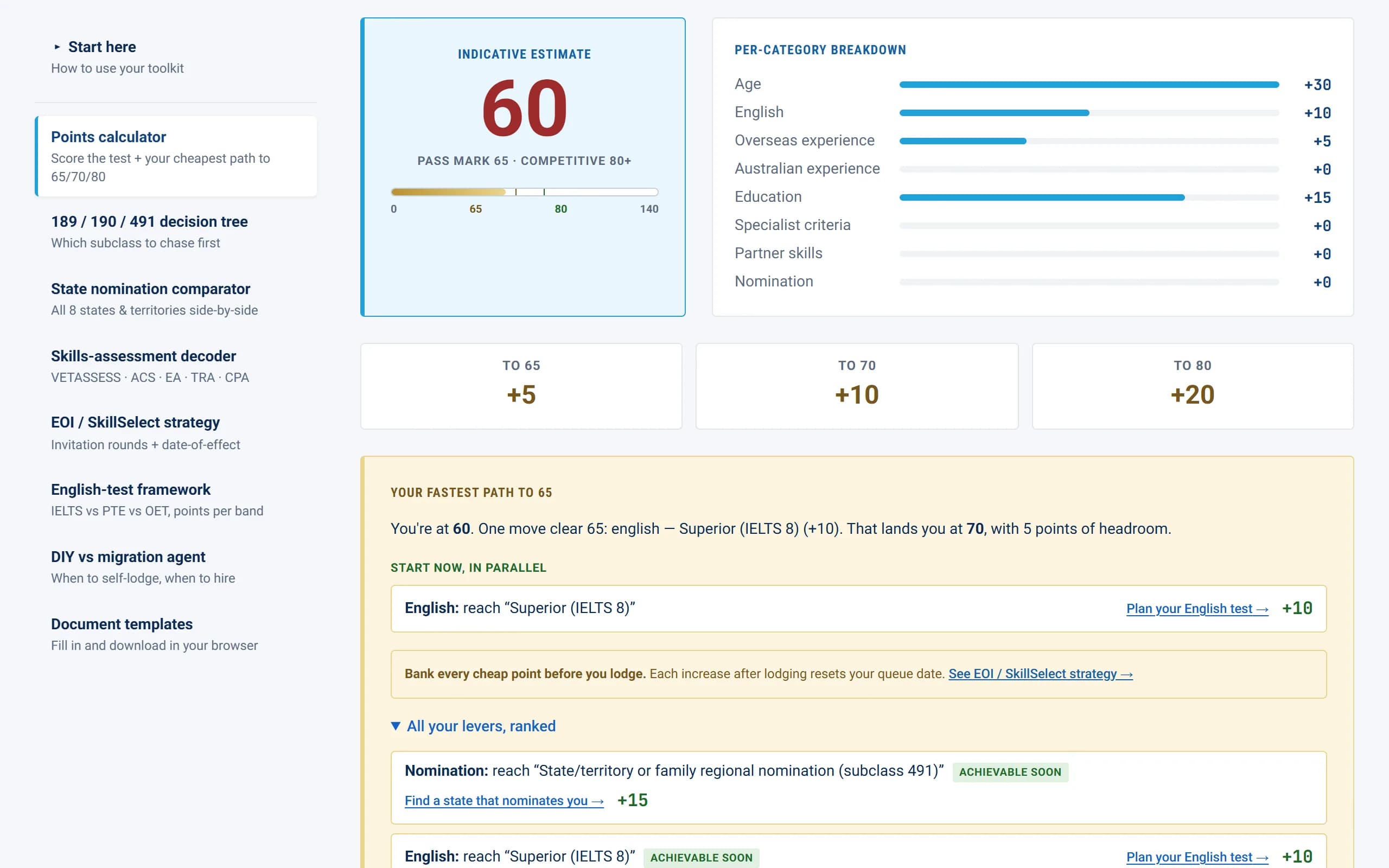
| Points Factor | Points | Notes |
|---|---|---|
| Age 25-32 | 30 | Maximum bracket |
| Qualification (PhD) | 20 | Common in biomedical and aeronautical |
| Qualification (Master) | 15 | |
| Qualification (Bachelor) | 15 | Minimum for skill level 1 |
| English (Superior 8.0+) | 20 | |
| English (Proficient 7.0) | 10 | |
| Overseas experience | 5-15 | EA does not deduct years like ACS — strong advantage |
| State nomination (190) | 5 | |
| Regional (491) | 15 | |
| Partner skills | 5-10 |
Realistic Scenarios
Biomedical engineer, 29, Master's, IELTS 7, 5 years experience: Age 30 + Master 15 + English 10 + Exp 10 = 65 points. Needs 190 (+5 → 70) or 491 (+15 → 80) to be competitive in 2026.
Aeronautical engineer, 32, PhD, IELTS 8, 8 years experience: Age 30 + PhD 20 + English 20 + Exp 15 = 85 points. Competitive for 189 directly; 190 stretches to 90.
State Nomination
Victoria
Victoria's 2025-26 program (2,700 × 190 + 700 × 491) prioritises critical-skills sectors including health technology and defence engineering. 233999 — particularly biomedical and aeronautical — appears regularly on Victorian invitation lists, especially for applicants already in Victoria or with a written Victorian job offer.
South Australia
SA is the strongest single state for 233999 because of the defence ecosystem at Osborne shipyards (naval architects), the Australian Space Agency in Adelaide CBD (aeronautical), and Flinders biomedical engineering. SA also runs the most generous offshore concessions for skilled migrants.
Western Australia
WA's nomination programme regularly includes 233999 for engineers willing to work in the Pilbara mining belt or Perth-based defence shipbuilding. Agricultural engineers find solid traction in the wheatbelt.
Australian Capital Territory
ACT nominates 233999 for defence-related engineering work in Canberra (DSTG, Defence Science and Technology Group, plus defence primes). Higher Australian-study and -experience points required.
New South Wales
NSW nominates 233999 selectively. Biomedical engineering positions in Sydney medical-device companies are the strongest fit; aeronautical at Williamtown.
Tasmania, Queensland and Northern Territory
Tasmania nominates 233999 for engineers willing to commit to long-term regional residency. Queensland and NT nominate sporadically — check the current published lists.
Salary and Employment Outlook
| Sub-discipline | Typical Salary Range |
|---|---|
| Graduate Biomedical Engineer | AUD $70,000-$85,000 |
| Mid-Level Biomedical Engineer | AUD $90,000-$120,000 |
| Senior Biomedical Engineer | AUD $120,000-$160,000+ |
| Aeronautical Engineer (graduate) | AUD $80,000-$95,000 |
| Aeronautical Engineer (senior, defence) | AUD $140,000-$200,000+ |
| Environmental Engineer | AUD $90,000-$140,000 |
| Agricultural Engineer | AUD $85,000-$130,000 |
| Naval Architect | AUD $100,000-$180,000 |
Sources: SEEK 2026, ERI SalaryExpert 2026, PayScale 2026. Add 11.5% superannuation and project-bonus loadings on top.
Highest-Paying Sectors
- Defence primes — BAE Systems, Lockheed Martin, Northrop Grumman, ASC, Boeing Defence Australia
- Medical device companies — Cochlear, ResMed, CSL, Pacific Edge, Stryker
- Mining technology — Rio Tinto, BHP, Fortescue (especially agricultural-engineering crossover for automated machinery)
- AUKUS-related work — security-clearance-eligible engineers attract retention premiums of 15-25%
Tips for a Successful Application
1. Write the CDR yourself
EA's 2026 detection tooling flags AI-generated career episodes and rejects on suspicion. Write in your own voice. Three career episodes of 1,500-2,000 words each, focused on personal engineering decisions and outcomes, will outperform polished AI output every time.
2. Choose the right sub-occupation
If your degree is in mechanical engineering but your work has shifted into biomedical device design, you are better off nominating 233512 Mechanical Engineer with episodes describing biomedical work, rather than 233999 Biomedical. EA cross-checks transcripts against episodes.
3. Document CPD continuously
The 50-hour CPD requirement is evidence-based. Keep dated certificates, conference attendances, and short-course completions. EA reviewers check CPD timestamps to confirm currency of practice.
4. Use the fast-track if you have a deadline
The AUD $396 fast-track fee is worth it if your visa lodgement window or employer offer has a date. Standard processing in mid-2026 has stretched to 10-12 weeks.
5. Save your skills assessment validity
EA assessment outcomes are valid for three years from the issue date. Plan your visa lodgement within this window, or you will pay the assessment fee a second time.
Step-by-Step Migration Roadmap
- Confirm your engineering qualification is recognised — Washington/Sydney/Dublin Accord shortcut, or CDR pathway
- Sit an English test — IELTS, PTE Academic, or OET. Target 7.0+ across the board
- Draft three Career Episodes — one each from three distinct engineering projects in your career
- Prepare CPD log covering the previous three years
- Submit EA Migration Skills Assessment with the CDR (AUD $1,034) or standard (AUD $555.50) pathway
- Receive positive assessment — outcome valid three years
- Submit Expression of Interest in SkillSelect — claim accurate points
- Apply for state nomination if pursuing 190 or 491
- Receive invitation to apply — within 60 days
- Lodge visa with Home Affairs — include health, character, sponsorship documents
- Complete biometrics and medicals
- Receive grant and relocate — link to the most in-demand occupations 2026 hub for sector context
Frequently Asked Questions
What's the difference between 233999 and a specific engineering code?
ANZSCO 233999 is a residual category for engineers without a dedicated six-digit code — aeronautical, agricultural, biomedical, engineering technologist, and naval architect. If your discipline has its own code (civil 233211, mechanical 233512, electrical 233311, chemical 233111), use that instead. Mapping incorrectly to 233999 when a specific code exists is one of the most common reasons EA assessments get returned.
Will my Washington Accord degree skip the CDR?
Yes. If your bachelor's degree is from a Washington Accord institution accredited at the time you graduated, EA accepts your qualification on a basic-assessment basis (AUD $555.50) without requiring a CDR. Check the EA Accord list before lodging.
How does Engineers Australia treat AI-written CDRs in 2026?
EA has publicly stated it deploys AI detection tooling on all CDR submissions from 2026 onwards. Career episodes flagged as AI-generated are returned without refund and may trigger a permanent file note. Write your own episodes — clumsy human prose passes; polished AI does not.
Can I use 233999 for software engineering work?
No. Software engineering work belongs under 261313 Software Engineer (assessed by ACS, not EA). 233999 is reserved for traditional engineering disciplines without their own ANZSCO code.
Which sub-occupation under 233999 has the strongest 2026 demand?
Biomedical engineering and aeronautical engineering both have strong demand signals — biomedical from the medtech sector, aeronautical from AUKUS-driven defence expansion. Naval architecture has a smaller but acute shortage in shipbuilding. Agricultural engineering demand is steady but concentrated geographically.
How many points do I realistically need in 2026?
For 189: 85+ for 233999. For 190: 75-80 plus state nomination. For 491: 70-75 plus regional nomination. Employer sponsorship via 482 bypasses the points test entirely if you can secure a sponsoring job offer that meets the salary threshold.
For broader context see the skills assessment bodies complete list and the skilled occupation list 2026.