Biomedical Engineer Visa Pathway to Australia: Complete 2026 Guide
Updated: 16 August 2026
Australia classifies biomedical engineers under ANZSCO 233913. Engineers Australia conducts the migration skills assessment. The occupation is on the MLTSSL and the Core Skills Occupation List, unlocking subclasses 189, 190, 491, 482, and 186. Typical 2026 salaries range AUD $70,000-$130,000. Jobs and Skills Australia confirms biomedical engineering as a national shortage occupation, with strong hiring at Cochlear, ResMed, public hospital networks, and CSIRO.
Quick Facts: Biomedical Engineer Migration Pathway
| Detail | Information |
|---|---|
| ANZSCO Code | 233913 (Biomedical Engineer) |
| Skill Level | 1 (Bachelor degree or higher, plus relevant experience) |
| Skills Assessment | Engineers Australia (Migration Skills Assessment) |
| Occupation List | MLTSSL and CSOL — full visa access |
| Visa Options | 189, 190, 491, 482, 186 |
| Demand Level | High — Jobs and Skills Australia confirms biomedical engineering shortage; UDI regulatory rollout and aging population drive demand |
| Salary Range | AUD $70,000-$130,000 (SEEK and Glassdoor, 2026); senior medical device roles to AUD $160,000+ |
| Typical 189 Score | 75-85 points — less competitive than ICT codes |
| Key Challenge | Hospital clinical engineering pays significantly less than the medical device industry — pick your sector before lodging |
Role Context: What Biomedical Engineers Do in Australia
Biomedical engineering in Australia splits into three distinct labour markets. First, the medical device industry — Cochlear (hearing implants, Sydney HQ), ResMed (sleep and respiratory devices, Sydney and Bella Vista), Compumedics (Melbourne), Saluda Medical, Nyrada, and a long tail of smaller device firms and contract manufacturers. Second, clinical engineering inside hospitals — NSW Health, Victorian public health services, Queensland Health, Metro North/South, the major private networks (Ramsay, Healthscope, Epworth), where biomedical engineers manage device fleets, perform safety testing, and support clinical use. Third, research — CSIRO, the Bionics Institute, Garvan, QIMR Berghofer, and university biomedical engineering departments at UNSW, Monash, UQ, Melbourne, and Sydney.
The 2026 hiring environment is structurally strong. The TGA's Unique Device Identification (UDI) rollout from 1 July 2026 — initially for higher-risk Class IIb and III devices — has triggered hiring across regulatory affairs, quality assurance, and post-market surveillance functions at every device manufacturer. The aging population means clinical engineering teams at hospitals are expanding to cover more devices and more complex procurements. CSIRO's medical technology priority area continues to attract Commonwealth funding. Salaries in the medical device industry run 30-50% above public-hospital clinical engineering rates — choose your sector deliberately.
ANZSCO 233913 — Biomedical Engineer
ANZSCO defines biomedical engineers as engineers who design, develop, install, and maintain medical equipment and devices used in the health system. The classification covers medical imaging equipment, prosthetics and orthotics, surgical instruments, patient monitoring systems, rehabilitation engineering, and clinical engineering services within hospitals. Specialisations include medical device design, regulatory affairs, clinical engineering, bioinstrumentation, and rehabilitation engineering.
The code sits cleanly in the 2339 Other Engineering Professionals unit group. If your work is software for medical devices, ANZSCO 261313 Software Engineer may also apply — and the data scientist and AI specialist guide covers the ICT mapping in detail. For medical imaging physics specifically, 234914 Physicist may fit. For most degree-holding biomedical engineers, 233913 is correct.
Skills Assessment: Engineers Australia
Engineers Australia is the assessing authority. The four pathways are CDR, Washington Accord, Sydney Accord, and Australian Qualification.
CDR Pathway
The default for offshore applicants from non-Accord countries. Career Episodes should describe biomedical engineering projects with explicit engineering content — device design with calculations, software validation with test plans, clinical engineering with risk analysis under IEC 60601 or ISO 14971.
- Assessment fee: AUD $1,034 (standard CDR, GST inclusive). With skilled-employment or PhD assessment: AUD $1,336.50-$1,815.
- Processing time: standard 15+ weeks to assessor allocation; fast-track 20 business days for AUD $396.
- English: IELTS 6.0 in each band or PTE Academic 50 in each.
- Common rejection reasons: Career Episodes that describe clinical use rather than engineering design or analysis; biomedical science (not engineering) qualifications nominating 233913; over-reliance on team contributions without isolating the applicant's individual engineering decisions.
Washington Accord Pathway
For accredited 4-year biomedical engineering Bachelor's degrees from Washington Accord signatories. Cheaper and faster.
- Assessment fee: AUD $555.50 (assessment only).
Australian Qualification Pathway
For Engineers Australia accredited Australian biomedical engineering degrees (UNSW, Monash, QUT, RMIT, UQ, Sydney). Fee AUD $346.50.
Visa Pathways for Biomedical Engineers
Subclass 482 — Skills in Demand Visa
The most common pathway when joining the medical device industry. Cochlear, ResMed, and the larger CROs and contract manufacturers are experienced sponsors with accredited sponsor status, which speeds nominations.
- Visa fee: approximately AUD $4,015 (Core Skills stream).
- Salary thresholds (2026-27): Core Skills Income Threshold AUD $79,423 (from 1 July 2026; previously AUD $76,515); Specialist Skills Income Threshold AUD $146,576. Most senior medical device engineering roles clear the Specialist threshold — useful because Specialist stream processes in 8-67 days (50%-90%) versus 51 days-3 months for Core Skills.
- Duration: up to 4 years, renewable.
Subclass 189 — Skilled Independent Visa
Available because 233913 is on the MLTSSL, but 189 invitations have been irregular through 2024-25. Realistic only at 85+ points.
- Visa fee: AUD $6,135.
- Processing time: 6-12 months once invited.
Subclass 190 — Skilled Nominated Visa
NSW and Victoria are the strongest 190 routes for biomedical engineering — the medical device industry concentrates in Sydney (Cochlear, ResMed) and Melbourne (Compumedics, Monash precincts). State nomination adds 5 points.
- Visa fee: AUD $6,140.
Subclass 491 — Skilled Work Regional (Provisional)
Less aligned with biomedical engineering because almost all medical device work is in Sydney and Melbourne metro. Clinical engineering roles exist in regional hospital networks (Townsville, Newcastle, Wollongong, Geelong) and these are 491-eligible postcodes.
- Visa fee: AUD $6,140.
- Points boost: +15.
Subclass 186 — Employer Nomination Scheme
Direct Entry stream requires 3 years' post-qualification experience. TRT stream after 2 years on 482 with sponsoring employer. Cochlear, ResMed, and the major hospital networks regularly support 186 transitions for migrants who perform well on 482.
- Visa fee: AUD $6,140.
- Processing time: Direct Entry 12-19 months (50%-90%); TRT 13-18 months.
Points Test Strategy
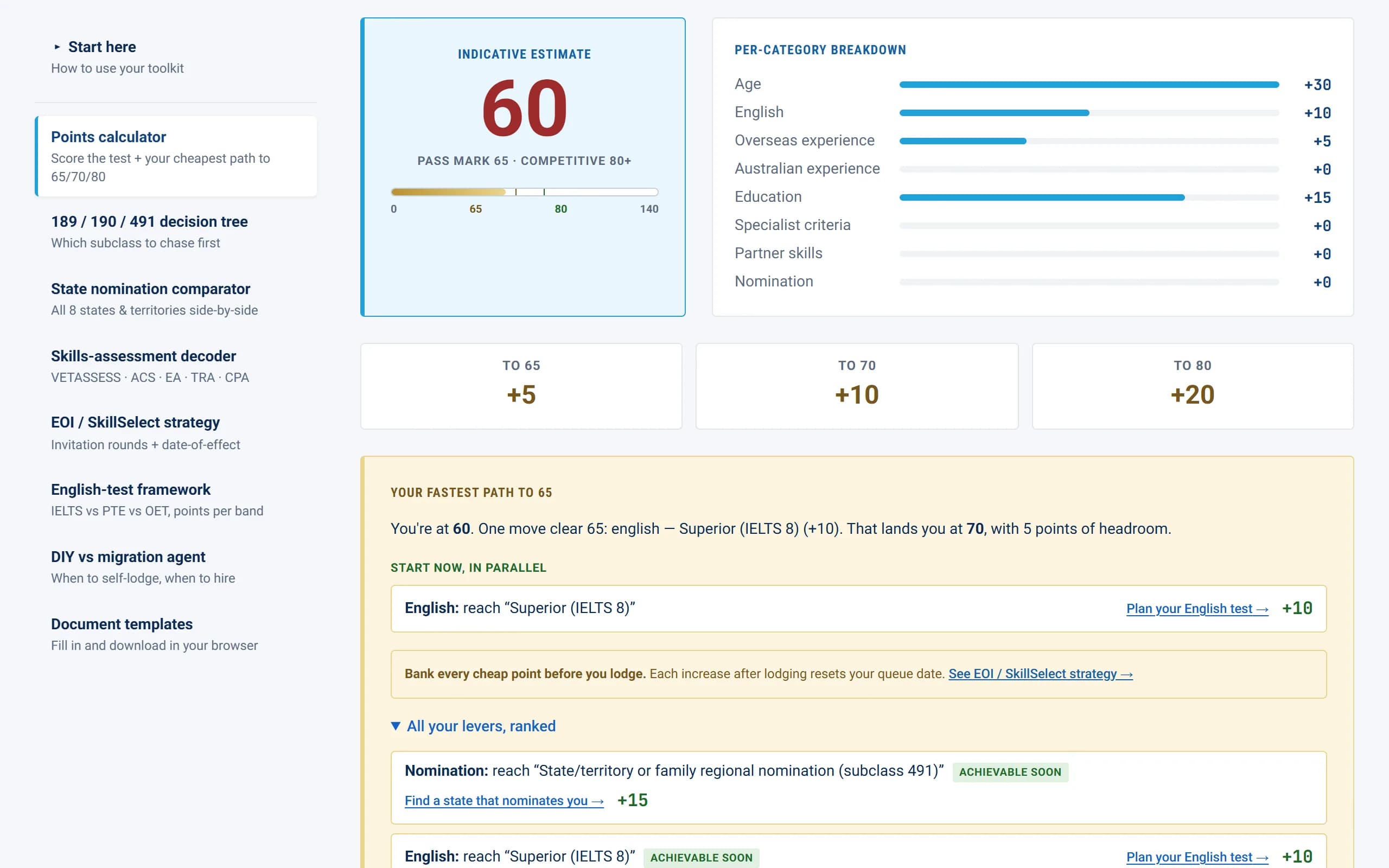
| Points Factor | Points | Notes |
|---|---|---|
| Age 25-32 | 30 | Maximum |
| Age 33-39 | 25 | |
| PhD | 20 | Common in research and senior device R&D |
| Master's | 15 | Common — Australian device industry prefers Master's-level applicants |
| Bachelor's (4-yr) | 15 | |
| English Superior (IELTS 8 / PTE 79) | 20 | |
| English Proficient (IELTS 7 / PTE 65) | 10 | |
| Skilled Experience Overseas 5-7 yrs | 10 | |
| Skilled Experience Overseas 8+ yrs | 15 | |
| State Nomination (190) | 5 | |
| Regional Nomination (491) | 15 | |
| Australian Study Requirement | 5 | Two years Australian study |
| Partner Skills | 5-10 |
Realistic Scenarios
Scenario A — Indian biomedical engineer, 28, 4 years at a medical device firm, Master's from a Washington Accord country, PTE 79. Age 30, Master's 15, English 20, overseas experience 5 (after EA assessment) = 70. Add NSW 190 (+5) = 75. Adding a skilled partner (+10) reaches 85 — strong for an invitation.
Scenario B — UK clinical engineer, 32, 9 years in NHS biomedical engineering, IELTS 7.5 (PTE equivalent 65-69). Age 30, Master's 15, English 10, overseas experience 15 = 70. Add 190 (+5) = 75 — competitive in 2026 rounds, with Victoria or NSW being the strongest targets. Employer sponsorship (482) at a major hospital network is often the faster route given clinical engineering's tight Australian hiring pipeline.
State Nomination for Biomedical Engineers
New South Wales
NSW hosts the densest medical device cluster in Australia — Cochlear (Macquarie Park), ResMed (Bella Vista), Saluda Medical (Artarmon), and a long tail of medtech startups across North Sydney and Westmead. NSW Health's biomedical engineering services across Sydney, Hunter, and Illawarra also hire. NSW includes 233913 on the 190 list in 2026.
Victoria
Melbourne's biomedical cluster centres on the Monash University precinct, the Parkville medical research precinct, and Compumedics in Abbotsford. Victoria accepts all national SOL occupations for 190 nomination.
Queensland
Brisbane's biomedical sector is smaller but growing — Queensland Health's biomedical engineering networks, the TRI (Translational Research Institute), and a developing medtech startup ecosystem. QUT and UQ produce a steady local pipeline, so Queensland 190 is less open to offshore biomedical engineers than NSW or VIC.
South Australia
Adelaide's medtech sector is limited but the state has used skilled migration aggressively. South Australia's 190 list typically includes biomedical engineering in offshore-eligible streams.
Salary and Employment Outlook
| Role | Typical Salary Range |
|---|---|
| Graduate Biomedical Engineer (medical device) | AUD $75,000-$95,000 |
| Biomedical Engineer 3-7 yrs (medical device) | AUD $100,000-$135,000 |
| Senior Biomedical Engineer (medical device) | AUD $130,000-$170,000 |
| Principal R&D Engineer / Tech Lead | AUD $160,000-$210,000 |
| Clinical Engineer (public hospital) | AUD $85,000-$120,000 |
| Senior Clinical Engineer (public hospital) | AUD $110,000-$145,000 |
| Regulatory Affairs Manager (medical device) | AUD $140,000-$190,000 |
Packages include superannuation (11.5%, rising to 12% from 1 July 2026). Medical device companies frequently add bonuses (10-20% of base), share schemes (Cochlear and ResMed both have employee share plans), and product-launch incentives. Hospital roles offer salary packaging (tax-effective fringe benefits up to AUD $9,010 per year on FBT-exempt items, plus AUD $2,650 meals/entertainment).
Highest-Paying Sectors
- Listed medical device companies — Cochlear, ResMed, Compumedics; senior R&D and regulatory roles
- Medical device startups and scale-ups — Saluda Medical, Nyrada, Anteris Technologies; lower base, higher equity
- Contract manufacturers and CROs — Vaisala, Trajan Scientific, contract sterilisation services
- Research institutes — Bionics Institute, Garvan, QIMR Berghofer
- Hospital biomedical engineering — NSW Health, Victorian public health, Queensland Health
Geographic Pay Differential
Sydney pays the largest premium — Cochlear and ResMed compete with US-headquartered firms for senior R&D talent. Melbourne is 10-15% behind Sydney at senior levels. Brisbane, Adelaide, and Perth pay 15-20% less than Sydney for the same role, partially offset by lower cost of living.
Tips for a Successful Application
-
Choose 233913 only if your degree is engineering, not biomedical science. Engineers Australia rejects Bachelor of Science (Biomedical) applicants because the qualification lacks engineering design and analysis content. Acceptable degrees include Bachelor of Engineering (Biomedical), Bachelor of Engineering (Biomedical Engineering), and combined Mechatronics or Mechanical + Biomedical specialisations. If your degree is biomedical science, you belong with VETASSESS as a Medical Scientist (234611).
-
For CDR applicants, anchor Career Episodes in IEC 60601, ISO 13485, or ISO 14971. Career Episodes that reference specific standards (IEC 60601-1 for medical electrical safety, ISO 13485 for medical device quality systems, ISO 14971 for risk management) signal to assessors that you understand the regulated engineering environment. Generic descriptions of "designed a medical device" rarely pass.
-
Decide between medical device industry and clinical engineering before lodging. The two markets pay differently (industry ~30-50% above clinical engineering), require different evidence in your assessment, and concentrate in different states. Industry experience is portable; clinical engineering experience is less portable to industry without retraining.
-
For migrants from EU regulatory backgrounds, document the EU MDR transition explicitly. Australia's TGA has aligned much of its medical device framework with EU MDR. Migrants from Germany, the Netherlands, Ireland, and France with EU MDR/IVDR experience are particularly valued — call this out in your Career Episodes and CV.
-
Time your application around Cochlear and ResMed graduate intakes. Both companies run structured graduate programs (Cochlear: annual February intake; ResMed: rolling) that include 482 sponsorship for international hires. Application windows typically open 6-9 months ahead. A graduate offer transforms the visa equation.
Step-by-Step Migration Roadmap
- Confirm 233913 is right — review the ANZSCO code finder and the most in-demand occupations hub
- Pick your pathway — Washington Accord (faster) or CDR
- Sit IELTS or PTE — target Proficient or Superior
- Compile evidence — degree transcripts, references describing engineering design or clinical engineering work
- Lodge with Engineers Australia — AUD $1,034 standard CDR or AUD $555.50 Washington Accord
- Receive positive assessment — valid 3 years
- Submit EOI in SkillSelect — 189, 190 (NSW or VIC), or 491
- Apply for state nomination — NSW and VIC are strongest for medical device industry
- In parallel, approach Cochlear, ResMed, and the major hospital networks — 482 sponsorship route is often the fastest
- Lodge visa within 60 days of invitation — or with 482 nomination
- Health and character checks
- Receive grant and relocate — Sydney and Melbourne for industry; any major metro for clinical engineering
Frequently Asked Questions
Can I be assessed as a biomedical engineer if my degree is biomedical science?
Almost certainly no. Engineers Australia's CDR pathway requires evidence of engineering coursework — calculus, physics, design, signals and systems, materials. Biomedical Science (a biology and chemistry-heavy degree) does not include this content. If your degree is biomedical science you belong with VETASSESS, typically as Medical Scientist (234611). If your degree is biomedical engineering or you completed substantial engineering content within a science degree, EA is correct. Check the skills assessment bodies complete list.
Should I nominate 233913 or 261313 if I write software for medical devices?
Choose based on where you spend the majority of your time. If you primarily write firmware or device software with limited hardware involvement, 261313 Software Engineer (assessed by ACS) often provides a deeper hiring pool. If your work spans hardware, firmware, regulatory, and clinical validation — true medical device engineering — 233913 is correct. Some applicants nominate 261313 because the ACS process is faster, but the trade-off is that your visa experience credit may not include hardware-design years.
Is the medical device industry or hospital clinical engineering the better visa route?
The medical device industry — Cochlear, ResMed, the larger startups — pays better, has more accredited sponsors, and offers cleaner 482-to-186 transitions. Hospital clinical engineering pays less but offers more stable employment, easier visa transitions through state-supported nomination programs, and lower cost-of-living locations. For migrants who care most about Permanent Residence speed, industry is usually faster. For migrants who want stable family-friendly hours, clinical engineering at a major public health service is often the better life.
What's the demand outlook for biomedical engineers in Australia in 2026?
Confirmed shortage. Jobs and Skills Australia includes biomedical engineering among the engineering disciplines in national shortage. Three factors drive demand: the TGA's UDI rollout from 1 July 2026 (creating regulatory and post-market surveillance hiring at every device firm), the aging population's effect on hospital device fleets, and continued growth at Cochlear, ResMed, and the device startup pipeline.
Can I bring my partner and children on a 482?
Yes. Subclass 482 includes the primary applicant plus dependent partner and children. Partners have full work rights with no occupational restriction. Children can attend school — though several states charge international student fees for 482 dependants in public schools.
What are the most common reasons biomedical engineer applications fail?
The two leading failure modes are wrong assessor (biomedical science applicants going to EA when they belong with VETASSESS, or vice versa) and Career Episode quality (descriptions that read like clinical use rather than engineering analysis). The third recurring issue is plagiarism in CDR documents — Engineers Australia uses both AI-detection and plagiarism software. Hire a CDR reviewer for an originality check before lodging, but do not use a CDR ghostwriter; the writing quality has to be your own.