Wine Maker Visa Pathway to Australia: Complete 2026 Guide
Updated: 16 August 2026
Australia classifies Wine Maker under ANZSCO 234213. VETASSESS conducts the skills assessment as a Group B occupation. The role is on the Regional Occupation List (ROL) and the Core Skills Occupation List (CSOL), unlocking subclasses 491, 494, 482, and 186 — but not 189 or 190. Typical 2026 salaries range AUD $80,000-$130,000+. South Australia, with the Barossa Valley, McLaren Vale, Coonawarra, Clare Valley, and Adelaide Hills, holds the largest concentration of wine-making roles in the country.
Quick Facts: Wine Maker Migration Pathway
| Detail | Information |
|---|---|
| ANZSCO Code | 234213 (Wine Maker) |
| Skill Level | 1 (Bachelor degree or higher in oenology, viticulture, or wine science) |
| Skills Assessment | VETASSESS (Vocational Education and Training Assessment Services) — Group B |
| Occupation List | ROL (Regional Occupation List) and CSOL — regional pathways only |
| Visa Options | 491, 494, 482, 186 |
| Demand Level | Moderate to high in wine regions — structural shortage of senior winemakers |
| Salary Range | AUD $80,000-$130,000+ (SEEK, Glassdoor, Jora 2026) |
| Typical 491 Score | 65-80 points |
| Key Challenge | Almost all wine-making roles sit outside metropolitan zones — committing to regional living is mandatory |
What a Wine Maker Does in Australia
Wine Makers plan, supervise, and coordinate the production of wine from grape harvest through bottling. The work covers fruit selection, fermentation management, blending decisions, oak and tannin management, lab testing, regulatory compliance with Wine Australia and Food Standards Australia New Zealand, and team leadership over cellar hands, lab technicians, and seasonal vintage staff. Senior winemakers also influence vineyard decisions in partnership with viticulturists, set stylistic direction across a winery's range, and represent the brand at trade shows and tastings.
Australia's wine industry is regionally concentrated. South Australia produces roughly half of the national crush, anchored by the Barossa Valley, McLaren Vale, Clare Valley, Coonawarra, Eden Valley, and Adelaide Hills. Victoria's Yarra Valley, Mornington Peninsula, Heathcote, Rutherglen, and Grampians regions support a strong premium and cool-climate sector. NSW's Hunter Valley, Mudgee, Orange, and Tumbarumba run alongside WA's Margaret River and Great Southern. Tasmania has emerged as the country's most important cool-climate sparkling wine region.
Employers include the major listed and corporate producers — Treasury Wine Estates (Penfolds, Wolf Blass), Pernod Ricard Winemakers (Jacob's Creek), Accolade Wines (Hardys), De Bortoli, Brown Family Wine Group, Casella (Yellow Tail) — and a long tail of family-owned and boutique premium producers. The boutique sector pays less but offers earlier stylistic autonomy. Vintage roles run seasonally; permanent roles are year-round.
ANZSCO 234213 Code Mapping
ANZSCO 234213 sits within Unit Group 2342 (Chemists, and Food and Wine Scientists). The role is distinct from Viticulturist (234112), which covers grape growing rather than wine production. If you primarily work in the vineyard managing vines, soil, irrigation, and pest management, your code is 234112. If you work in the winery making decisions about pressing, fermentation, maturation, blending, and bottling, your code is 234213.
The two roles often overlap in small operations, where one person may handle both. VETASSESS expects your reference letters and employment evidence to describe duties that fall predominantly within one code. Sample tasks under 234213 include managing the production process of wine, analysing fruit quality, supervising fermentation and maturation, blending wines, ensuring compliance with food safety and labelling regulations, and managing winery staff during vintage.
Skills Assessment — VETASSESS
VETASSESS is the designated assessing authority. Wine Maker is a Group B occupation, requiring qualification plus a defined minimum of relevant employment.
Requirements (Group B):
- Qualification assessed as comparable to AQF Bachelor degree or higher in a highly relevant field — Bachelor of Oenology, Bachelor of Wine Science, Bachelor of Agricultural Science with viticulture or oenology major, Bachelor of Viticulture and Oenology
- Plus at least one year of post-qualification highly relevant employment in the last five years, working 20+ hours per week
- Alternative: Bachelor in a less directly related field plus three years of post-qualification highly relevant employment
Assessment cost (2025-26):
- Outside Australia: AUD $1,096
- Within Australia (incl. GST): AUD $1,205.60
- Priority processing: additional AUD $825-$907.50
Processing time: 8-10 weeks standard for Wine Maker (faster than the standard 12-20 week Group B range); priority processing available.
Common rejection reasons:
- Vintage-only seasonal work without enough year-round employment to clear the one-year continuous-employment threshold
- Duties described in references look more like cellar hand work (food handler / production assistant level) than winemaker-level decision-making
- Qualifications in general agriculture or food technology without sufficient oenology or wine science depth
- Sole-trader winemakers who lack ABN documentation, BAS evidence, or independent reference letters
The Wine Maker pathway is one of the more forgiving Group B assessments because the qualification field is tightly defined and the industry's vintage-cycle work patterns are well understood by VETASSESS officers.
Visa Pathways for Wine Makers
Wine Maker is on the ROL and CSOL but not on the MLTSSL or full-coverage state nomination lists for 189/190. Realistic pathways are regional nomination (491, 494) and employer sponsorship (482, 186).
Subclass 491 — Skilled Work Regional (Provisional)
Five-year provisional visa with a pathway to permanent residency via the 191 after meeting income (AUD $53,900+ taxable income for 3 years) and residency thresholds. The 491 is the dominant pathway for Wine Makers because virtually every wine-making job sits in a regional postcode.
- Visa fee: AUD $6,140 (primary applicant)
- Points boost: +15 from regional nomination
- Reality: Wine country is largely classified as regional — the Barossa, McLaren Vale, Margaret River, Yarra Valley (outside Melbourne metro), Hunter Valley, Coonawarra, Adelaide Hills, and Tasmania are all eligible regional zones
Subclass 494 — Skilled Employer Sponsored Regional (Provisional)
Employer-sponsored regional visa with a pathway to permanent residency via the 191.
- Visa fee: AUD $6,140
- Reality: Used by mid-size regional wineries that want a long-term sponsorship pathway and don't have the size to pursue Direct Entry 186
Subclass 482 — Skills in Demand Visa (Core Skills stream)
Employer-sponsored temporary visa, applicable in regional and metropolitan areas.
- Visa fee (Core Skills stream): AUD $4,015
- Salary threshold (Core Skills stream, 2026-27): AUD $79,423 (CSIT)
- Duration: Up to 4 years
- Reality: Mid- and senior-level winemaker roles typically exceed the salary threshold comfortably. The major corporate producers (TWE, Pernod Ricard, Accolade) have established sponsorship programs and prefer 482 for new hires before transitioning to 186
Subclass 186 — Employer Nomination Scheme (ENS)
Permanent residency via Direct Entry or Temporary Residence Transition (after 2+ years on 482).
- Visa fee: AUD $6,140
- Processing: 12-19 months for Direct Entry under Ministerial Direction 105; regional sponsors and accredited employers move faster
- Reality: The most common end-state for winemakers who land via 482 and stay with the same employer for two-plus years
Points Test Strategy
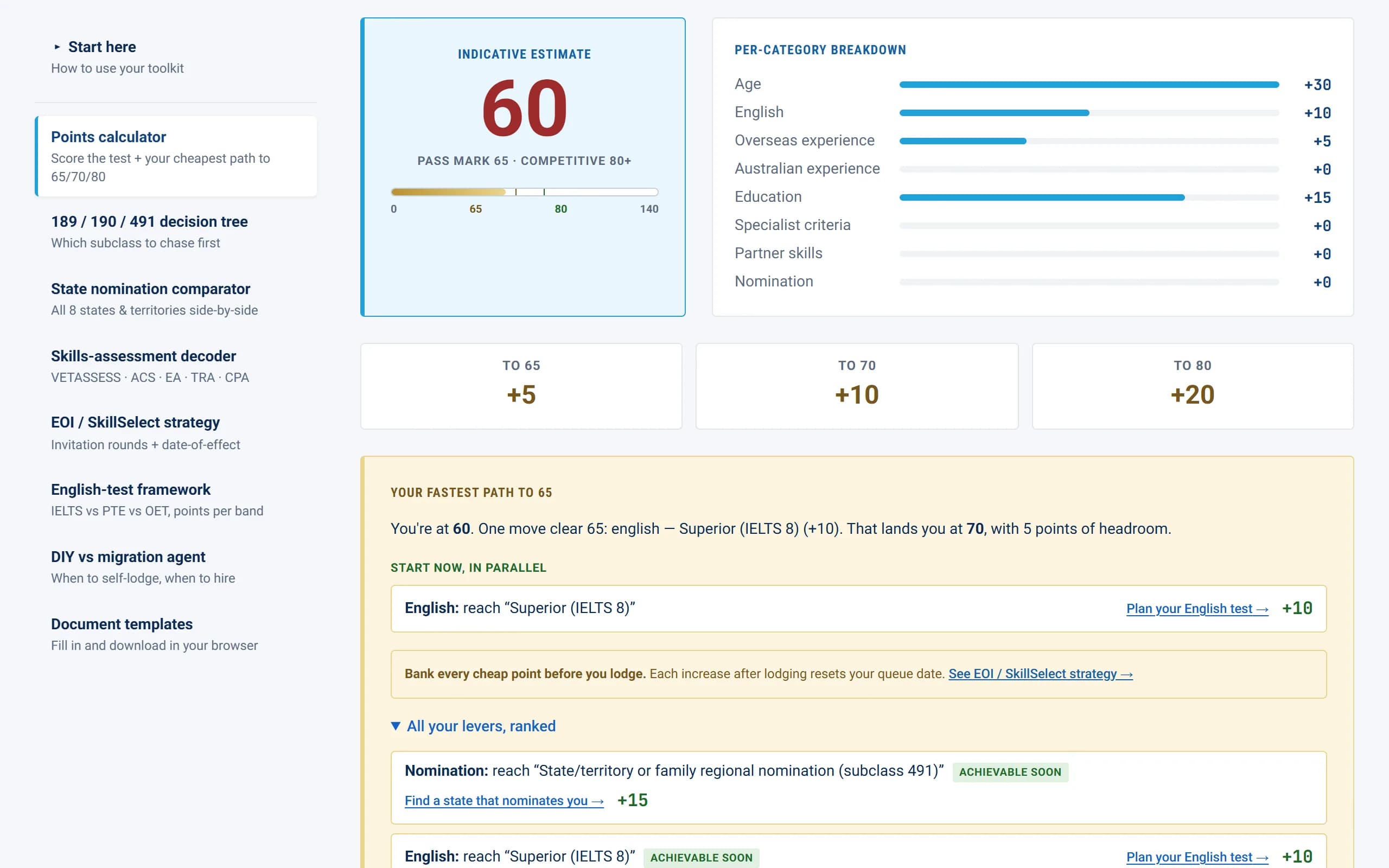
The 189 and 190 are unavailable for 234213. Realistic 491 totals usually land between 65 and 85.
| Points Factor | Points | Notes |
|---|---|---|
| Age (25-32) | 30 | Maximum bracket |
| Age (33-39) | 25 | Common for experienced winemakers |
| English (Superior 8.0+) | 20 | High value |
| English (Proficient 7.0) | 10 | Realistic minimum |
| Bachelor degree | 15 | Standard |
| Doctorate | 20 | Common among research-oriented winemakers |
| Overseas experience (8+ years) | 15 | Maximum |
| Regional nomination (491) | 15 | The big lever for this occupation |
| Australian study | 5 | Adelaide, Wagga Wagga (CSU), and Curtin offer recognised oenology programs |
| Professional Year | N/A | Not applicable to this occupation |
Realistic Scenario
Mid-career winemaker, 34, Proficient English, Bachelor of Oenology, 9 years experience, regional 491
Age 25 + Bachelor 15 + English 10 + Experience 15 + 491 nomination 15 = 80 points. Strong position for a regional nomination from South Australia or another wine-producing state.
State Nomination
Wine Maker eligibility for state nomination is concentrated in the wine-producing states. Always verify the state's current 2025-26 occupation list before lodging.
South Australia
South Australia is the country's wine heartland and the dominant nominator for 234213. The state's 2025-26 program offers 2,250 nomination places (1,350 for 190 — though 234213 is not eligible for 190 from the federal list, and 900 for 491). Wine Maker sits on South Australia's 491 nomination list with strong access for both onshore and offshore applicants.
Onshore applicants generally need 6 months of South Australian residence and current full-time employment at an appropriate skill level. Offshore applicants need to demonstrate genuine intent to live and work in regional South Australia. South Australia's offshore allocation prioritises high-value-add sectors, and wine making sits in that bracket given its export contribution.
Victoria
Victoria's regional 491 program covers the Yarra Valley (outside metro Melbourne), Mornington Peninsula, Bendigo, Heathcote, and Rutherglen wine regions. The program is more competitive than South Australia's, with smaller allocations.
New South Wales
NSW's 491 regional program covers the Hunter Valley, Mudgee, Orange, and Tumbarumba. Allocations are smaller than SA's, but Hunter Valley demand for winemakers in the premium segment is steady.
Western Australia
WA's regional pathway covers Margaret River, Great Southern, Pemberton, and Swan Valley (where regional). Margaret River's premium positioning makes for a competitive pool of applicants targeting Cabernet specialists.
Tasmania
Tasmania's cool-climate sector — particularly for sparkling wine producers (House of Arras, Jansz, Bay of Fires, Henskens Rasmussen) — has expanded substantially. Tasmania includes Wine Maker on its 491 list and welcomes applicants with sparkling experience or PhD-level research backgrounds.
Salary and Employment Outlook
What Wine Makers Earn in 2026
| Role | Typical Salary Range |
|---|---|
| Cellar Hand / Vintage Casual | AUD $55,000-$70,000 |
| Assistant Winemaker | AUD $70,000-$90,000 |
| Winemaker (mid-level) | AUD $90,000-$115,000 |
| Senior Winemaker | AUD $115,000-$150,000 |
| Chief Winemaker / Head of Winemaking | AUD $150,000-$220,000+ |
| Specialist Sparkling Winemaker (Tasmania) | AUD $110,000-$160,000 |
SEEK 2026 lists the broad average for Winemaker at AUD $80,000-$90,000; Glassdoor records a higher AUD $99,500 average with the 75th percentile at AUD $127,000. The Jora median sits at AUD $92,500. Senior and Chief Winemaker roles at major producers sit well above these averages, with package deals including vehicle, accommodation supplementation in remote regions, and performance bonuses tied to vintage outcomes.
Highest-paying segments
- Chief Winemaker roles at major listed producers — Treasury Wine Estates, Pernod Ricard, Accolade
- Iconic premium estates — Penfolds, Henschke, Wynns Coonawarra Estate, Cullen Wines, Vasse Felix
- Sparkling wine specialists — House of Arras, Jansz, Hardys, Chandon Australia
- Export-focused producers — Yellow Tail (Casella), 19 Crimes, Wolf Blass
- Family premium producers — Brown Family Wine Group, De Bortoli, McWilliam's, Yalumba
Total package context: 11.5% superannuation (rising to 12% from 1 July 2025), vehicle allowance for senior roles, vintage bonuses, and equity arrangements in family-owned operations after long tenure.
Jobs and Skills Australia Outlook
Jobs and Skills Australia's national occupation profile for Wine Makers describes the role as smaller in headcount than mainstream agriculture but with stable demand and a structural shortage at senior level. Australia's wine export sector continues to recover from the trade tariff cycle with China, opening room for senior winemakers with export-market experience.
Tips for a Successful Application
1. Choose the right ANZSCO between 234213 and 234112
If your work centres on the winery, fermentation, blending, and bottling, you're 234213 (Wine Maker). If your work is in the vineyard managing vines, soil, water, and pest management, you're 234112 (Viticulturist). Many applicants overlap — VETASSESS will accept whichever code your duties predominantly match.
2. Document vintage cycles properly
Wine making is a vintage-cycle occupation, and many roles include a peak vintage period plus a quieter off-season. VETASSESS understands this rhythm. Your reference letters should describe year-round duties — pre-vintage planning, post-vintage maturation and blending, lab work, regulatory compliance, sales tasting — not just the harvest peak.
3. Target South Australia first for regional nomination
South Australia produces roughly half of Australia's wine and runs the most welcoming 491 program for 234213. Onshore applicants in particular benefit from SA's residence-based pathway. Offshore applicants should prepare a strong regional commitment statement showing why South Australian wine country fits their career trajectory.
4. Use priority processing where it shortens a job offer window
VETASSESS priority processing (additional AUD $825-$907.50) compresses the assessment to 4-6 weeks. If a major producer has offered a 482 sponsorship contingent on assessment, priority is usually worth the cost.
5. Build connections with the ASVO and Wine Australia networks
The Australian Society of Viticulture and Oenology (ASVO) and Wine Australia run industry events that connect senior winemakers with employers. Onshore applicants benefit from membership. Offshore applicants should follow ASVO publications and Wine Australia export market reports to demonstrate industry literacy in 482 / 494 sponsorship interviews.
Step-by-Step Migration Roadmap
- Confirm 234213 is the correct code — review the ANZSCO code finder and compare against 234112 (Viticulturist)
- Check ROL and CSOL status — verify against the 2026 SOL and CSOL hub
- Gather employment evidence — references describing winemaker-level duties, payslips, contracts covering vintage and non-vintage periods
- Sit IELTS / PTE — target Superior (8.0+) for 20 points
- Lodge VETASSESS assessment — AUD $1,096 offshore / $1,205.60 onshore; 8-10 weeks standard
- Submit EOI in SkillSelect flagging 491 and 494
- Apply for state nomination — South Australia first, then Victoria, NSW, WA, Tasmania
- Alternative: pursue employer sponsorship via 482 Skills in Demand — TWE, Pernod Ricard, Accolade, premium estates
- Receive invitation and lodge visa within 60 days
- Complete health and character checks
- Visa grant and relocation to wine region
- After 3 years on 491, transition to 191 permanent visa — or after 2 years on 482, transition to 186
Frequently Asked Questions
Can I get a 189 Skilled Independent visa as a Wine Maker?
No. ANZSCO 234213 is on the ROL and CSOL but not the MLTSSL. The 189 (Skilled Independent) and 190 (Skilled Nominated) main pathways are unavailable. Realistic pathways are 491 (Skilled Work Regional), 494 (Skilled Employer Sponsored Regional), 482 (Skills in Demand), and 186 (ENS).
Which state is the best option for Wine Maker nomination?
South Australia is the dominant choice. SA produces around half of Australia's wine, hosts the Barossa, McLaren Vale, Clare, Coonawarra, and Adelaide Hills regions, and runs the broadest 491 program for 234213 with strong onshore and offshore access. Victoria, NSW, WA, and Tasmania also nominate Wine Maker on their 491 lists but with smaller allocations.
Is the 491 visa worth the regional commitment?
For Wine Makers, yes. Almost every wine-making job is in a regional postcode, so the 491's regional requirement is naturally satisfied. The +15 points from regional nomination significantly outweighs the +5 from the unavailable 190. The 491 also leads to the 191 permanent visa after 3 years of meeting income and residency thresholds.
How do major Australian producers handle visa sponsorship?
Treasury Wine Estates, Pernod Ricard Winemakers, Accolade Wines, and De Bortoli have established 482 sponsorship programs. They typically hire senior winemakers internationally on 482 Skills in Demand, then transition to 186 ENS after two-plus years. Boutique producers occasionally sponsor at senior level but more often hire locally or rely on the 491 nomination route.
Does vintage seasonal work count toward the VETASSESS employment requirement?
Vintage-only casual work generally does not satisfy the one-year-at-20-hours-per-week threshold unless your contract or evidence covers a full year of continuous employment that includes vintage peak and the surrounding off-season duties. Winemaker-level decision-making — not cellar-hand harvest work — is what VETASSESS is assessing.
Can I move into Wine Maker from a viticulture or food science background?
Yes, with caveats. VETASSESS Group B's three-year alternative pathway allows applicants with a less directly related Bachelor (general agriculture, food science, biological sciences) to qualify by demonstrating three years of post-qualification winemaker-level employment. A targeted graduate diploma in oenology — offered by the University of Adelaide, Charles Sturt University, or Curtin — strengthens the qualification side of the assessment significantly.