Surveying or Spatial Science Technician Visa Pathway to Australia: Complete 2026 Guide
Updated: 16 August 2026
Australia classifies Surveying or Spatial Science Technician under ANZSCO 312116. VETASSESS conducts the skills assessment. The occupation sits on the Core Skills Occupation List (CSOL) and the Regional Occupation List (ROL), unlocking subclasses 491, 494, 482 and 186. Typical 2026 salaries range AUD $100,000-$120,000 (SEEK 2026). Industry bodies report a critical national shortage projected to exceed 2,000 unfilled roles annually by 2029.
Quick Facts: Surveying Technician Migration Pathway
| Detail | Information |
|---|---|
| ANZSCO Code | 312116 (Surveying or Spatial Science Technician) |
| Skill Level | 2 (AQF Diploma or higher) |
| Skills Assessment | VETASSESS |
| Occupation List | CSOL and ROL — regional pathways dominant |
| Visa Options | 491, 494, 482, 186 |
| Demand Level | Critical — Surveyors Australia confirms structural shortage |
| Salary Range | AUD $100,000-$120,000 (SEEK 2026) |
| Typical 491 Score | 65-80 with regional nomination |
| Key Challenge | No 189 or 190 access; regional commitment required |
What Surveying Technicians Actually Do in Australia
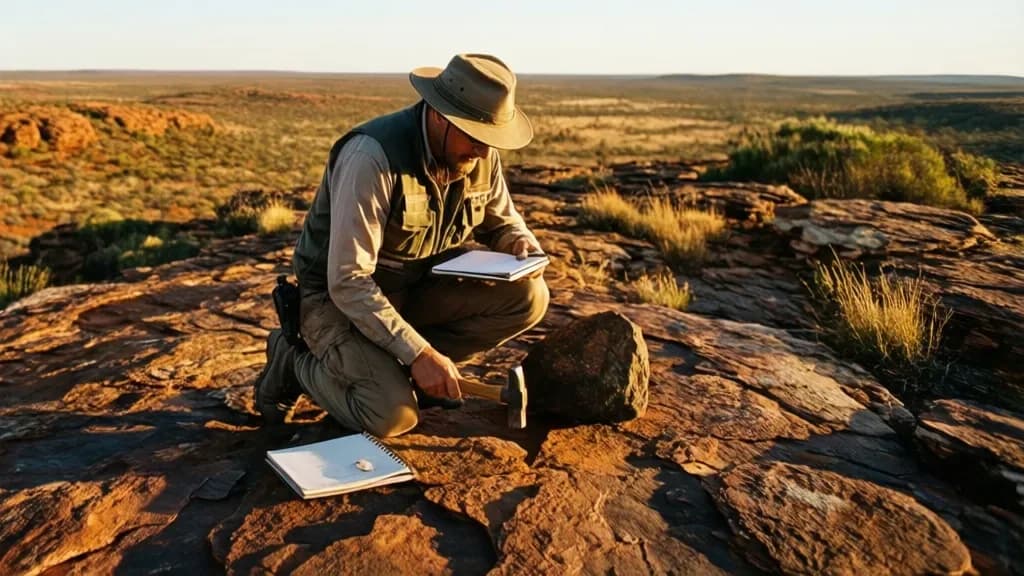
Surveying and spatial science technicians collect, record, and process spatial data for civil engineering projects, mining, resource exploration, cadastral boundary work, and construction setout. They operate total stations, GNSS receivers, terrestrial laser scanners, UAV photogrammetry rigs, and increasingly LiDAR-equipped drones. Most work alongside registered surveyors or spatial scientists who certify the final outputs.
The demand picture is unambiguous. Surveyors Australia, the peak industry body, warned in 2025 that the country requires at least 1,500 new entrants per year to meet baseline demand, with projections showing the gap widening to over 2,000 professionals per year by 2029. The shortage spans cadastral surveying for housing subdivisions, engineering surveying for the federal infrastructure pipeline, and mine surveying for iron ore, lithium, and rare earth operations.
Work concentrates around the mining states (Western Australia, Queensland), housing growth corridors (South-East Queensland, Western Sydney, Outer Melbourne), and the renewable energy transition zones in regional NSW and Victoria. Brisbane-based firms cite vacancy fill times of 6-9 months for experienced technicians. Perth firms regularly recruit internationally to staff Pilbara operations.
ANZSCO Code Mapping
ANZSCO 312116 covers technicians who assist surveyors and spatial scientists with field data collection, processing in CAD and GIS software, and the preparation of maps, plans, and charts. The code captures four main career paths:
- Cadastral survey technicians supporting registered surveyors on title and boundary work
- Engineering survey technicians on construction sites and infrastructure projects
- Mine survey technicians in resource operations
- GIS and spatial analysts working in mapping, planning, or environmental roles
Adjacent codes worth considering:
- 232212 Surveyor — for fully qualified, registered surveyors with Bachelor of Surveying
- 232214 Other Spatial Scientists — for GIS analysts and cartographers with bachelor-level qualifications
- 312115 Architectural, Building and Surveying Technicians nec — rarely the right fit; covers fallback cases
312116 specifically requires AQF Diploma-level capability with field and technical processing duties. If your work is purely office-based GIS analysis with a Bachelor's degree, 232214 is the closer match.
Skills Assessment
VETASSESS Assessment
VETASSESS is the assessing authority. The occupation is classified Group A, which means the qualification field of study must directly match surveying or spatial science.
Requirements:
- Qualification assessed at AQF Diploma level or higher in a highly relevant field (surveying, geomatics, spatial science, cartography, geodesy, or photogrammetry)
- At least one year of post-qualification, highly relevant employment in the last five years
- Pathway B available for Certificate IV holders with additional experience
- Pathway C and D available for non-relevant qualifications combined with extended employment
Assessment Cost: AUD $1,096 (offshore) or AUD $1,205.60 (in-Australia, GST inclusive). Priority processing adds AUD $825-$907.50. Current fees took effect 22 October 2025.
Processing Time: 7 weeks standard; 10 business days under priority processing once eligibility is confirmed. Surveying applications run on the longer end of the standard window because VETASSESS often requests evidence of field hours, software competence, and project-specific outputs.
Common rejection reasons: Generic civil engineering degrees without surveying-specific units; employment evidence that documents drafting rather than field data capture; insufficient detail on software (AutoCAD Civil 3D, 12d Model, ArcGIS, Trimble Business Center) and instrument types used.
Note on Registered Surveyor Status
VETASSESS confirms suitability for migration. It does not grant registration as a Licensed or Registered Surveyor in Australia — that remains a state-by-state process through bodies like the Board of Surveying and Spatial Information NSW or the Surveyors Board of Victoria. Technicians who plan to upgrade to registered surveyor status after arrival should research state pathways early, including university bridging programs and supervised practice requirements.
For a full list of assessing bodies, see the skills assessment hub.
Visa Pathways for Surveying Technicians
Because 312116 is on the CSOL and ROL — not MLTSSL or STSOL — the available pathways centre on regional and employer-sponsored routes.
Subclass 491 — Skilled Work Regional (Provisional) Visa
The dominant points-based pathway. Five-year provisional visa with a route to PR through subclass 191 after meeting income and residence requirements.
- Visa fee: AUD $6,140 (primary applicant)
- Points boost: +15 from regional nomination
- Processing time: 15-28 months at the 90th percentile in 2026
- Occupation quirk: Regional firms across WA, Queensland, and NSW actively use 491 to bring in experienced technicians for cadastral and mining surveys.
Subclass 494 — Skilled Employer Sponsored Regional (Provisional) Visa
Five-year employer-sponsored regional visa, with a pathway to PR through 191.
- Visa fee: Comparable to 491 — refer to current Home Affairs pricing
- Sponsor: Regional employer with approved nomination
- Processing time: 6-15 months typical, faster with priority processing for designated regional roles
- Occupation quirk: 494 is heavily used in the Pilbara, Goldfields, and Hunter Valley for surveying technicians supporting resource and infrastructure projects.
Subclass 482 — Skills in Demand Visa
Employer-sponsored temporary visa, valid up to four years.
- Visa fee: AUD $4,015 (primary applicant)
- Salary thresholds: Core Skills Income Threshold AUD $79,423 (from 1 July 2026; previously AUD $76,515); Specialist Skills stream from AUD $146,576
- Processing time: Core Skills median 51 days; Specialist Skills median 8 days
- Occupation quirk: Most experienced surveying technician salaries comfortably clear the Core Skills threshold.
Subclass 186 — Employer Nomination Scheme
Permanent residency through employer sponsorship.
- Visa fee: AUD $6,140 (primary applicant)
- Streams: Direct Entry (3 years relevant experience) or Temporary Residence Transition
- Processing time: Direct Entry median 12 months, 90% within 19 months in 2026
Points Test Strategy
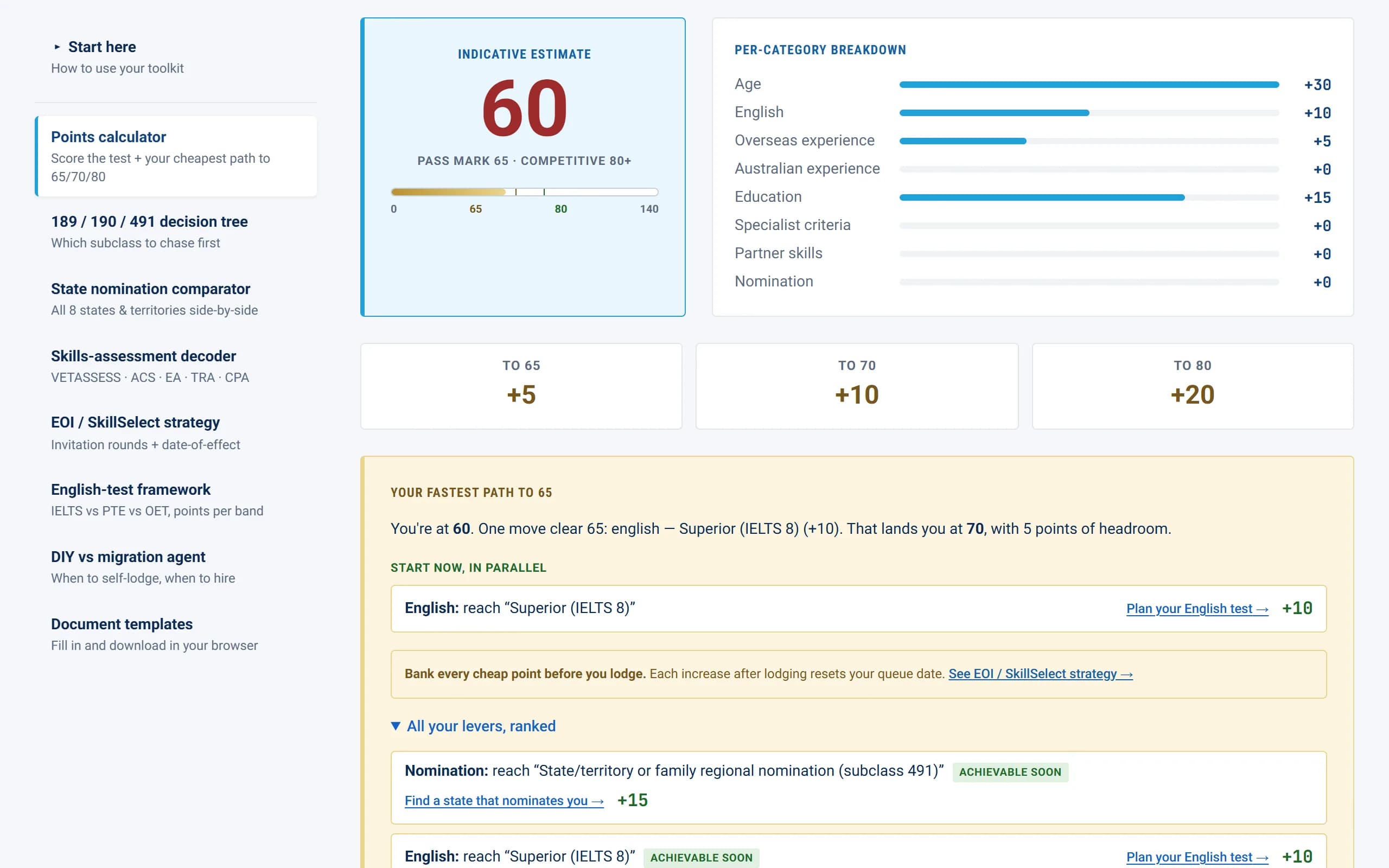
A 189 invitation is not available for 312116. The points calculation still matters because 491 nominations are competitive and state allocations are limited.
| Points Factor | Points | Notes |
|---|---|---|
| Age (25-32) | 30 | Maximum bracket |
| Age (33-39) | 25 | Common for experienced technicians |
| English (Superior 8.0+) | 20 | Significant uplift |
| English (Proficient 7.0) | 10 | Standard target |
| Qualification (Bachelor's) | 15 | Bachelor of Surveying / Geomatics |
| Qualification (Diploma) | 10 | AQF Diploma minimum |
| Overseas Experience (5-7 years) | 10 | Caps at 15 for 8+ years |
| Regional (491) | 15 | Largest single boost |
| Partner Skills | 5-10 | Depends on partner status |
Realistic Scenarios
Scenario 1: 29-year-old technician from the Philippines, Bachelor of Geodetic Engineering, 6 years field experience, Proficient English
- Age 30 + Bachelor 15 + English 10 + Experience 10 = 65 points
- Add 491 (+15) = 80 points — competitive for regional nomination in WA or Queensland
Scenario 2: 35-year-old applicant from South Africa, Diploma in Land Surveying, 10 years experience, Proficient English
- Age 25 + Diploma 10 + English 10 + Experience 15 = 60 points
- Add 491 (+15) = 75 points — sufficient given current shortage status
State Nomination
Western Australia
WA is the strongest market. The Pilbara iron ore expansion, Western Trade Coast lithium projects, and the cross-state renewable energy zone require surveying technicians in volume. WA's regional 491 program regularly opens for 312116 with relatively low EOI thresholds compared to ICT occupations.
Queensland
Queensland's combination of mining, housing growth, and infrastructure projects (Olympic Games preparation, Inland Rail) keeps demand high. The state's regional 491 program covers Townsville, Cairns, Mackay, Toowoomba, and Bundaberg. The Sunshine Coast and Gold Coast hinterland also fall inside regional postcodes for nomination purposes.
New South Wales (Regional)
Regional NSW includes the Hunter, Illawarra, Central West, and Riverina under 491 designations. The renewable energy zone in Central-West Orana is generating sustained surveying technician demand for transmission line and solar farm projects.
Northern Territory
The NT often runs targeted 491 nominations for surveying technicians supporting Defence estate work and mining exploration. Lower EOI competition than the larger states.
Tasmania
Tasmania nominates for 312116 in shortage years, particularly to support council-led subdivision approvals and forestry mapping. Lower volume but historically lower competition.
Always verify the current state list — they refresh around July each program year.
Salary and Employment Outlook
Salary Bands
| Role | Typical Salary Range |
|---|---|
| Junior Survey Technician | AUD $70,000-$85,000 |
| Survey Technician (Mid-level) | AUD $100,000-$120,000 |
| Senior Survey Technician / Party Chief | AUD $120,000-$145,000 |
| Mine Surveyor (FIFO) | AUD $140,000-$180,000+ |
| Spatial / GIS Analyst (technician level) | AUD $90,000-$115,000 |
Source: SEEK Salary Hub 2026, supported by SalaryExpert 2026. Total packages include 11.5% superannuation. FIFO roles typically pay 25-40% more than equivalent metro positions and include site allowances and accommodation.
Highest-Paying Sectors
- Mining and resources — BHP, Rio Tinto, Fortescue, and contractors like Monadelphous and NRW Holdings pay top of market for FIFO mine surveyors
- Engineering consultancies — Aurecon, GHD, Arup, Tetra Tech maintain large spatial teams for infrastructure projects
- Cadastral firms — partnerships with registered surveyors offering career paths into licensure
- Government — state survey departments, local councils, and federal agencies (Geoscience Australia, Defence Geospatial Intelligence)
- Renewable energy developers — solar farm and wind farm setout work has expanded rapidly since 2024
Geographic premium is significant. Pilbara FIFO can add $40,000-$60,000 over Perth metro rates. Sydney and Melbourne metro pay more than regional inland NSW or Victoria, but regional firms often offer relocation assistance and faster progression to senior roles.
Tips for a Successful Application
1. Quantify Instrument and Software Hours in Your References
VETASSESS reviewers look for evidence of hands-on technical work. References that name specific instruments (Trimble S7, Leica TS16, Topcon GR-5), software (12d Model, Civil 3D, Magnet Office, ArcGIS Pro), and project counts carry more weight than generic descriptions. Avoid bland phrases like "performed surveying duties".
2. Confirm Your Qualification is Surveying-Specific
Civil engineering degrees often fail VETASSESS Group A relevance because surveying units are minor components. If your degree is broad civil or geomatics with limited surveying focus, gather your transcript and unit outlines — VETASSESS will assess at the unit level.
3. Target a Regional State Before Lodging EOI
312116 is on the ROL, not on STSOL or MLTSSL. State nomination is mandatory for points-based pathways. Identify your target state (WA for mining, Queensland for infrastructure, NSW for renewables) before paying for the skills assessment, and confirm 312116 is on its current 491 list.
4. Consider the Path to Registered Surveyor
Many technicians earn substantially more after upgrading to registered surveyor status. NSW, Victoria, and Queensland run formal bridging pathways. Research the requirements before arrival — they typically need a recognised bachelor's degree, supervised practice years, and a registration exam.
5. Leverage Industry Body Membership
Surveying and Spatial Sciences Institute (SSSI) and state-level surveyors' associations connect applicants to sponsoring employers. Many regional firms recruit through industry channels before posting on SEEK. Membership is inexpensive and often pays back through one job referral.
Step-by-Step Migration Roadmap
- Match your role to ANZSCO 312116 — confirm against the VETASSESS occupation page
- Verify list status — check 312116 is current on the skilled occupation list 2026
- Choose your target state — WA, Queensland, NSW (regional), NT, or Tasmania
- Gather qualification and transcript evidence — unit-by-unit detail matters
- Prepare quantified employment references — instruments, software, project counts
- Sit your English test — aim for Proficient (7.0) minimum
- Lodge VETASSESS application — AUD $1,096-$1,205.60
- Submit Expression of Interest in SkillSelect targeting 491
- Apply for state regional nomination with documented intent to settle
- Alternative: secure 482 or 494 employer sponsorship with a regional firm
- Receive invitation — lodge within 60 days
- Plan post-arrival registration pathway if upgrading to registered surveyor
Frequently Asked Questions
Can a surveying technician get a 189 visa?
No. ANZSCO 312116 sits on the CSOL and ROL, not the MLTSSL. Subclass 189 only accepts MLTSSL occupations. The realistic pathways are 491 (regional state nomination), 494 (regional employer sponsorship), 482 (employer sponsorship), and 186 (employer nomination scheme).
Why is the surveying shortage so severe in Australia in 2026?
Surveyors Australia attributes the gap to retiring baby boomer surveyors, low university enrolments through the 2010s, and a federal infrastructure pipeline that requires field setout for housing, transmission lines, rail, and resources projects simultaneously. The Geospatial Council of Australia liquidation in August 2025 also disrupted the skilled migration pipeline for registered surveyors, increasing reliance on technician-level entrants.
Will my overseas degree be recognised by VETASSESS?
VETASSESS assesses the degree against the Australian Qualifications Framework. Bachelor-level surveying or geomatics degrees from recognised institutions usually clear AQF Bachelor or Diploma equivalence. Degrees from non-traditional providers or those older than 10 years may require extra evidence. The unit content matters more than the institutional name.
Should I aim for technician (312116) or fully qualified surveyor (232212)?
If you hold a bachelor's degree in surveying with field experience but no Australian registration, 232212 Surveyor is on the MLTSSL and unlocks the 189 visa — a stronger pathway. 312116 is for diploma-level technicians or bachelor-level applicants whose role description matches technician duties. Choose the code that genuinely matches your work; lying invalidates the assessment.
Is FIFO mine surveying realistic for someone arriving on a 491 visa?
Yes. Major mining contractors regularly sponsor 491 and 494 technicians into Pilbara, Goldfields, and Bowen Basin operations. Regional postcodes for nomination purposes include the entire mining belt. FIFO rotations (8-on/6-off or 2-on/1-off) generally satisfy 491 regional residence requirements if you also rent in a regional centre.
How does this pathway compare to becoming a registered surveyor after arrival?
Technician (312116) is the faster migration pathway. Many applicants enter on 491 or 494, gain Australian field experience, then transition to a bridging course at universities such as the University of Southern Queensland or RMIT. After 4-5 years of supervised practice and the registration exam, they qualify as a Licensed Surveyor and shift to the higher-paying 232212 career track. Plan the staged pathway from day one.