Automotive Electrician Visa Pathway to Australia: Complete 2026 Guide
Updated: 16 August 2026
Australia classifies Automotive Electrician under ANZSCO 321111. Trades Recognition Australia (TRA) conducts the skills assessment via the Offshore Skills Assessment Program or the Job Ready Program. The occupation sits on the CSOL and MLTSSL, unlocking subclasses 189, 190, 491, 482, and 186. Typical 2026 pay ranges AUD $75,000-$95,000 nationally, with FIFO mining roles reaching $130,000+ (SEEK, May 2026).
Quick Facts: Automotive Electrician Migration Pathway
| Detail | Information |
|---|---|
| ANZSCO Code | 321111 (Automotive Electrician) |
| Skill Level | 3 (AQF Certificate III or IV, or equivalent experience) |
| Skills Assessment | TRA via OSAP (offshore) or Job Ready Program (onshore) |
| Occupation List | CSOL + MLTSSL |
| Visa Options | 189, 190, 491, 482, 186 |
| Demand Level | High — sustained shortage signal in automotive, transport, and mining sectors |
| Salary Range | AUD $75,000-$95,000 (SEEK, May 2026); FIFO mining $110,000-$140,000+ |
| Typical 189 Score | 65-75 points (trades clear at lower thresholds than ICT) |
| Key Challenge | TRA assessment requires either an offshore technical interview or a 12+ month Job Ready Program in Australia |
What Automotive Electricians Actually Do in Australia
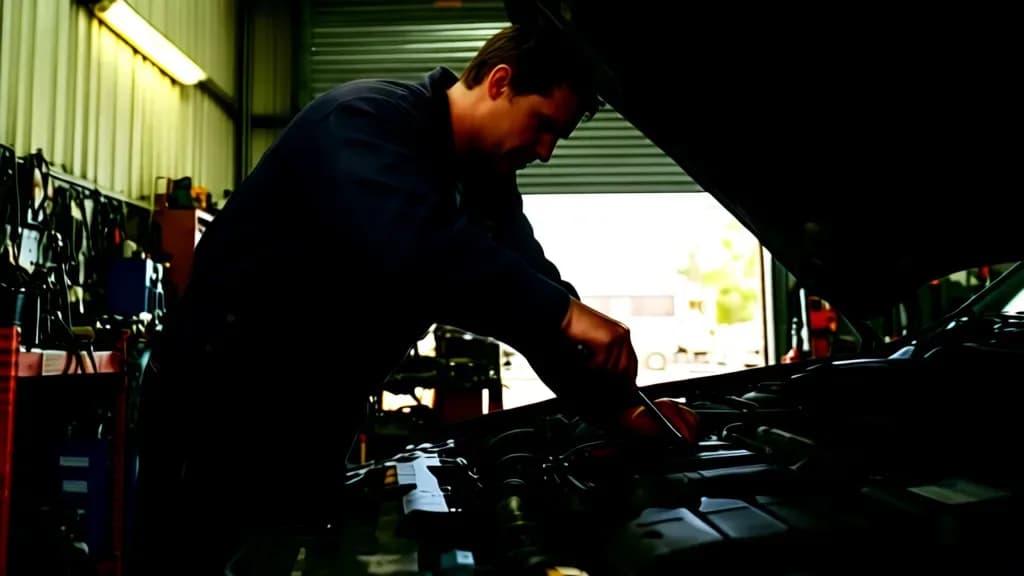
An Automotive Electrician installs, diagnoses, and repairs the electrical and electronic systems in motor vehicles. The work has changed substantially in the past decade. A modern Australian automotive electrician handles engine management ECUs, body control modules, ADAS sensors, hybrid and EV high-voltage systems, telematics, CAN bus diagnostics, and aftermarket installations from caravan power systems to mining vehicle dual-battery rigs.
Demand is concentrated in three sectors. First, mainstream automotive service — dealerships, independent workshops, and chain operators like Ultra Tune and Repco Service. Second, heavy transport and logistics — trucking fleets, bus operators, and rail rolling stock. Third, mining and resources — every iron ore haul truck, dragline, and underground vehicle in the Pilbara, Bowen Basin, and Goldfields runs on systems that an automotive electrician maintains. FIFO rates from Perth and Brisbane regularly clear AUD $60-$100 per hour. The transition to battery-electric trucks and buses, plus the rapid expansion of charging infrastructure, has added new specialisations in HV safety and EV diagnostics.
The work is mobile. Many migrants finish their first Australian year in metropolitan service workshops and progress to mining FIFO or specialised marine and aviation work where pay is materially higher.
ANZSCO 321111 Mapping
ANZSCO 321111 covers tradespeople who install, examine, repair, and maintain electrical wiring and computer-based equipment in motor vehicles. Typical tasks include:
- Diagnosing and repairing faults in vehicle electrical and electronic systems
- Installing electrical equipment such as gauges, lighting, alarms, audio systems, and air conditioning controls
- Servicing and repairing starter motors, alternators, generators, and ignition systems
- Performing diagnostic tests with scan tools and oscilloscopes
- Installing and servicing electric and hybrid vehicle systems
321111 is distinct from 341111 Electrician (General), which deals with building wiring and does not require automotive knowledge. It is also distinct from 321211 Motor Mechanic and 321212 Diesel Motor Mechanic, both of which cover mechanical (not electrical) work. If your work crosses both mechanical and electrical, you must choose the code that best matches the majority of your duties.
Skills Assessment
Trades Recognition Australia (TRA)
TRA offers two routes depending on whether you are onshore or offshore at lodgement.
Authoritative reference: tradesrecognitionaustralia.gov.au.
Route 1 — Offshore Skills Assessment Program (OSAP)
For applicants outside Australia with a relevant overseas qualification and trade experience.
Requirements:
- A formal trade qualification recognised in the home country (typically requires 3-4 years of training)
- At least 3 years of paid post-qualification work as an automotive electrician
- 12 months of recent trade currency (work in the occupation within the last 3 years)
- A documentary evidence stage followed by a Technical Interview conducted in English
- English language evidence may be required by some assessment streams
Cost: Around AUD $1,000-$2,000 depending on program (subject to change — check TRA's fees page before paying)
Processing time: Documentary evidence stage 8-12 weeks; Technical Interview scheduled after fees are paid
Route 2 — Job Ready Program (JRP)
For applicants already in Australia, typically after completing an Australian Certificate III in Automotive Electrical Technology (or equivalent). The JRP has four stages.
- Provisional Skills Assessment (PSA) — confirms your Australian qualification is genuine and relevant. Around AUD $300.
- Job Ready Employment (JRE) — minimum 12 months full-time paid employment (38 hrs/week) as an automotive electrician with a TRA-approved employer. Around AUD $450.
- Job Ready Workplace Assessment (JRWA) — after a minimum of 6 months of employment, a TRA-approved RTO assessor visits the workplace and conducts a competency assessment.
- Job Ready Final Assessment (JRFA) — confirms all stages are complete.
The full JRP must be completed within 3 years of the successful PSA. The JRP is the dominant TRA pathway for migrants who have completed their qualification through an Australian RTO under a Down Under Centre, Wyatt, or similar arrangement.
Common rejection reasons:
- Insufficient trade currency (less than 12 months work in the occupation within the previous 3 years)
- Qualification structure that does not align with the AQF Certificate III in Automotive Electrical Technology
- Lack of documentary evidence of practical training or apprenticeship at the foundational stage
- For JRP candidates: failing to maintain continuous TRA-approved employment
Visa Pathways for Automotive Electricians
Subclass 482 — Skills in Demand Visa
Employer-sponsored temporary visa. For most overseas automotive electricians, 482 is the fastest path to legal Australian work, particularly in mining and heavy transport sectors where employers actively sponsor.
- Visa fee: AUD $4,015 (Core Skills stream, primary applicant)
- Salary thresholds (to 30 June 2026): Core Skills stream AUD $76,515; Specialist Skills stream AUD $141,210. From 1 July 2026 these become $79,423 and $146,576.
- Processing time: Core Skills stream around 8 months for 90% of cases; Specialist Skills stream 7-14 days (Home Affairs, April 2026)
- Reality check: Standard workshop wages fall around the Core Skills threshold. FIFO mining roles regularly clear $146,576 and qualify for Specialist Skills processing.
Subclass 491 — Skilled Work Regional Visa
Regional nomination adds 15 points. A five-year provisional visa with a pathway to PR via subclass 191. Genuinely strong route for trades because most automotive electrician demand sits in regional Australia anyway.
- Visa fee: AUD $6,140
- Processing time: 50% within 6-20 months; 90% within 15-28 months (Home Affairs, April 2026)
- Reality check: Mining-belt cities like Karratha, Kalgoorlie, Mackay, and Mount Isa are regional for migration purposes and have heavy demand.
Subclass 190 — Skilled Nominated Visa
State nomination adds 5 points and grants permanent residency.
- Visa fee: AUD $6,140
- Obligation: Live and work in the nominating state for 2 years
- Reality check: Western Australia, Queensland, and South Australia are the realistic nominators for 321111 given the resources-sector demand.
Subclass 189 — Skilled Independent Visa
Permanent residency through points alone. Available because 321111 is on the MLTSSL.
- Visa fee: AUD $6,135
- Minimum points: 65; trades historically clear at 65-75 points in invitation rounds
- Processing time: Median around 6-9 months following the March 2026 reform
- Reality check: Trade occupations invite at lower thresholds than ICT or accounting. A 75-point automotive electrician profile is genuinely competitive.
Subclass 186 — Employer Nomination Scheme
Permanent residency through employer sponsorship.
- Visa fee: AUD $6,140
- Streams: Direct Entry (3 years' relevant experience) or Temporary Residence Transition (after 2 years on 482)
- Processing time: Direct Entry median 12 months; 90th percentile 19 months (Home Affairs, April 2026)
Points Test Strategy
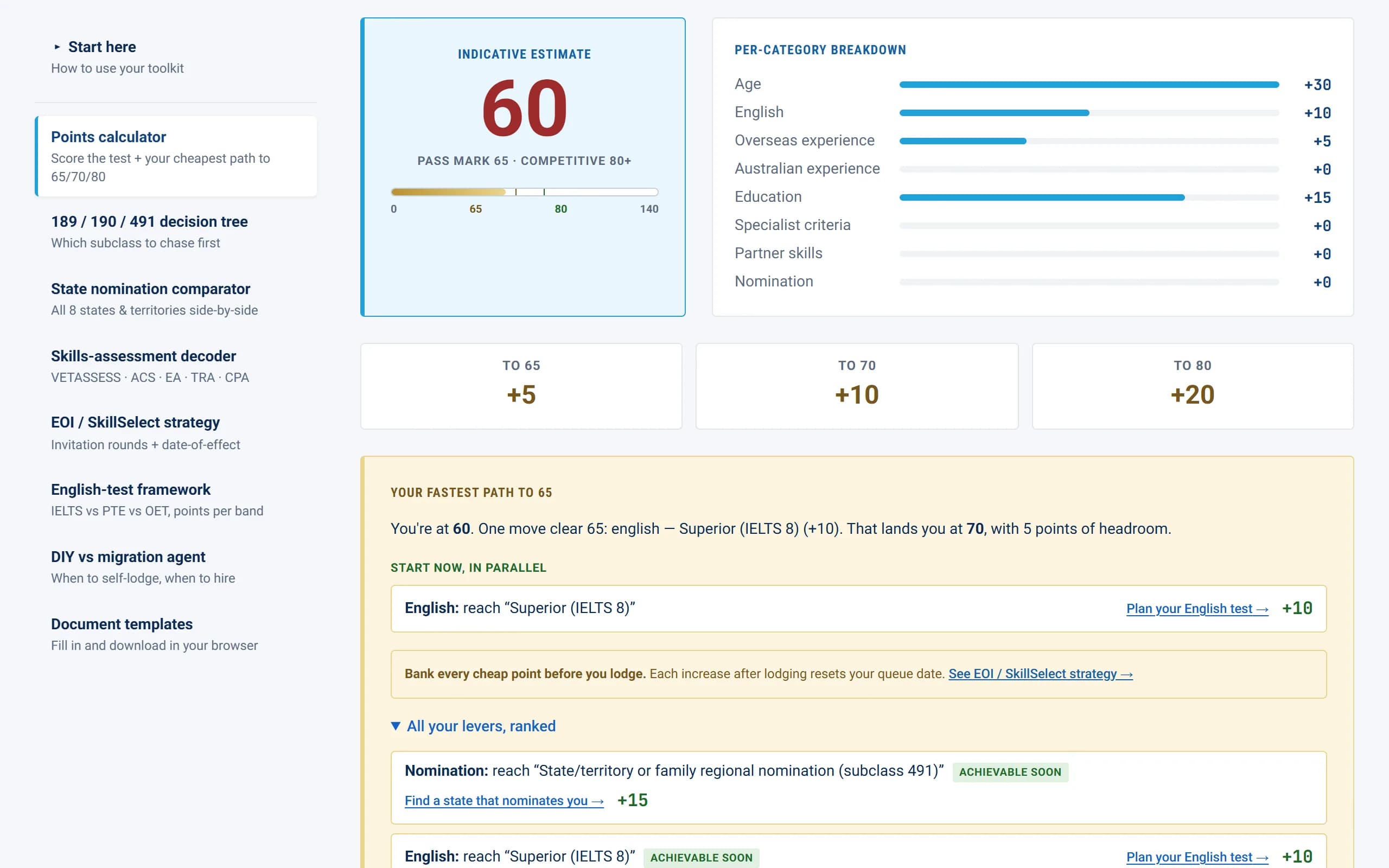
Trades invite at lower thresholds than professional occupations. A realistic budget for 321111 sits at 65-75 points.
| Points Factor | Points | Notes |
|---|---|---|
| Age 25-32 | 30 | Maximum bracket |
| Age 33-39 | 25 | Still strong |
| AQF Certificate III/IV or equivalent | 10 | Standard trade qualification |
| Bachelor degree | 15 | Rare for trades but possible |
| Superior English (IELTS 8 / PTE 79) | 20 | Hard for many trade candidates |
| Proficient English (IELTS 7 / PTE 65) | 10 | Realistic target |
| Competent English (IELTS 6 / PTE 50) | 0 | Floor — required to qualify |
| 5-7 years skilled employment overseas | 10 | Standard for senior tradesmen |
| 8+ years skilled employment overseas | 15 | |
| State nomination (190) | 5 | |
| Regional nomination (491) | 15 | The biggest single lever for trades |
| Partner with skilled occupation | 10 |
Realistic scenario
Filipino-trained automotive electrician, 32, 10 years' experience, IELTS 7: Age 30 + Cert III/IV 10 + Proficient English 10 + 8+ years experience 15 = 65 points. Add 491 regional (+15) = 80 points — strongly competitive for invitation, particularly if WA, QLD, or SA nominates.
State Nomination
Western Australia
The WA Skilled Migration Occupation List (WASMOL) for 2026 includes more than 600 occupations across two schedules and is the leading nominator for automotive trades. WA has 3,000 subclass 190 places and 2,000 subclass 491 places for 2025-26. Mining and heavy transport demand sustains the Perth, Pilbara, and Goldfields markets.
Queensland
Queensland Skilled Occupation List (QSOL) for 2025-26 has 2,600 nomination places, with strong emphasis on trades including diesel and automotive specialisations. Regional Queensland — Townsville, Mackay, Rockhampton, Cairns — offers genuine 491 pathways for automotive electricians supporting heavy transport and mining services.
South Australia
SA's 2025-26 skilled occupation list includes automotive trades under regional categories. Adelaide's defence industry expansion and the broader trades shortage in regional SA have kept 321111 on the list.
New South Wales
NSW's 2025-26 nomination list includes selected trades but tends to prioritise construction and healthcare. Automotive electrician demand in NSW concentrates in Sydney's heavy transport, bus, and rail sectors.
Victoria
Victoria's 2025-26 program closed to new ROIs after December 2025. Trade demand in Victoria sits in metropolitan Melbourne (rail, bus, light commercial) and regional centres like Geelong and Ballarat.
Salary and Employment Outlook
What Automotive Electricians earn in 2026
| Role | Typical Salary Range (AUD, ex super) |
|---|---|
| Apprentice / Year 1-3 | $40,000-$60,000 |
| Qualified Automotive Electrician | $75,000-$95,000 |
| Senior Automotive Electrician | $90,000-$110,000 |
| Heavy vehicle / fleet specialist | $95,000-$125,000 |
| FIFO mining (residential) | $110,000-$140,000 |
| FIFO mining (high-cycle, experienced) | $140,000-$180,000+ |
| Workshop Foreman / Supervisor | $110,000-$140,000 |
Source: SEEK Career Advice (May 2026, national average AUD $75,000-$95,000), PayScale (national average hourly AUD $29-$38, with Perth significantly higher), and reported FIFO rates from current mining job listings.
Hourly rates outside fixed salary roles commonly range AUD $40-$60 per hour for capable tradespeople, with FIFO field service positions pushing AUD $75-$105 per hour including allowances.
Highest-paying sectors
- FIFO mining services — BHP, Rio Tinto, Fortescue contractors (WestTrac, Komatsu, Liebherr)
- Heavy haulage and rail — Aurizon, Pacific National, Qube, major bus operators
- Specialised aviation and marine — limited but well-paid roles in regional airports and coastal cities
- Auto-electrical contracting on EV charging infrastructure — fast-growing
- Dealership network high-voltage and ADAS specialists — Tesla, Polestar, BYD, BMW, Mercedes
Tips for a Successful Application
1. Decide between OSAP and JRP before booking flights
OSAP is faster but requires a fully recognised offshore qualification and 3+ years of post-qualification experience. JRP is slower but achievable for applicants who studied in their home country to a lower standard, completed an Australian RTO Certificate III, and want time on a 485 graduate visa to consolidate. Get this decision wrong and you waste 12 months.
2. Front-load your trade currency evidence
TRA's most common failure point is insufficient evidence of recent paid trade work. Build a document pack that includes employer letters with explicit task descriptions, payslips, tax records, and photographs of completed work. References should use the language of the ANZSCO description.
3. Aim for the FIFO market with your first Australian role
Migration is expensive. Mining-belt FIFO positions cover the cost faster than metropolitan workshop wages and place you above the AUD $146,576 Specialist Skills threshold for future 482 nominations. WA contractors like WestTrac, Liebherr, and Macmahon hire automotive electricians on rotating rosters with no Australian residency premium.
4. Pick a state nomination strategy aligned to demand
Submitting an EOI without a clear state target wastes time. Western Australia is the strongest single market for 321111 in 2026. Queensland regional is the next-best lever. Build your post-arrival plan around the state that nominates.
5. Don't underestimate English requirements for sponsorship
Subclass 482 and 186 require Competent English (IELTS 5 across all bands or equivalent), and the Job Ready Program requires unassisted English in the Technical Interview. Many candidates with strong trade skills lose their visa pathway because they delay PTE preparation. Book the test early.
Step-by-Step Migration Roadmap
- Confirm ANZSCO mapping to 321111 using the ANZSCO code finder — verify duties are primarily electrical, not mechanical
- Verify list status via the Skilled Occupation List 2026 and the Core Skills Occupation List
- Choose OSAP or JRP — see the skills assessment bodies hub for TRA program details
- Compile trade currency evidence — employer letters, payslips, photos, tax records
- Sit IELTS or PTE — target Proficient English (7.0 / 65+) for points; Competent is the visa floor
- Submit TRA application — OSAP from offshore, or PSA from onshore
- Complete Technical Interview (OSAP) or 12-month JRE + JRWA + JRFA (JRP)
- Calculate points including age, qualification, English, and post-qualification experience
- Submit EOI in SkillSelect for 189, 190, or 491
- Apply for state nomination — WA, QLD, or SA are the realistic nominators
- Alternatively, seek 482 employer sponsorship — mining contractors actively sponsor
- Receive invitation, lodge visa, complete medicals and police checks, and relocate
Frequently Asked Questions
Is Automotive Electrician in shortage in Australia in 2026?
Jobs and Skills Australia has consistently flagged automotive electrical trades as in shortage across regional and metropolitan markets, particularly in mining-aligned states. The Skills Priority List and Occupation Shortage List have included automotive trades in recent reports. Hourly rates and FIFO sign-on bonuses reflect the structural shortage.
Can I migrate as an Automotive Electrician without an apprenticeship if I have 10+ years of experience?
Possibly, but it is harder. TRA's OSAP requires a recognised qualification plus experience. Without a formal qualification, you may need to undertake an Australian Certificate III via RPL through a TRA-approved RTO, then complete the Job Ready Program. The Down Under Centre and Wyatt Education Group both run RPL pathways specifically for migrants.
What's the difference between Automotive Electrician (321111) and Motor Mechanic (321211)?
Automotive Electrician (321111) focuses on the electrical and electronic systems — wiring, computers, sensors, alternators, starter motors, EV high-voltage systems. Motor Mechanic (321211) focuses on the mechanical systems — engines, transmissions, brakes, suspension. Both are MLTSSL trades, but your duties (not your job title) determine which code applies. Many real-world mechanics cross both; choose the code that matches the majority of your work.
Will EV and hybrid experience help my application?
Yes, materially. EV-capable automotive electricians are scarce in Australia, and dealerships, public-transport operators, and the rapidly growing charging infrastructure sector are actively recruiting. Document any high-voltage safety certifications and brand-specific EV training (BYD, Tesla, Mercedes EQ, Hyundai/Kia, Polestar) prominently in your TRA evidence pack.
Do I have to live in a regional area if I get a 491 visa?
Yes. The 491 visa requires you to live, work, and study only in designated regional areas of Australia for the duration of the visa. For most automotive electrical work this is not a constraint — mining-belt cities, regional service hubs, and most non-Sydney/Melbourne/Brisbane locations qualify. After 3 years of regional residency meeting the income threshold, you can apply for the subclass 191 permanent residence visa.
Can my family migrate with me as an Automotive Electrician?
Yes. All five mainstream skilled visa subclasses (189, 190, 491, 482, 186) allow inclusion of a partner and dependent children. Partner skills can add 5-10 points to the points test if your partner holds a skilled occupation. Children retain access to public schooling, and PR-holding partners gain Medicare eligibility.
For broader trades context, see the Automotive Mechanic Visa Pathway and the Electrician & Plumber Visa Pathway. Compare overall trade demand on the most in-demand occupations list for 2026.