Booked Flights to Australia: What to Do Next
Flights booked — now what? One thing genuinely matters before anything else: the visa, because without one the airline won't board you. After that it's your passport, then the arrival paperwork. Here's the order to do things in, how early to do them, and what to do if you're flying within days, not months.
Independent guide — not a government service. Australian Visa Online is an independent information resource. We are not affiliated with the Australian Government or the Department of Home Affairs, and we do not lodge applications on your behalf.
Step 1: Work out which visa your passport needs
Everyone except New Zealand citizens needs a visa before flying — there is no visa on arrival for Australia. For a holiday or family visit, it's one of three:
| Visa | Cost | Where to apply | Typical fit |
|---|---|---|---|
| ETA (subclass 601) | $20 service fee | Australian ETA app | US, Canadian, Japanese and other eligible passports |
| eVisitor (subclass 651) | Free | ImmiAccount (browser) | UK and European passports |
| Visitor (subclass 600) | From $250 | ImmiAccount | Everyone else, and stays over 3 months |
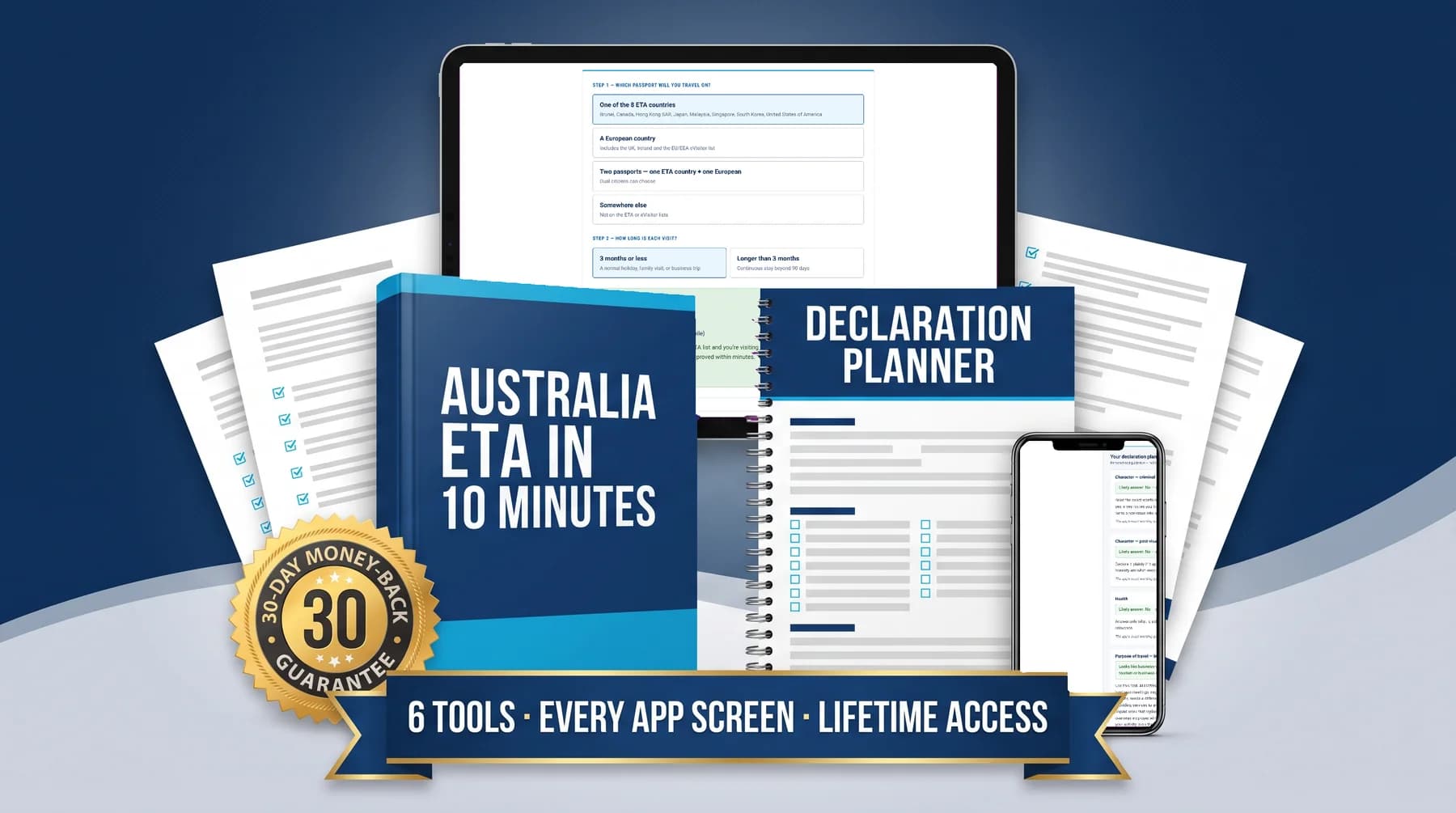
Some passports qualify for both the ETA and the free eVisitor — the comparison guide settles which to pick. Not sure where your passport lands? Two minutes with our visa finder answers it.
Step 2: Apply now, not later
The published numbers look reassuring: Home Affairs' June 2026 median processing time for visitor visas (the 600, 601 and 651 combined) is less than one day, and most ETA applications are decided immediately. So why apply early? Because the median hides the tail. Applications get pulled aside for extra checks (a declared conviction, a name match, information that's hard to verify), and for those there is no published timeline at all. Home Affairs' own advice runs both directions: apply "well in advance of travel", and don't make travel arrangements until the visa is granted. You've already booked, so make the gap between booking and applying as short as you can.
Warning: if your application does get held for further checks, nothing publicly available speeds it up: not for a booked flight, not at the airport. The stuck-in-processing guide covers that scenario. Applying today is the only lever you fully control.
A note on the subclass 600: its processing times vary far more than the ETA and eVisitor, from days to months depending on stream and circumstances. If that's your visa, it is the first thing you do after booking, full stop.
Step 3: Check your passport — two things only
Valid for the whole trip. Australia requires your passport to be valid for the period of your travel in and out. There is no six-month validity rule for entering Australia. But two caveats: countries you transit through may impose their own six-month rules, and airlines sometimes apply them at check-in. If your passport runs out within six months of the trip, check the rules for every country on the itinerary, not just Australia.
The same passport as the visa. Your Australian visa is linked electronically to the passport you applied with — no label, no stamp. Renew your passport after the visa is granted and an ETA simply ceases: you'd apply again with the new passport. If a renewal is due, do it before the visa application, not after.
Step 4: Know what happens at check-in
When you check in, the airline's system queries Australia's immigration database directly (the Advance Passenger Processing system) and gets a per-passenger answer: OK to board, or not. This is why the visa dominates this checklist — a missing visa isn't discovered at Sydney airport, it's discovered at your departure gate, where the only fix is not flying.
Step 5: The week before — arrival paperwork and packing rules
On the plane you'll fill in the paper Incoming Passenger Card (a digital version is being phased in, but in 2026 the paper card is still standard for nearly everyone). It asks what you're bringing in — food, plant and animal products must be declared, and medicines have their own rules (original packaging, carry the prescription, no more than a 3-month supply). The entry requirements guide covers the declaration, duty-free limits and biosecurity rules in full. Read it before you pack, not after.
Flying in 72 hours or less
No visa yet? Triage order:
- ETA or eVisitor passport: apply right now. Most are decided in minutes to hours. The ETA runs through the Australian ETA app — have your passport, phone with NFC, and a card ready; the eVisitor runs through ImmiAccount in a browser.
- Subclass 600 territory: apply immediately and talk to your airline about your rebooking options before check-in closes. A 600 can come through fast, but nothing guarantees it, and a booked flight doesn't speed it up.
- Applied but still pending: check your junk folder and VEVO before assuming the worst — decided applications sometimes sit unread in spam. Then see what to do when an ETA is stuck.
FAQ
How soon after booking flights should I apply for the Australian visa?
Immediately. Most visitor visas are decided fast (the June 2026 median is under a day), but applications flagged for extra checks have no published timeline, and Home Affairs advises applying well in advance of travel. The earlier you apply, the more room the slow tail leaves you.
Does my passport need six months' validity to enter Australia?
No. Australia only requires the passport to be valid for your period of travel in and out. Countries you transit through may have their own six-month rules though, so check each stop on the itinerary.
Can I board the plane while my visa is still processing?
No. Airline check-in systems verify your visa electronically with Australia's immigration database before issuing a boarding pass. No granted visa, no boarding — regardless of how promising the application looks.
I booked the flights before applying for the visa. Was that a mistake?
It's the common order, and usually fine — most visitor visas are granted quickly. Home Affairs' formal advice is the cautious opposite (don't arrange travel until the visa is granted), which matters most for subclass 600 applicants and anyone with a conviction, a past refusal or an overstay on record. If that's you, apply today and keep the tickets flexible.