Travelling to Australia from Ireland: Entry Rules and Documents
To travel to Australia on an Irish passport you need a visa granted before you fly. Irish passports qualify for both the free eVisitor (subclass 651) and the $20 ETA (subclass 601), and the free eVisitor is the sensible default. After that, the trip comes down to a valid passport, an honest arrival card, clean biosecurity answers and knowing what Medicare will and won't cover.
Independent guide — not a government service. Australian Visa Online is an independent information resource. We are not affiliated with the Australian Government or the Department of Home Affairs, and we do not lodge applications on your behalf.
This page is the checklist for the trip itself. For every visa option open to an Irish passport, see our main guide to Australian visas for Irish citizens.
Quick facts for Irish travellers
| What | The rule for an Irish passport |
|---|---|
| Visa before you fly | Yes. Only New Zealand passport holders get a visa on arrival |
| Your options | eVisitor (651): free, applied for online in ImmiAccount. ETA (601): $20 service charge in the Australian ETA app |
| Validity | 12 months from the grant date, multiple entries. An ETA ends sooner if your passport expires first |
| Length of each stay | Up to 3 months after each entry |
| Passport | Must be valid. Home Affairs and the Australian Border Force publish no six-month rule |
| Arrival card | Incoming Passenger Card, completed in English |
| SmartGate | Open to ePassport holders aged 7 or over and at least 1.1 m tall |
| Health cover | If you were living in Ireland before you arrive, the Reciprocal Health Care Agreement covers public hospital care and some PBS medicines |
Which visa an Irish passport gets, and when the ETA makes sense
Ireland is on both official lists: the 34 passports that can use the ETA and the 36 European passports eligible for the eVisitor. Both visas are valid for 12 months, allow multiple entries and let you stay up to 3 months each time. Neither allows work. The difference is cost and channel. Home Affairs says plainly that "The eVisitor is free", and you apply for it online through ImmiAccount. The ETA carries a $20 service charge, and the only way to apply is the Australian ETA app on a mobile device.
So when would an Irish traveller pay the $20? The app scans your passport to pre-fill your details, and Home Affairs says it usually gives the result immediately. And if someone in your group holds an ETA-only passport, such as a US or Canadian one, one device can submit and pay for everyone's ETA together. Against that, the eVisitor's published processing figure is already under 1 day for 90% of applications, and an ETA ceases if you replace your passport. For most people the free option wins. The ETA vs eVisitor comparison and our eVisitor guide for Irish citizens go into the detail.
If you want to work while you're there, neither visa covers it. That's the separate Working Holiday visa for Irish citizens.
Your pre-trip timeline, from first plan to arrival
Home Affairs publishes no "apply X weeks before" figure, so this order is our suggestion, built around the official rules.
Step 1: Before you book anything, check the passport
Check the expiry date and, if you hold more than one passport, pick the one you'll use. Your visa is linked digitally to it. If it needs renewing, renew first and apply second (see the passport section below).
Step 2: Before you pay for non-refundable flights, apply
Apply for the eVisitor in ImmiAccount, one application per person, children included. Home Affairs' instruction is direct: "Do not arrange to travel to Australia until we let you know in writing that we have granted you the visa." Don't apply too early either. The 12 months start on the grant date and you have to enter Australia within them, so apply once your arrival date sits comfortably inside that window. Our eVisitor processing-time guide for Irish passports covers timing in detail.
Step 3: If you have a criminal conviction, start weeks earlier
Home Affairs advises anyone with a conviction in any country to apply for a Visitor visa (subclass 600) instead. That route can involve a Garda police certificate, which An Garda Síochána says takes approximately three weeks to process. Read visiting Australia with a criminal record from Ireland before you book.
Step 4: Two to three weeks out, sort cover and paperwork
Arrange travel insurance (see the health section below). Open your grant letter and check that the name, date of birth and passport number match your passport exactly. Home Affairs says to keep a copy of the decision with you in Australia, and you can see your visa conditions in VEVO.
Step 5: 72 hours out, check whether a digital declaration is offered
If you're flying Qantas on a route in the Australia Travel Declaration pilot, you may be able to pre-fill a digital passenger card up to 72 hours before travel. Otherwise, expect the paper card.
Passport rules for Irish travellers
Validity. The Australian Border Force requires "a valid passport or other acceptable travel document". Home Affairs and ABF publish no six-month rule. Airlines and transit countries on your route can have their own rules, so check each stop if your passport is close to expiry.
Same passport, start to finish. If you're a citizen of two or more countries other than Australia, Home Affairs says you "must use the passport you used when applying for your visa for both entering and leaving Australia". Present a different one and the airline may refuse to board you. This matters for Irish–British dual citizens: both passports qualify for both visas, so pick one and stick with it.
Renewing your passport. An ETA ceases when your passport expires or is replaced, and you must apply for a new one. The eVisitor page asks you to tell Home Affairs about changes to your passport. Either way, renewing before you apply avoids the problem.
Irish–Australian dual citizens. Home Affairs says Australian citizens "should use their Australian passport to enter and leave Australia". Australian citizens can't apply for an eVisitor or an ETA. Our family and mixed-passport guide covers this and other combinations.
What to carry through the airport
- The passport you applied with
- A copy of your grant letter, on your phone or printed
- The address where you'll stay in Australia and your flight number, both asked for on the arrival card
- A pen, because the paper card is still the norm
- Your travel insurance details
- Prescriptions or a doctor's letter for any medicines (our entry requirements checklist has the medicine rules)
Arriving in Australia: the card, SmartGate and fingerprints
The Incoming Passenger Card. Home Affairs says "Everyone who arrives in Australia must complete an Incoming Passenger Card." It must be completed in English. It includes customs and quarantine declarations and asks non-citizens about health and prior criminal convictions. ABF warns that for non-Australian citizens, "providing false information can affect their visa status." The digital Australia Travel Declaration, piloted on Qantas since October 2024, is due at all international airports and seaports before the end of 2027, so paper is still the norm for now.
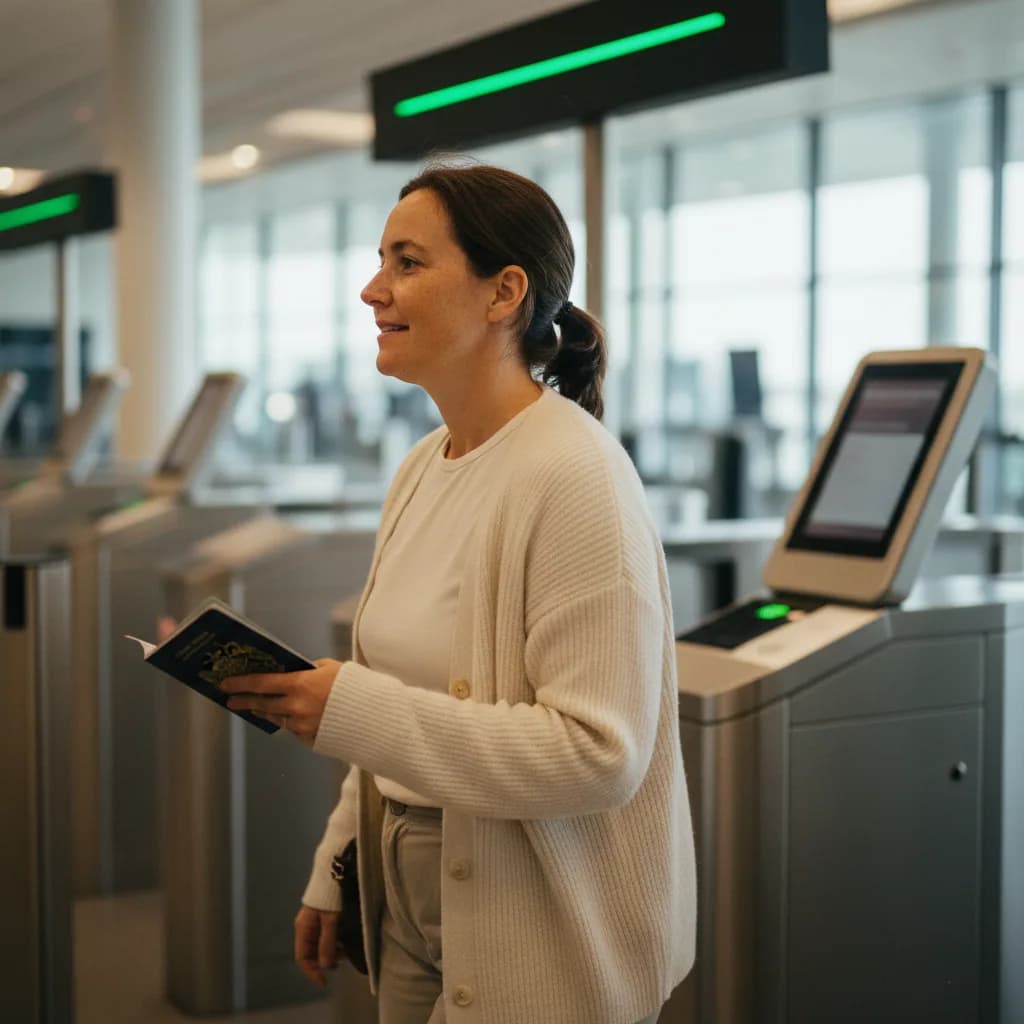
SmartGate. SmartGate isn't limited by nationality. You may be able to use it if your Irish passport shows the ePassport symbol, you're at least 1.1 m tall, and you're aged 7 or over (children must be travelling with a parent or legal guardian). Unaccompanied children under 16 can't use arrivals SmartGates.
Fingerprints. ABF says non-citizens "may be required to have your fingerprints checked when arriving or departing", and that the scans are not retained.
Biosecurity: declare it or bin it
The Department of Agriculture, Fisheries and Forestry says you must either declare risk goods, "including food, animal products and plant material (including wooden articles), and all footwear, clothing and equipment used in rural areas or near animals", or dispose of them in the bins at the airport. Getting it wrong is expensive: for false or misleading information, the department lists an infringement notice of up to $7,280, civil penalty proceedings or prosecution, and your visa may also be cancelled.
Irish packing habits to rethink:
- Food from home. Rashers, sausages, cheese and homemade baking for relatives are all food or animal products. Declare them, bin them, or leave them at home.
- Hurleys and sports gear. A hurley is a wooden article, so declare it. For faster clearance, the department asks for footwear and sporting equipment to be clean and dry, free from soil, seeds and grass, and it names golf clubs and bikes.
- Boots from a farm visit. Footwear used in rural areas or near animals must be declared.
Duty-free allowances, cash and medicines are covered in our full entry requirements checklist.
Health cover: what the Irish agreement does and doesn't cover
Services Australia lists Ireland among the countries with a Reciprocal Health Care Agreement. If you're visiting from Ireland, it says, "you may be eligible for medical care under Medicare while you're here":
- Who: you must have been living in Ireland before arriving in Australia. Irish citizens show their Irish passport. Residents who aren't Irish citizens show their passport and a valid European Health Insurance Card with the initials IE.
- What: medically necessary care as a public patient in a public hospital (inpatient and outpatient), and some PBS prescription medicines at the general rate.
- What not: outpatient care "doesn't include visits to a medical practitioner", and there's no Medicare benefit for out-of-hospital services. The agreement doesn't apply if you travel to Australia for medical treatment.
- How: you don't enrol and won't get a Medicare card. Ask hospital or pharmacy staff to treat you under the agreement.
- When: cover starts the day you arrive and ends the day your visa expires.
Home Affairs still recommends health insurance for eVisitor holders: "You are personally liable for all your healthcare costs while you are in Australia." Travel insurance is the usual way to cover gaps such as GP visits and private care.
Money
The eVisitor rules say you must have enough money to support yourself in Australia and to leave at the end of your stay. No figure is set, so have a way to pay for the trip and your way home sorted before you fly.
Common mistakes Irish travellers make
- Paying a website for a free visa. The eVisitor costs nothing in ImmiAccount, and for the ETA Home Affairs says "There is no other charge payable" beyond the $20 app fee. Anything more pays for a website's service, not the visa.
- Applying on one passport and flying on the other. Irish–British dual citizens are the most exposed to this one.
- Renewing the passport after the visa is granted. Renew first, then apply.
- Name slips. Enter your name exactly as your passport shows it, including middle names, and check that your device hasn't auto-corrected it. Home Affairs warns about auto-correct specifically, and names with a fada or an apostrophe deserve a second look.
- Answering "no" because a conviction is spent in Ireland. Australian character questions ask about convictions in any country. See the criminal record guide.
Frequently Asked Questions
Should an Irish citizen pay $20 for the ETA instead of the free eVisitor?
Usually not. Both give 12 months of validity, multiple entries and stays of up to 3 months. The ETA mainly suits a group already using the app for an ETA-only passport, such as a US or Canadian family member.
Does my Irish passport need six months' validity for Australia?
Not under any published Australian rule. Home Affairs and the Australian Border Force ask for a valid passport and set no six-month minimum. Your airline or a country you transit through may apply its own, so check those before you fly.
Can I get Medicare as an Irish visitor to Australia?
If you were living in Ireland before you arrived, the Reciprocal Health Care Agreement covers medically necessary public hospital care and some PBS medicines, without a Medicare card. It doesn't cover GP visits or other out-of-hospital services.
I'm Irish and British. Which passport should I travel on?
Either works, because both are on the eVisitor and ETA lists. What matters is consistency: apply with one passport, then use that same passport to check in, to enter Australia and to leave again.