Australian Skilled Migration for Indian Citizens: 2026 Guide
Updated: 16 August 2026
India is Australia's largest source country for skilled migrants. Indian citizens apply through the subclass 189 (independent), 190 (state-nominated), and 491 (regional) visas, lodged via SkillSelect after a positive skills assessment. ACS handles ICT, Engineers Australia covers engineering, and VETASSESS assesses most other professions. Competitive Indian IT applicants typically need 80 or more points.
Quick Facts: Skilled Migration for Indian Citizens
| Detail | Information |
|---|---|
| Independent | Subclass 189: uncapped location, highest points threshold |
| State-nominated | Subclass 190: +5 points, live in nominating state |
| Regional | Subclass 491: +15 points, 5-year provisional |
| Pass mark | 65 points minimum, competitive scores 80+ for IT |
| EOI system | SkillSelect (Expression of Interest) |
| Top assessing bodies | ACS, Engineers Australia, VETASSESS, ANMAC, CPA Australia |
| English | Competent (IELTS 6.0 each band) minimum; higher for points |
| PR conversion | 491 transitions to 191 PR after three years |
Why India Sits at the Top of the Programme
Indian applicants make up a substantial share of recent permanent migration grants, concentrated in IT, engineering, accounting, and healthcare. The pipeline is built on India's English-medium higher education and large STEM graduate output.
The consequence for individual applicants is competition. Indian-born candidates regularly hit the upper bound of point scores for popular occupations. The 65-point legislative pass mark translates into an effective floor of 80 or higher for ICT and accounting in invitation rounds.
The Three Main Subclasses
Subclass 189: Skilled Independent
The 189 grants permanent residency directly with no state, regional, or sponsor tie. Your occupation must sit on the Medium and Long-term Strategic Skills List or the equivalent core skills list. You compete on points alone. The full 189 pillar page is here, with the visa-stream detail in the 189 deep dive.
For Indian applicants, this is the most competitive path. IT and accounting cohorts in particular have seen 189 invitation thresholds rise as Indian, Pakistani, and Chinese applicants concentrate at the top of the pool.
Subclass 190: State Nominated
The 190 also grants permanent residency, but you accept a moral commitment to live in your nominating state for two years. State nomination adds 5 points and routes you through that state's own occupation list and criteria. Each state runs its own selection process. NSW, Victoria, Queensland, South Australia, Western Australia, Tasmania, the Northern Territory, and the ACT all publish their own programmes for 2026 (see state nomination 2026 pages).
For Indian applicants who can't reach 189 thresholds, state nomination is often where the file becomes viable.
Subclass 491: Skilled Work Regional
The 491 is a five-year provisional visa that adds 15 points and requires you to live and work in designated regional Australia. After three years of regional living with adequate income, you can transition to the subclass 191 PR visa. Regional is the largest growth pathway for Indian applicants because the points uplift compensates for borderline profiles. The 189 vs 190 vs 491 comparison lays out the trade-offs.
Skills Assessment by Profession
Every skilled visa requires a positive assessment from the designated assessing authority for your nominated ANZSCO occupation. For Indian applicants, the high-volume bodies are:
- ACS (Australian Computer Society) for ICT roles. Indian B.Tech and MCA graduates without an ICT major often face deductions of years of experience as "non-ICT qualification", a common surprise that has to be planned around. The skills assessment guide explains the deduction logic.
- Engineers Australia for civil, mechanical, electrical, chemical, and electronics engineers. Washington Accord recognition smooths the path for graduates from accredited Indian programmes. Non-Washington Accord graduates pursue a Competency Demonstration Report.
- VETASSESS for accounting (where CPA Australia, CA ANZ, or IPA can also assess), business, social work, and many other professional occupations.
- ANMAC for nurses and midwives, with subsequent AHPRA registration.
- TRA for trades, including chefs and motor mechanics.
The single most common reason Indian skilled applications fall apart at the skills-assessment stage is employment evidence that can't be substantiated: undated reference letters on plain paper, inconsistent salary figures across affidavits and bank credits, and tasks that read as cut-and-paste from ANZSCO descriptions. ACS in particular cross-references reference letters against tax records, bank-credit history, and sometimes calls employers directly.
Points Test and What Indian Applicants Really Need
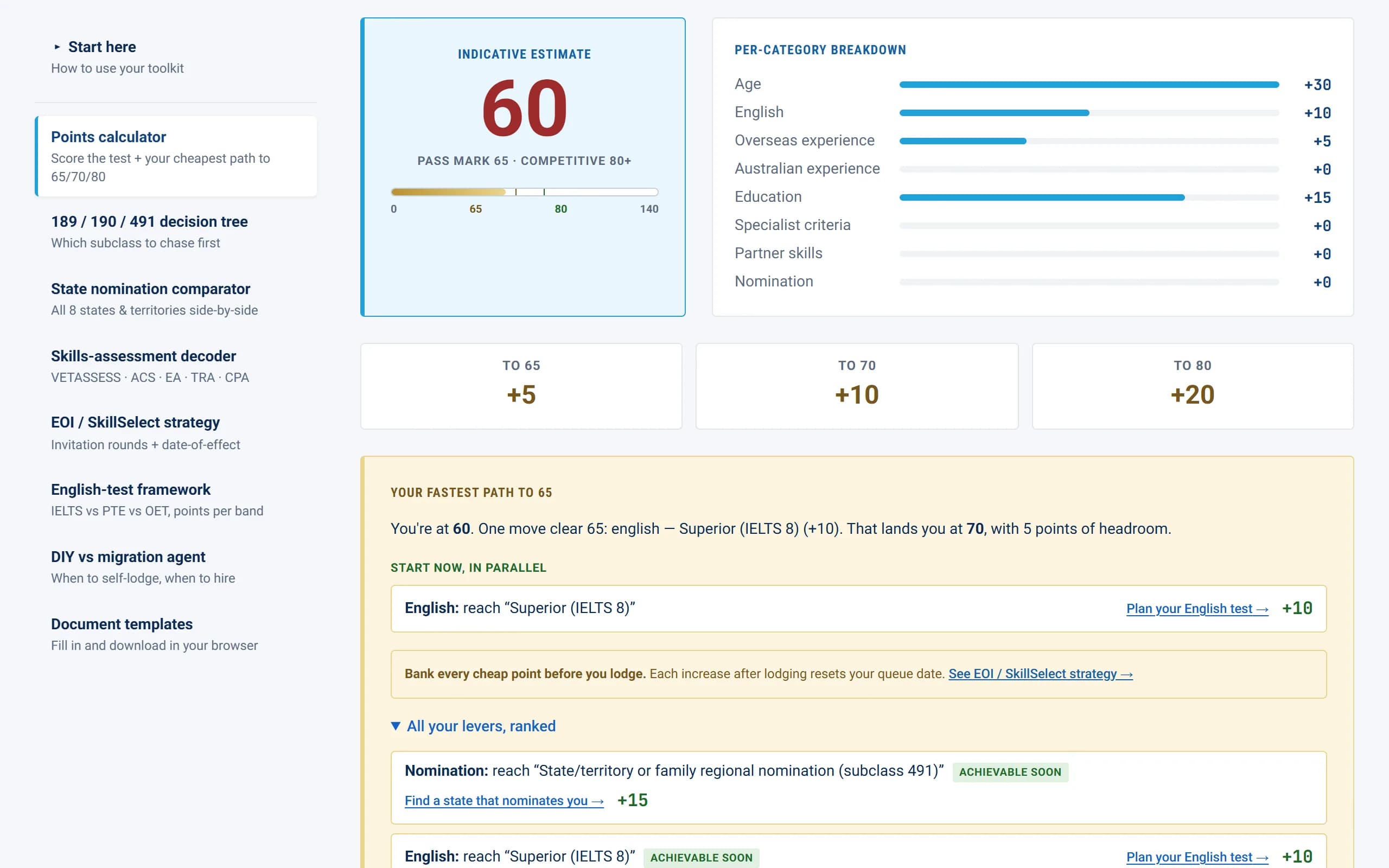
The legislated minimum is 65 points. The competitive minimum in current invitation rounds for popular Indian-dominant occupations is 80 or higher, depending on the round. Points come from:
- Age: maximum 30 points for ages 25-32, dropping for younger and older applicants
- English: 0 / 10 / 20 points for competent / proficient / superior
- Skilled employment overseas: up to 15 points
- Skilled employment in Australia: up to 20 points
- Qualifications: up to 20 points (with credentialed bachelors, masters, doctorate)
- Australian study: 5 points if you have a CRICOS qualification
- Specialist STEM qualification: 10 points for certain master's and PhD qualifications
- Regional study: 5 points
- Partner skills: 0, 5 or 10 points depending on partner's profile
- State/regional nomination: +5 (190) or +15 (491)
The points calculator guide walks the maths step by step. The practical levers for Indian applicants who need more points are usually English (re-sit for proficient or superior), an Australian master's adding study and STEM points, or shifting from 189 to 190 / 491 to capture nomination uplift.
How the Process Runs
- Identify your ANZSCO occupation and confirm it's on the relevant list for the subclass you want.
- Sit your English test (IELTS, PTE Academic, TOEFL iBT, Cambridge, or OET).
- Lodge a skills assessment with the designated authority. Allow two to four months.
- Once you have a positive assessment, submit an EOI through SkillSelect.
- For 190/491, also lodge with your chosen state or territory.
- Wait for an invitation. ITAs are issued in monthly invitation rounds.
- From the date of invitation, you have 60 days to lodge a full visa application.
- Get medicals and PCC done. Indian PCC comes from PSK or RPO; medical at a Bupa panel clinic.
- Wait for grant.
The EOI mechanics are covered in SkillSelect EOI: how it works, and the lodgement walkthrough is in the step-by-step apply guide.
Cost and Timelines
| Item | Cost |
|---|---|
| Skills assessment | ₹50,000-1,00,000+ depending on body |
| English test | ₹17,000-19,000 |
| 189 / 190 / 491 visa charge (primary) | AUD $6,135 (189) / AUD $6,140 (190, 491) |
| Partner inclusion (over 18) | — |
| Child inclusion (under 18) | — |
| Health exam | ₹5,000-7,000 |
| PCC | ₹500-2,000 |
Additional-applicant charges change with the base fee — confirm current figures on the official fee schedule.
End-to-end timelines for Indian applicants typically run 12 to 24 months from skills-assessment lodgement to visa grant, with 491 generally faster than 189 because of the nomination structure. The visa processing times guide tracks current medians.
What Indian Applicants Need to Know
ACS deductions are not negotiable
If your B.Tech, BE, or BCA was assessed as non-ICT or partially aligned, ACS will deduct two, four, or even six years of experience before counting your post-qualification work toward points. This is one of the biggest gaps between expected and actual point scores for Indian IT applicants. Plan around it. The IT professional pathway guide goes deeper.
English scoring is where most points are made
A jump from IELTS 6.0 to 7.0 each band is worth 10 points. From 7.0 to 8.0 each band is worth another 10. For Indian applicants already strong in English, the most efficient point uplift is almost always a re-sit targeting superior English. PTE Academic is the popular choice because of result speed and the on-screen format, but no test is intrinsically easier.
State nomination changes the maths
If you're at 70 to 75 points and stuck below the 189 invitation threshold, 190 nomination adds 5 points and 491 adds 15. The trade-off is geographic. You commit to a state, or to a regional area for at least three years. The state nomination 2026 pages cover each state's criteria.
Employment evidence has to be bullet-proof
Reference letters on company letterhead, signed and dated, listing your duties matched to ANZSCO descriptions, with employment dates and salary, and corroborated by tax records. ACS will reject files where the reference letter is generic, where salary doesn't match the bank statements, or where Form 16 / 26AS evidence is missing. The skills assessment guide covers what each authority accepts.
Police clearance and health for the whole family
Every family member over 16 needs a PCC. For Indian principal applicants with a spouse from a third country (the UAE, Singapore, the UK, the US), a PCC from that country is also required. Bupa health checks apply to all included family members.
Common Pitfalls for Indian Applicants
Overestimating points. Self-assessed scores frequently come in 5 to 10 points higher than what the Department actually credits. Run the points calculator conservatively, and assume the assessor will not give you the benefit of the doubt on borderline items.
Choosing the wrong ANZSCO code. Indian IT applicants often hover between Software Engineer (261313), Developer Programmer (261312), and ICT Business Analyst (261111). The code drives the assessing authority's evidentiary requirements and changes which list your occupation sits on.
Stale skills assessment. Skills assessments are typically valid for three years. Lodge the EOI well within that window. A lapsed assessment means re-paying and re-evidencing.
Ignoring 190 / 491 because of perceived prestige. The 190 grants permanent residency from day one. The 491 grants PR after three regional years. Indian applicants who hold out for 189 invitations sometimes spend years cycling EOIs when they could have been in Australia on a 190 grant.
Failing the genuine intention test on regional 491s. Living in Sydney or Melbourne for three years while holding a 491 issued by a regional state will block the 191 transition. The compliance regime checks tax records, address history, and employment.
Frequently Asked Questions
How many points do Indian IT applicants need for skilled migration in 2026?
The legislated minimum is 65. In recent invitation rounds, ICT applicants from India have typically needed 80 or more on the 189, with 190 nomination cut-offs varying by state. Software engineers and ICT business analysts sit at the upper end of the competition.
Which assessing body do Indian IT graduates use?
ACS (Australian Computer Society) assesses ICT occupations. Indian B.Tech, BE, BCA, MCA, and M.Tech graduates are assessed by ACS, which decides how closely the qualification matches the nominated ANZSCO occupation and applies experience deductions where the match is partial.
Can Indian engineers apply for skilled migration to Australia?
Yes. Engineers Australia is the assessing body. Graduates of Washington Accord-accredited Indian engineering programmes have a smoother route. Non-accredited graduates apply through the Competency Demonstration Report pathway, which involves career episodes and a CV review.
How long does the whole skilled-migration process take from India?
End-to-end timelines from starting the skills assessment to visa grant typically run 12 to 24 months. Skills assessment usually takes two to four months; EOI-to-invitation depends on points and round outcomes; visa lodgement itself runs six to twelve months for most subclasses.
Is the 491 worth it compared to the 189?
If you can reach 189 invitation thresholds, the 189 is usually preferable because it's immediate PR. If you're 10 to 15 points below the effective 189 threshold, the 491 is often the realistic route, with PR available after three years of regional work and residence through the 191.
Can I include my parents on a skilled visa?
No. Skilled visas include partners and dependent children only. Parents apply through separate parent visa pathways with their own waiting times and contribution amounts.