Australian Student Visa for Vietnamese Citizens: 2026 Guide
Updated: 13 May 2026
The Subclass 500 student visa is the dominant Australian pathway for Vietnamese applicants, with strong demand in business, IT, hospitality, and TAFE programs. Applicants must satisfy the Genuine Student requirement, show roughly AUD $29,710 per year in living costs plus tuition, hold a valid CoE, and meet the institution's English standard. The fee is AUD $710.
Quick Facts: Student Visa for Vietnamese Citizens
| Detail | Information |
|---|---|
| Visa subclass | 500 (Student) |
| Base application fee | AUD $710 |
| Genuine Student (GS) | Mandatory written statement plus supporting evidence |
| English | Set by institution; commonly IELTS 5.5–6.5 overall |
| Living costs benchmark | ~AUD $29,710 per year (per Department settings) |
| Health insurance | OSHC for the full visa duration |
| Lodgement | ImmiAccount, with biometrics at VFS Hanoi or Ho Chi Minh City |
| Health exam | Yes, Bupa-approved panel physician |
| Police clearance | Phiếu Lý Lịch Tư Pháp (Form No. 2) often requested |
| Work rights | 48 hours per fortnight during semester, unlimited on scheduled breaks |
Who the Subclass 500 Is For
The Subclass 500 covers Vietnamese students enrolled in any CRICOS-registered course in Australia: ELICOS English programs, secondary school, vocational diplomas (VET), undergraduate degrees, postgraduate coursework, research degrees, and non-award study. The same visa, the same Genuine Student test, the same financial rules. Only the documentation depth varies by sector.
For Vietnamese applicants, the strongest profiles tend to come from university applicants with a clear academic line: a relevant undergraduate degree in Vietnam, a defined career path, and a master's in Australia that obviously builds on the earlier study. VET applicants and ELICOS-only applicants can absolutely succeed, but they carry a heavier burden of proof on the GS statement.
Genuine Student Requirement for Vietnamese Applicants
The Genuine Student requirement replaced the older Genuine Temporary Entrant test in 2024 and is now the single biggest variable in a Subclass 500 outcome. Vietnamese applications are read with this in mind: the Department wants to see a student who is genuinely there to study, who has chosen this course and this provider for reasons that hold up, and who can articulate a future that the qualification actually serves.
Your GS written statement should answer:
- Your academic and work background in Vietnam, with any gaps explained
- Why this specific course and this specific provider, in your own words
- How the qualification connects to your career plans, whether in Vietnam, Australia, or a third country
- Why Australia, rather than Vietnam, the UK, Canada, or another destination
- Your understanding of the cost of living and your financial plan
- Your immigration and travel history, including any prior refusals or cancellations
A model GS statement runs 600 to 1,200 words, written in your voice, with specifics: unit codes from the course handbook, the lecturer or research group you want to work with, the industries in Vietnam where this qualification is recognised. The Genuine Student requirement walkthrough and the how-to-pass GS guide cover the structure in detail. The GS glossary entry explains how it differs from the old GTE.
Vietnamese applications for short, generic diplomas at small private providers in metropolitan Sydney and Melbourne attract the heaviest scrutiny. If that describes your file, the GS statement is doing the heaviest work.
Financial Evidence
Vietnamese applicants typically demonstrate funds through one of three routes, or a combination:
- Family savings. A Vietcombank, BIDV, Techcombank, ACB, or VPBank account in the applicant's, parent's, or spouse's name. Funds should be held for at least three months and supported by a bank statement showing the build-up, not just a closing balance.
- Education loan. A loan sanction letter from a recognised Vietnamese bank, with clear terms, disbursement schedule, and confirmation that the loan covers tuition plus living costs.
- Scholarship. Letters from the Australian institution, the Australian government (Australia Awards), or a Vietnamese sponsor.
The Department applies a per-year living cost benchmark of around AUD $29,710 per primary applicant, with additional amounts for a spouse and dependent children. You'll add the full tuition stated on your CoE and a return airfare amount. Show enough to cover all of these for at least the first twelve months. Case officers don't expect you to evidence three years of postgraduate funding up front, but they do expect a credible plan for the second and third years.
If a parent is sponsoring you, attach their employment certificate, three years of personal income tax filings, bank statements, business registration documents if self-employed, and evidence of your relationship (birth certificate with English translation).
The full breakdown of expected documents is in the student visa financial requirements guide.
English Language Requirements
The Subclass 500 itself doesn't impose a fixed English score. The institution does, through the CoE. Universities usually want IELTS Academic 6.0 to 6.5 overall, with no band below 5.5 or 6.0. Many VET courses accept IELTS 5.5 overall. ELICOS English packaging is available for applicants whose institution-required score is just below threshold.
Accepted tests in Vietnam include IELTS (British Council and IDP test centres in Hanoi, Ho Chi Minh City, Da Nang, Hai Phong, Can Tho), PTE Academic, TOEFL iBT, Cambridge Advanced, and Occupational English Test for healthcare courses. The Department's accepted-test list and minimum thresholds for visa-grant purposes are in the English language requirements guide.
Application Process
A typical Vietnamese applicant moves through this sequence:
- Apply to your chosen Australian institution and accept the offer
- Pay the initial tuition instalment and Overseas Student Health Cover (OSHC) premium
- Receive your electronic CoE
- Prepare your GS statement and supporting documents
- Book the health examination with a Bupa panel clinic in Hanoi or Ho Chi Minh City (a HAP ID is generated through ImmiAccount before the appointment)
- Obtain a Phiếu Lý Lịch Tư Pháp (Form No. 2) if your case officer requests it
- Lodge the Subclass 500 application in ImmiAccount, pay AUD $710, attach evidence
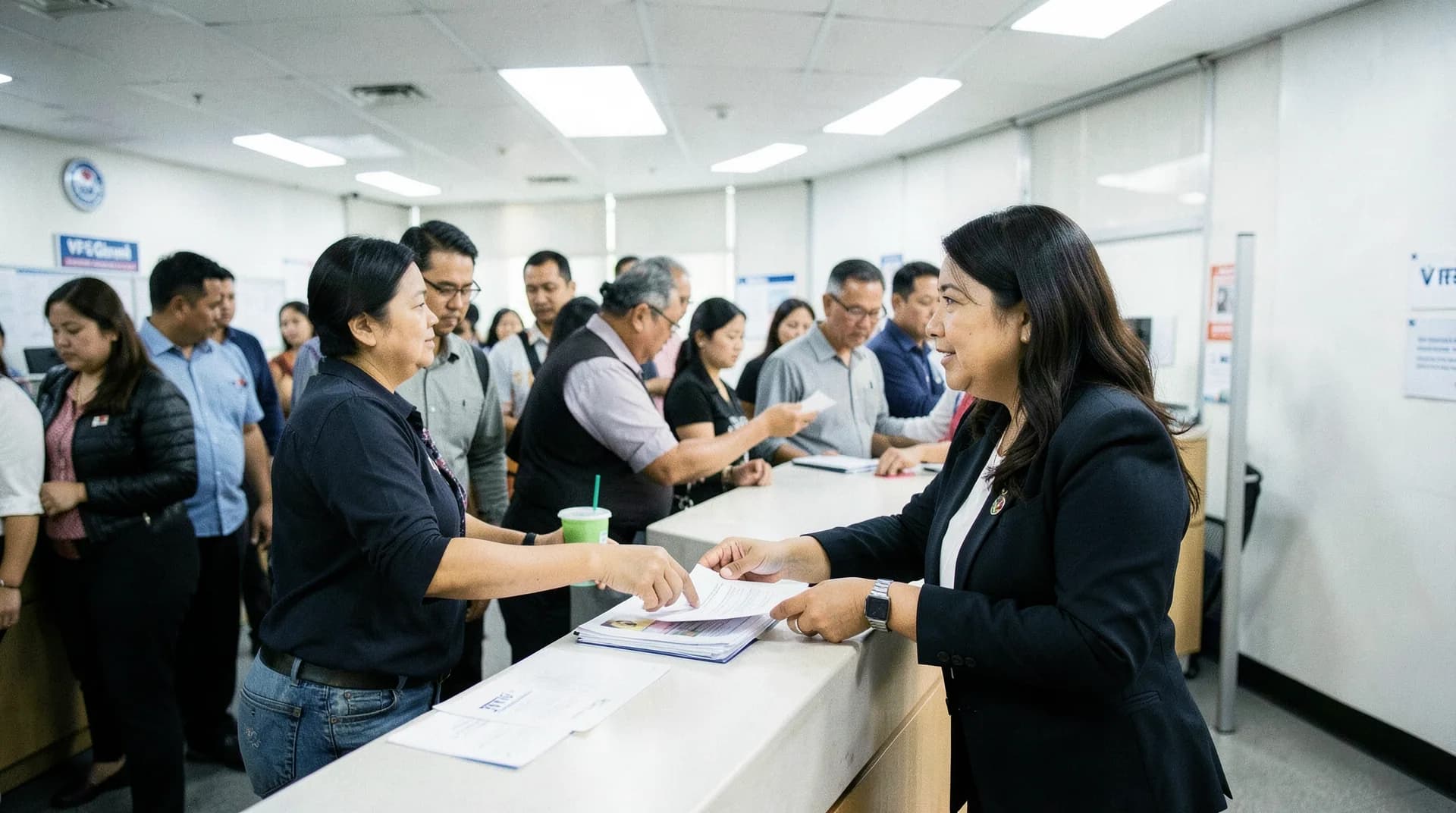
- Attend biometrics at the VFS Global AVAC in Hanoi or Ho Chi Minh City
- Respond to any s56 request for further information within the time given
- Receive the grant letter and check the visa conditions in your grant email
The full sequence is documented in How to apply for an Australian visa, step by step.
Cost and Processing Times
The base Subclass 500 application charge is AUD $710. Additional applicants (spouse and children) pay reduced charges per the published fee schedule. Other costs to budget for:
- OSHC premium for the full visa duration
- IELTS or PTE registration
- Health examination at the Bupa panel clinic
- Police clearance fee, where requested
- Translation fees for academic and civil documents
- VFS Global service fee at the AVAC
Processing times for Vietnamese applicants generally run from four to fourteen weeks. Applications attached to a university CoE, particularly for a regional or postgraduate course, often process at the faster end. VET applications at smaller private providers in Sydney or Melbourne tend to sit at the slower end and are more likely to receive an s56 information request before decision. Current published ranges are tracked in the visa processing times guide.
What Vietnamese Applicants Need to Know
A few things specific to the Vietnamese cohort that affect outcomes more than applicants expect:
The Department reads your education history closely. Long gaps between secondary school, undergraduate study, and the proposed course in Australia are not fatal, but they need explanation. If you worked for five years after a Vietnamese bachelor's degree and now want a master's in business analytics in Sydney, say so plainly and link the work to the study.
A property valuation is not financial evidence on its own. Some agents in Vietnam still bundle a notarised valuation of a family home into the financial pack. The Department considers liquid funds and approved loans. A house is part of the broader picture of ties to Vietnam, not money you can spend on tuition.
Migration agent involvement is fine but should be disclosed. If a registered migration agent in Vietnam or Australia is helping with your file, Form 956 must be completed. Use of unregistered "education consultants" who write your GS statement for you is one of the most common reasons applications are quietly downgraded. Case officers recognise templated GS prose immediately.
Spouses and children can come with you. Dependents apply on the same Subclass 500, attached to the primary applicant. School-age children of master's and PhD students are eligible for state-school enrolment under most state policies. Spouses of master's-by-coursework or higher students generally receive full work rights once the primary applicant has commenced study.
Common Pitfalls for Vietnamese Applicants
The most frequent reasons Vietnamese student visa files run into trouble:
- Generic GS statements. Three paragraphs that could describe any Vietnamese applicant applying for any business diploma. Case officers see these constantly and discount them.
- Course-hopping CoEs. Switching from a master's at a regional university to an unrelated VET diploma in a capital city, with no explanation, raises an immediate flag.
- English certificate gaps. Documents that show a TOEIC score (sometimes used in Vietnam for domestic purposes) rather than one of the Department-accepted tests.
- Insufficient OSHC coverage. Buying OSHC for the course length only, when the visa is granted with extra months on either side, will trigger a follow-up.
- Family bank statements without the relationship link. A father's statement of VND 2 billion is only useful if the case officer can see who your father is and that he supports your study. Attach birth certificate, English translation, and a short statutory declaration.
- Last-minute biometrics. Until VFS captures fingerprints and a facial image at the Hanoi or Ho Chi Minh City AVAC, the file is parked.
The full list of refusal reasons is documented in the top reasons student visas are refused write-up.
Frequently Asked Questions
How long does an Australian student visa take from Vietnam?
Most Vietnamese applications are decided in four to fourteen weeks. University CoEs and regional providers generally process faster than metropolitan VET providers.
What English score do I need for a Subclass 500?
There is no single Subclass 500 minimum. Your institution sets the score on your CoE, usually IELTS 6.0 to 6.5 for universities and 5.5 for many VET courses. ELICOS packaging is available if your score is below threshold.
Can I work on a student visa?
Yes. Subclass 500 holders can work up to 48 hours per fortnight during semester and unlimited hours during scheduled breaks. Master's-by-research and PhD students have unlimited work rights once study commences.
Can my spouse come with me?
Yes. Spouses are added as dependents on the same Subclass 500 application. Spouses of master's coursework, master's research, or PhD students generally receive unrestricted work rights after the primary applicant commences.
Do I need a Phiếu Lý Lịch Tư Pháp for a student visa?
It's often requested for applicants aged 17 or older when the case officer is assessing character. Use Form No. 2, which is the version produced for visa purposes. The provincial Department of Justice issues this; standard processing is about ten working days.
Can I switch courses after I arrive?
You can change courses at the same AQF level or higher with the same provider relatively freely. Switching providers or moving to a lower AQF level has stricter rules. See can you change courses on a student visa for the current settings.
Related Guides
- Australian Visa for Vietnamese Citizens: full country overview
- Genuine Student requirement: how to pass
- GS requirement guide
- GS glossary entry
- English language requirements
- Student visa financial requirements
- How to apply, step by step
- ImmiAccount setup and management
- Top reasons student visas are refused