Australian Skilled Migration for Vietnamese Citizens: 2026 Guide
Updated: 13 May 2026
Vietnamese citizens access Australian skilled migration through three points-tested visas via SkillSelect: Subclass 189 (Skilled Independent), Subclass 190 (State Nominated), and Subclass 491 (Skilled Work Regional). Each requires a positive skills assessment, competent English at IELTS 6.0 each band, and an occupation on the applicable list. Common Vietnamese pathways: TRA-assessed trades, Engineers Australia, ACS, and ANMAC plus AHPRA for healthcare.
Quick Facts: Skilled Migration for Vietnamese Citizens
| Detail | Information |
|---|---|
| Main visas | Subclass 189, 190, 491 (points-tested) |
| Selection | SkillSelect EOI then invitation |
| Minimum points | 65, but competitive scores are typically higher |
| English minimum | Competent (IELTS 6.0 each band; more points at higher levels) |
| Skills assessment | Required from the body that covers your ANZSCO code |
| Common assessing bodies | ACS, Engineers Australia, VETASSESS, TRA, ANMAC, AHPRA |
| Health exam | Yes (Bupa panel physician in Hanoi or Ho Chi Minh City) |
| Police clearance | Phiếu Lý Lịch Tư Pháp (Form No. 2), plus any country lived in 12+ months |
| Embassy | Australian Embassy, Hanoi |
How Skilled Migration Works From Vietnam
The points-tested skilled stream is a queue, not a deadline. Vietnamese applicants who meet the minimum submit an EOI in SkillSelect, sit in the pool for their occupation, and wait for an invitation. Invitations go to the highest-scoring profiles per occupation per round. Once invited, you have sixty days to lodge the visa.
The three points-tested subclasses you'll choose between:
- Subclass 189, Skilled Independent. No state or family sponsorship needed. Lifelong PR on grant. Highest competition for invitations because there's no sponsorship buffer. Covered in detail at the Subclass 189 pillar and in the 189 vs 190 vs 491 comparison.
- Subclass 190, Skilled Nominated. State or territory nomination adds 5 points and you commit to live in the nominating state for the early years of the visa. Each state runs its own list and timing, not synchronised with the Department's lists.
- Subclass 491, Skilled Work Regional. State nomination or eligible family sponsorship in a designated regional area adds 15 points. Five-year provisional visa, with a pathway to permanent Subclass 191 after three years of regional residence and income thresholds met.
Employer-sponsored alternatives (Subclass 482 to 186, or Subclass 494 regionally) are not points-tested and sit in the broader PR pathways overview.
Occupation Lists and Common Vietnamese Pathways
Australia operates several occupation lists (MLTSSL, STSOL, RSMS, CSOL). The current picture is in the skilled occupation list 2026 and the MLTSSL vs STSOL vs RSMS vs CSOL comparison.
The occupations that come through most often for Vietnamese applicants:
- Cooks and chefs. Trades Recognition Australia, typically through the Job Ready Program for applicants without Australian work history.
- Automotive trades, electricians, plumbers, carpenters. TRA-assessed, sometimes via the Migration Skills Assessment or Offshore Skills Assessment Program.
- Software engineers, ICT business analysts, developer-programmers. Assessed by the Australian Computer Society.
- Civil, mechanical, electrical, electronics, telecommunications engineers. Engineers Australia via the Competency Demonstration Report pathway for graduates of non-Washington-Accord institutions.
- Registered nurses and healthcare practitioners. ANMAC plus AHPRA registration; the relevant national board for doctors, pharmacists, dentists, and allied health.
- Accountants and finance professionals. CPA Australia, CA ANZ, or IPA.
- General professional and management roles. VETASSESS, the assessing body for the largest range of occupations and most less-common ANZSCO codes.
The full list of authorities is in the skills assessment bodies guide.
Skills Assessment for Vietnamese Qualifications
Assessing bodies are independent of the Department and apply their own criteria. A positive outcome is mandatory for the points-tested visas. Mechanics are in the skills assessment complete guide.
ACS for IT. ACS recognises Vietnamese university IT qualifications but applies year-deductions where the qualification doesn't align with the nominated ANZSCO code. Reference letters must come on company letterhead, signed by a senior manager, and describe duties in ANZSCO terms.
Engineers Australia. Vietnam is not a Washington Accord signatory, so Vietnamese engineering graduates typically apply via the Competency Demonstration Report pathway. The CDR is three career episodes plus a summary statement, and EA reads it closely for plagiarism.
TRA for trades. Cooks, chefs, automotive mechanics, electricians, and similar trades go through TRA. Vietnamese applicants without an Australian apprenticeship usually need the Job Ready Program. Plan a longer timeline than the desk-based assessments.
ANMAC and AHPRA for nursing. ANMAC assesses the qualification and English standard; AHPRA registers you to practise. Vietnamese-trained nurses typically need IELTS Academic 7.0 in each band (or OET B) and may need a bridging program in Australia depending on the qualification mapping.
VETASSESS. The qualification, employment evidence, and duties description all need to align with the ANZSCO code. VETASSESS publishes country-specific guides for Vietnam; read the one for your occupation before lodging.
All Vietnamese-language documents need certified English translations. NAATI-credentialed translators are the gold standard; see the NAATI glossary entry.
English Language Requirements
The minimum English standard across all three points-tested subclasses is Competent English: IELTS 6.0 in each band, PTE Academic 50 in each, Cambridge 169 in each, or OET B in each.
Most Vietnamese applicants test well above the minimum to capture extra points:
- Proficient English (IELTS 7.0 each band) = 10 points
- Superior English (IELTS 8.0 each band) = 20 points
The English-test result is one of the highest-yield areas to focus on. Twenty points is enough to lift a 65-point profile to invitation territory. The full equivalence table is in the English language requirements guide.
Points Test
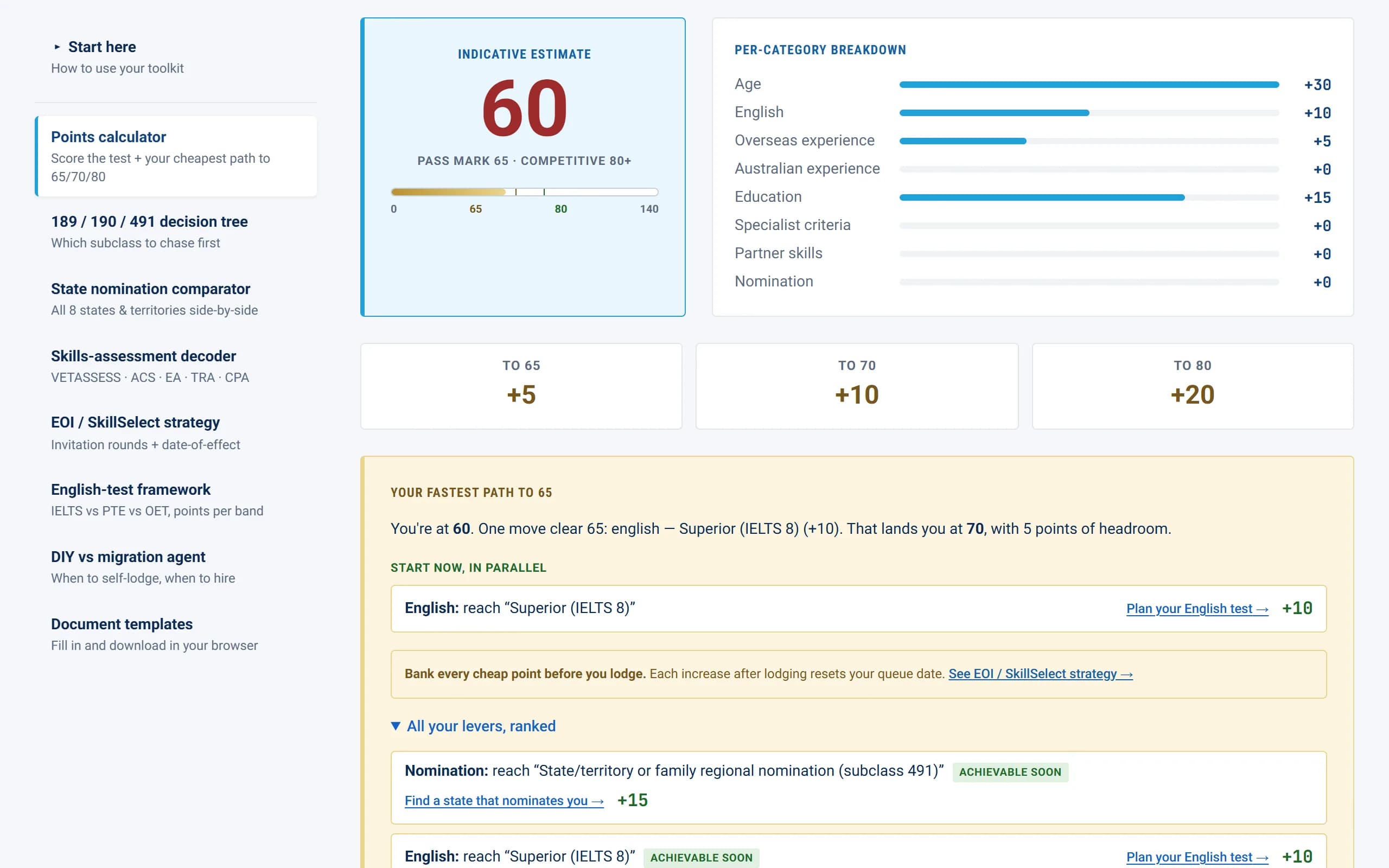
The minimum to submit an EOI is 65 points; the score required for an invitation depends on occupation and round. Mechanics are in the Australian points calculator guide and the how-to-maximise-points walkthrough.
Main points categories:
- Age (25–32 captures the maximum 30 points)
- English (up to 20)
- Skilled employment (up to 20)
- Educational qualifications (up to 20)
- Australian study (5), specialist education (10), regional study (5)
- Professional Year (5), community language NAATI credentialed (5)
- Skilled spouse / partner (up to 10)
- State nomination (5 for 190, 15 for 491)
Vietnamese applicants without Australian study or work history often hit a ceiling around 65–80 points. Levers that move the needle: lifting English to Proficient or Superior, a year of skilled employment after assessment, NAATI credentialing in Vietnamese, and the 491 regional pathway where the 15 nomination points apply.
Application Sequence
A typical end-to-end sequence for a Vietnamese applicant:
- Identify the right ANZSCO code and confirm your occupation is on the relevant list
- Sit the English test (IELTS, PTE, TOEFL iBT, Cambridge, or OET)
- Lodge the skills assessment with the relevant authority
- Run the points calculation honestly once positive
- Submit an Expression of Interest in SkillSelect
- For 190 or 491, apply separately to the state or territory for nomination
- Wait for an invitation
- Within 60 days of invitation, lodge in ImmiAccount and pay the visa charge
- Complete the health examination and provide police clearances
- Attend biometrics at the VFS AVAC in Hanoi or Ho Chi Minh City
- Receive the grant letter
End-to-end from skills assessment to grant typically runs twelve to twenty-four months for a competitive profile.
Cost and Processing Times
Fees you'll meet across the process:
- Skills assessment fee (varies by body)
- English-test registration
- Visa application charge (several thousand AUD for the primary applicant on 189, 190, or 491)
- Health examination per applicant
- Police clearance fees in Vietnam and any other country lived in 12+ months
- Document translation and notarisation
Current fees are in the Australian visa fees schedule 2026. Processing-time ranges vary by subclass and occupation and are tracked in the visa processing times guide.
What Vietnamese Applicants Need to Know
Reference letters are doing the heavy lifting. Employer references for ACS, EA, or VETASSESS must come on company letterhead, be signed by a manager senior to you, and describe duties in ANZSCO terms. A bare HR letter confirming title and dates is rarely enough.
Statutory declarations matter when references fail. Where a former Vietnamese employer cannot or will not provide a detailed reference, a statutory declaration from a colleague who worked alongside you, supported by payslips and tax records, is acceptable to most assessing bodies.
State nomination is parallel, not sequential. Don't wait for one state's decision before applying to another. Vietnamese applicants regularly hold open files with two or three states and accept the first that nominates.
The 491 regional path is real, not a consolation prize. Three years living and working in a designated regional area opens the permanent Subclass 191. Regional postcodes include all of Adelaide, Hobart, Canberra, Newcastle, Wollongong, and the Gold Coast.
A spouse's profile is part of the points calculation. A skilled spouse under 45 with competent English and a positive skills assessment in an eligible occupation adds 10 points. Competent English alone adds 5. This is often the cheapest 5 or 10 points available.
Common Pitfalls for Vietnamese Applicants
- Wrong ANZSCO code. Reference-letter duties don't actually match the nominated code, so the assessing body downgrades or refuses.
- Unexpected year-deductions. ACS and EA frequently deduct two to four years of claimed experience from a Vietnamese graduate where qualification and occupation don't align tightly.
- English-test bands below the level claimed. A 7.0 overall with a 6.5 in writing is competent, not proficient. The Department reads each band individually.
- Wrong police-clearance form. Form No. 2 is the version for visa purposes; Form No. 1 (issued for domestic Vietnamese employment) is not accepted.
- Missing third-country police clearances. Time studying or working in Singapore, Japan, or anywhere else for twelve months or more requires that country's clearance.
- Letting an EOI expire. EOIs are valid for two years and date-of-effect rules govern queue position. The EOI date-of-effect rules cover the nuances.
- Bridging visa assumptions. If you're invited while in Australia, the bridging visa granted on lodgement has work and travel rights that depend on your substantive visa, not on the skilled application.
Frequently Asked Questions
What's the minimum points score?
The Department's minimum is 65 across all three points-tested subclasses. Invitation scores are usually higher and depend on the occupation and round. Competitive occupations like accountants and IT can require scores well above 65.
Do I need a job offer for the 189 or 190?
No. The 189, 190, and 491 are points-tested and do not require a job offer, though state nomination criteria for 190 and 491 sometimes prefer applicants with a regional connection or job lead.
Are Vietnamese qualifications recognised?
Yes, but the body that covers your ANZSCO code decides the credit. Year-deductions are common where the qualification doesn't align tightly with the nominated occupation. Plan for an outcome that may credit fewer years than your CV claims.
Can I include my family?
Yes. Spouses, partners, and dependent children are added to the primary applicant's visa. Each family member needs their own health check and police clearances.
How long does the whole process take?
End-to-end from sitting English through to PR grant is typically twelve to twenty-four months. Variation is driven by the assessing body's queue, invitation timing, and visa-processing windows.
Can I move to PR from a Subclass 482 instead?
Yes. Employer-sponsored to permanent residency through Subclass 186 is a separate, non-points-tested route. Many Vietnamese applicants run both paths in parallel: 482 employer sponsorship while keeping a SkillSelect EOI live.
Related Guides
- Australian Visa for Vietnamese Citizens: full country overview
- Subclass 189 Skilled Independent
- Subclass 494 Skilled Employer-Sponsored Regional
- 189 vs 190 vs 491 comparison
- Skills assessment complete guide
- Skills assessment bodies: complete list
- English language requirements guide
- How to maximise points score
- Australian PR: every pathway
- How to apply, step by step