Australian Working Holiday Visa for Vietnamese Citizens: 2026 Guide
Updated: 16 August 2026
Vietnam sits on the Subclass 462 Work and Holiday programme, not the Subclass 417 stream. Access requires a MOLISA letter of support, functional English (IELTS 4.5 equivalent), two completed years of undergraduate study, and an age of 18 to 30 at lodgement. An annual cap applies. The fee is AUD $840; the visa permits twelve months of work and travel.
Quick Facts: Work and Holiday Visa for Vietnamese Citizens
| Detail | Information |
|---|---|
| Visa subclass | 462 (Work and Holiday), not the 417 stream |
| Age | 18 to 30 inclusive at lodgement |
| Base application fee | AUD $840 |
| English | Functional English (IELTS 4.5 overall or equivalent) |
| Education | At least two years of undergraduate university study |
| Government letter | MOLISA letter of support required |
| Annual cap | Yes, capped each Australian program year (July–June) |
| Stay length | Up to 12 months per visa, with second- and third-year extensions possible |
| Funds | Around AUD $5,000 plus a return airfare amount |
| Work limit | Up to 6 months with any one employer |
| Study limit | Up to 4 months of study during the visa |
Subclass 462 vs Subclass 417, and Why It Matters
Australia operates two near-identical working-holiday programmes. The 417 covers a separate list of partner countries (UK, Ireland, Germany, France, Italy, Japan, Korea, Taiwan and so on), the 462 covers Vietnam and a different partner list including Indonesia, Thailand, the Philippines, China, and others. The lived experience inside Australia is almost the same: same age range, same one-year initial stay, same option to extend with specified regional work. But the front door is different.
For Vietnamese applicants, this means three extra hurdles compared with a 417 country:
- An annual cap on how many 462 visas are granted
- A MOLISA letter of support, which is its own application inside Vietnam
- A tertiary education requirement (two years of undergraduate study), which the 417 does not have
The Subclass 462 pillar page details the full programme rules and how the visa works inside Australia.
Eligibility Requirements
To qualify for the Subclass 462 as a Vietnamese citizen, you must:
- Hold a current Vietnamese passport
- Be aged 18 to 30 inclusive at the time you lodge the application (not at the time of grant)
- Have completed at least two years of undergraduate university study, evidenced by transcripts and a degree certificate where awarded
- Hold a current letter of support from the Vietnamese Ministry of Labour, Invalids and Social Affairs (MOLISA)
- Meet the functional English standard (IELTS 4.5 overall, or equivalent PTE Academic, TOEFL iBT, Cambridge, or OET)
- Have access to approximately AUD $5,000 to support yourself on arrival
- Hold a return airfare or sufficient funds to purchase one
- Have no dependent children accompanying you at any time during the visa
- Have not previously held a Subclass 462 (unless applying for a second or third year)
- Meet character and health requirements
The age cut-off is strict. An applicant who turns 31 on the day they lodge is over age. The Department reads the date of lodgement, not the date of grant.
The MOLISA Letter of Support
This is the part of the application that is unique to Vietnam and the one that derails the most timelines.
The Vietnamese Ministry of Labour, Invalids and Social Affairs administers a domestic process that confirms an applicant is sponsored by the Vietnamese government for the 462 programme. The letter must be current at the time of visa lodgement. Without it, the visa application cannot be granted, and Department officers cannot waive it.
In practice, applicants need to:
- Confirm the current intake window with MOLISA. The Ministry generally aligns its support-letter cycles with the Australian program year that runs July through June, and intakes can open and close without much notice.
- Submit Vietnamese-language documentation to MOLISA, including university transcripts, English-test results, passport copy, and personal statement.
- Wait for the letter to issue. Lead times vary by intake but are rarely shorter than several weeks.
- Lodge the Subclass 462 in ImmiAccount with the MOLISA letter attached as soon as it issues.
Applicants who try to lodge a 462 before the MOLISA letter has issued risk a refusal on the back of an unsatisfied criterion. Applicants who let the letter lapse before lodgement risk the same outcome.
Annual Cap and Timing
The 462 stream for Vietnamese citizens operates with a capped number of places each Australian program year (1 July to 30 June). The Department publishes the cap and tracks places against it, and once the cap is reached, no further grants issue until the next program year.
In practice, this means timing matters. The most reliable approach is to be ready to lodge as soon as the program year opens and your MOLISA letter is current. The published cap numbers shift year to year and are not stable enough to quote here with confidence. Check the Department's site for the current settings before planning a timeline.
Application Process
The typical sequence for a Vietnamese applicant looks like this:
- Confirm you meet age, education, and English thresholds
- Sit IELTS, PTE, or another accepted test and obtain the score report
- Apply to MOLISA in Vietnamese for the letter of support
- Once the MOLISA letter issues, gather supporting documents (passport, transcripts, English-test result, MOLISA letter, evidence of funds)
- Create or sign into ImmiAccount and lodge the Subclass 462 application
- Pay AUD $840 by Visa or Mastercard
- Complete the health examination at a Bupa panel clinic with a HAP ID generated through ImmiAccount
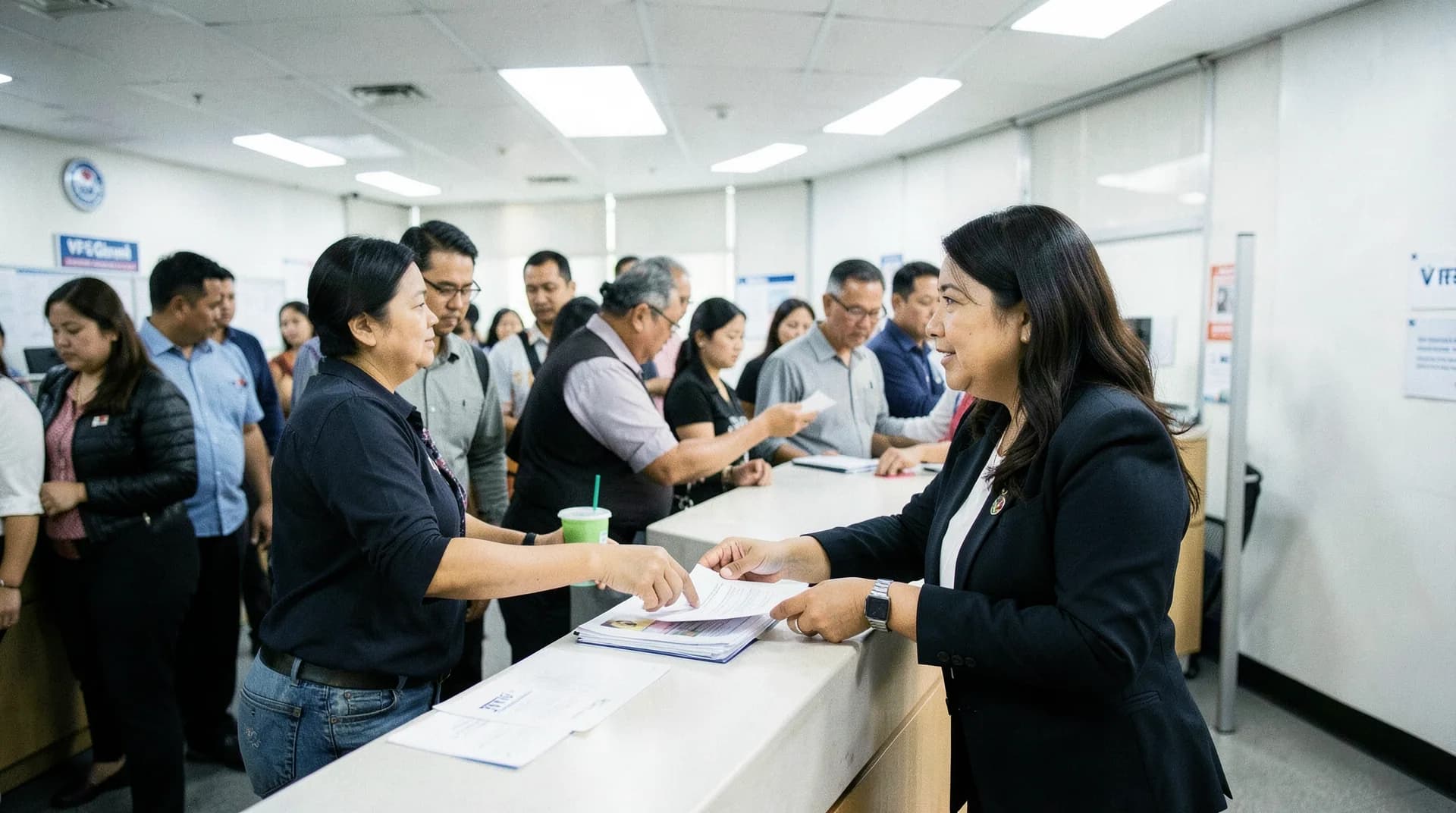
- Attend biometrics at the VFS Global AVAC in Hanoi or Ho Chi Minh City
- Obtain a Phiếu Lý Lịch Tư Pháp (Form No. 2) if requested by the case officer
- Receive the grant letter and check visa conditions
The general lodgement sequence is covered in How to apply for an Australian visa, step by step.
Cost and Processing Times
The base application charge is AUD $840. Other costs to plan for:
- IELTS or PTE registration fee
- Document preparation and translation for the MOLISA application
- Health examination
- Police clearance fee, where required
- VFS Global service fee at the AVAC
- Travel insurance (recommended though not mandated)
Processing times once the application is lodged with all evidence are usually in the order of several weeks, though cap pressure and incomplete files extend this. Many delays are MOLISA-side rather than Department-side; the most common pattern is a Vietnamese applicant waiting six to eight weeks for the support letter before they can even lodge.
What the 462 Allows in Australia
A Subclass 462 grant lets you:
- Stay in Australia for up to twelve months from first entry
- Work for any employer, but no more than six months with any single employer
- Study or train for up to four months in total
- Leave and re-enter Australia as many times as you want during the visa period
- Apply for a second-year and, if eligible, a third-year 462 by completing specified work in regional Australia
The visa does not lead directly to permanent residency, but it can be a useful first step. Some Vietnamese holders transition to a Subclass 482 employer-sponsored visa, others move into a Subclass 500 student visa, and others apply for skilled migration through SkillSelect after their working-holiday year if their occupation is on the relevant list.
Second- and Third-Year 462 Extensions
If you complete 88 days of specified regional work during your first 462, typically in agriculture, fishing, forestry, mining, construction, tourism and hospitality in remote and very remote areas, or in select critical sectors, you can apply for a second-year 462. A further three months of specified work during the second year opens the door to a third-year visa.
The specified-work definitions and eligible postcodes are tightly defined and change. Keep payslips, employer letters, and the original time-and-attendance records. Applicants who lose this paperwork part-way through the year often cannot prove their eligibility later.
What Vietnamese Applicants Need to Know
A handful of points that consistently catch out Vietnamese 462 applicants:
English-test result currency. IELTS results are valid for two years. If your test sits past that point before you lodge, the case officer will treat it as expired.
Tertiary study evidence. Two years of undergraduate study means at least two completed academic years, not two enrolled years. A Vietnamese university transcript with course-by-course unit results is the standard evidence; a "still enrolled" letter is not enough.
Functional English isn't fluent English. IELTS 4.5 overall is genuinely modest. At this level you can hold a basic conversation and read simple texts. Don't over-prepare to the point of delay. Sit the test, hit the number, move on.
Age math is at lodgement, not grant. If your 31st birthday falls between MOLISA letter issuance and Department lodgement, you've aged out. Build a buffer.
Bank statements matter less than for the 600. The 462 financial test is a modest threshold around AUD $5,000. Showing dramatically more is fine but unnecessary. What you do need is evidence the money is yours and accessible. A parent's account is harder to argue than your own.
Common Pitfalls for Vietnamese Applicants
The recurring failure modes:
- Lodging without the MOLISA letter in the hope of "fixing it later." The Department won't grant without it.
- Letting the MOLISA letter expire between issuance and lodgement.
- Applying after cap closure. Once the program year cap is reached, files lodged that year are at risk regardless of strength.
- IELTS Life Skills rather than IELTS Academic or General Training. The Department-accepted modules are specific.
- No-further-stay condition (8503). This condition can be imposed on 462 grants and blocks lodging another substantive visa from inside Australia. Read the grant letter conditions carefully before making downstream plans.
- Inconsistent name spellings. The MOLISA letter, passport, and ImmiAccount profile must match exactly. A diacritic missing on one document is enough to trigger a follow-up.
Frequently Asked Questions
Can Vietnamese citizens get a Subclass 417 working holiday visa?
No. Vietnam is on the Subclass 462 Work and Holiday programme only. The 417 stream is closed to Vietnamese passport holders.
Do I really need a MOLISA letter?
Yes. The 462 cannot be granted to a Vietnamese citizen without a current MOLISA letter of support. There is no waiver pathway.
What English score is enough?
Functional English: IELTS 4.5 overall, or equivalent in PTE Academic, TOEFL iBT, Cambridge Advanced, or OET. The English language requirements guide lists the exact equivalents.
Can I extend my 462 if I don't do regional work?
No. Second- and third-year 462 grants require completion of specified work in eligible regional areas during the previous visa period. Without that work, the visa is single-year only.
Can my partner come with me?
Not on the same application. The 462 does not allow accompanying spouses or children. A partner would need to apply for their own visa, whether another 462 if eligible or a different subclass.
Can I move to PR from a 462?
Not directly. The 462 itself is not a PR pathway, but it can be a stepping stone: to employer sponsorship (Subclass 482, then Subclass 494 regionally or 186 permanently) or to skilled migration (Subclass 189, 190, 491).
Related Guides
- Australian Visa for Vietnamese Citizens: full country overview
- Subclass 462 Work and Holiday: programme overview
- How to apply, step by step
- ImmiAccount setup and management
- English language requirements guide
- Australian visa health examination guide
- Subclass 494 skilled employer-sponsored regional
- Subclass 189 skilled independent visa